
This website uses cookies
We use cookies to personalise content and ads, to provide social media features and to analyse our traffic. We also share information about your use of our site with our social media, advertising and analytics partners who may combine it with other information that you’ve provided to them or that they’ve collected from your use of their services.
Consent Selection
Details
  • Necessary cookies help make a website usable by enabling basic functions like page navigation and access to secure areas of the website. The website cannot function properly without these cookies.

    • Learn more about this provideropens in a new window
      CookieConsentStores the user's cookie consent state for the current domain
      Maximum Storage Duration: 1 yearType: HTTP Cookie
    • Learn more about this provideropens in a new window
      bcookieUsed in order to detect spam and improve the website's security.
      Maximum Storage Duration: 1 yearType: HTTP Cookie
      li_gcStores the user's cookie consent state for the current domain
      Maximum Storage Duration: 180 daysType: HTTP Cookie
    • Learn more about this provideropens in a new window
      datadomeUsed in context with the website's BotManager. The BotManager detects, categorizes and compiles reports on potential bots trying to access the website.
      Maximum Storage Duration: 1 yearType: HTTP Cookie
    • _pk_testcookie_domainThis cookie determines whether the browser accepts cookies.
      Maximum Storage Duration: 1 dayType: HTTP Cookie
    • __cf_bm [x3]This cookie is used to distinguish between humans and bots. This is beneficial for the website, in order to make valid reports on the use of their website.
      Maximum Storage Duration: 1 dayType: HTTP Cookie
  • Preference cookies enable a website to remember information that changes the way the website behaves or looks, like your preferred language or the region that you are in.
    • Learn more about this provideropens in a new window
      lidcRegisters which server-cluster is serving the visitor. This is used in context with load balancing, in order to optimize user experience.
      Maximum Storage Duration: 1 dayType: HTTP Cookie
  • Statistic cookies help website owners to understand how visitors interact with websites by collecting and reporting information anonymously.
    • Learn more about this provideropens in a new window
      guestRegisters data on visitors' website-behaviour. This is used for internal analysis and website optimization.
      Maximum Storage Duration: 1 monthType: HTTP Cookie
    • Learn more about this provideropens in a new window
      personalization_idThis cookie is set by Twitter - The cookie allows the visitor to share content from the website onto their Twitter profile.
      Maximum Storage Duration: 400 daysType: HTTP Cookie
    • _pk_uidUsed by Piwik Analytics Platform to identify the visitor on repeat visits to the website.
      Maximum Storage Duration: 1 yearType: HTTP Cookie
      _pk_id#Collects statistics on the user's visits to the website, such as the number of visits, average time spent on the website and what pages have been read.
      Maximum Storage Duration: 1 yearType: HTTP Cookie
      _pk_ses#Used by Piwik Analytics Platform to track page requests from the visitor during the session.
      Maximum Storage Duration: 1 dayType: HTTP Cookie
    • FPGSIDRegisters statistical data on users' behaviour on the website. Used for internal analytics by the website operator.
      Maximum Storage Duration: 1 dayType: HTTP Cookie
      FPIDRegisters statistical data on users' behaviour on the website. Used for internal analytics by the website operator.
      Maximum Storage Duration: 400 daysType: HTTP Cookie
      FPLCRegisters a unique ID that is used to generate statistical data on how the visitor uses the website.
      Maximum Storage Duration: 1 dayType: HTTP Cookie
    • _gaRegisters a unique ID that is used to generate statistical data on how the visitor uses the website.
      Maximum Storage Duration: 2 yearsType: HTTP Cookie
      _ga_#Used by Google Analytics to collect data on the number of times a user has visited the website as well as dates for the first and most recent visit.
      Maximum Storage Duration: 2 yearsType: HTTP Cookie
  • Marketing cookies are used to track visitors across websites. The intention is to display ads that are relevant and engaging for the individual user and thereby more valuable for publishers and third party advertisers.
    • Learn more about this provideropens in a new window

      Some of the data collected by this provider is for the purposes of personalization and measuring advertising effectiveness. The provider may use the IP Addresses for ads measurement and ads personalization.

      ads/ga-audiencesUsed by Google AdWords to re-engage visitors that are likely to convert to customers based on the visitor's online behaviour across websites.
      Maximum Storage Duration: SessionType: Pixel Tracker
    • Learn more about this provideropens in a new window
      userRefererDetermines how the user accessed the website. This information is used by the website operator in order to measure the efficiency of their marketing.
      Maximum Storage Duration: 1 monthType: HTTP Cookie
    • Learn more about this provideropens in a new window
      #:session-dataTracks the individual sessions on the website, allowing the website to compile statistical data from multiple visits. This data can also be used to create leads for marketing purposes.
      Maximum Storage Duration: PersistentType: HTML Local Storage
      eng_mtTracks the conversion rate between the user and the advertisement banners on the website - This serves to optimise the relevance of the advertisements on the website.
      Maximum Storage Duration: PersistentType: HTML Local Storage
      t_gidThis cookie assigns a specific visitor ID, when the visitor interacts with ads or content from the website - this allows the website to target the visitor with similar ads or content.
      Maximum Storage Duration: 1 yearType: HTTP Cookie
      t_pt_gidCollects information on user preferences and/or interaction with web-campaign content - This is used on CRM-campaign-platform used by website owners for promoting events or products.
      Maximum Storage Duration: 1 yearType: HTTP Cookie
      taboola global:user-idSets a unique ID for the visitor, that allows third party advertisers to target the visitor with relevant advertisement. This pairing service is provided by third party advertisement hubs, which facilitates real-time bidding for advertisers.
      Maximum Storage Duration: PersistentType: HTML Local Storage
      taboola_session_idThis cookie is used to collect information on a visitor. This information will become an ID string with information on a specific visitor – ID information strings can be used to target groups with similar preferences, or can be used by third-party domains or ad-exchanges.
      Maximum Storage Duration: SessionType: HTTP Cookie
    • Learn more about this provideropens in a new window
      1/i/adsct [x2]Collects data on user behaviour and interaction in order to optimize the website and make advertisement on the website more relevant.
      Maximum Storage Duration: SessionType: Pixel Tracker
      muc_adsCollects data on user behaviour and interaction in order to optimize the website and make advertisement on the website more relevant.
      Maximum Storage Duration: 400 daysType: HTTP Cookie
      guest_idCollects data related to the user's visits to the website, such as the number of visits, average time spent on the website and which pages have been loaded, with the purpose of personalising and improving the Twitter service.
      Maximum Storage Duration: 400 daysType: HTTP Cookie
      guest_id_adsCollects information on user behaviour on multiple websites. This information is used in order to optimize the relevance of advertisement on the website.
      Maximum Storage Duration: 400 daysType: HTTP Cookie
      guest_id_marketingCollects information on user behaviour on multiple websites. This information is used in order to optimize the relevance of advertisement on the website.
      Maximum Storage Duration: 400 daysType: HTTP Cookie
    • _gcl_auUsed by Google AdSense for experimenting with advertisement efficiency across websites using their services.
      Maximum Storage Duration: 3 monthsType: HTTP Cookie
      _gcl_lsTracks the conversion rate between the user and the advertisement banners on the website - This serves to optimise the relevance of the advertisements on the website.
      Maximum Storage Duration: PersistentType: HTML Local Storage
    • pardot [x2]Used in context with Account-Based-Marketing (ABM). The cookie registers data such as IP-addresses, time spent on the website and page requests for the visit. This is used for retargeting of multiple users rooting from the same IP-addresses. ABM usually facilitates B2B marketing purposes.
      Maximum Storage Duration: SessionType: HTTP Cookie
  • Unclassified cookies are cookies that we are in the process of classifying, together with the providers of individual cookies.
    • cs_analytics_ip_blockedPending
      Maximum Storage Duration: SessionType: HTTP Cookie
      user_tokenPending
      Maximum Storage Duration: 1 yearType: HTTP Cookie
    • _twpidPending
      Maximum Storage Duration: SessionType: HTTP Cookie
Cookie declaration last updated on 8/20/26 by Cookiebot
[#IABV2_TITLE#]
[#IABV2_BODY_INTRO#]
[#IABV2_BODY_LEGITIMATE_INTEREST_INTRO#]
[#IABV2_BODY_PREFERENCE_INTRO#]
[#IABV2_BODY_PURPOSES_INTRO#]
[#IABV2_BODY_PURPOSES#]
[#IABV2_BODY_FEATURES_INTRO#]
[#IABV2_BODY_FEATURES#]
[#IABV2_BODY_PARTNERS_INTRO#]
[#IABV2_BODY_PARTNERS#]
About
Cookies are small text files that can be used by websites to make a user's experience more efficient.

The law states that we can store cookies on your device if they are strictly necessary for the operation of this site. For all other types of cookies we need your permission.

This site uses different types of cookies. Some cookies are placed by third party services that appear on our pages.

You can at any time change or withdraw your consent from the Cookie Declaration on our website.

Learn more about who we are, how you can contact us and how we process personal data in our Privacy Policy.

Please state your consent ID and date when you contact us regarding your consent.
Image Cos'è Tezos - Guida

Cos'è Tezos - Guida

Timer10 minuti di lettura

  • Altcoins
  • Tecnologia

Tezos: la blockchain auto‑emendabile

Tezos è una blockchain di livello 1 (Layer 1 o L1), al pari di Ethereum e Solana. Utilizza una variante del meccanismo di consenso proof of stake per elaborare le transazioni e proteggere la rete. Ciò che la distingue dalle altre blockchain è il suo modello di governance unico, che consente al protocollo di aggiornarsi automaticamente.

Dati chiave

  • Data di lancio: 2018

  • Total value locked (TVL): tra 21 milioni e 28 milioni di dollari a metà 2026

  • Capitalizzazione di mercato: 220,3 milioni di dollari (al 30 giugno 2026)

  • Transazioni giornaliere: 112.000 (incluse le transazioni interne, dicembre 2025)

Tezos in sintesi

Governance: Tezos è una blockchain definita “auto‑emendabile”. Una volta che i detentori del token nativo (XTZ) votano per approvare un aggiornamento della rete, questo viene implementato automaticamente. Questo approccio evita le scissioni della catena che porterebbero alla creazione di una nuova criptovaluta (come accaduto con Bitcoin Cash), note come “hard fork”. Questo meccanismo ha finora prodotto ventuno aggiornamenti del protocollo dal 2018, la prova più solida disponibile che funzioni come promesso.

Affidabilità: Dal lancio nel 2018, l’uptime della rete – ovvero il tempo in cui è rimasta operativa senza interruzioni dovute a problemi tecnici – è pari al 99,99%. Un livello paragonabile a quello di Bitcoin, considerata una blockchain estremamente resiliente.

Arte generativa: Tezos si è affermata come un importante sostenitore dell'arte generata al computer, grazie al lancio del marketplace pionieristico FXHash nel 2021, seguito da piattaforme come Objkt e Verse.

Meccanismo del protocollo

Il proof of stake (PoS) richiede che i partecipanti, detti validatori, depositino o “mettano in staking” una determinata quantità del token nativo della blockchain per ottenere il diritto di elaborare le transazioni. In cambio di questo servizio, ricevono ricompense sotto forma di nuovi token emessi, mentre i comportamenti scorretti vengono puniti con sanzioni finanziarie.

La versione di Tezos è chiamata liquid PoS. I "baker" devono mettere in stake 8.000 XTZ (pari a circa 1.620 dollari al 30 giugno 2026) per partecipare. Chi non raggiunge questa soglia può delegare i propri token ad altri baker e guadagnare una quota delle ricompense. Il termine "liquido" si riferisce alla possibilità di utilizzare altrove i token delegati, ad esempio per generare un rendimento tramite un'applicazione di finanza decentralizzata (DeFi) come un protocollo di prestito.

Performance di mercato

L'XTZ veniva scambiato a 0,202 dollari al 30 giugno 2026, per una capitalizzazione di mercato in circolazione di 220,3 milioni di dollari su 1,09 miliardi di token. Il token è sceso del 63,7% nel corso del 2025 e di un ulteriore 60,0% nella prima metà del 2026. Rispetto al picco di ottobre 2021, pari a 8,55 dollari, l'XTZ ha perso circa il 98% del proprio valore. Le performance passate non sono indicative dei rendimenti futuri.
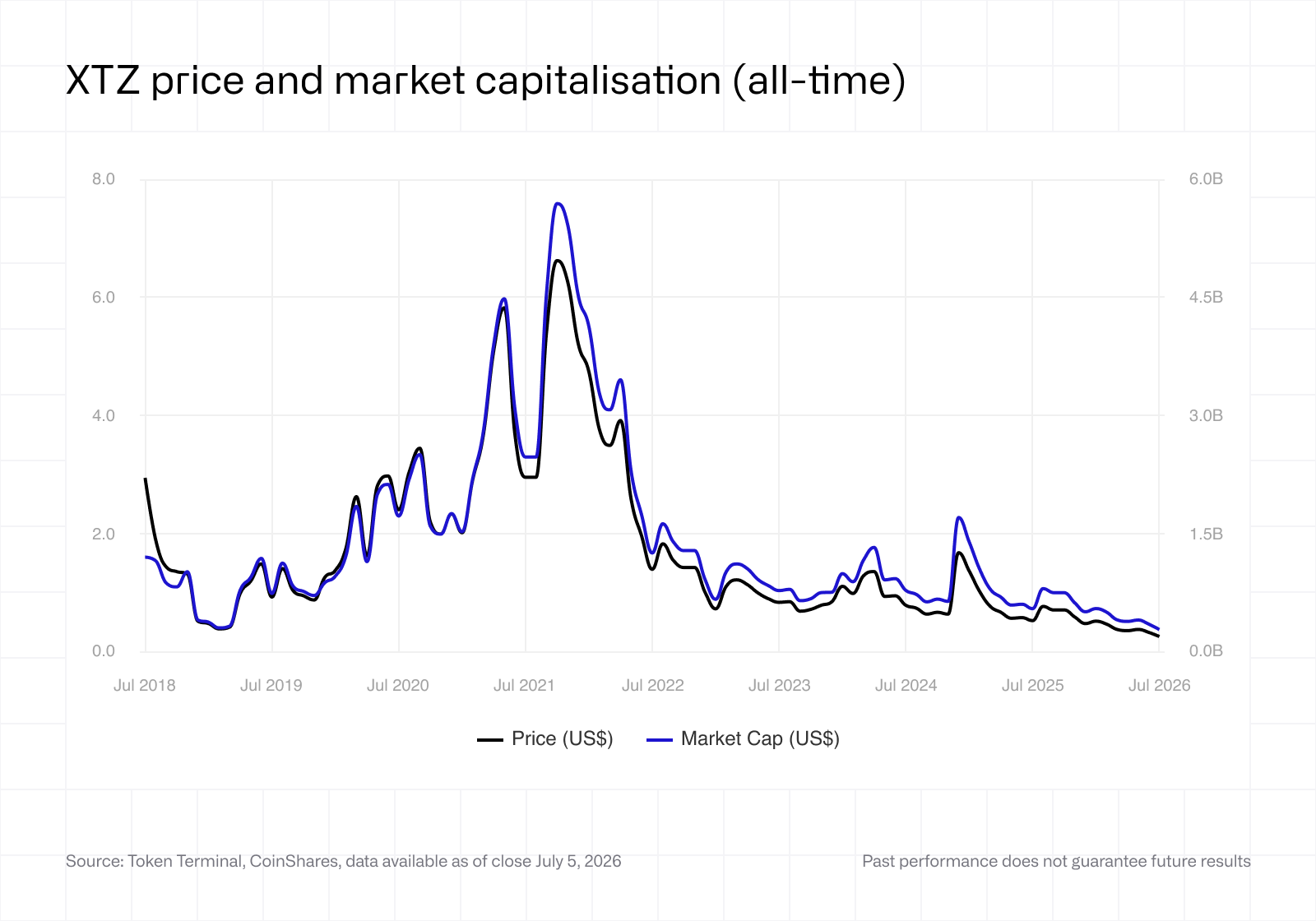
XTZ price and market capitalisation (all-time)

Storia

Arthur e Kathleen Breitman hanno creato Tezos nel 2014 e raccolto capitali tramite una initial coin offering (ICO) – l’equivalente nel mondo crypto di una quotazione in borsa – nel 2017. L’ICO ha raccolto 232 milioni di dollari, un record all’epoca, e la blockchain è stata lanciata nel settembre 2018.

Tappe fondamentali

  • Maggio 2019: l’aggiornamento Athens ha ridotto il roll minimo a 8.000 XTZ, rendendo più accessibile la partecipazione al meccanismo di consenso.

  • Marzo 2020: l’aggiornamento Carthage ha aumentato del 30% la capacità di Tezos di elaborare transazioni.

  • Febbraio 2021: l’upgrade Edo ha migliorato la privacy introducendo le zero‑knowledge proofs, che consentono a una parte di dimostrare qualcosa a un’altra senza rivelare le informazioni esatte (simile a dimostrare di essere maggiorenni senza mostrare un documento).

  • Settembre 2022: l’aggiornamento Kathmandu ha preparato il protocollo all’introduzione dei rollup, che riducono la congestione elaborando le transazioni su una rete di livello 2 (Layer 2 o L2), un passaggio chiave per la scalabilità.

  • Marzo 2023: l’aggiornamento Mumbai ha attivato i rollup.

  • Giugno 2024: l’aggiornamento Paris ha ridotto il block time – il tempo medio necessario per produrre un nuovo blocco di transazioni – a 10 secondi, migliorando ulteriormente la scalabilità.

  • Gennaio 2025: l’aggiornamento Quebec ha ridotto il block time a otto secondi.

  • Febbraio 2025: Tezos ha lanciato Etherlink, la propria rete L2 compatibile con l’Ethereum Virtual Machine (EVM), il software che alimenta Ethereum.

  • Maggio 2025: l'aggiornamento Rio, il diciottesimo, ha ridotto i cicli a un giorno e abbreviato l'attesa per l'unstaking da dieci a quattro giorni.

  • Settembre 2025: l'aggiornamento Seoul, il diciannovesimo, ha introdotto la multisig nativa del protocollo per gli account Tezos, pensata specificamente per i requisiti di custodia istituzionale.

  • 2026: sono seguiti altri due aggiornamenti, che hanno ridotto il block time a sei secondi e adottato un modello di attestazione con tutti i baker, oltre ad aumentare la larghezza di banda del Data Availability Layer a 10 MB/s.

Prospettive future

Nel giugno 2024, Tezos ha pubblicato la propria visione per il futuro del protocollo, denominata Tezos X. Invece di fare affidamento su una moltitudine di soluzioni L2 (come Ethereum), Tezos X punta a creare un’unica L2 in grado di gestire tutte le transazioni elaborate sulla blockchain L1, con l’obiettivo di raggiungere 1 milione di transazioni al secondo (TPS). A titolo di confronto, Visa può arrivare fino a circa 83.000 TPS.

Per supportare l’interoperabilità – l’interazione tra blockchain diverse – gli sviluppatori potranno utilizzare vari linguaggi di programmazione per creare smart contract, ovvero programmi che si eseguono automaticamente al verificarsi di determinate condizioni (paragonabili a un distributore automatico). Gli smart contract rappresentano i mattoni fondamentali delle applicazioni decentralizzate (dApp).

Per quanto riguarda Etherlink, in un’intervista a CoinShares dell’aprile 2025 il co‑fondatore Arthur Breitman ha spiegato che lo slancio iniziale proviene soprattutto da applicazioni DeFi come exchange decentralizzati e protocolli di lending, oltre a memecoin e gaming. Tezos sta cercando di incentivare la partecipazione al proprio ecosistema DeFi attraverso un programma di ricompense chiamato Apple Farm. La prima “stagione” ha generato 50 milioni di dollari di TVL, una metrica utilizzata per misurare il valore dei fondi depositati dagli utenti nelle dApp della rete. La seconda stagione è stata lanciata nel luglio 2025 con un montepremi di 3 milioni di dollari.

A distanza di un anno, i numeri di Etherlink raccontano una storia chiara sulla TVL incentivata. La TVL di Etherlink è salita da 1,5 milioni di dollari a fine 2024 a un picco di 83,3 milioni di dollari il 2 novembre 2025, per poi scendere a 16,7 milioni di dollari entro il 30 giugno 2026, un calo di circa l'80% rispetto al picco. I depositi sono arrivati mentre venivano erogate le ricompense, per poi uscire una volta terminate. Questo non è un fenomeno esclusivo di Tezos, ma il normale esito del liquidity mining.

Analisi CoinShares

Tezos beneficia di un solido modello di governance e di una rete durevole. Tuttavia, mentre Etherlink è cresciuta rapidamente per poi restituirne gran parte, Tezos deve affrontare anche una forte concorrenza da parte di blockchain rivali che hanno già ottenuto una trazione maggiore.

Punti di forza

  • Il meccanismo di governance unico di Tezos previene hard fork potenzialmente destabilizzanti, evitando la creazione di un nuovo token e divisioni all’interno della comunità. Questo garantisce anche maggiore coerenza agli sviluppatori di dApp. Ventuno aggiornamenti in otto anni, nessuno dei quali abbastanza controverso da provocare una scissione della chain, rappresentano un risultato significativo.

  • La rete Tezos ha dimostrato un’elevata affidabilità e resilienza sin dal lancio nel 2018, con un uptime del 99,99%.

Debolezze

  • Secondo lo stesso Arthur Breitman, Tezos non si è evoluta abbastanza rapidamente nelle fasi iniziali e ha perso terreno rispetto ai concorrenti nel 2019 e 2020. A suo avviso, la blockchain è ancora in fase di recupero.

  • Breitman riconosce inoltre che Tezos soffre di una bassa adozione (riflessa nella capitalizzazione di mercato). La rete ha incassato 50.711 dollari di commissioni di transazione totali nell'intero 2025 e 10.615 dollari nella prima metà del 2026.

Opportunità

Minacce

  • Tezos potrebbe incontrare difficoltà nell’aumentare la propria quota di mercato a causa della concorrenza di rivali che hanno già ottenuto un’adozione significativa.

  • Se Tezos non riuscirà a realizzare la propria ambiziosa visione per il futuro, potrebbero emergere interrogativi sulla sua sostenibilità nel lungo periodo.

Pubblicato ilFeb 26th, 2024

Articoli correlati

Benvenuto to CoinShares

Dati personali

0102

Quando visiti il sito web di CoinShares, i cookie migliorano la tua esperienza. Ci aiutano a mostrarti contenuti più pertinenti. Alcuni cookie sono necessari per il funzionamento del sito e saranno sempre attivi. Bloccare alcuni tipi di cookie potrebbe influire sulla tua esperienza del sito web e sui servizi che offriamo sul nostro sito.

Utilizziamo i cookie sul nostro sito per ottimizzare i nostri servizi. Scopri di più sulla nostra politica sui cookie per l’UE o sulla nostra politica sui cookie per gli Stati Uniti.

  • Necessari
    Question circle icon
  • Preferences
    Question circle icon
  • Statistici
    Question circle icon
  • Marketing
    Question circle icon
I cookie necessari aiutano a rendere un sito web utilizzabile abilitando funzioni di base come la navigazione tra le pagine e l'accesso alle aree protette del sito. Il sito web non può funzionare correttamente senza questi cookie.
I cookie di preferenza permettono a un sito web di ricordare informazioni che modificano il modo in cui il sito si comporta o appare, come la lingua preferita o la regione in cui ti trovi.
I cookie statistici aiutano i proprietari del sito web a capire come i visitatori interagiscono con i siti raccogliendo e riportando informazioni in modo anonimo.
I cookie di marketing vengono utilizzati per tracciare i visitatori attraverso i siti web. L'intento è di mostrare annunci pertinenti e coinvolgenti per l'utente individuale, rendendoli così più preziosi per gli editori e gli inserzionisti di terze parti.