
This website uses cookies
We use cookies to personalise content and ads, to provide social media features and to analyse our traffic. We also share information about your use of our site with our social media, advertising and analytics partners who may combine it with other information that you’ve provided to them or that they’ve collected from your use of their services.
Consent Selection
Details
  • Necessary cookies help make a website usable by enabling basic functions like page navigation and access to secure areas of the website. The website cannot function properly without these cookies.

    • Learn more about this provideropens in a new window
      CookieConsentStores the user's cookie consent state for the current domain
      Maximum Storage Duration: 1 yearType: HTTP Cookie
    • Learn more about this provideropens in a new window
      bcookieUsed in order to detect spam and improve the website's security.
      Maximum Storage Duration: 1 yearType: HTTP Cookie
      li_gcStores the user's cookie consent state for the current domain
      Maximum Storage Duration: 180 daysType: HTTP Cookie
    • Learn more about this provideropens in a new window
      datadomeUsed in context with the website's BotManager. The BotManager detects, categorizes and compiles reports on potential bots trying to access the website.
      Maximum Storage Duration: 1 yearType: HTTP Cookie
    • _pk_testcookie_domainThis cookie determines whether the browser accepts cookies.
      Maximum Storage Duration: 1 dayType: HTTP Cookie
    • __cf_bm [x3]This cookie is used to distinguish between humans and bots. This is beneficial for the website, in order to make valid reports on the use of their website.
      Maximum Storage Duration: 1 dayType: HTTP Cookie
  • Preference cookies enable a website to remember information that changes the way the website behaves or looks, like your preferred language or the region that you are in.
    • Learn more about this provideropens in a new window
      lidcRegisters which server-cluster is serving the visitor. This is used in context with load balancing, in order to optimize user experience.
      Maximum Storage Duration: 1 dayType: HTTP Cookie
  • Statistic cookies help website owners to understand how visitors interact with websites by collecting and reporting information anonymously.
    • Learn more about this provideropens in a new window
      guestRegisters data on visitors' website-behaviour. This is used for internal analysis and website optimization.
      Maximum Storage Duration: 1 monthType: HTTP Cookie
    • Learn more about this provideropens in a new window
      personalization_idThis cookie is set by Twitter - The cookie allows the visitor to share content from the website onto their Twitter profile.
      Maximum Storage Duration: 400 daysType: HTTP Cookie
    • _pk_uidUsed by Piwik Analytics Platform to identify the visitor on repeat visits to the website.
      Maximum Storage Duration: 1 yearType: HTTP Cookie
      _pk_id#Collects statistics on the user's visits to the website, such as the number of visits, average time spent on the website and what pages have been read.
      Maximum Storage Duration: 1 yearType: HTTP Cookie
      _pk_ses#Used by Piwik Analytics Platform to track page requests from the visitor during the session.
      Maximum Storage Duration: 1 dayType: HTTP Cookie
    • FPGSIDRegisters statistical data on users' behaviour on the website. Used for internal analytics by the website operator.
      Maximum Storage Duration: 1 dayType: HTTP Cookie
      FPIDRegisters statistical data on users' behaviour on the website. Used for internal analytics by the website operator.
      Maximum Storage Duration: 400 daysType: HTTP Cookie
      FPLCRegisters a unique ID that is used to generate statistical data on how the visitor uses the website.
      Maximum Storage Duration: 1 dayType: HTTP Cookie
    • _gaRegisters a unique ID that is used to generate statistical data on how the visitor uses the website.
      Maximum Storage Duration: 2 yearsType: HTTP Cookie
      _ga_#Used by Google Analytics to collect data on the number of times a user has visited the website as well as dates for the first and most recent visit.
      Maximum Storage Duration: 2 yearsType: HTTP Cookie
  • Marketing cookies are used to track visitors across websites. The intention is to display ads that are relevant and engaging for the individual user and thereby more valuable for publishers and third party advertisers.
    • Learn more about this provideropens in a new window

      Some of the data collected by this provider is for the purposes of personalization and measuring advertising effectiveness. The provider may use the IP Addresses for ads measurement and ads personalization.

      ads/ga-audiencesUsed by Google AdWords to re-engage visitors that are likely to convert to customers based on the visitor's online behaviour across websites.
      Maximum Storage Duration: SessionType: Pixel Tracker
    • Learn more about this provideropens in a new window
      userRefererDetermines how the user accessed the website. This information is used by the website operator in order to measure the efficiency of their marketing.
      Maximum Storage Duration: 1 monthType: HTTP Cookie
    • Learn more about this provideropens in a new window
      #:session-dataTracks the individual sessions on the website, allowing the website to compile statistical data from multiple visits. This data can also be used to create leads for marketing purposes.
      Maximum Storage Duration: PersistentType: HTML Local Storage
      eng_mtTracks the conversion rate between the user and the advertisement banners on the website - This serves to optimise the relevance of the advertisements on the website.
      Maximum Storage Duration: PersistentType: HTML Local Storage
      t_gidThis cookie assigns a specific visitor ID, when the visitor interacts with ads or content from the website - this allows the website to target the visitor with similar ads or content.
      Maximum Storage Duration: 1 yearType: HTTP Cookie
      t_pt_gidCollects information on user preferences and/or interaction with web-campaign content - This is used on CRM-campaign-platform used by website owners for promoting events or products.
      Maximum Storage Duration: 1 yearType: HTTP Cookie
      taboola global:user-idSets a unique ID for the visitor, that allows third party advertisers to target the visitor with relevant advertisement. This pairing service is provided by third party advertisement hubs, which facilitates real-time bidding for advertisers.
      Maximum Storage Duration: PersistentType: HTML Local Storage
      taboola_session_idThis cookie is used to collect information on a visitor. This information will become an ID string with information on a specific visitor – ID information strings can be used to target groups with similar preferences, or can be used by third-party domains or ad-exchanges.
      Maximum Storage Duration: SessionType: HTTP Cookie
    • Learn more about this provideropens in a new window
      1/i/adsct [x2]Collects data on user behaviour and interaction in order to optimize the website and make advertisement on the website more relevant.
      Maximum Storage Duration: SessionType: Pixel Tracker
      muc_adsCollects data on user behaviour and interaction in order to optimize the website and make advertisement on the website more relevant.
      Maximum Storage Duration: 400 daysType: HTTP Cookie
      guest_idCollects data related to the user's visits to the website, such as the number of visits, average time spent on the website and which pages have been loaded, with the purpose of personalising and improving the Twitter service.
      Maximum Storage Duration: 400 daysType: HTTP Cookie
      guest_id_adsCollects information on user behaviour on multiple websites. This information is used in order to optimize the relevance of advertisement on the website.
      Maximum Storage Duration: 400 daysType: HTTP Cookie
      guest_id_marketingCollects information on user behaviour on multiple websites. This information is used in order to optimize the relevance of advertisement on the website.
      Maximum Storage Duration: 400 daysType: HTTP Cookie
    • _gcl_auUsed by Google AdSense for experimenting with advertisement efficiency across websites using their services.
      Maximum Storage Duration: 3 monthsType: HTTP Cookie
      _gcl_lsTracks the conversion rate between the user and the advertisement banners on the website - This serves to optimise the relevance of the advertisements on the website.
      Maximum Storage Duration: PersistentType: HTML Local Storage
    • pardot [x2]Used in context with Account-Based-Marketing (ABM). The cookie registers data such as IP-addresses, time spent on the website and page requests for the visit. This is used for retargeting of multiple users rooting from the same IP-addresses. ABM usually facilitates B2B marketing purposes.
      Maximum Storage Duration: SessionType: HTTP Cookie
  • Unclassified cookies are cookies that we are in the process of classifying, together with the providers of individual cookies.
    • cs_analytics_ip_blockedPending
      Maximum Storage Duration: SessionType: HTTP Cookie
      user_tokenPending
      Maximum Storage Duration: 1 yearType: HTTP Cookie
    • _twpidPending
      Maximum Storage Duration: SessionType: HTTP Cookie
Cookie declaration last updated on 8/20/26 by Cookiebot
[#IABV2_TITLE#]
[#IABV2_BODY_INTRO#]
[#IABV2_BODY_LEGITIMATE_INTEREST_INTRO#]
[#IABV2_BODY_PREFERENCE_INTRO#]
[#IABV2_BODY_PURPOSES_INTRO#]
[#IABV2_BODY_PURPOSES#]
[#IABV2_BODY_FEATURES_INTRO#]
[#IABV2_BODY_FEATURES#]
[#IABV2_BODY_PARTNERS_INTRO#]
[#IABV2_BODY_PARTNERS#]
About
Cookies are small text files that can be used by websites to make a user's experience more efficient.

The law states that we can store cookies on your device if they are strictly necessary for the operation of this site. For all other types of cookies we need your permission.

This site uses different types of cookies. Some cookies are placed by third party services that appear on our pages.

You can at any time change or withdraw your consent from the Cookie Declaration on our website.

Learn more about who we are, how you can contact us and how we process personal data in our Privacy Policy.

Please state your consent ID and date when you contact us regarding your consent.
Image What are staking ETPs?

What are staking ETPs?

Timer12 min read

  • Finance
  • Technology

Some crypto ETPs come with the option to stake your crypto, i.e be rewarded for holding assets. In this article, we will outline how Staked ETPs operate, and what their benefits are.

Proof-of-Stake: the mechanism behind staking crypto assets

Blockchains are decentralised systems: in the absence of a central authority, the community is responsible for maintaining the security and reliability of the network. To do so, there are two main consensus algorithms at work in blockchain networks: Proof of work (PoW) and proof of stake (PoS). 

In proof of work systems, such as Bitcoin, miners compete to solve complex mathematical problems to validate transactions and create new blocks. They are rewarded with newly minted tokens for their efforts. However, PoW networks consume large amounts of energy and resources, prompting the development of an alternative method known as proof of stake (PoS).

In proof of stake networks, such as Ethereum, Cardano, Solana and Polkadot, token holders "stake", or lock, their tokens to help validate transactions. Validators are chosen based on their staked amount, and they earn rewards for contributing to the network's security.

This explains why blockchains would want to reward holders for “simply” holding on to their tokens.  It’s to encourage them to participate in keeping PoS-based blockchains secure and reliable. By staking tokens, holders can validate transactions and create new blocks, ensuring the blockchain runs smoothly. 

Staking in action

The two main uses of the word staking refer to:

  • Depositing tokens into an application to support a service offering for users, and

  • Locking tokens on a network to propose, attest, and add blocks to a blockchain.

Staking tokens involves locking them up as collateral in order to participate in the network's governance and earn rewards. This system provides validators with a financial motivation to act in accordance with protocol rules and maintain the integrity of the network, which benefits all participants. In the event that a validator fails to fulfil their responsibilities, they may face consequences such as losing a portion or all of their collateral. 

Because staking implies a high degree of technicity, many stakers delegate this activity to third-party providers - sharing rewards with them.

Proof of stake mechanism graph

Staking comes with many advantages, both for the blockchain itself and for asset holders. 

Benefits of staking for the blockchain

  • Increased decentralisation of the network: to take part in the network’s decision-making process, investors only need to set aside an amount as collateral (and not set up expensive computers to mine crypto as in PoW). As a result, more people are in charge of the network’s integrity and stability.

  • Reduction of the circulating supply: as investors are rewarded for long-term holding of the token (via staking rewards), they are incentivized not to sell, potentially allowing a rise in value. Investors are also encouraged to stake their rewards, in order to avoid inflation. 

  • Eco-friendly process: PoS consumes significantly less energy than PoW. The Ethereum Foundation estimates that switching from PoW to PoS reduced energy consumption by roughly 99.95%.

Benefits of staking for asset holders

  • Earn a passive income through rewards: as we have seen, you don’t have to actively manage your crypto to make money through staking. Simply lock it as a collateral, and the code does the work for you. 

  • Potential increase in value of tokens over time as the network becomes more secure and valuable.

There is one drawback to keep in mind, however: staked assets are locked up and not easily tradable. That’s the trade-off you have to make for the passive reward system.  

When you stake your digital assets, you're essentially locking them up and turning them illiquid, meaning they cannot be easily traded or transferred until the staking period is over or until you withdraw your stake.

The lack of liquidity may be considered a drawback for some investors or traders who prioritise having the ability to move their assets quickly and easily. This is because staked assets cannot be readily used for other purposes or traded on other platforms, which can limit their flexibility and accessibility.

However, most proof-of-stake blockchains can now rely on third-party liquid staking protocols, which essentially provide stakers with a synthetic version of their locked tokens—maintaining a similar value—so they can continue using their assets within the network. Yet, this increasingly popular solution (offered by protocols such as Lido, Jito, Aftermath, and others) comes with several risks, including smart contract bugs, rug pulls, and value depeg.

Staking crypto ETPs: the easy path to proof-of-stake rewards?

An exchange-traded product (ETP) is a type of financial instrument that allows investors to gain exposure to the price movements of an underlying benchmark or asset without having to own the asset itself. 

Our article What are Crypto ETPs provides more detail on the key features and typical structure of crypto ETPs. 

Crypto ETPs have a few main advantages for investors:

  • Regulation. ETPs trade on regulated securities exchange, and as such follow strict rules and transparency guidelines for investors’ protection. 

  • Convenience. You can buy and sell ETPs through your broker, just like you would for stocks and shares. They can be seamlessly added to your current portfolio along with other investment products, making management easy. 

  • Security. ETPs take away many of the complexities and risks associated with holding crypto assets in self-custody or on crypto exchanges. This is especially true for physical ETPs, which physically buy and hold their underlying assets. When considering Staked ETPs, investors should check to ensure any staked coins do not move from the secure custodian where they are stored, and the ETP remains 100% physically backed at all times.

Staked crypto ETPs track the performance of an underlying cryptocurrency, but also include an additional layer of exposure to the staking rewards associated with that particular blockchain. This means there are additional benefits to be considered above and beyond traditional crypto ETPs:

  • Liquidity.  Investors who choose to stake crypto using self-storage have to lock their assets to reap rewards, essentially rendering the assets illiquid. Staked ETPs do not have this downside: they can be traded freely during market hours.

  • Simplicity. Staking usually requires strong technical skills should an investor decide to do it independently. Staked ETPs remove much of this complexity by ‘baking in’ staking rewards into the return of the product itself. 

Staked Crypto ETPs structure

However, not all staked ETPs are created equal: their structure can differ greatly from issuer to issuer across the crypto ETP industry. 

Let’s explore how. 

Staked crypto ETPs’ benefits: accessing staking rewards through regulated products

Not all staked ETPs are created equal. When deciding on a staked crypto ETP, there are several points to consider:

Management Fees

Some ETP issuers choose to offer lower management fees for their products, and retain a portion of staking rewards in exchange for operating the ETP. However, many staked crypto ETPs do not pass these benefits on to investors: fees are not lowered, and there is no coin entitlement adjustment.

Transparent staking rewards 

Are staking rewards being shared with investors in a transparent way? Whilst there are several PoS based crypto ETPs available in the market offering no staking rewards, there are also some which do offer rewards, but are not specific regarding the additional yield that investors should expect to receive over time. 

Daily accrual

Do rewards accrue on a daily basis? Are investors able to see exactly how much they are being rewarded for each day that they hold the ETP?

Disclosure and mitigation of risks

Staking introduces new risks, such as illiquidity due to lock-up periods and slashing.  Are all the risks fully disclosed on the issuer’s website? Are any key service providers experienced in managing and mitigating these risks?

Full physical backing

The ETP should remain 100% physically-backed at all times. When coins are staked, are any private keys kept securely with an independent custodian? Do the coins ever leave the issuer’s control?

Track record in underlying crypto markets

Staking is an exciting but fledgling activity, and requires in-depth knowledge to properly manage the process. Do all relevant counterparties have sufficient experience operating in crypto markets, and specifically with PoS blockchains?

Reward Sharing Mechanism

CoinShares staked ETPs

CoinShares currently offers 12 physical staked ETPs, covering major PoS blockchains. What sets CoinShares’ Staked ETPs apart from similar products is their innovative approach to staking. 

To ensure complete transparency, CoinShares' Staked ETPs are built to share staking rewards with investors in two ways:

  1. A reduction of the ETP management fee;

  2. An increase in the Coin Entitlement (i.e. the amount of crypto each unit of an ETP is worth) each day, as staking awards accrue.
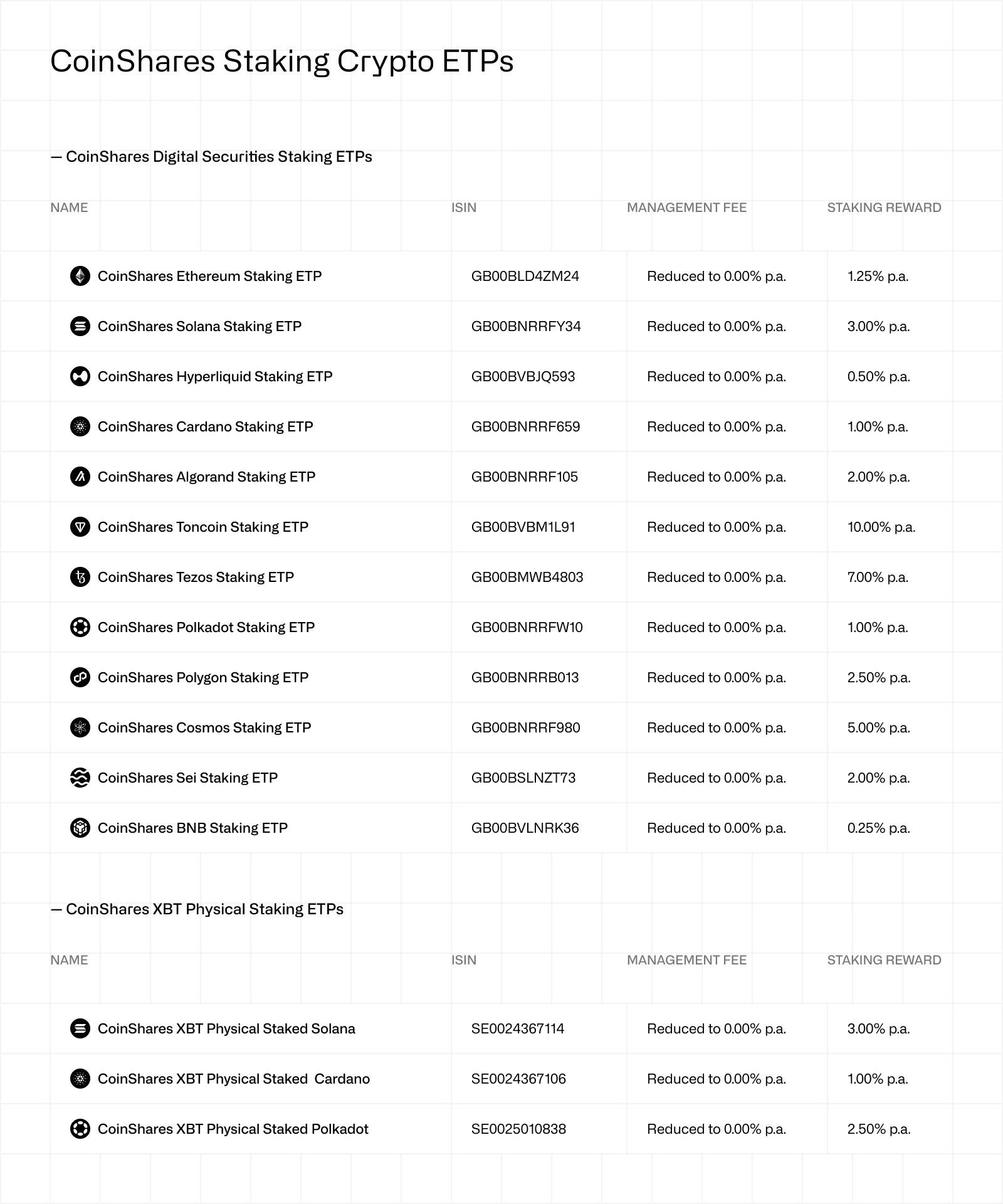
Staked ETP list (CSDS + XBT)

  • The Coinshares Digital Securities Physical Staked range is available across major European exchanges, offering broad access to digital assets for European investors, with institutional-grade transparency and security.

  • For Swedish investors, the CoinShares XBT Provider range is tailored specifically to local needs - denominated in SEK and listed on Nasdaq Stockholm - providing a familiar and accessible way to gain simple exposure to the crypto market.

CoinShares Staked ETPs also include several security features designed to mitigate the risks associated with staking. Further details and documentation can be found on the relevant product page for each ETP. 

It is important to note that Crypto ETPs are complex products, may be difficult to understand and have a high risk of capital loss. Before investing, you should always read the information contained in the Base Prospectus, any Supplemental Prospectus, the Final Terms and the Key Information Documents and other offering documents available free of charge on the ETP’s legal documentation website under coinshares.com/etp/documents/ in accordance with legal requirements as well as via the relevant stock exchanges and brokers. 

Is crypto staking a no-brainer? 

Staking can result in several benefits, including increased network decentralisation and the potential to earn a passive income through rewards. However, investors must agree to lock up their assets, causing them to become illiquid for a period of time. Staked ETPs can make the process easier to navigate, provided proper due diligence is carried out on the ETP. 
You can browse the full CoinShares Physical Staked ETPs catalogue for more details on each ETP.

Published onMay 20th, 2026

related articles

Welcome to CoinShares

Personal Data

0102

When you visit CoinShares website, cookies enhance your experience. They help us to show you more relevant content. Some cookies are necessary for the site to work and will always be active. Blocking some types of cookies may impact your experience of the website and the services which we offer on our website.

We use cookies on our site to optimize our services. Learn more about our EU cookie policy or US cookie policy.

  • Necessary
    Question circle icon
  • Preferences
    Question circle icon
  • Statistical
    Question circle icon
  • Marketing
    Question circle icon
Necessary cookies help make a website usable by enabling basic functions like page navigation and access to secure areas of the website. The website cannot function properly without these cookies.
Preference cookies enable a website to remember information that changes the way the website behaves or looks, like your preferred language or the region that you are in.
Statistic cookies help website owners to understand how visitors interact with websites by collecting and reporting information anonymously.
Marketing cookies are used to track visitors across websites. The intention is to display ads that are relevant and engaging for the individual user and thereby more valuable for publishers and third party advertisers.