
This website uses cookies
We use cookies to personalise content and ads, to provide social media features and to analyse our traffic. We also share information about your use of our site with our social media, advertising and analytics partners who may combine it with other information that you’ve provided to them or that they’ve collected from your use of their services.
Consent Selection
Details
  • Necessary cookies help make a website usable by enabling basic functions like page navigation and access to secure areas of the website. The website cannot function properly without these cookies.

    • Learn more about this provideropens in a new window
      CookieConsentStores the user's cookie consent state for the current domain
      Maximum Storage Duration: 1 yearType: HTTP Cookie
    • Learn more about this provideropens in a new window
      bcookieUsed in order to detect spam and improve the website's security.
      Maximum Storage Duration: 1 yearType: HTTP Cookie
      li_gcStores the user's cookie consent state for the current domain
      Maximum Storage Duration: 180 daysType: HTTP Cookie
    • Learn more about this provideropens in a new window
      datadomeUsed in context with the website's BotManager. The BotManager detects, categorizes and compiles reports on potential bots trying to access the website.
      Maximum Storage Duration: 1 yearType: HTTP Cookie
    • _pk_testcookie_domainThis cookie determines whether the browser accepts cookies.
      Maximum Storage Duration: 1 dayType: HTTP Cookie
    • __cf_bm [x3]This cookie is used to distinguish between humans and bots. This is beneficial for the website, in order to make valid reports on the use of their website.
      Maximum Storage Duration: 1 dayType: HTTP Cookie
  • Preference cookies enable a website to remember information that changes the way the website behaves or looks, like your preferred language or the region that you are in.
    • Learn more about this provideropens in a new window
      lidcRegisters which server-cluster is serving the visitor. This is used in context with load balancing, in order to optimize user experience.
      Maximum Storage Duration: 1 dayType: HTTP Cookie
  • Statistic cookies help website owners to understand how visitors interact with websites by collecting and reporting information anonymously.
    • Learn more about this provideropens in a new window
      guestRegisters data on visitors' website-behaviour. This is used for internal analysis and website optimization.
      Maximum Storage Duration: 1 monthType: HTTP Cookie
    • Learn more about this provideropens in a new window
      personalization_idThis cookie is set by Twitter - The cookie allows the visitor to share content from the website onto their Twitter profile.
      Maximum Storage Duration: 400 daysType: HTTP Cookie
    • _pk_uidUsed by Piwik Analytics Platform to identify the visitor on repeat visits to the website.
      Maximum Storage Duration: 1 yearType: HTTP Cookie
      _pk_id#Collects statistics on the user's visits to the website, such as the number of visits, average time spent on the website and what pages have been read.
      Maximum Storage Duration: 1 yearType: HTTP Cookie
      _pk_ses#Used by Piwik Analytics Platform to track page requests from the visitor during the session.
      Maximum Storage Duration: 1 dayType: HTTP Cookie
    • FPGSIDRegisters statistical data on users' behaviour on the website. Used for internal analytics by the website operator.
      Maximum Storage Duration: 1 dayType: HTTP Cookie
      FPIDRegisters statistical data on users' behaviour on the website. Used for internal analytics by the website operator.
      Maximum Storage Duration: 400 daysType: HTTP Cookie
      FPLCRegisters a unique ID that is used to generate statistical data on how the visitor uses the website.
      Maximum Storage Duration: 1 dayType: HTTP Cookie
    • _gaRegisters a unique ID that is used to generate statistical data on how the visitor uses the website.
      Maximum Storage Duration: 2 yearsType: HTTP Cookie
      _ga_#Used by Google Analytics to collect data on the number of times a user has visited the website as well as dates for the first and most recent visit.
      Maximum Storage Duration: 2 yearsType: HTTP Cookie
  • Marketing cookies are used to track visitors across websites. The intention is to display ads that are relevant and engaging for the individual user and thereby more valuable for publishers and third party advertisers.
    • Learn more about this provideropens in a new window

      Some of the data collected by this provider is for the purposes of personalization and measuring advertising effectiveness. The provider may use the IP Addresses for ads measurement and ads personalization.

      ads/ga-audiencesUsed by Google AdWords to re-engage visitors that are likely to convert to customers based on the visitor's online behaviour across websites.
      Maximum Storage Duration: SessionType: Pixel Tracker
    • Learn more about this provideropens in a new window
      userRefererDetermines how the user accessed the website. This information is used by the website operator in order to measure the efficiency of their marketing.
      Maximum Storage Duration: 1 monthType: HTTP Cookie
    • Learn more about this provideropens in a new window
      #:session-dataTracks the individual sessions on the website, allowing the website to compile statistical data from multiple visits. This data can also be used to create leads for marketing purposes.
      Maximum Storage Duration: PersistentType: HTML Local Storage
      eng_mtTracks the conversion rate between the user and the advertisement banners on the website - This serves to optimise the relevance of the advertisements on the website.
      Maximum Storage Duration: PersistentType: HTML Local Storage
      t_gidThis cookie assigns a specific visitor ID, when the visitor interacts with ads or content from the website - this allows the website to target the visitor with similar ads or content.
      Maximum Storage Duration: 1 yearType: HTTP Cookie
      t_pt_gidCollects information on user preferences and/or interaction with web-campaign content - This is used on CRM-campaign-platform used by website owners for promoting events or products.
      Maximum Storage Duration: 1 yearType: HTTP Cookie
      taboola global:user-idSets a unique ID for the visitor, that allows third party advertisers to target the visitor with relevant advertisement. This pairing service is provided by third party advertisement hubs, which facilitates real-time bidding for advertisers.
      Maximum Storage Duration: PersistentType: HTML Local Storage
      taboola_session_idThis cookie is used to collect information on a visitor. This information will become an ID string with information on a specific visitor – ID information strings can be used to target groups with similar preferences, or can be used by third-party domains or ad-exchanges.
      Maximum Storage Duration: SessionType: HTTP Cookie
    • Learn more about this provideropens in a new window
      1/i/adsct [x2]Collects data on user behaviour and interaction in order to optimize the website and make advertisement on the website more relevant.
      Maximum Storage Duration: SessionType: Pixel Tracker
      muc_adsCollects data on user behaviour and interaction in order to optimize the website and make advertisement on the website more relevant.
      Maximum Storage Duration: 400 daysType: HTTP Cookie
      guest_idCollects data related to the user's visits to the website, such as the number of visits, average time spent on the website and which pages have been loaded, with the purpose of personalising and improving the Twitter service.
      Maximum Storage Duration: 400 daysType: HTTP Cookie
      guest_id_adsCollects information on user behaviour on multiple websites. This information is used in order to optimize the relevance of advertisement on the website.
      Maximum Storage Duration: 400 daysType: HTTP Cookie
      guest_id_marketingCollects information on user behaviour on multiple websites. This information is used in order to optimize the relevance of advertisement on the website.
      Maximum Storage Duration: 400 daysType: HTTP Cookie
    • _gcl_auUsed by Google AdSense for experimenting with advertisement efficiency across websites using their services.
      Maximum Storage Duration: 3 monthsType: HTTP Cookie
      _gcl_lsTracks the conversion rate between the user and the advertisement banners on the website - This serves to optimise the relevance of the advertisements on the website.
      Maximum Storage Duration: PersistentType: HTML Local Storage
    • pardot [x2]Used in context with Account-Based-Marketing (ABM). The cookie registers data such as IP-addresses, time spent on the website and page requests for the visit. This is used for retargeting of multiple users rooting from the same IP-addresses. ABM usually facilitates B2B marketing purposes.
      Maximum Storage Duration: SessionType: HTTP Cookie
  • Unclassified cookies are cookies that we are in the process of classifying, together with the providers of individual cookies.
    • cs_analytics_ip_blockedPending
      Maximum Storage Duration: SessionType: HTTP Cookie
      user_tokenPending
      Maximum Storage Duration: 1 yearType: HTTP Cookie
    • _twpidPending
      Maximum Storage Duration: SessionType: HTTP Cookie
Cookie declaration last updated on 8/20/26 by Cookiebot
[#IABV2_TITLE#]
[#IABV2_BODY_INTRO#]
[#IABV2_BODY_LEGITIMATE_INTEREST_INTRO#]
[#IABV2_BODY_PREFERENCE_INTRO#]
[#IABV2_BODY_PURPOSES_INTRO#]
[#IABV2_BODY_PURPOSES#]
[#IABV2_BODY_FEATURES_INTRO#]
[#IABV2_BODY_FEATURES#]
[#IABV2_BODY_PARTNERS_INTRO#]
[#IABV2_BODY_PARTNERS#]
About
Cookies are small text files that can be used by websites to make a user's experience more efficient.

The law states that we can store cookies on your device if they are strictly necessary for the operation of this site. For all other types of cookies we need your permission.

This site uses different types of cookies. Some cookies are placed by third party services that appear on our pages.

You can at any time change or withdraw your consent from the Cookie Declaration on our website.

Learn more about who we are, how you can contact us and how we process personal data in our Privacy Policy.

Please state your consent ID and date when you contact us regarding your consent.

QE Dystopia & Corporate Bitcoin Adoption

Timer5 min read

  • Bitcoin

Requiem for a Dream is a film about the drug-induced utopias of four Coney Island people, although these utopias are shattered when their addictions begin to run deep. Sometimes, it now feels like Requiem for a Dream “monetary policy” version is now upon us, the drug of quantitative easing (QE) is now wearing off and addictions to loose monetary policy are beginning to reveal themselves in subtle but potentially ugly ways. The recent covid crisis has only exacerbated things with government yields in both the UK and the US likely to turn negative soon. Corporations are well aware of negative yields and the problems it poses, and are beginning to look for alternative reserve assets and potential stores of value.

Risk mitigation strategies aren't working

The recent sell-off in markets has been unusual in that traditional risk mitigation strategies haven't worked all that well. There are several reasons for this but it is mainly due to the behaviour of profligate governments combined with central banks adopting unconventional monetary policy, primarily in the form of QE. Central bankers QE policies began in earnest in 2009 during the great financial crisis where “bazooka policies” were required to prevent a deep recession. Initially these expansionary policies helped recapitalise corporations by raising the value of assets. Furthermore, it also forced money market funds to waive fees (https://www.brookings.edu/wp-content/uploads/2016/07/2014a_ChodorowReich.pdf), to the benefit of corporations but it also instigated the hunt for yield amongst investment institutions and corporations.

The hunt for yield distorting investor positioning

This hunt for yield has been driving demand and pushing down yields in fixed-income and other yielding assets ever since, in an almost drug-like fashion, and now to such an extreme, that yields are turning negative. As it stands, according to Reuters roughly 30% of yields in European government bonds are negative. This has also led to an almost unprecedented high weighting of fixed-income instruments in the average investor portfolio, potentially creating big risks for investment managers if there is a sharp unwind in bond prices.

Negative interest rates made worse by Covid

Negative interest rates impose penalties on those who deposit funds. For most of the nations that have begun adopting negative interest rate policies, the affected accounts were held primarily by banks at central banks, in essence to encourage them to lend rather than keep excess funds. This has led to negative interest rates across the financial system, such as interbank deposits and the deposits of corporations and individuals with large deposits. This situation is likely to get worse as governments grapple with high debt burdens made worse by the Covid crisis. Covid has also led to considerably less use of cash, and as we move more towards an increasingly cashless society so it is easier for negative rates to be imposed on individuals.

The challenge for corporate treasury

Traditionally, corporate treasury departments are generally responsible for managing an organisation's liquidity risks, financial risks and working capital to support management and business units. Cash rich corporations’ treasury departments tend to use money markets for short-term investments of their cash, rather than sitting idle in deposit accounts. But this has been challenging as cash on deposit or in investments less than a year are predominantly negative yielding, and have been since March 2015 in Europe.

Corporate treasury departments have had to simply accept negative yields in Europe, but those with more international exposure have exploited the “yield differential” between the US and Europe, where US short-term lending has remained positive. This has been helpful, particularly when the consensus outlook for the US dollar remained positive.

Rising disillusionment of US monetary & fiscal policy

Since Covid-19 took grip in February, the United States reaction was to create a stimulus package representing 13% of gross domestic product (GDP), far greater than the European Union’s package representing 4.3% of GDP (https://www.statista.com/statistics/1107572/covid-19-value-g20-stimulus-packages-share-gdp/). The US stimulus package has had a marked negative impact on interest rates for short-term deposits, as represented in the chart on 1-month LIBOR below.
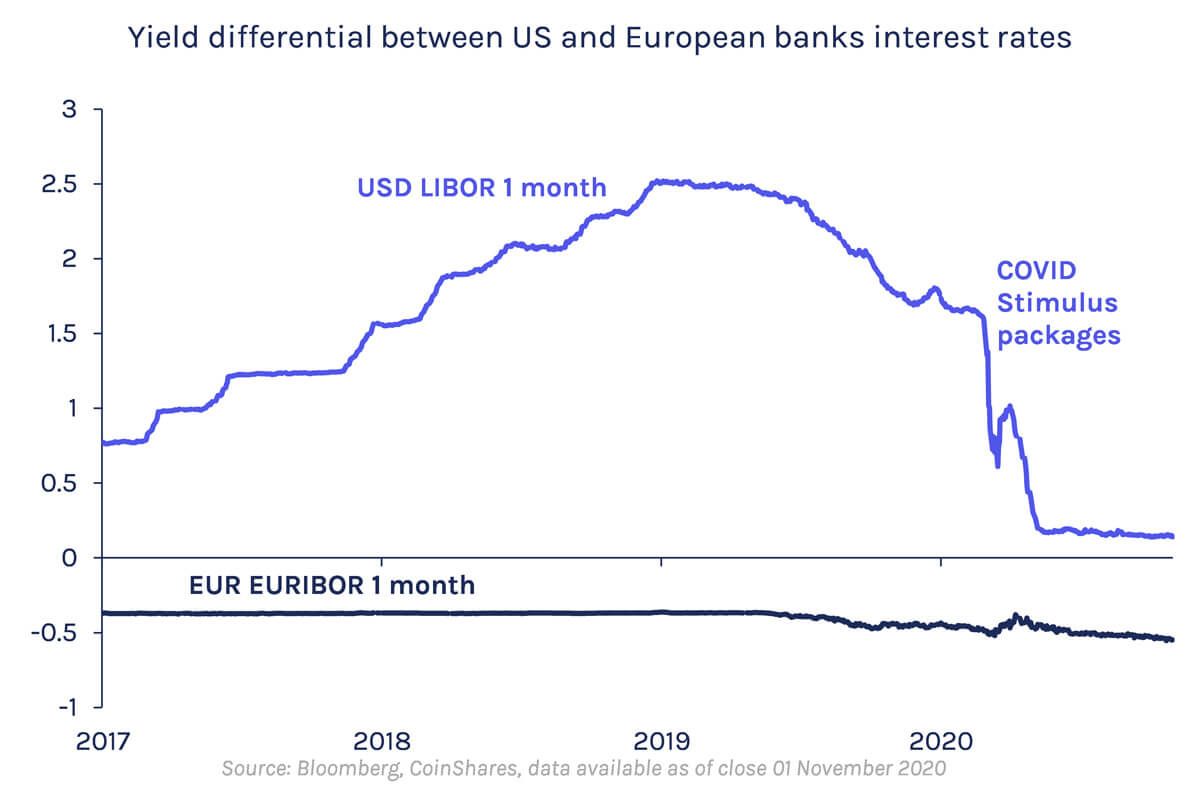
Yield differential between US and European banks interest ratesUS yields are now very close to zero having fallen from 1.5% at the beginning of 2020, while the yield differential is now rapidly narrowing relative to European lending rates. Monetary expansion is causing concern amongst corporate treasury departments: As rapidly as businesses are generating revenues, they are losing it in purchasing power. Expansion also has the effect of increasing mistrust in the US fiscal and monetary system and is fundamentally changing the outlook for the US dollar amongst investors and corporate treasury departments.

Corporate treasury departments are beginning to look elsewhere

As a consequence of burgeoning negative interest rates and a poor US dollar outlook, corporate treasury management departments are beginning to source alternative stores of value/reserve assets. A quick search highlights that there are very few instruments that work effectively in these roles. Initially, longer dated US treasuries were popular, but in recent months the correlation to US equities has been high and other traditional safe havens such as the Japanese Yen are showing less defensive characteristics than they historically have.

There ends up being very little store of value choice, particularly if US dollar denomination is required. Currently, the two main viable low-correlation liquid stores of value are gold and Bitcoin, and as we have demonstrated here our research suggests that Bitcoin is a much better diversifier than gold. Furthermore, there does seem to be a link emerging between Bitcoin and the volume of negative yielding debt, highlighted in the chart below.

Bitcoin price versus negative yielding debtWe are seeing a small but ever-increasing number of companies announce that they are holding Bitcoin as a reserve asset or store of value.

Bitcoin holdings for publicy traded companiesLike Requiem for a Dream, corporate treasury departments are beginning to wake up to the reality of negative yields, and are looking for viable alternative reserve assets. As Michael Saylor, the CEO of MicroStrategy recently said, each public commitment to Bitcoin is the next catalyst for further adoption, as companies begin to think about the world differently.

Published onNov 19th, 2020

Writer
Former Head of Research at ETF Securities, James leads CoinShares' Research department with deep expertise in equity and fund management.

Welcome to CoinShares

Personal Data

0102

When you visit CoinShares website, cookies enhance your experience. They help us to show you more relevant content. Some cookies are necessary for the site to work and will always be active. Blocking some types of cookies may impact your experience of the website and the services which we offer on our website.

We use cookies on our site to optimize our services. Learn more about our EU cookie policy or US cookie policy.

  • Necessary
    Question circle icon
  • Preferences
    Question circle icon
  • Statistical
    Question circle icon
  • Marketing
    Question circle icon
Necessary cookies help make a website usable by enabling basic functions like page navigation and access to secure areas of the website. The website cannot function properly without these cookies.
Preference cookies enable a website to remember information that changes the way the website behaves or looks, like your preferred language or the region that you are in.
Statistic cookies help website owners to understand how visitors interact with websites by collecting and reporting information anonymously.
Marketing cookies are used to track visitors across websites. The intention is to display ads that are relevant and engaging for the individual user and thereby more valuable for publishers and third party advertisers.