
This website uses cookies
We use cookies to personalise content and ads, to provide social media features and to analyse our traffic. We also share information about your use of our site with our social media, advertising and analytics partners who may combine it with other information that you’ve provided to them or that they’ve collected from your use of their services.
Consent Selection
Details
  • Necessary cookies help make a website usable by enabling basic functions like page navigation and access to secure areas of the website. The website cannot function properly without these cookies.

    • Learn more about this provideropens in a new window
      CookieConsentStores the user's cookie consent state for the current domain
      Maximum Storage Duration: 1 yearType: HTTP Cookie
    • Learn more about this provideropens in a new window
      bcookieUsed in order to detect spam and improve the website's security.
      Maximum Storage Duration: 1 yearType: HTTP Cookie
      li_gcStores the user's cookie consent state for the current domain
      Maximum Storage Duration: 180 daysType: HTTP Cookie
    • Learn more about this provideropens in a new window
      datadomeUsed in context with the website's BotManager. The BotManager detects, categorizes and compiles reports on potential bots trying to access the website.
      Maximum Storage Duration: 1 yearType: HTTP Cookie
    • _pk_testcookie_domainThis cookie determines whether the browser accepts cookies.
      Maximum Storage Duration: 1 dayType: HTTP Cookie
    • __cf_bm [x3]This cookie is used to distinguish between humans and bots. This is beneficial for the website, in order to make valid reports on the use of their website.
      Maximum Storage Duration: 1 dayType: HTTP Cookie
  • Preference cookies enable a website to remember information that changes the way the website behaves or looks, like your preferred language or the region that you are in.
    • Learn more about this provideropens in a new window
      lidcRegisters which server-cluster is serving the visitor. This is used in context with load balancing, in order to optimize user experience.
      Maximum Storage Duration: 1 dayType: HTTP Cookie
  • Statistic cookies help website owners to understand how visitors interact with websites by collecting and reporting information anonymously.
    • Learn more about this provideropens in a new window
      personalization_idThis cookie is set by Twitter - The cookie allows the visitor to share content from the website onto their Twitter profile.
      Maximum Storage Duration: 400 daysType: HTTP Cookie
    • _pk_uidUsed by Piwik Analytics Platform to identify the visitor on repeat visits to the website.
      Maximum Storage Duration: 1 yearType: HTTP Cookie
      _pk_id#Collects statistics on the user's visits to the website, such as the number of visits, average time spent on the website and what pages have been read.
      Maximum Storage Duration: 1 yearType: HTTP Cookie
      _pk_ses#Used by Piwik Analytics Platform to track page requests from the visitor during the session.
      Maximum Storage Duration: 1 dayType: HTTP Cookie
    • FPGSIDRegisters statistical data on users' behaviour on the website. Used for internal analytics by the website operator.
      Maximum Storage Duration: 1 dayType: HTTP Cookie
      FPIDRegisters statistical data on users' behaviour on the website. Used for internal analytics by the website operator.
      Maximum Storage Duration: 400 daysType: HTTP Cookie
      FPLCRegisters a unique ID that is used to generate statistical data on how the visitor uses the website.
      Maximum Storage Duration: 1 dayType: HTTP Cookie
    • _gaRegisters a unique ID that is used to generate statistical data on how the visitor uses the website.
      Maximum Storage Duration: 2 yearsType: HTTP Cookie
      _ga_#Used by Google Analytics to collect data on the number of times a user has visited the website as well as dates for the first and most recent visit.
      Maximum Storage Duration: 2 yearsType: HTTP Cookie
  • Marketing cookies are used to track visitors across websites. The intention is to display ads that are relevant and engaging for the individual user and thereby more valuable for publishers and third party advertisers.
    • Learn more about this provideropens in a new window

      Some of the data collected by this provider is for the purposes of personalization and measuring advertising effectiveness. The provider may use the IP Addresses for ads measurement and ads personalization.

      ads/ga-audiencesUsed by Google AdWords to re-engage visitors that are likely to convert to customers based on the visitor's online behaviour across websites.
      Maximum Storage Duration: SessionType: Pixel Tracker
    • Learn more about this provideropens in a new window
      #:session-dataTracks the individual sessions on the website, allowing the website to compile statistical data from multiple visits. This data can also be used to create leads for marketing purposes.
      Maximum Storage Duration: PersistentType: HTML Local Storage
      eng_mtTracks the conversion rate between the user and the advertisement banners on the website - This serves to optimise the relevance of the advertisements on the website.
      Maximum Storage Duration: PersistentType: HTML Local Storage
      t_gidThis cookie assigns a specific visitor ID, when the visitor interacts with ads or content from the website - this allows the website to target the visitor with similar ads or content.
      Maximum Storage Duration: 1 yearType: HTTP Cookie
      t_pt_gidCollects information on user preferences and/or interaction with web-campaign content - This is used on CRM-campaign-platform used by website owners for promoting events or products.
      Maximum Storage Duration: 1 yearType: HTTP Cookie
      taboola global:user-idSets a unique ID for the visitor, that allows third party advertisers to target the visitor with relevant advertisement. This pairing service is provided by third party advertisement hubs, which facilitates real-time bidding for advertisers.
      Maximum Storage Duration: PersistentType: HTML Local Storage
      taboola_session_idThis cookie is used to collect information on a visitor. This information will become an ID string with information on a specific visitor – ID information strings can be used to target groups with similar preferences, or can be used by third-party domains or ad-exchanges.
      Maximum Storage Duration: SessionType: HTTP Cookie
    • Learn more about this provideropens in a new window
      1/i/adsct [x2]Collects data on user behaviour and interaction in order to optimize the website and make advertisement on the website more relevant.
      Maximum Storage Duration: SessionType: Pixel Tracker
      muc_adsCollects data on user behaviour and interaction in order to optimize the website and make advertisement on the website more relevant.
      Maximum Storage Duration: 400 daysType: HTTP Cookie
      guest_idCollects data related to the user's visits to the website, such as the number of visits, average time spent on the website and which pages have been loaded, with the purpose of personalising and improving the Twitter service.
      Maximum Storage Duration: 400 daysType: HTTP Cookie
      guest_id_adsCollects information on user behaviour on multiple websites. This information is used in order to optimize the relevance of advertisement on the website.
      Maximum Storage Duration: 400 daysType: HTTP Cookie
      guest_id_marketingCollects information on user behaviour on multiple websites. This information is used in order to optimize the relevance of advertisement on the website.
      Maximum Storage Duration: 400 daysType: HTTP Cookie
    • _gcl_auUsed by Google AdSense for experimenting with advertisement efficiency across websites using their services.
      Maximum Storage Duration: 3 monthsType: HTTP Cookie
      _gcl_lsTracks the conversion rate between the user and the advertisement banners on the website - This serves to optimise the relevance of the advertisements on the website.
      Maximum Storage Duration: PersistentType: HTML Local Storage
    • pardot [x2]Used in context with Account-Based-Marketing (ABM). The cookie registers data such as IP-addresses, time spent on the website and page requests for the visit. This is used for retargeting of multiple users rooting from the same IP-addresses. ABM usually facilitates B2B marketing purposes.
      Maximum Storage Duration: SessionType: HTTP Cookie
  • Unclassified cookies are cookies that we are in the process of classifying, together with the providers of individual cookies.
    • cs_analytics_ip_blockedPending
      Maximum Storage Duration: SessionType: HTTP Cookie
      user_tokenPending
      Maximum Storage Duration: 1 yearType: HTTP Cookie
    • aw_daPending
      Maximum Storage Duration: PersistentType: HTML Local Storage
    • _twpidPending
      Maximum Storage Duration: SessionType: HTTP Cookie
      _twsidPending
      Maximum Storage Duration: SessionType: HTTP Cookie
Cookie declaration last updated on 10/19/26 by Cookiebot
[#IABV2_TITLE#]
[#IABV2_BODY_INTRO#]
[#IABV2_BODY_LEGITIMATE_INTEREST_INTRO#]
[#IABV2_BODY_PREFERENCE_INTRO#]
[#IABV2_BODY_PURPOSES_INTRO#]
[#IABV2_BODY_PURPOSES#]
[#IABV2_BODY_FEATURES_INTRO#]
[#IABV2_BODY_FEATURES#]
[#IABV2_BODY_PARTNERS_INTRO#]
[#IABV2_BODY_PARTNERS#]
About
Cookies are small text files that can be used by websites to make a user's experience more efficient.

The law states that we can store cookies on your device if they are strictly necessary for the operation of this site. For all other types of cookies we need your permission.

This site uses different types of cookies. Some cookies are placed by third party services that appear on our pages.

You can at any time change or withdraw your consent from the Cookie Declaration on our website.

Learn more about who we are, how you can contact us and how we process personal data in our Privacy Policy.

Please state your consent ID and date when you contact us regarding your consent.
Image What did the SEC's tokenised stock exemption actually approve?

What did the SEC's tokenised stock exemption actually approve?

Timer10 min read

On 17 September 2026, the SEC allowed certain platforms to trade US shares as blockchain tokens under a temporary set of rules. But following a share’s price is not enough. Investors must receive the same shareholder rights, including dividends and voting rights, as buyers of the original shares.

The announcement was not approval for every product sold as a “tokenised stock”. The distinction is between owning a share and buying a separate product whose price follows a share.

Platforms meeting the SEC’s conditions can trade eligible tokens without registering as traditional stock exchanges. Some firms providing tokens for buyers and sellers also receive relief from dealer registration requirements.

Automated market makers are software allowing participants admitted by the platform to trade against a pool of assets, rather than matching buyers with sellers. Order, page 33

The SEC also limits the scale of trading:

  • For shares in the S&P 500 and Russell 1000, plus certain other exchange-traded investments: a platform can offer up to 75 securities. Its average daily trading in each token cannot exceed 0.25% of the underlying investment’s average daily trading volume during the previous month.

  • For other eligible listed investments: a platform can offer up to 250 securities, with a higher limit of 2.5%.

  • For how long: the permission lasts from 17 September 2026 to 17 September 2031, unless the SEC changes the dates. Order, Section V

Affiliated platforms must combine trading volumes when applying the limits.The limits do not apply to the token market as a whole.

Before offering a token, a platform must check whether the token carries the same shareholder rights as the original share. If an unrelated business creates a token representing a company’s shares, the company must receive notice and a chance to object.

The US exemption relieves trading venues and liquidity providers; it does not approve individual products. Nor does it replace the permissions providers need to offer products in the EU.

Is a tokenised stock the same as owning the share, and do you get dividends and voting rights?

A tokenised stock can represent the share itself, an ownership interest held through a custodian, or a separate instrument linked to its price. Dividend treatment and voting rights depend on the structure. For the SEC exemption, the holder must receive the rights of the equivalent traditional share class.

Tokenisation represents an asset digitally on a shared ledger. CoinShares' tokenisation guide explains the process.

SEC staff explained the different types of tokenised securities in January 2026.
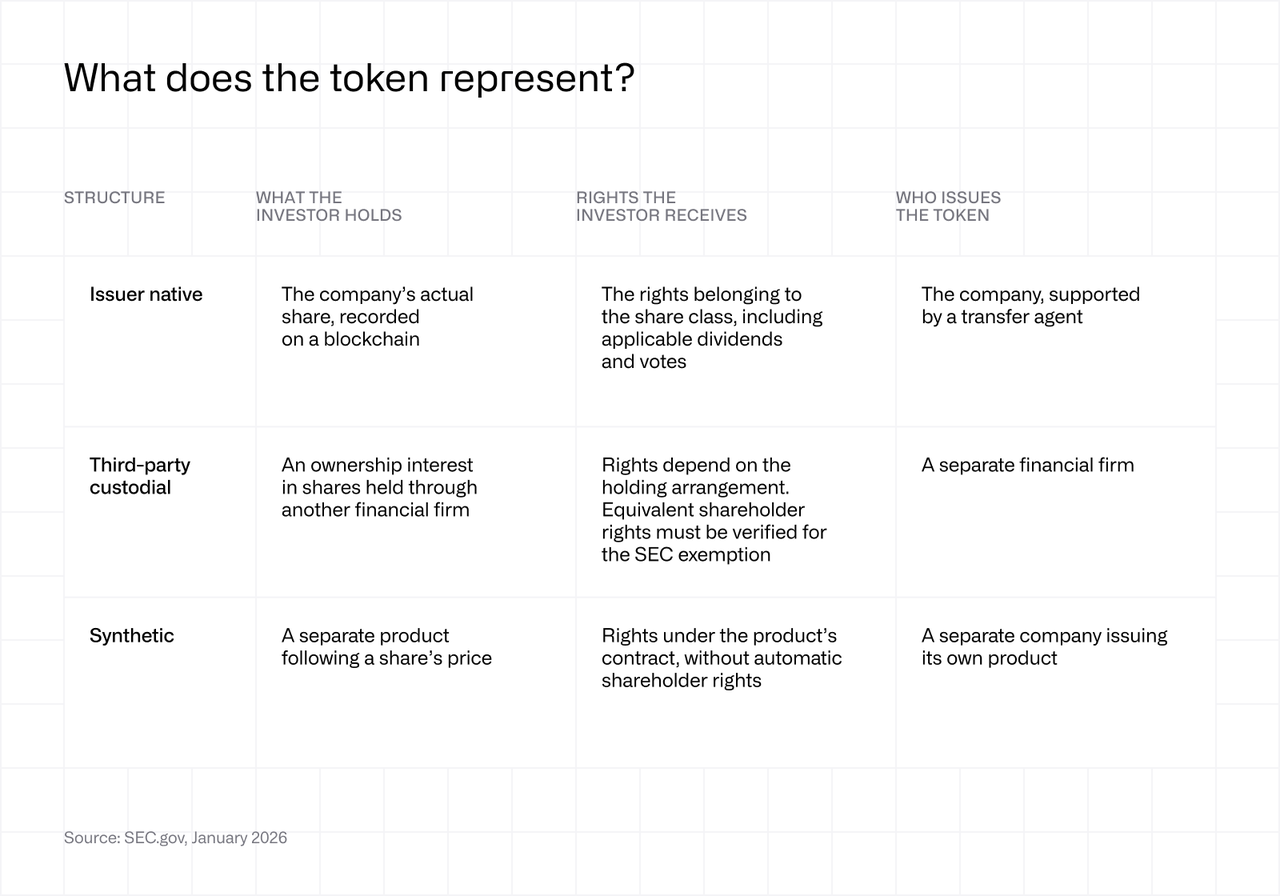
What does the token represent

A transfer agent keeps track of who owns a company’s shares. A security entitlement gives an investor rights to shares held through a broker or another financial firm, rather than directly in the investor’s name.

The order excludes synthetic exposure and requires equivalent company interests and liquidation rights. The standard is not 1:1 backing or 1:1 redeemability: the test is whether the holder receives the same shareholder rights, dividends and votes included.

Who issues tokenised equities and how do their structures differ?

Tokenised equities do not all give investors the same ownership rights. Ondo and xStocks offer claims against an issuer, while Superstate describes recording actual company shares. Backpack separates its tokens from shares held in a brokerage account. The table compares the products and what investors receive.

According to Token Terminal, the tokenised equity market reached $4.68B on 2 November 2026, up from $407.5M a year earlier, with growth recorded every month.
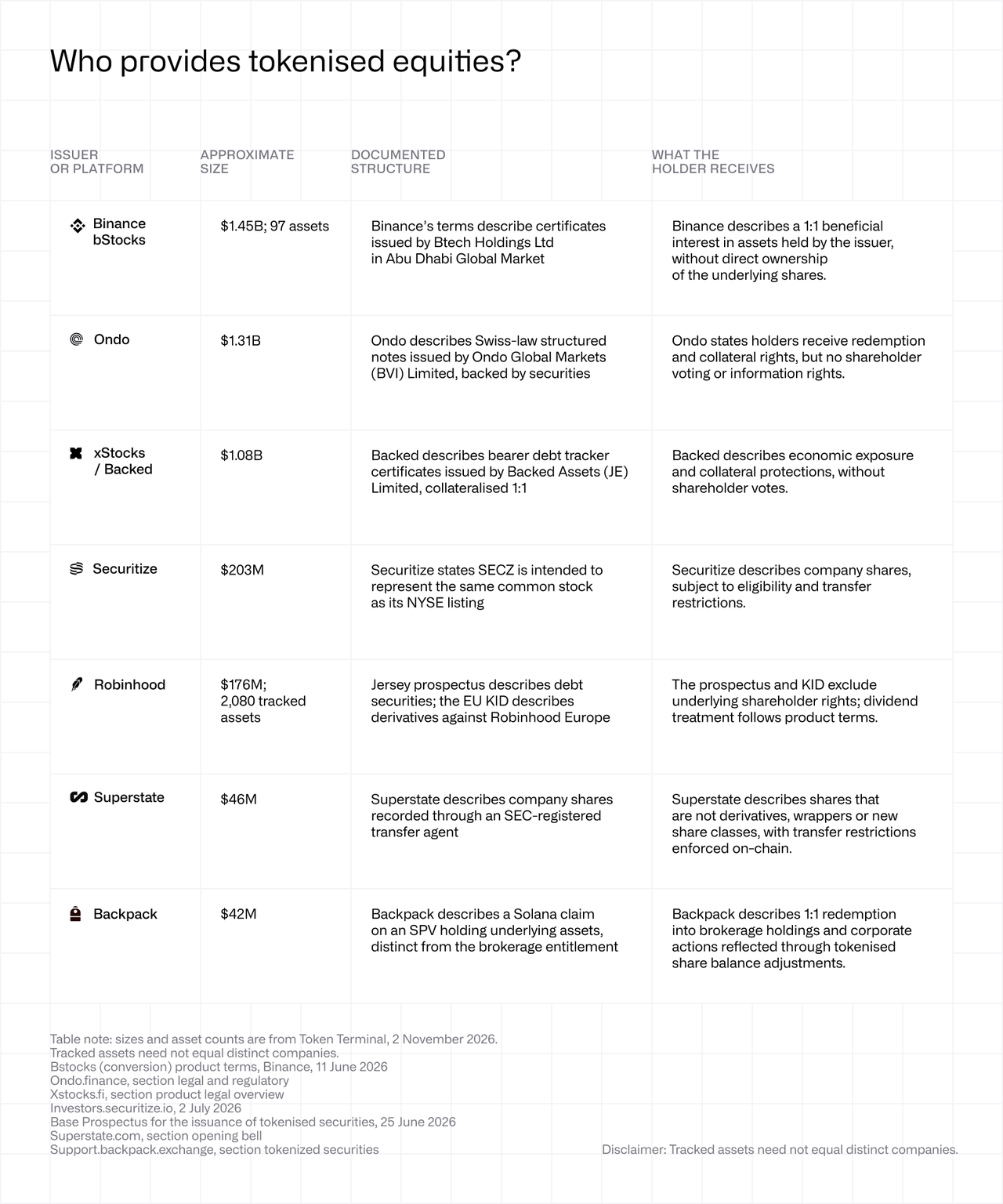
Who provides tokenised equities

Backpack's brokerage explanation describes a property interest under New York's Uniform Commercial Code, Article 8. The token is a claim on a special purpose vehicle, a separate company holding the assets. Compare token rights with the rights attached to the brokerage holding received on redemption.

Securitize's 8 October 2026 entitlement-token launch describes dividend and applicable voting rights, separately from issuer-sponsored SECZ.

Beyond the table, Figure describes OPEN as a network for blockchain-registered equities. Dinari describes its Financial Network as infrastructure for securities liquidity and settlement. DTCC launched tokenised DTC entitlements on 28 October 2026, including through Canton Network.

The ranking is led by certificates and notes offering broad distribution. Native share offerings are smaller. Whether equivalent-rights structures gain market share over the following year is the comparison to revisit.

Why do tokenised stocks trade at a different price to the real share?

A token and its referenced share can trade in separate markets. Creation and redemption help keep the token’s price close to the share price, but access, inventory and trading hours can limit the process. When the stock market is closed, token demand can push the price far from the share’s last traded price.

Tram Doman, of Bullish, a backer of issuer-sponsored tokenisation, writing in CoinDesk opinion on 24 September 2026, reports Robinhood's AMC token moving from $2.55 to $23.16 late on 3 September, then back to $3.26 within the hour, on $10.5M of pool volume. The peak was 9.1 times AMC's $2.54 NYSE close seven hours earlier.

Doman links the move to demand for a memecoin quoted in tokenised AMC and reports a median closing-price deviation of 0.9% across seven sessions from 31 August to 9 September. Tram Doman column identifies one authorised participant, no minting or burning during the spike, and 47 mints on 4 September. The account suggests constrained arbitrage; causation remains Doman's interpretation.

An authorised participant creates or redeems through an issuer. Minting creates tokens; burning cancels tokens. Creation and redemption align depositary receipts with shares and ETPs with net asset value, but require access, inventory or borrowing, and executable conversion.

Robinhood's prospectus page 60, warns the issuer may be unable to trade collateral "outside of exchange market hours, or in the necessary quantities, or at all". The NYSE's regular session occupies 32.5 hours of a normal week, or 19.3% of 168 hours. Inventory and extended-hours trading can help, but continuous token trading cannot guarantee continuous underlying liquidity.

The wrapper serves investors seeking price exposure. Robinhood's EU KID pages 1 and 2, describes a derivative linked to a US-listed asset and identifies Robinhood Europe as the sole counterparty. As with a participating note, access comes through another party's obligation, bringing counterparty risk rather than shareholder ownership.

Before allocating, ask four questions: what rights does the token itself carry? Who is the issuer, and which jurisdiction governs the claim? Can more than one participant create and redeem? What happens to pricing when the underlying market closes?

FAQs

What did the SEC's tokenised stock exemption approve?

Conditional relief for qualifying venues and liquidity providers, not blanket product approval.

Is a tokenised stock the same as owning the share, and do you get dividends and voting rights?

Only some structures carry shareholder rights; backing alone is insufficient.

Who issues tokenised equities and how do their structures differ?

Companies and intermediaries issue shares, custodial interests or separate price-linked instruments.

Why do tokenised stocks trade at a different price to the real share?

Separate liquidity and constrained creation or redemption can prevent price alignment.

Published on

Writer
CoinShares Author Logo
CoinShares