
This website uses cookies
We use cookies to personalise content and ads, to provide social media features and to analyse our traffic. We also share information about your use of our site with our social media, advertising and analytics partners who may combine it with other information that you’ve provided to them or that they’ve collected from your use of their services.
Consent Selection
Details
  • Necessary cookies help make a website usable by enabling basic functions like page navigation and access to secure areas of the website. The website cannot function properly without these cookies.

    • Learn more about this provideropens in a new window
      CookieConsentStores the user's cookie consent state for the current domain
      Maximum Storage Duration: 1 yearType: HTTP Cookie
    • Learn more about this provideropens in a new window
      bcookieUsed in order to detect spam and improve the website's security.
      Maximum Storage Duration: 1 yearType: HTTP Cookie
      li_gcStores the user's cookie consent state for the current domain
      Maximum Storage Duration: 180 daysType: HTTP Cookie
    • Learn more about this provideropens in a new window
      datadomeUsed in context with the website's BotManager. The BotManager detects, categorizes and compiles reports on potential bots trying to access the website.
      Maximum Storage Duration: 1 yearType: HTTP Cookie
    • _pk_testcookie_domainThis cookie determines whether the browser accepts cookies.
      Maximum Storage Duration: 1 dayType: HTTP Cookie
    • __cf_bm [x3]This cookie is used to distinguish between humans and bots. This is beneficial for the website, in order to make valid reports on the use of their website.
      Maximum Storage Duration: 1 dayType: HTTP Cookie
  • Preference cookies enable a website to remember information that changes the way the website behaves or looks, like your preferred language or the region that you are in.
    • Learn more about this provideropens in a new window
      lidcRegisters which server-cluster is serving the visitor. This is used in context with load balancing, in order to optimize user experience.
      Maximum Storage Duration: 1 dayType: HTTP Cookie
  • Statistic cookies help website owners to understand how visitors interact with websites by collecting and reporting information anonymously.
    • Learn more about this provideropens in a new window
      guestRegisters data on visitors' website-behaviour. This is used for internal analysis and website optimization.
      Maximum Storage Duration: 1 monthType: HTTP Cookie
    • Learn more about this provideropens in a new window
      personalization_idThis cookie is set by Twitter - The cookie allows the visitor to share content from the website onto their Twitter profile.
      Maximum Storage Duration: 400 daysType: HTTP Cookie
    • _pk_uidUsed by Piwik Analytics Platform to identify the visitor on repeat visits to the website.
      Maximum Storage Duration: 1 yearType: HTTP Cookie
      _pk_id#Collects statistics on the user's visits to the website, such as the number of visits, average time spent on the website and what pages have been read.
      Maximum Storage Duration: 1 yearType: HTTP Cookie
      _pk_ses#Used by Piwik Analytics Platform to track page requests from the visitor during the session.
      Maximum Storage Duration: 1 dayType: HTTP Cookie
    • FPGSIDRegisters statistical data on users' behaviour on the website. Used for internal analytics by the website operator.
      Maximum Storage Duration: 1 dayType: HTTP Cookie
      FPIDRegisters statistical data on users' behaviour on the website. Used for internal analytics by the website operator.
      Maximum Storage Duration: 400 daysType: HTTP Cookie
      FPLCRegisters a unique ID that is used to generate statistical data on how the visitor uses the website.
      Maximum Storage Duration: 1 dayType: HTTP Cookie
    • _gaRegisters a unique ID that is used to generate statistical data on how the visitor uses the website.
      Maximum Storage Duration: 2 yearsType: HTTP Cookie
      _ga_#Used by Google Analytics to collect data on the number of times a user has visited the website as well as dates for the first and most recent visit.
      Maximum Storage Duration: 2 yearsType: HTTP Cookie
  • Marketing cookies are used to track visitors across websites. The intention is to display ads that are relevant and engaging for the individual user and thereby more valuable for publishers and third party advertisers.
    • Learn more about this provideropens in a new window

      Some of the data collected by this provider is for the purposes of personalization and measuring advertising effectiveness. The provider may use the IP Addresses for ads measurement and ads personalization.

      ads/ga-audiencesUsed by Google AdWords to re-engage visitors that are likely to convert to customers based on the visitor's online behaviour across websites.
      Maximum Storage Duration: SessionType: Pixel Tracker
    • Learn more about this provideropens in a new window
      userRefererDetermines how the user accessed the website. This information is used by the website operator in order to measure the efficiency of their marketing.
      Maximum Storage Duration: 1 monthType: HTTP Cookie
    • Learn more about this provideropens in a new window
      #:session-dataTracks the individual sessions on the website, allowing the website to compile statistical data from multiple visits. This data can also be used to create leads for marketing purposes.
      Maximum Storage Duration: PersistentType: HTML Local Storage
      eng_mtTracks the conversion rate between the user and the advertisement banners on the website - This serves to optimise the relevance of the advertisements on the website.
      Maximum Storage Duration: PersistentType: HTML Local Storage
      t_gidThis cookie assigns a specific visitor ID, when the visitor interacts with ads or content from the website - this allows the website to target the visitor with similar ads or content.
      Maximum Storage Duration: 1 yearType: HTTP Cookie
      t_pt_gidCollects information on user preferences and/or interaction with web-campaign content - This is used on CRM-campaign-platform used by website owners for promoting events or products.
      Maximum Storage Duration: 1 yearType: HTTP Cookie
      taboola global:user-idSets a unique ID for the visitor, that allows third party advertisers to target the visitor with relevant advertisement. This pairing service is provided by third party advertisement hubs, which facilitates real-time bidding for advertisers.
      Maximum Storage Duration: PersistentType: HTML Local Storage
      taboola_session_idThis cookie is used to collect information on a visitor. This information will become an ID string with information on a specific visitor – ID information strings can be used to target groups with similar preferences, or can be used by third-party domains or ad-exchanges.
      Maximum Storage Duration: SessionType: HTTP Cookie
    • Learn more about this provideropens in a new window
      1/i/adsct [x2]Collects data on user behaviour and interaction in order to optimize the website and make advertisement on the website more relevant.
      Maximum Storage Duration: SessionType: Pixel Tracker
      muc_adsCollects data on user behaviour and interaction in order to optimize the website and make advertisement on the website more relevant.
      Maximum Storage Duration: 400 daysType: HTTP Cookie
      guest_idCollects data related to the user's visits to the website, such as the number of visits, average time spent on the website and which pages have been loaded, with the purpose of personalising and improving the Twitter service.
      Maximum Storage Duration: 400 daysType: HTTP Cookie
      guest_id_adsCollects information on user behaviour on multiple websites. This information is used in order to optimize the relevance of advertisement on the website.
      Maximum Storage Duration: 400 daysType: HTTP Cookie
      guest_id_marketingCollects information on user behaviour on multiple websites. This information is used in order to optimize the relevance of advertisement on the website.
      Maximum Storage Duration: 400 daysType: HTTP Cookie
    • _gcl_auUsed by Google AdSense for experimenting with advertisement efficiency across websites using their services.
      Maximum Storage Duration: 3 monthsType: HTTP Cookie
      _gcl_lsTracks the conversion rate between the user and the advertisement banners on the website - This serves to optimise the relevance of the advertisements on the website.
      Maximum Storage Duration: PersistentType: HTML Local Storage
    • pardot [x2]Used in context with Account-Based-Marketing (ABM). The cookie registers data such as IP-addresses, time spent on the website and page requests for the visit. This is used for retargeting of multiple users rooting from the same IP-addresses. ABM usually facilitates B2B marketing purposes.
      Maximum Storage Duration: SessionType: HTTP Cookie
  • Unclassified cookies are cookies that we are in the process of classifying, together with the providers of individual cookies.
    • cs_analytics_ip_blockedPending
      Maximum Storage Duration: SessionType: HTTP Cookie
      user_tokenPending
      Maximum Storage Duration: 1 yearType: HTTP Cookie
    • _twpidPending
      Maximum Storage Duration: SessionType: HTTP Cookie
Cookie declaration last updated on 8/20/26 by Cookiebot
[#IABV2_TITLE#]
[#IABV2_BODY_INTRO#]
[#IABV2_BODY_LEGITIMATE_INTEREST_INTRO#]
[#IABV2_BODY_PREFERENCE_INTRO#]
[#IABV2_BODY_PURPOSES_INTRO#]
[#IABV2_BODY_PURPOSES#]
[#IABV2_BODY_FEATURES_INTRO#]
[#IABV2_BODY_FEATURES#]
[#IABV2_BODY_PARTNERS_INTRO#]
[#IABV2_BODY_PARTNERS#]
About
Cookies are small text files that can be used by websites to make a user's experience more efficient.

The law states that we can store cookies on your device if they are strictly necessary for the operation of this site. For all other types of cookies we need your permission.

This site uses different types of cookies. Some cookies are placed by third party services that appear on our pages.

You can at any time change or withdraw your consent from the Cookie Declaration on our website.

Learn more about who we are, how you can contact us and how we process personal data in our Privacy Policy.

Please state your consent ID and date when you contact us regarding your consent.
Image What is Polygon - POL guide

What is Polygon - POL guide

Timer12 min read

  • Altcoins
  • Technology

Polygon is a network built to make transactions on Ethereum faster and cheaper. It launched in 2020 offering the same applications at lower fees, and for several years that was the extent of it.

Since 2024 Polygon has changed its token, POL (formerly MATIC) appointed its first chief executive, shut down its flagship zero-knowledge product and narrowed its focus to moving stablecoins. Network fees have tripled over that period

What Polygon is, and why the name changed

A sidechain close to Ethereum

Ethereum is a blockchain that can run programmes, not just record payments. It is also slow and expensive when busy, because every transaction competes for the same limited space.

A sidechain is a separate network that processes transactions away from Ethereum, then periodically reports the results back to it. Users get lower fees and faster confirmation. Polygon was one of the first secondary networks to reach real scale.

Polygon PoS, the network's main chain, works in four steps. A user makes a transaction in an application. That transaction is grouped into a block on Polygon. Validators, the computers that check and record transactions, confirm the block. Periodically, a summary of many blocks is written back to Ethereum as a checkpoint.

MATIC became POL

Polygon launched in 2017 as Matic Network and rebranded to Polygon in 2021, but the token kept the old MATIC ticker for years afterwards. In 2024 the network migrated to a new token, POL, which replaced MATIC one-for-one.

Nothing about a holder's economic position changed in the migration. What changed was the design intent: POL was built to secure several Polygon chains at once rather than one, which is the foundation the network's current architecture rests on.

What POL is used for

Transaction fees

Every transaction on Polygon costs a small fee paid in POL, typically a fraction of a cent, way below Ethereum's fee levels.

Staking and network security

Validators lock up POL as collateral, a process called staking, and are rewarded for confirming transactions honestly. Holders who do not want to run a validator can delegate their tokens to one and share the rewards. Staking is also the mechanism that ties POL's value to network security rather than to speculation alone.

Governance

POL holders vote on network decisions, including funding from the ecosystem treasury. In practice, direction has been set by Polygon Labs and the Polygon Foundation, and the 2025 leadership change made that more explicit rather than less.

Supply

Circulating supply stood at 10,67 billion POL on 30 June 2026.1 POL carries an annual issuance designed to fund validator rewards and ecosystem development, which means the token supply grows over time. That matters for anyone comparing POL's price history to its market value, because a falling price and a rising supply do not move together.

How Polygon performs today

Speed and cost

The Rio upgrade, activated in October 2025, rebuilt how Polygon produces blocks. It raised throughput to roughly 5,000 transactions per second and brought confirmation close to instant, while making it cheaper to run a node.2

Polygon's stated target is far higher. The Gigagas roadmap sets out a path to more than 100,000 transactions per second, framed explicitly around payments rather than general computing.3 Polygon has not demonstrated anything close to that figure in production, and the roadmap should be read as an ambition.

Fees and usage

Network fees measure whether anyone is willing to pay to use a blockchain. On Polygon they have tripled.

Polygon collected $19,83M in fees over the first half of 2026, more than three times the $5,91M it collected across the whole of 2025. Protocol revenue, the share of those fees the network retains, rose from $2,11M to $11,12M over the same comparison.1 Average daily transactions roughly doubled year on year, and fee income grew faster still.1

The user base did not grow with it. Polygon averaged 649,000 daily active addresses in 2025 and 601,000 over the first half of 2026, so the additional fee income came from more activity per address rather than from more addresses.1

How Polygon compares to Ethereum or Solana

Against Ethereum, Polygon trades security assurances for cost. Ethereum is the settlement layer with the deepest liquidity and the strongest guarantees; Polygon is where transactions happen when those guarantees cost more than they are worth.

Against Solana, the difference is scope. Solana runs a broad consumer and trading ecosystem at high speed. Polygon has deliberately narrowed to payments and tokenised assets.

Against Layer 2 networks such as Arbitrum and Optimism, Polygon's distinguishing feature is enterprise and payments distribution rather than DeFi depth, and its own consensus. 

Market performance

POL traded at $0,0707 on 30 June 2026, giving a circulating market capitalisation of $729,7M.1 Its highest price on record was $2,88, reached on 26 December 2021.1 Past performance is not a guide to future returns.

The network earned more since January 2026 than in the preceding year, while the token lost nearly a third of its value. One explanation is that the market has not yet priced the payments business. Another is that it has priced it, and concluded that very little of the payment volume reaches POL holders. Half-year fees of $19,83M against a market capitalisation of $729,7M lend some weight to the second.
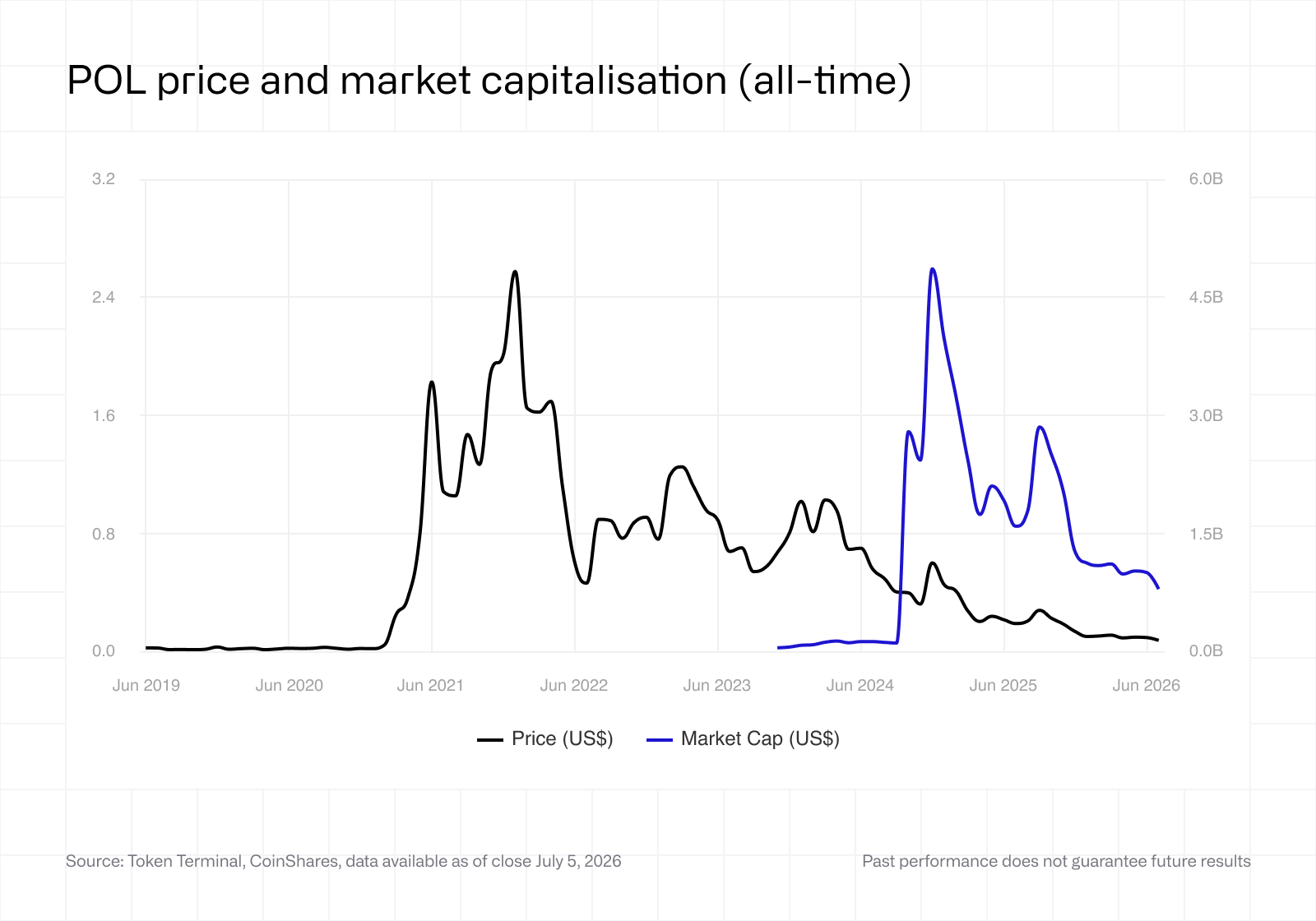
POL price and market capitalisation (all-time)


The ecosystem

Stablecoins and payments

Payments are now the centre of the network. Stablecoin supply on Polygon was $1,25B on 30 June 2026.1 Polygon reports that stablecoin transactions grew 264% year on year through 2025 and that the network processed more than 577 million stablecoin transactions in April 2026 alone.

In January 2026, Polygon Labs announced the Open Money Stack, a set of tools aimed at fintechs, enterprises and payment applications building on stablecoins and tokenised deposits. It is the clearest statement yet of what Polygon sells.

Tokenised real-world assets

Tokenised real-world assets are traditional instruments, such as money market funds or bonds, issued as tokens on a blockchain. Polygon has pursued this alongside payments, on the logic that both need cheap, fast settlement rather than complex programmability.

Decentralised finance

Total value locked, meaning the value of assets deposited in applications on a network, stood at $1,88B on 30 June 2026.1 That is well below Polygon's 2021 peak but has been broadly stable through 2025 and 2026, which is more than several competing networks managed over the same period.
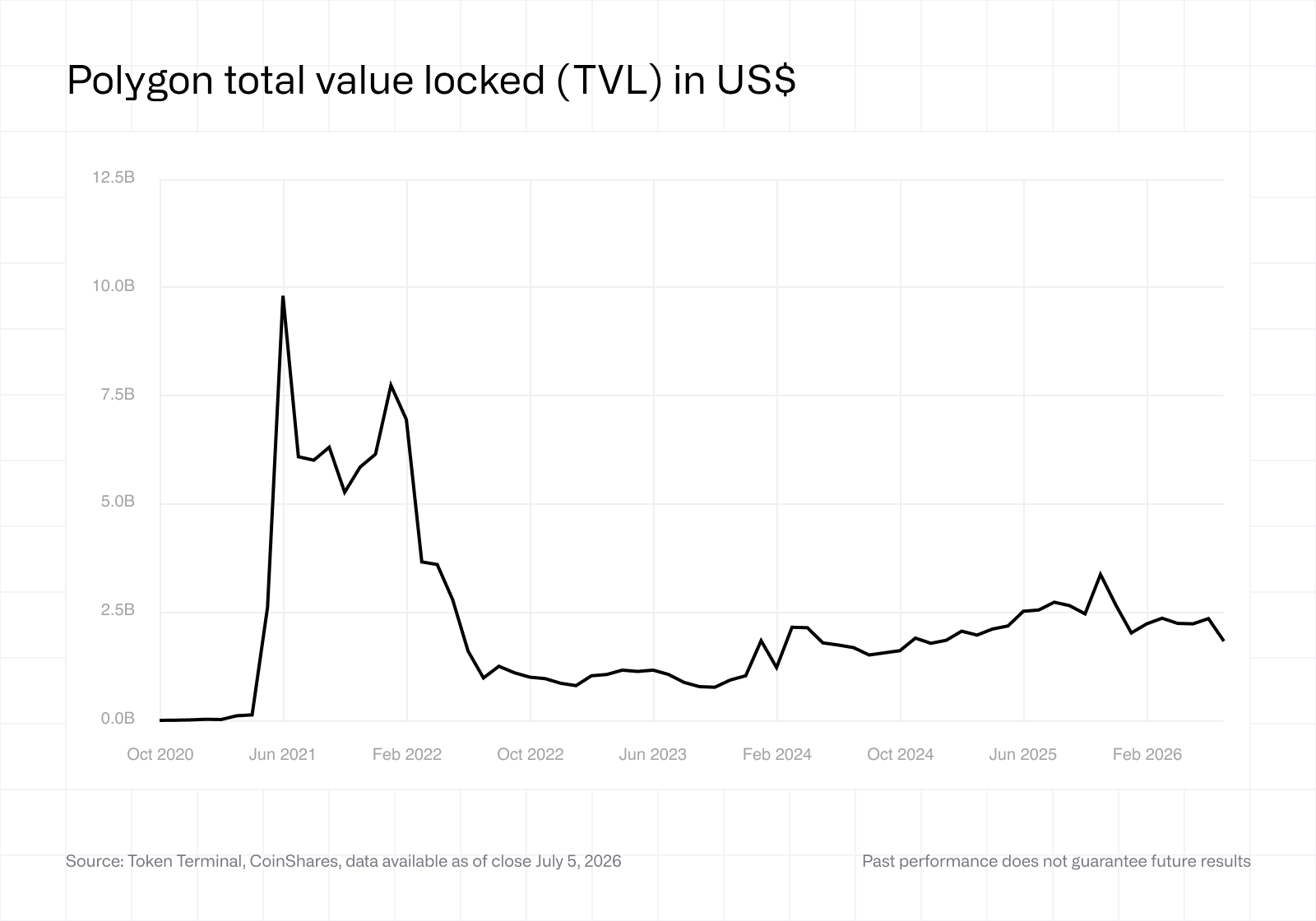
Polygon total value locked (TVL)


What was retired

Polygon zkEVM, a zero-knowledge scaling network launched in 2023 and once presented as the network's future, is being shut down. Its sequencer, the component that orders transactions, was scheduled to stop in July 2026. Polygon PoS is unaffected, as are independent chains built with Polygon's Chain Development Kit.

Few networks retire a flagship product. zkEVM absorbed several years of engineering work, and writing it off is the sharpest available evidence of how far the strategy moved under new leadership.

Strengths and limitations

Strengths

Polygon has a real and growing payments business, evidenced by fee income rather than announcements. It has an unusually clear strategy for a network of its age. Fees are low enough for small payments to work, and the Rio upgrade made confirmation fast enough for point-of-sale use. Enterprise and fintech distribution is a genuine advantage over Layer 2 networks that compete only on DeFi.

Limitations

The token has not captured the network's improvement, and that is the central risk for anyone holding POL rather than using Polygon. Ongoing issuance adds supply regardless of demand.

Polygon mostly depends on Ethereum, so changes to Ethereum's own costs and capacity directly affect the case for using a secondary network at all. Competition in stablecoin payments has intensified, with several networks now targeting the same customers, and some issuers launching chains of their own.

And Polygon has changed direction before. The current strategy is around eighteen months old, which is not long enough to judge it.

Conclusion

Polygon in 2026 is a narrower business than before. It processes payments, and in the first half of 2026 it earned more than three times what it earned in the whole of 2025 doing so. Whether any of that reaches POL holders is a separate question, and the token price suggests the market is doubtful.

Anyone weighing exposure is therefore choosing between two different propositions: the payments business, or the token. They have not moved together since 2024.

Frequently asked questions

Is Polygon the same as MATIC?

Yes. Polygon is the network; MATIC was the original name of its token. The token migrated to POL, which replaced MATIC one-for-one. Older articles and some exchanges still use the MATIC name, but POL is the current ticker.

Is Polygon a Layer 1 or a Layer 2?

Neither one or the other. Often confused as a Layer 2, Polygon PoS is an independent sidechain network: it processes transactions separately and periodically writes summaries back to Ethereum. It has its own validators, so it is more independent than some Layer 2 networks, but its security is anchored to Ethereum.

What is POL used for?

Four things : - paying transaction fees on Polygon- staking, to secure the network and earn rewards- voting on network governance decisions- funding ecosystem development through the treasury.

Why did Polygon shut down zkEVM?

Polygon zkEVM did not attract enough usage to justify continued development. Its sequencer was scheduled to stop in July 2026, and the network refocused on Polygon PoS for payments and on AggLayer for connecting chains. Polygon PoS and chains built with the Chain Development Kit are unaffected.

Is Polygon still used?

Yes, and more heavily than in 2025 by the measure that matters most. Polygon collected $19,83M in network fees in the first half of 2026 against $5,91M for all of 2025, with roughly 601,000 daily active addresses.1 Usage and token price have moved in opposite directions.


Sources

1 Token Terminal, Polygon network and market metrics, figures at 30 June 2026

2 Polygon, "Polygon launches major payments upgrade with Rio", October 2025

Published onJul 26th, 2023

Welcome to CoinShares

Personal Data

0102

When you visit CoinShares website, cookies enhance your experience. They help us to show you more relevant content. Some cookies are necessary for the site to work and will always be active. Blocking some types of cookies may impact your experience of the website and the services which we offer on our website.

We use cookies on our site to optimize our services. Learn more about our EU cookie policy or US cookie policy.

  • Necessary
    Question circle icon
  • Preferences
    Question circle icon
  • Statistical
    Question circle icon
  • Marketing
    Question circle icon
Necessary cookies help make a website usable by enabling basic functions like page navigation and access to secure areas of the website. The website cannot function properly without these cookies.
Preference cookies enable a website to remember information that changes the way the website behaves or looks, like your preferred language or the region that you are in.
Statistic cookies help website owners to understand how visitors interact with websites by collecting and reporting information anonymously.
Marketing cookies are used to track visitors across websites. The intention is to display ads that are relevant and engaging for the individual user and thereby more valuable for publishers and third party advertisers.