



What is Litecoin - LTC guide
 7 min read
- Altcoins
Litecoin: An Ossified Bitcoin fork
Launch date: 13th October 2011
Active addresses: Litecoin averaged 221,605 daily active addresses over the first half of 2026, against 249,363 across 2025 and a peak of 1,354,473 on 20 December 2023.
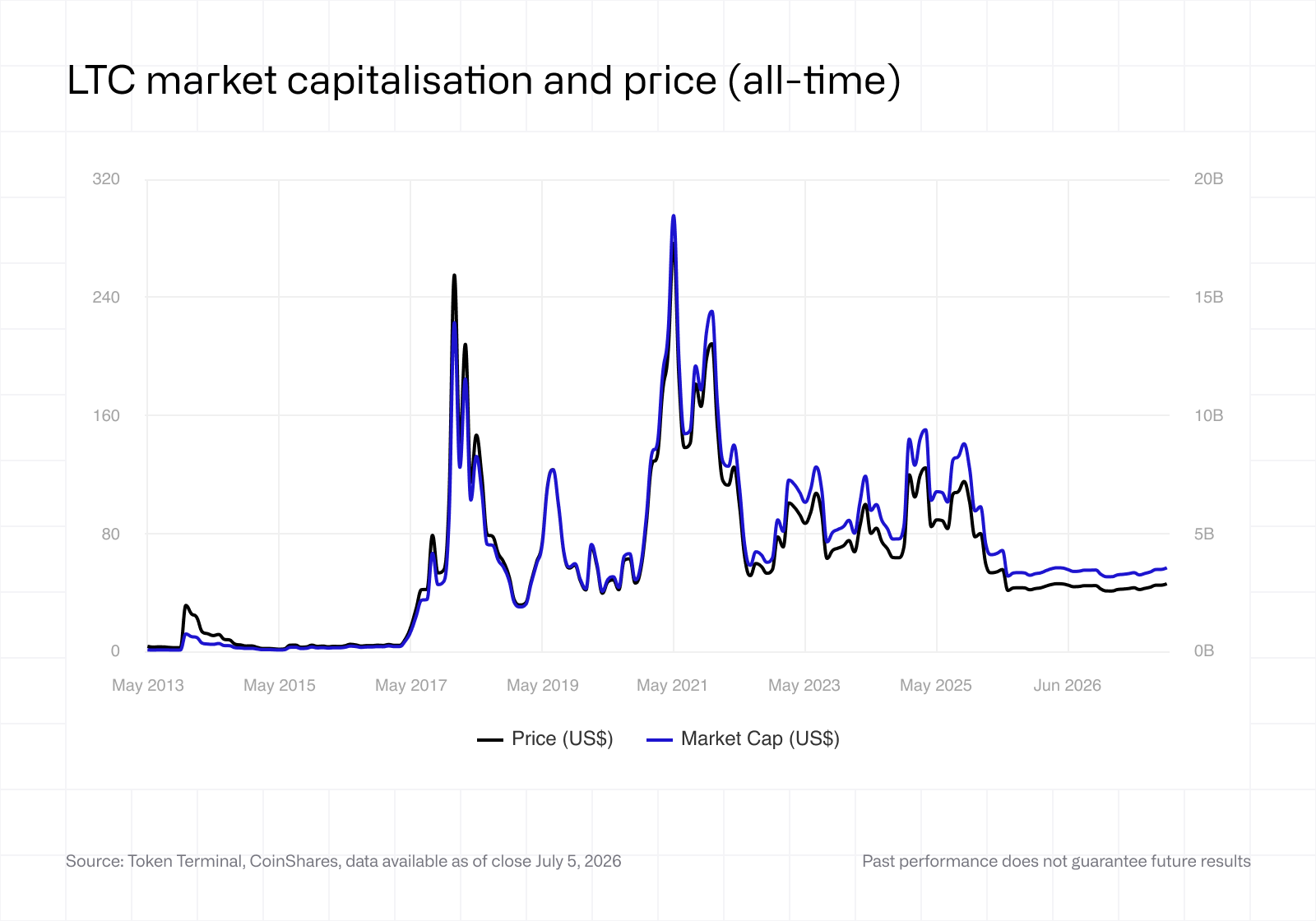
Market capitalisation: $3,24B at 30 June 2026, with LTC at $41,87 and 77,3 million LTC in circulation.
Litecoin at a Glance
Network activity has drifted down rather than up. Average daily active addresses fell from 320,270 in 2024 to 249,363 in 2025 and 221,605 over the first half of 2026.
Fee revenue is flat and very small in absolute terms: $372,371 across 2024, $378,335 across 2025 and $90,640 over the first half of 20261 For a network of Litecoin's age and name recognition, annual fees of under $400,000 are the clearest single indicator of how little economic activity it captures.
A US spot Litecoin ETF, the Canary Litecoin ETF (Nasdaq: LTCC), began trading on 27 October 2025.
Key Figures
Litecoin has had three distinct price cycles across fourteen years, and each peak has been lower than the last relative to the broader market. The network works exactly as designed and has done since 2011. What it has not done is capture a growing share of anything.
Protocol Mechanism
Scrypt, pronounced 'ess crypt', is a security tool initially created for online backup. Its main purpose is to make it expensive and hard for large-scale attacks using custom hardware by needing a lot of memory. It's also used in mining digital currencies, designed to be incompatible with Bitcoin mining ASICs which uses SHA-256. This ensures Bitcoin and currencies using Scrypt, like Litecoin, don't compete over the same mining resources.
In practice that separation has softened. Most Scrypt hashrate now comes from merge-mined Dogecoin, which means Litecoin's security budget is partly underwritten by a second asset it does not control.
History
Key milestones
After launch, the early growth of Litecoin was aided by its increasing exchange availability and liquidity on early exchanges.
Dogecoin forked from Litecoin in December 2013.
Litecoin deployed the SegWit softfork before Bitcoin did in May 2017, which allowed signatures to be recorded and verified in their own section of a block where data could be added at a discount. SegWit did increase the blocksize, but did so in a way that didn't force users to update their software rules.
In May 2022, MWEB (Mimblewimble Extension Blocks) upgrade was activated on the Litecoin network as a soft fork. This upgrade provides users with the option of sending confidential Litecoin transactions, in which the amount being sent is only known between the sender and receiver.
2nd August 2023 saw Litecoin’s third successful halving, reducing block reward from 12.5LTC to 6.25LTC. The fourth halving, to 3,125 LTC, is expected in mid-2027.
In October 2025, the Canary Litecoin ETF (Nasdaq: LTCC) began trading, the first US spot ETF holding Litecoin directly.
In March and April 2026, an attacker exploited a validation flaw in MWEB, producing an inflated peg-out of roughly 85,000 LTC and, on the second attempt, a 13-block chain reorganisation covering about 32 minutes of history. The bug has been patched.
What's next
One development is worth adding. LitVM, an EVM-compatible execution layer built to run alongside Litecoin, has been positioned as a route to smart contracts and DeFi on a chain that has never supported them.
CoinShares View on Litecoin
Litecoin is a true crypto-old-timer with one of the longest running track records of any crypto asset in the market. While most early altcoins suffered from bugs, design failures and lack of community support, Litecoin maintained an unbroken record of continuous operation for its first fourteen years. That record has now been qualified: the MWEB exploit of March and April 2026 produced a 13-block reorganisation, and double-spend attacks against cross-chain swap protocols during the window cost one counterparty an estimated $600,000.4 The bug was patched and the chain recovered, which is the outcome you want. But "never had an incident" is no longer available as a claim, and the guide should not keep making it. Like most other crypto assets, Litecoin needs to strengthen its real-world utility, security and decentralisation to increase its appeal in the long term.
 Strengths
Litecoin’s increased block frequency compared to Bitcoin lends itself better towards payments as transactions clear securely (6 confirmations) in an average of 15 minutes as opposed to an hour for Bitcoin.
Fourteen years of continuous operation, and a supply schedule and codebase that have barely changed. For an asset class where most projects rewrite their fundamentals every cycle, that predictability has some value.
 Weaknesses
The market has decided that Litecoin has worse properties and characteristics than Bitcoin, hence the much lower market cap, security, decentralisation and interest. Therefore, limiting its upper bound potential for adoption.
The network captures almost no economic value. Total transaction fees were $378,335 across the whole of 2025 and $90,640 over the first half of 2026.1 Fees are the price users are willing to pay for blockspace, and on Litecoin that price is close to zero because demand for the blockspace is close to zero.
Activity is trending down, not flat. Average daily active addresses fell in each of the last two periods, from 320,270 in 2024 to 249,363 in 2025 to 221,605 in H1 2026.1
Source
1 Token Terminal, Litecoin network and market metrics, all figures struck at 30 June 2026, accessed 24 August 2026
Published onApr 11th, 2024