



Bitcoin mining stocks vs ETFs
 11 min read
Investors who want exposure to bitcoin mining face a choice between buying individual operators and buying a fund that holds a basket of them. The first offers concentrated exposure to a specific business and requires you to underwrite that business. The second spreads the position across the sector and hands the selection decision to an index. Neither is a substitute for owning bitcoin, and in 2026 mining equities and the coin itself came apart to an unusual degree.
Why invest in bitcoin mining rather than bitcoin directly
Owning bitcoin gives you the asset. Owning a miner gives you a business that produces the asset, and businesses can do things an asset cannot: raise capital, acquire assets, sign contracts, and fail.
Mining directly is the third option and almost nobody chooses it. A competitive operation requires industrial power contracts, purpose-built facilities, continuous hardware replacement and enough scale to absorb a difficulty increase. The capital requirement and operational risk put it outside the reach of most investors, which is why the listed operators exist.
The distinction that matters most in 2026 is that mining equities have stopped tracking bitcoin. Over the twelve months to 1 September, bitcoin fell roughly 31%.¹ Over the same period Riot Platforms gained 29.9%, CleanSpark gained 22.7%, Core Scientific gained 9.3%, and Hut 8 gained 188.1%, while MARA fell 36.1%.² Four of the five largest names beat bitcoin in a market where bitcoin lost nearly a third of its value. Any thesis that treats these shares as geared bitcoin needs revisiting.
Bitcoin mining stocks: owning the operators
How mining companies generate value
A miner converts electricity into bitcoin. It buys power, runs it through application-specific machines that make trillions of guesses per second at the cryptographic puzzle securing the network, and collects the block subsidy of 3.125 BTC plus transaction fees when it wins.³ Revenue is a function of how much of the global computing total the operator controls, and cost is a function of the price it pays for power and the efficiency of its fleet.
Efficiency is measured in joules per terahash, and it is decisive. A megawatt-hour is roughly a month's electricity for an average American home, about 864 kWh.⁴ At the end of August, an operator running fleets below 14 J/TH turned that much power into about $136 of bitcoin. An operator on 25 to 38 J/TH hardware turned the same megawatt-hour into about $51.³
Set those figures against what the power costs. The average US industrial electricity price was 8.85 cents per kWh in July 2026, or $88.50 per megawatt-hour, and large miners negotiate below that.⁴ At that average rate the efficient fleet clears about $48 per megawatt-hour while the old fleet loses about $38. Same electricity, same bitcoin price, opposite sign.
Retention strategy is the other variable. Some operators sell production to fund operations, others hold. MARA held 35,577 BTC at the end of June, Riot held 11,380 BTC of which 5,821 were pledged as collateral, and CleanSpark held 13,931 BTC at the end of July. Core Scientific holds effectively none, carrying $49.7M of cryptocurrency against $1.77B of cash.⁵
Key players and performance metrics
The evaluation criteria worth applying are cost per bitcoin mined, fleet efficiency, the ratio of debt to deployed computing power, and exposure to the next halving. Applied to 2026, they produce an uncomfortable picture.
Riot disclosed an all-in cost of $90.6k to mine one bitcoin in the second quarter of 2026 against a production value of $71.7k, meaning cost ran at 126.4% of output value.⁵ In the second quarter of 2025 the same ratio was 92.4%. MARA reported purchased energy cost per bitcoin of $38.7k, and CleanSpark reported roughly 38% gross margin on mining at about $72k of revenue per coin. Neither of those is on Riot's all-in basis, and the three should not be read as a like-for-like ranking: operators define cost per coin differently, and only Riot publishes a figure that includes fleet depreciation.
Two structural facts sit behind this. Revenue per unit of computing power is down about 25% in dollar terms over twelve months, and total network computing power has itself contracted by somewhere between 7% and 14%, and we can find no comparable sustained decline outside a policy shock.³ The listed cohort shrank faster than the network, giving up 13.4% of its combined output in six months.⁶
The critical development is what the operators did in response. They leased their electrical capacity to artificial intelligence data centres. At Core Scientific, colocation revenue reached $136.7M in the second quarter against $27.5M from mining: 83% of revenue is no longer bitcoin.⁵ At TeraWulf it is 71%. Riot signed a 191 MW twenty-year lease in August with initial contracted revenue of $9.1B.⁵ Hut 8 holds 949 MW of contracted capacity with an expected base-term value of $26.6B, none of it yet energised, and has moved its mining business into a separately listed company in which it holds about 54%.⁵ Hut 8 is no longer a bitcoin miner in any meaningful sense.
Advantages and risks of mining stocks
The case for individual operators is that you can select on the criteria above and express a specific view: this fleet, this power contract, this balance sheet. Equity exposure also brings the possibility of capital returns and sits inside conventional brokerage and retirement accounts.
The case against is concentration. Combined quarterly losses at MARA and CleanSpark reached $851M in the August reporting round.⁵ Several smaller operators have faced sub-$1 listing compliance problems. The sector's aggregate capital spending reached $30.7B in 2026, exceeding the whole of 2025, and it is being funded with debt and equity issuance.⁶ Underwriting one name now means underwriting power markets, data centre construction schedules and counterparty credit alongside mining economics.
Bitcoin mining ETFs: the hands-off approach
Spot bitcoin ETFs vs mining stock ETFs
These are frequently conflated and they are not similar.
A spot bitcoin ETF holds bitcoin. Its value tracks the coin price, less fees. It holds no equities.
A mining ETF holds shares in companies. It holds no bitcoin, directly or through derivatives. Its value tracks the equity performance of its constituents, which as the figures above show can diverge sharply from bitcoin over any given period.
Anyone buying the second while expecting the behaviour of the first will be surprised, and 2026 is the year that surprise became expensive in both directions.
Advantages and limitations of ETFs
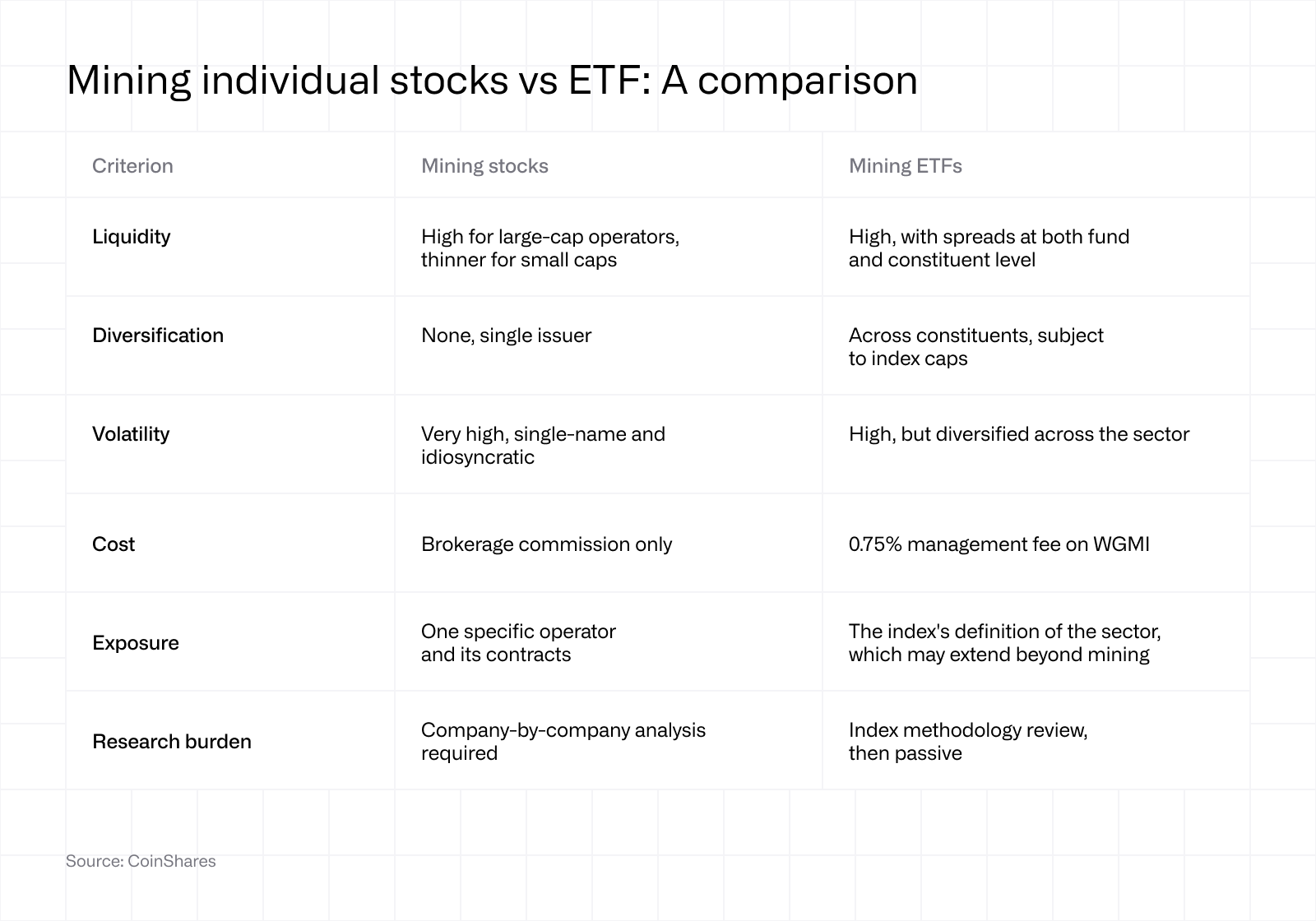
The advantages are diversification across operators, a single trade for sector exposure, intraday liquidity and no requirement to hold the underlying asset or select between companies.
The limitations are real. You pay a management fee. You accept the index's judgement about what belongs in the basket, and in this sector that judgement is currently in flux. You give up the ability to avoid a specific name you dislike. And an index cap does not eliminate concentration: a fund with an 18% single-issuer limit is still a concentrated portfolio by conventional standards.
A live example of index drift is worth knowing about. On 11 August 2026 the fund trading as WGMI changed its investment strategy, and on 18 August it was renamed the CoinShares Bitcoin Mining and Digital Power ETF. Its mandate now extends beyond miners to hyperscale data centres, AI and data centre semiconductors, power generation and high-performance computing.⁷ Its largest holdings include Nebius, CoreWeave and WhiteFiber alongside Cipher, Hut 8 and Riot. Performance published for periods before 11 August reflects the previous strategy. Investors comparing mining funds should check what each one actually holds today rather than what its ticker implies.
Key risks for mining investors
Market volatility and bitcoin price dependency
Mining equities are more volatile than bitcoin, though the multiple is often overstated. A bitcoin mining equities index carried a published one-year volatility of about 86%, against roughly 43% for bitcoin on a trailing-year realised basis, so the honest figure is closer to two times than the three to five times sometimes quoted.⁸ On a single-month comparison in July 2026, an onchain-economy fund ran at 68.9% annualised volatility against bitcoin at 31.8%, the Nasdaq 100 at 23.5% and the S&P 500 at 11.9%.⁸
Dependency on the bitcoin price has also become less direct as AI hosting revenue has grown, which cuts both ways. In the month to 26 August, bitcoin rose 22.5% and the operators that had leaned hardest into AI finished flat or lower, while three of the most financially stressed pure bitcoin operators led the market.⁶
Regulatory uncertainty
Mining faces jurisdiction risk that bitcoin itself does not: outright prohibitions in some countries, power market and grid interconnection rules, and the corporate tax treatment of mined output. The AI pivot introduces a second regulatory surface, since large data centre loads attract utility and planning scrutiny that mining loads did not always face.
Hardware obsolescence and network difficulty
Difficulty adjusts roughly every two weeks to hold block times near ten minutes, so a fleet's share of network output erodes automatically unless the operator keeps adding capacity. Machines do not stop working; they stop being economic. The April 2024 halving cut the subsidy in half and accelerated the separation between efficient and inefficient fleets, and the J/TH revenue gap cited earlier is the measurable result. Capacity being retired for AI conversion is a version of the same pressure: an operator with an ageing fleet and a grid connection can earn more by reassigning that power than by replacing the machines, which is why the listed cohort has been shrinking its mining output rather than refreshing it.⁶ The next halving is expected in April 2028, when the subsidy falls to 1.5625 BTC.³
The CoinShares perspective on mining investment
Our view is that "bitcoin mining equity" is becoming a misleading category label. The listed operators are converging on a different business: owning connected industrial electrical capacity and selling it to whoever pays most for it. Today that is sometimes bitcoin and increasingly artificial intelligence. These contracts run fifteen to twenty years with investment-grade counterparties, and at the three largest operators alone the announced base-term values run into the tens of billions of dollars.⁵ That is a materially different asset than a leveraged bitcoin proxy, with a different volatility profile and a different set of things that can go wrong.
The practical implication is that the choice between stocks and a fund matters less than knowing what you are buying in either case. An investor who wants bitcoin exposure should buy bitcoin exposure. An investor who wants exposure to the infrastructure layer should be clear that they are underwriting power and data centres, and should check the current mandate of any fund they use, because at least one has changed this year.
For investors seeking mining exposure in a fund wrapper, CoinShares offers the CoinShares Bitcoin Mining and Digital Power ETF (WGMI) in the US, which also holds AI infrastructure names, such as Nebius, CoreWeave and WhiteFiber.
FAQ
What is the difference between a bitcoin ETF and a mining stock?
A spot bitcoin ETF holds bitcoin and tracks its price. A mining stock is equity in a company that produces bitcoin, and its price depends on that company's costs, contracts, balance sheet and management decisions as well as the bitcoin price. In the twelve months to September 2026 bitcoin fell about 31% while four of the five largest miners rose, which illustrates how far apart the two can move.
Are bitcoin mining stocks more volatile than bitcoin ETFs?
Yes. A mining equities index showed roughly 86% one-year volatility against about 43% for bitcoin on a trailing-year basis. Individual operators are more volatile still than a diversified mining fund, because single-name risks such as a debt covenant, a failed contract or a listing compliance problem are not diversified away.
Which bitcoin mining stocks are worth watching in 2026?
The five largest listed operators are MARA, Riot Platforms, CleanSpark, Core Scientific and Hut 8, though Hut 8 has moved its mining business into a separate company and Core Scientific now earns 83% of revenue from AI colocation rather than mining. The metrics worth tracking are cost per bitcoin mined, fleet efficiency in joules per terahash, contracted AI capacity that is actually energised rather than merely announced, and debt relative to deployed computing power. This is not investment advice and none of these should be taken as a recommendation.
Does CoinShares offer exposure to bitcoin mining?
Yes. In the US, the CoinShares Bitcoin Mining and Digital Power ETF trades as WGMI on Nasdaq with a 0.75% management fee.
Sources
Barchart, BTC/USD performance report, 2 Sep 2026
Stock Analysis, 52-week share price performance, closing prices 1 Sep 2026
Hashrate Index, hashprice and energy hashprice by fleet efficiency, 31 Aug 2026 against 8 Sep 2025; YCharts, Bitcoin network hash rate, 1 Sep 2026; CoinWarz, block subsidy and halving schedule, 1 Sep 2026
US Energy Information Administration, average residential electricity consumption and average industrial electricity price, 2026
Companies second quarter 2026 results and operational updates: Core Scientific 28 Jul, Hut 8 Corp 4 Aug, CleanSpark 5 and 6 Aug, MARA Holdings 6 Aug, Riot Platforms 10 Aug
TheEnergyMag, 13, 20 and 27 Aug 2026
SEC Form 497K, CoinShares ETF Trust, 18 Aug 2026
MarketVector, MVIS Global Digital Assets Mining Index; VanEck, Bitcoin ChainCheck 20 Jul 2026 and NODE ETF monthly commentary 6 Aug 2026
Published onSept 11th, 2026