



What is Aptos - APT guide
 10 min read
- Altcoins
Aptos was launched on October 18, 2022, by Aptos Labs, a team led by Mo Shaikh and Avery Ching, former Meta engineers involved in the Diem blockchain project. When Diem was discontinued, they repurposed much of the technology, including the Move programming language. The Move programming language is a smart contract language originally developed by Meta for its Diem blockchain and now used by Aptos (and Sui). Shaikh stepped down as chief executive in December 2024 and Ching, previously chief technology officer, took over; Shaikh stayed on as a strategic adviser.
Aptos Labs raised $200 million in a seed round in March 2022 led by a16z Crypto with contributions from Multicoin Capital and others.
Months later, on July 26, 2022, Aptos Labs completed a $150 million Series A round co‑led by FTX Ventures and Jump Crypto, bringing total capital raised to approximately $350 million.
Key technical features
Aptos is a Layer 1 blockchain designed to make Web3 feel like Web2. By reducing delays, minimizing failed transactions and improving better user experience. Aptos aims to close the performance and reliability gap that separates decentralized apps from the smoothness of traditional internet platforms.
Through innovations like parallel execution, a safe-by-design programming language (Move), and a pipelined Proof-of-Stake consensus, Aptos offers developers a high-performance foundation for building the next generation of Web3 applications.
Aptos combines a parallel execution engine, the Move programming language, and a pipelined Byzantine Fault Tolerant (BFT) consensus protocol secured by Proof-of-Stake. This design accelerates transaction finality, enhances resilience under varying network loads, and lays the groundwork for advanced real-time applications.
Network performance
Aptos has demonstrated performance above 160,000 transactions per second (TPS) in controlled environments. In real-world, geo-distributed tests, it delivers around 20,000 TPS with sub-second latency.
Latency is kept low through a technique called Zaptos, which overlaps transaction execution, validation and storage with consensus operations. This reduces end-to-end delay between submitting a transaction and seeing confirmation.
Validators are globally distributed and designed to handle high throughput. However, fault injection studies show that Aptos is sensitive to local validator failures. .
If a few validators in one area fail or go offline, the network doesn’t bounce back quickly, it takes time to recover, which could slow down transactions or reduce network reliability in the short term.
It is worth highlighting the realised demand. Aptos collected $1,40M in total network fees across 2025 and $643,637 over the first half of 2026.1 Capacity above 160,000 TPS is not the constraint on this network.
Token utility: what is APT for?
The Aptos token (APT) launched with a total supply of 1 billion, split between the community (51%), core contributors (19%), foundation (16.5%) and investors (13.5%).
While this might initially appear foundation-heavy, 82% of tokens are currently staked, most of which are locked and vest gradually over 4 to 10 years, limiting sudden sell pressure.
The APT token powers the Aptos blockchain in multiple ways, from transaction processing to network security. While its primary role centers around operations on the mainnet, APT also plays a role in governance and ecosystem alignment. Aptos APT token is used for:
Transaction fees: APT is required to pay for sending transactions, interacting with smart contracts and moving assets across accounts.
Staking and validator security: APT can be staked directly or delegated to validators. In return, participants earn a share of network rewards, reinforcing honest behavior and securing the network.
Governance participation: while still limited, APT holders are beginning to shape protocol decisions through off-chain coordination, with formal voting mechanisms expected in future updates.
Incentive programs: APT is used to support ecosystem growth, aligning developers, users and projects through grants and incentives.
Market performance
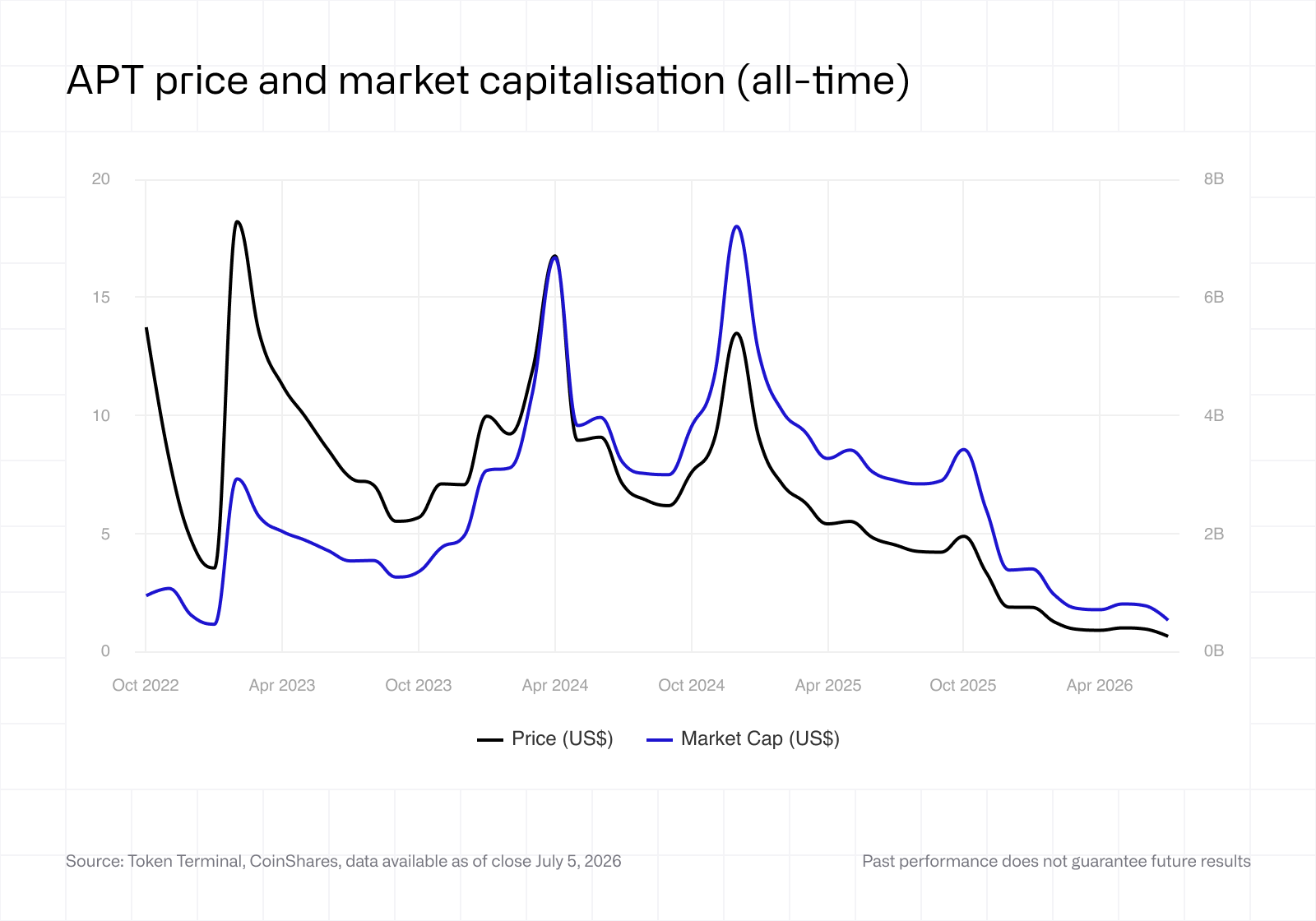
APT traded at $0,57 on 30 June 2026, giving a circulating market capitalisation of $474,5M across 833 million tokens. That divergence between the price peak and the market-cap peak is theis the mechanical consequence of the token unlock schedule.
Ecosystem and Use Cases
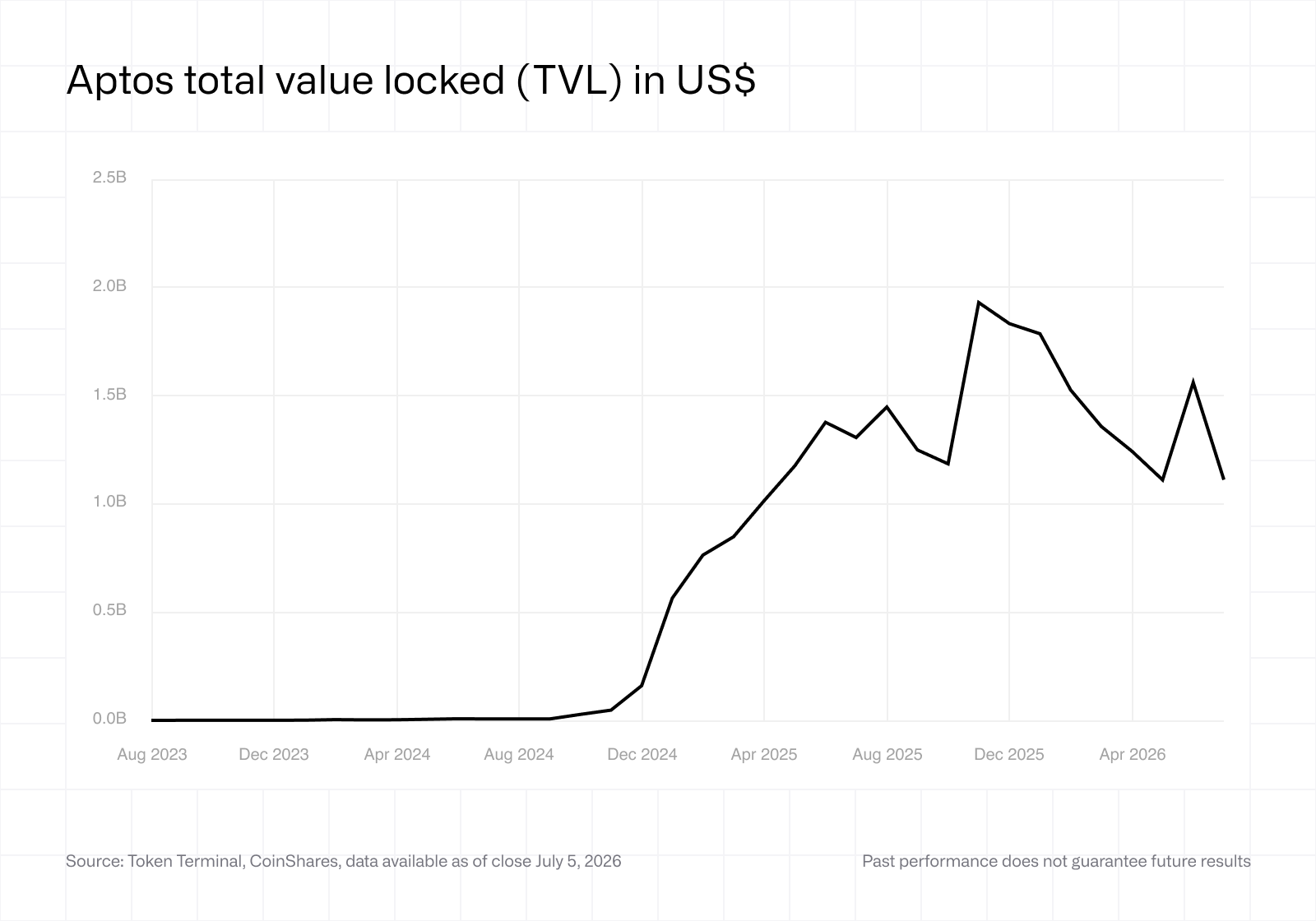
Aptos has found a use case, and it is not the one the chain was marketed early on. Ecosystem total value locked stood at $1,08B on 30 June 2026, down from a peak of $2,18B in October 2025, but the composition is what matters: stablecoin supply on Aptos was $975,9M, and the five largest applications on the chain by value are Tether ($840,4M), Circle ($135,5M), Securitize ($34,4M), Franklin Templeton ($19,6M) and Apollo ($18,3M). Four of those five are issuers of stablecoins or tokenised traditional assets. Aptos is functioning as settlement infrastructure for real world assets (RWA) rather than as a venue for crypto-native DeFi.
 The fee data says the same thing. Over the first half of 2026, Tether generated $11,32M and Circle $3,61M of the economic activity attributed to applications on Aptos, while the largest crypto-native applications were Merkle Trade at $217K and Aave at $180K. Two orders of magnitude separate the issuers from the protocols built on top of them.
Franklin Templeton and Apollo choosing to issue on Aptos is a meaningful institutional signal, and one that most Layer 1s of comparable size cannot claim. The open question is whether issuance attracts the trading, lending and collateral activity that would make the chain economically self-sustaining, or whether it stays a low-cost place to park tokenised assets. On the evidence to June 2026, it has not happened yet.
Cross-Chain: Compatible but Not EVM
Aptos is not natively EVM-compatible—it uses the Move language instead—so Solidity-based dApps (most notably Ethereum’s ones) must be rewritten. However, interoperability is supported via secure bridges such as LayerZero, Wormhole, and Celer, which enable token transfers between Ethereum, Solana, and Aptos.
The Aptos Foundation continues to fuel adoption with grants and ecosystem programs aimed at onboarding developers from rival chains.
Pros and Cons
Aptos presents a mix of promising technical strengths and early-stage challenges, offering both upside potential and key risks for informed investors to weigh.
Pros
Aptos brings technical and architectural innovations that offer real advantages for a next-gen Layer 1 performance such as:
Parallel transaction execution: Enables high-throughput dApps with minimal congestion, ideal for DeFi and gaming scalability.
Move smart contract language: Offers built-in protections like resource-based security, significantly lowering smart contract exploit risk.
Strong VC and foundation backing: Backed by a16z, Binance Labs and others, offering sustained capital for long-term ecosystem development.
Low-latency consensus mechanism: Ensures near-instant transaction finality, improving UX and suitability for high-frequency apps.
Bridging to major chains: Interoperability via LayerZero, Wormhole, and Celer gives users exposure to Ethereum and Solana assets.
Institutional issuance: Franklin Templeton, Apollo and Securitize all issue tokenised assets on Aptos, alongside Tether and Circle. For a chain of this size, that is the strongest evidence available that its security model is being taken seriously by regulated issuers.
Cons
However, Aptos also faces growing pains typical of early-stage blockchains, including:.
Ongoing token unlocks: A large portion of APT remains locked and gradual releases which could introduce persistent sell pressure. The effect is visible in the record: APT's market capitalisation peaked in December 2024 at a price roughly a third of its January 2023 high, because supply grew faster than price fell.
Validator set is relatively concentrated: Early network control is skewed toward insiders, raising decentralization and censorship-resistance concerns.
Ecosystem is still in its infancy: native protocol activity remains very small. Total network fees were $1,40M across 2025 and $643,637 in the first half of 2026, and the largest native application generated $217,656 over that half.
Not EVM-compatible: Developers must learn Move and rewrite apps, creating a higher onboarding friction despite long-term safety benefits.
Conclusion
Four years in, the gap between what Aptos can do and what it is asked to do remains significant. What has changed is where the demand is coming from: Aptos is now carrying close to a billion dollars of stablecoins and tokenised assets from issuers including Tether, Circle, Franklin Templeton and Apollo, which is a genuine and unusual position for a chain of its market value. Whether that becomes a business depends on whether activity builds on top of those assets. So far it has not.
Published onSept 1st, 2025
