



What is Bitcoin mining?
 20 min read
- Finance
Introduction to crypto
Crypto in the real world
Crypto investment options
Strategies and practical tips
Bitcoin mining is the process by which new transactions are verified and added to Bitcoin's public ledger — the blockchain. Miners use specialized computers to solve complex cryptographic puzzles, competing to add the next block roughly every ten minutes. The first to solve the puzzle earns newly created bitcoins and transaction fees. This process simultaneously validates transactions, issues new supply, and secures the network against fraud — making miners the backbone of Bitcoin's decentralised design.
Key takeaways
Bitcoin mining validates transactions and adds new blocks to the blockchain approximately every 10 minutes.
Miners compete by solving SHA-256 cryptographic puzzles; the winner earns the block reward plus transaction fees.
The block reward halves roughly every four years; it currently stands at 3.125 BTC per block (approximately $229,000 as of June 2026).
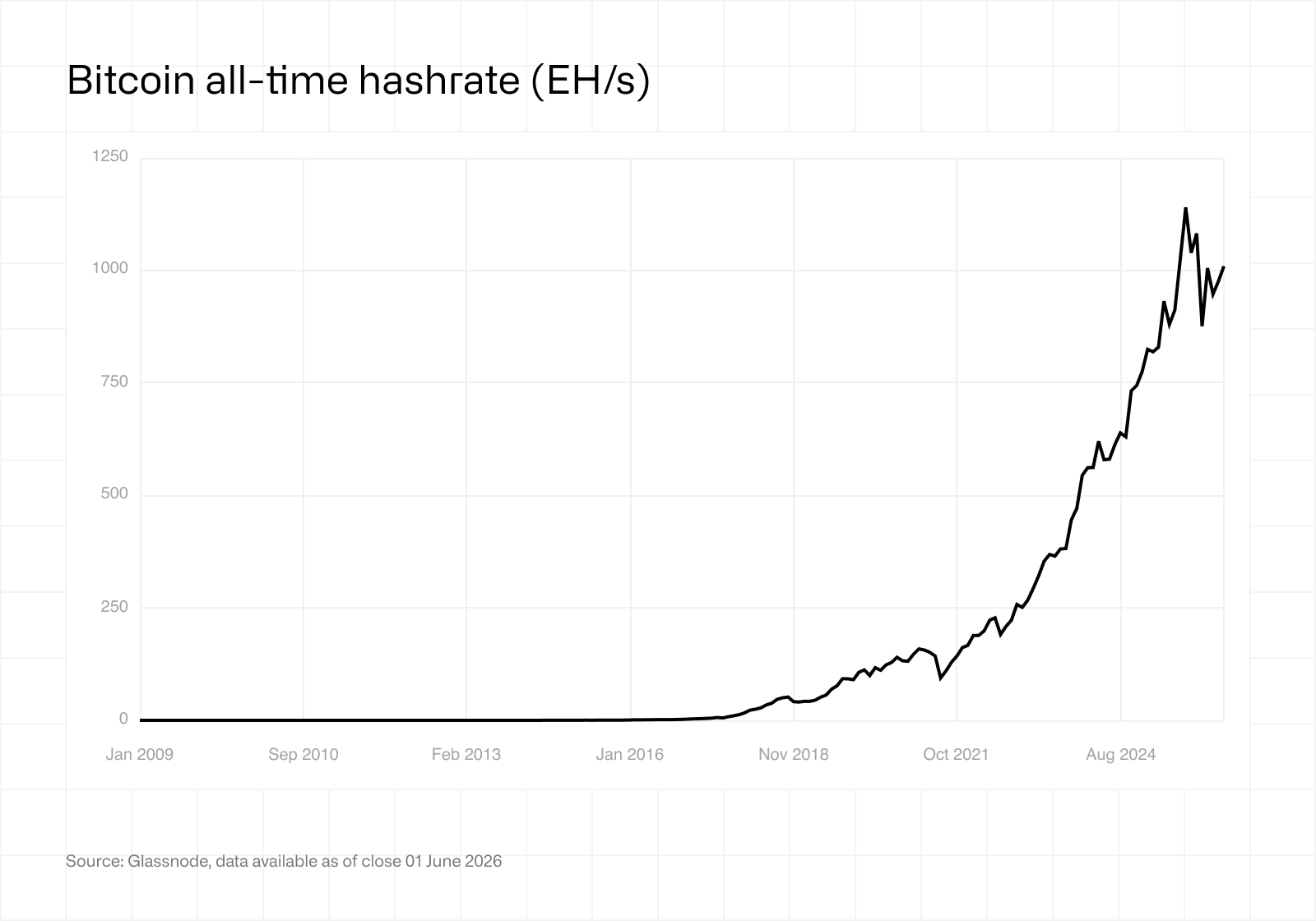
Bitcoin's hashrate reached approximately 1,008 EH/s in June 2026 (Glassnode), making the network increasingly resistant to attack.
The US leads global mining with ~38% of hashrate (Cambridge Centre for Alternative Finance, Bitcoin Mining Map), supported by cheap energy, a transparent regulatory framework, and publicly listed mining companies.
Bitcoin mining explained
Bitcoin mining is best understood as a global lottery: miners spend electricity on computational tickets, and roughly every ten minutes, one winner earns the right to add the next block to the blockchain and collect the associated reward.
Mining serves three interconnected functions.
Transaction validation: every transaction in a candidate block is checked for authenticity, verified against the existing ledger, and confirmed to carry a valid digital signature.
Block creation: validated transactions are organised into a new block that permanently extends the chain.
Issuance of new bitcoin: newly minted coins enter circulation via the block reward, recorded in a special coinbase transaction, alongside transaction fees paid by users.
This process is also the source of Bitcoin's financial security. Every block represents real-world expenditure: electricity, hardware, time. Because that cost cannot be faked, any attempt to rewrite the ledger would require repeating all of it faster than the honest network can move forward. Mining, in other words, converts energy into protection for every bitcoin in circulation. The more value the network carries, the stronger the economic incentive to mine honestly, and the more expensive any attack becomes.
Miners earn revenue in two ways:
Block rewards: newly issued bitcoins awarded for validating each block. The reward started at 50 BTC and halves approximately every four years. It currently stands at 3.125 BTC (approximately $229,000 as of June 2026).
Transaction fees: small fees paid by users to have their transactions processed. These become increasingly significant as block rewards decline over time.
How Bitcoin mining works
The proof-of-work mechanism
Mining is competitive by design. Thousands of machines worldwide race to solve the same puzzle simultaneously, and roughly every ten minutes one finds the answer and earns the right to add the next block to the chain.
The puzzle works like a combination lock with astronomical odds. Bitcoin's protocol requires that a block's identifying fingerprint starts with a very specific pattern. Miners compute these fingerprints by cycling through billions of candidate values per second until one produces the required result. There is no way to calculate the answer in advance — the only path is trial and error, repeated at industrial scale. This is what proof-of-work means in practice: the winning miner has demonstrably spent real resources. No shortcut exists and the work cannot be faked.
For investors, this matters: every bitcoin on the ledger is backed by a verifiable record of that expenditure, making historical transactions extremely costly to alter.
Two concepts worth distinguishing: proof-of-work is the computation miners perform to produce a candidate block; consensus is the separate step by which thousands of independent nodes — computers running Bitcoin software — verify the winning block before accepting it. PoW creates the candidate; consensus accepts or rejects it, without any central authority.
How difficulty adjusts to keep the 10-minute pace
Bitcoin is designed to produce one new block every ten minutes, regardless of how many miners are active. To hold that pace, the protocol automatically recalibrates the puzzle’s difficulty every two weeks. If blocks have been arriving faster than the target, the puzzle gets harder; if slower, it gets easier. This self-correcting mechanism means the block schedule stays predictable even as global mining power fluctuates dramatically.
Before a winning block is broadcast to the network, every transaction inside it is independently verified by nodes. By convention, a payment is considered final after six subsequent blocks have been added on top of it — roughly one hour — making it economically impractical to reverse.
Transactions waiting for inclusion sit in the mempool, a shared queue visible to all miners. When network activity is high and block space is limited, miners prioritise transactions offering higher fees, creating a natural bidding market for confirmation speed.
How mining secures the Bitcoin network
Preventing double spending and the 51% attack
Mining is Bitcoin's primary defence against double spending — the attempt to use the same coins in more than one transaction. Each block is linked cryptographically to the one before it via the Merkle root. Altering even a single historical transaction would change that block's hash, invalidating every subsequent block and requiring an attacker to redo all the proof-of-work from that point forward.
To successfully rewrite history, an attacker would need to control more than half of global hashrate — a so-called 51% attack. At today's hashrate of approximately 1,008 EH/s, sustaining such an attack for even one hour would require purpose-built ASIC hardware costing hundreds of millions of dollars to acquire, plus ongoing electricity costs. The economics are self-defeating: any gain from double-spending would be dwarfed by the cost of the attack itself.
The role of hashrate in network security
Hashrate is the collective computational output of the entire mining network. The higher the hashrate, the greater the cost and difficulty of attacking the blockchain. Bitcoin's hashrate has grown continuously since 2009, reaching approximately 1,008 EH/s as of June 2026 — a figure representing the combined effort of miners operating across every continent.As new blocks are added approximately every ten minutes, past transactions become progressively more irreversible. Each additional block adds another layer of computational work any attacker would need to redo, making deep reorgs increasingly impractical over time.
Fast fact
A solo miner running a single Antminer S21 XP (270 TH/s) continuously for a year has roughly a 1 in 70 chance of finding a block on their own, making their annual odds of earning a block reward approximately 4 million times better than winning the Powerball jackpot with a single ticket. Even a Bitaxe Gamma 602 (1.2 TH/s), the open-source hobbyist device that draws less power than a desk lamp, runs at roughly 1 in 15,800 odds per year — still around 18,500 times better than Powerball. Even so, most miners join pools to convert that slim probability into a steady, predictable income stream.
Block rewards, halvings, and Bitcoin's monetary policy
The block subsidy halves every 210,000 blocks, roughly every four years, in an event known as the halving. On 20 April 2024, the reward dropped from 6.25 BTC to 3.125 BTC. These scheduled reductions ensure Bitcoin's total supply will never exceed 21 million coins.
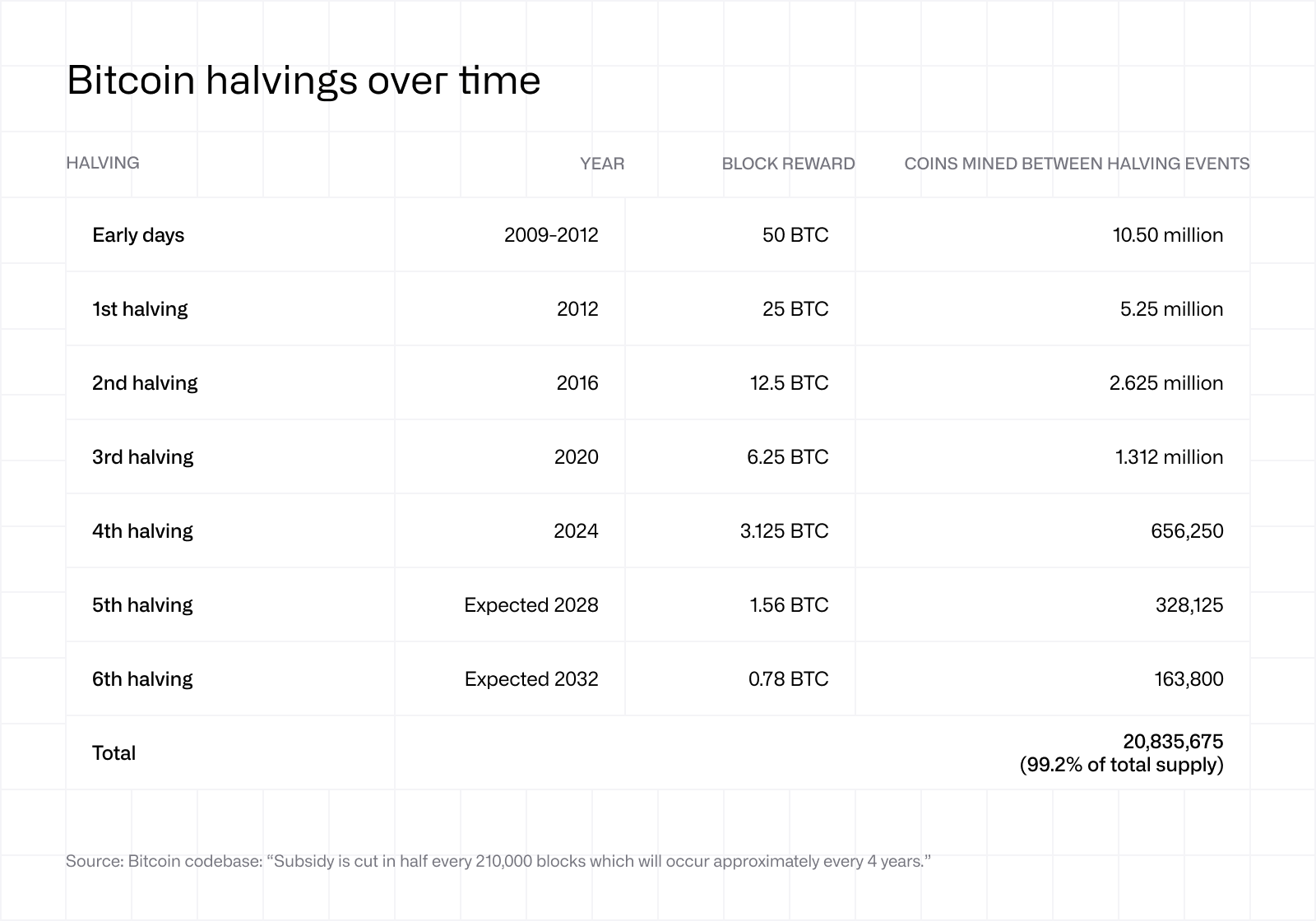 Each halving reduces miner revenue from the subsidy component, pressuring less efficient operators to exit. Future halvings will likely accelerate consolidation into larger, more energy-efficient operations.
The long-term role of transaction fees
Once the final block subsidy drops to zero — expected around 2140 — miners will be compensated solely through transaction fees. This long-term transition matters for the network's security model: if fees are insufficient to incentivise miners, the hashrate could decline, weakening Bitcoin's defences.
Fee revenue has grown as the network matures and on-chain demand increases. For CoinShares, the sustainability of the fee market is a key variable in assessing Bitcoin's durability as a reserve asset over multi-decade horizons. Institutional investors tracking Bitcoin's macro case increasingly factor this trajectory into long-term security analysis.
The economics of Bitcoin mining
Profitability, costs, and hardware
Mining profitability depends on the relationship between revenue (block rewards and fees) and three categories of operating cost:
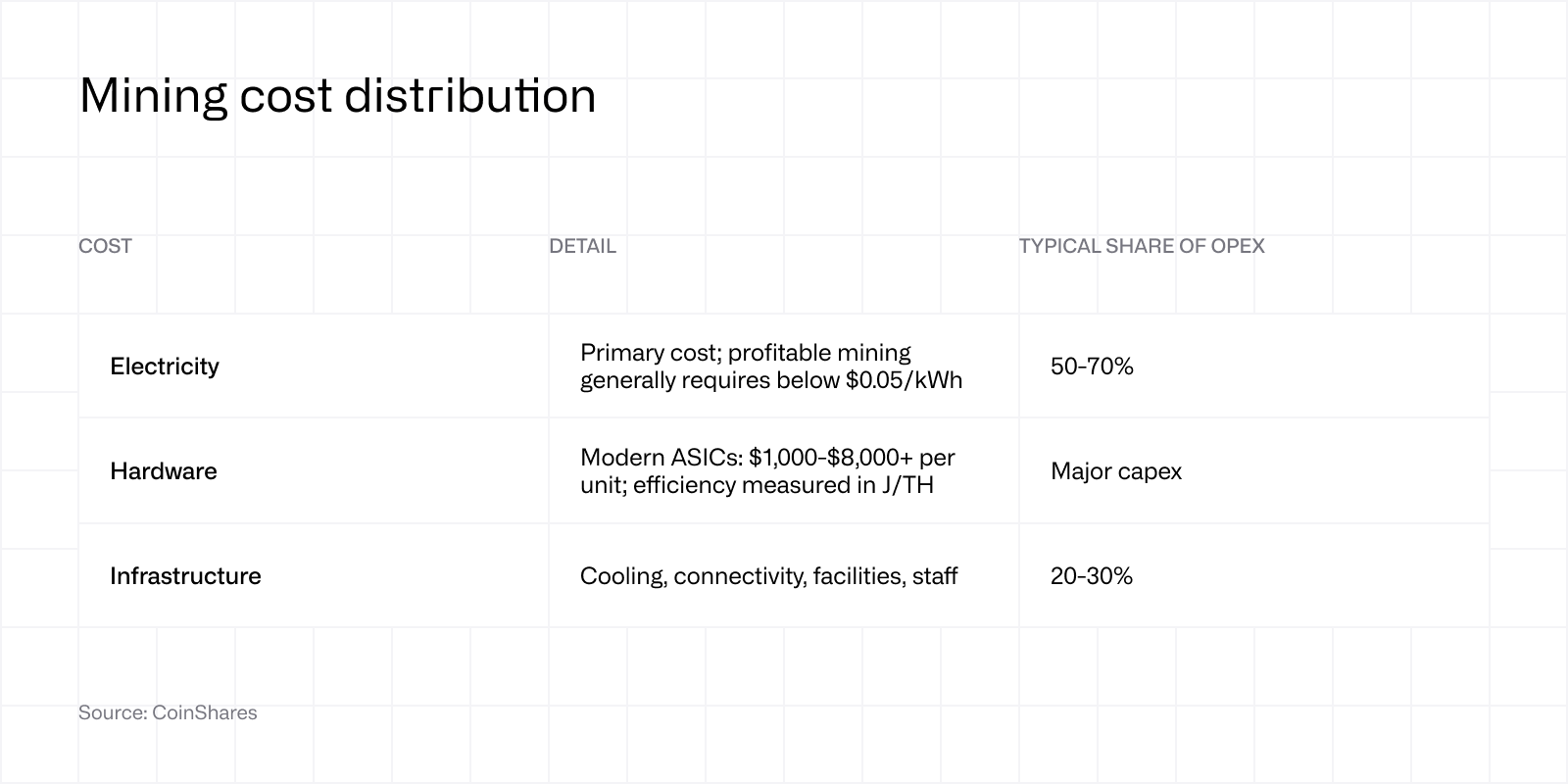 Modern ASIC machines are purpose-built for SHA-256 hashing. Their efficiency, measured in joules per terahash (J/TH), is the key metric for comparing hardware — lower J/TH means cheaper electricity cost per unit of hashrate. Operators with older, less efficient ASICs are typically the first to become unprofitable when the bitcoin price falls or difficulty rises.
Most miners join mining pools, where participants combine hashrate and share rewards proportionally. Pools provide more predictable income than solo mining, where the odds of finding a block independently are astronomically low.
Investing in Bitcoin mining: stocks and ETFs
For investors seeking exposure to Bitcoin mining without running hardware directly, listed mining equities provide regulated market access. US-listed companies including Riot Platforms, Marathon Digital Holdings, CleanSpark, Cipher Mining, and TeraWulf collectively account for a significant share of global hashrate and give investors regulated equity-market access to Bitcoin's infrastructure.
For diversified exposure across the sector, the CoinShares Valkyrie Bitcoin Miners ETF (WGMI) offers a single-ticker way to access US mining stocks within a regulated ETF structure.
The evolution of the mining industry
From CPU to industrial-scale ASIC mining
The hardware used for mining has undergone a complete transformation since Bitcoin launched in 2009.
Today, mining is dominated by industrial-scale ASIC deployments — large data centres located in areas with cheap electricity, stable grid infrastructure, and favourable regulation. Leading ASIC manufacturers include Bitmain (Antminer series) and MicroBT (Whatsminer series). Unit prices range from approximately $1,000 to over $8,000, with enterprise operators typically negotiating direct contracts for large-volume orders.
Mining pools and global hashrate distribution
Solo mining is no longer economically viable for most participants. The vast majority of hashrate is directed through mining pools. Among identifiable pool participants, AntPool leads with approximately 19% of blocks, followed by F2Pool (~12%) and ViaBTC (~9%) as of 1 June 2026 (source: blockchain.com). Approximately 55% of blocks are attributed to unknown or unlabelled sources. Contrary to the most beliefs, pools do not mean centralization as miners are free to move from a pool to another at any moment.
Bitcoin mining environmental impact
Bitcoin's proof-of-work mechanism requires substantial energy — approximately 170-180 TWh/year according to the Cambridge Bitcoin Electricity Consumption Index (CBECI) as of early 2026, broadly comparable to the annual electricity consumption of countries such as Thailand or Vietnam. This is the most common criticism of Bitcoin mining and the subject of ongoing debate.
The energy mix matters as much as total consumption. Fossil fuels still power a portion of global hashrate, but renewable integration is expanding. Hydroelectric power has proven the most reliable baseload source: consistent output 24 hours a day, without the intermittency of solar and wind. Mining operations in regions with surplus renewable capacity effectively monetise energy that would otherwise be wasted or curtailed.
For context, Ethereum's 2022 transition to proof-of-stake reduced its energy consumption by over 99%. Bitcoin's mining community argues that PoW's energy expenditure is precisely what creates its security properties: unlike PoS, which relies on cryptoeconomic incentives alone, PoW anchors security in physical resource expenditure that cannot be easily replicated.
At the margin, innovation is also accelerating. Flared gas capture — using otherwise-wasted natural gas from oil extraction to power mining — is being piloted in Texas and in Argentina by a joint venture between YPF Luz and Genesis Digital Assets. These projects reduce methane emissions while generating productive economic output from what would otherwise be pollution.
Where is Bitcoin mining legal?
Bitcoin mining in 2026 is shaped as much by geography and regulation as by technology. A summary of the global legal landscape:
Notable countries supporting mining
United States. The US is the world's largest mining hub, with Texas leading through its deregulated power grid, abundant renewables, and openness to flared-gas capture. Publicly listed companies — Riot Platforms, Marathon Digital Holdings, CleanSpark, Cipher Mining, and TeraWulf — secure a major share of global hashrate and give investors regulated equity-market access to Bitcoin's infrastructure.
Canada. Vast hydropower resources in Quebec, Manitoba, and British Columbia, combined with a cool climate and transparent regulatory framework, make Canada a stable jurisdiction. Quebec has capped electricity allocation to miners, limiting large-scale expansion in that province.
Paraguay. Paraguay is emerging as a Latin American hub thanks to surplus renewable energy from the Itaipu Dam. The national utility ANDE requires special contracts for mining operations, but the country's abundant low-carbon power remains a significant draw.
Kazakhstan. Kazakhstan rose to prominence after China's 2021 ban. Grid instability, new electricity taxes, and stricter licensing have eroded its position. As of 2025, it holds approximately 13% of global hashrate — still substantial, but well below its peak (source: ainvest.com, June 2025 — recommend cross-referencing with Cambridge Bitcoin Mining Map for a stronger primary source).
UAE. By 2026, the UAE has established itself as a strategic mining location. Citadel Mining, funded by the Abu Dhabi royal family's International Holding Company and built on Al Reem Island, has mined an estimated 9,300 BTC, of which approximately 6,333 BTC are held in government-controlled wallets.
Ethiopia. Ethiopian Electric Power tapped excess hydropower capacity to generate $55 million in revenue over 10 months by selling surplus energy to Bitcoin miners. EEP has since halted new crypto mining power permits due to grid strain.
Notable countries with restrictions or bans
China. Once home to more than 60% of global mining power, China implemented a comprehensive ban in 2021, triggering a migration to North America, Central Asia, and Russia. Small-scale unauthorised mining still exists, but China's dominance is firmly in the past.
Algeria and Morocco. Both countries prohibit mining outright. Strict controls over financial activity and energy policy prevent any legal operations.
Iran. Iran has cycled between promoting mining and imposing seasonal bans during periods of grid stress. The unpredictable policy environment and current geopolitical environment limit large-scale institutional investment.
Malaysia. Mining is permitted but treated as taxable income. Some facilities have faced scrutiny for unlicensed electricity use, but Malaysia remains more open than ban-implementing jurisdictions.
How regulation shapes mining
Energy availability is essential, but consistent regulation is equally critical. Countries that have attracted institutional-scale investment share two properties: transparent rules and secure property rights. When either is absent — as in Kazakhstan's shifting policies, Iran's recurring restrictions, or China's outright prohibition — miners redirect machines to more stable jurisdictions. The global trend is unmistakable: Bitcoin mining flourishes where low-cost energy meets regulatory clarity.
The future of Bitcoin mining
Halvings and consolidation. Each halving reduces the subsidy component of miner revenue, forcing innovation and consolidation. The April 2024 halving has already pressured less efficient operators. Future halvings will continue this trend, likely accelerating the shift toward large-scale operations with optimised energy costs.
Sustainability. Mining is moving steadily toward cleaner power sources. The Cambridge Centre for Alternative Finance estimated in Q1 2025 that 52.4% of Bitcoin mining energy came from sustainable sources — 42.6% from renewables (hydro, wind, solar) and 9.8% from nuclear (CCAF, Cambridge Blockchain Network Sustainability Index). Hydroelectric remains the most reliable baseload option given its consistent 24/7 output. Wind and solar adoption is growing, though intermittency often requires backup capacity for round-the-clock mining uptime.
Institutional integration. Publicly listed companies, energy firms, and investment funds are integrating mining into broader business models. Some operators are pursuing hybrid strategies, combining Bitcoin production with AI and high-performance computing data centre infrastructure.
Transaction fee market. As block subsidies decline toward zero by approximately 2140, the fee market becomes the sole mechanism sustaining miner revenue. The health and growth of on-chain transaction demand is a long-term security variable institutional investors should monitor alongside price and hashrate.
Conclusion
Bitcoin mining is both the foundation of Bitcoin's security and one of its most debated features. Mining validates transactions, secures the blockchain, and governs the issuance of new coins — all without any central authority. For US investors, understanding mining is essential to grasping what gives bitcoin its durability as a digital asset.
As halvings continue and sustainability becomes central to the economic model, mining will increasingly consolidate into clean, industrial-scale, renewable-powered operations. The dynamics of mining — costs, rewards, regulation, energy sourcing — are increasingly relevant to portfolio construction and long-term crypto strategy. Investors who understand the engine behind Bitcoin will be better positioned to assess its value, risk profile, and role in a diversified portfolio.
Frequently asked questions
How are new bitcoins created?
New bitcoins are created through the block reward — a fixed amount of BTC issued to the miner who successfully adds each new block. The reward started at 50 BTC and halves every ~four years, currently standing at 3.125 BTC. This process will continue until approximately 2140, after which no new bitcoins will be created.
What determines Bitcoin mining difficulty?
Difficulty is automatically adjusted every 2,016 blocks (approximately two weeks) based on how quickly recent blocks were found. If blocks arrived faster than the 10-minute target, difficulty increases; if slower, it decreases. This keeps Bitcoin's block production rate steady regardless of how many miners participate.
Is Bitcoin mining profitable?
Profitability depends on three variables: the bitcoin price, electricity costs, and hardware efficiency. Mining is generally profitable for operators with efficient modern ASICs and access to electricity below approximately $0.05/kWh. Rising difficulty and halving events compress margins, typically pushing less efficient operations out first.
How long does it take to mine 1 Bitcoin?
It depends on hashrate and pool participation. At current network difficulty, even industrial-scale operations rarely find a block independently. Pool miners receive proportional shares of rewards continuously — the rate at which they accumulate BTC depends directly on their share of the pool's total hashrate.
Can a normal person still mine Bitcoin?
Solo mining with consumer hardware is no longer economically viable. Participation is typically through mining pools. Entry-level ASIC machines are available, but home electricity prices in most developed markets are too high to generate returns. Some hobbyists use low-power devices like the Bitaxe for educational purposes, but the odds of finding a block independently are astronomically low.
What is a mining pool and how does it work?
A mining pool is a collective where miners combine their hashrate and share block rewards proportionally to contribution. Pools provide more predictable, regular income compared to solo mining. The most common payout models are PPLNS (pay per last N shares) and FPPS (full pay per share including estimated fees).
Is Bitcoin mining legal?
Legality varies by jurisdiction. The US, Canada, Paraguay, UAE, and most of Europe permit mining. China has banned it outright since 2021. Algeria and Morocco prohibit it. Iran alternates between permitting and restricting it. Malaysia allows mining but treats revenue as taxable income. Investors considering exposure to mining equities or infrastructure should monitor regulatory developments in key jurisdictions.
Is Bitcoin mining traceable?
Mining rewards are recorded on the public blockchain. Wallet addresses are visible to anyone, but the identities behind them are not directly revealed by the protocol. Large mining operations — particularly listed companies — are subject to standard KYC and AML requirements in their home jurisdictions.
What happens after all 21 million BTC are mined?
No new bitcoins will be created after the final block subsidy reaches zero, expected around 2140. At that point, miners will be compensated entirely through transaction fees. The long-term health of Bitcoin's security model depends on sufficient on-chain transaction demand to sustain miner revenue — a key variable for analysts assessing Bitcoin's durability as a store of value over multi-decade horizons.
Published onJun 10th, 2026

Introduction to crypto
Crypto in the real world
Crypto investment options
Strategies and practical tips