
This website uses cookies
We use cookies to personalise content and ads, to provide social media features and to analyse our traffic. We also share information about your use of our site with our social media, advertising and analytics partners who may combine it with other information that you’ve provided to them or that they’ve collected from your use of their services.
Consent Selection
Details
  • Necessary cookies help make a website usable by enabling basic functions like page navigation and access to secure areas of the website. The website cannot function properly without these cookies.

    • Learn more about this provideropens in a new window
      CookieConsentStores the user's cookie consent state for the current domain
      Maximum Storage Duration: 1 yearType: HTTP Cookie
    • Learn more about this provideropens in a new window
      bcookieUsed in order to detect spam and improve the website's security.
      Maximum Storage Duration: 1 yearType: HTTP Cookie
      li_gcStores the user's cookie consent state for the current domain
      Maximum Storage Duration: 180 daysType: HTTP Cookie
    • Learn more about this provideropens in a new window
      datadomeUsed in context with the website's BotManager. The BotManager detects, categorizes and compiles reports on potential bots trying to access the website.
      Maximum Storage Duration: 1 yearType: HTTP Cookie
    • _pk_testcookie_domainThis cookie determines whether the browser accepts cookies.
      Maximum Storage Duration: 1 dayType: HTTP Cookie
    • __cf_bm [x3]This cookie is used to distinguish between humans and bots. This is beneficial for the website, in order to make valid reports on the use of their website.
      Maximum Storage Duration: 1 dayType: HTTP Cookie
  • Preference cookies enable a website to remember information that changes the way the website behaves or looks, like your preferred language or the region that you are in.
    • Learn more about this provideropens in a new window
      lidcRegisters which server-cluster is serving the visitor. This is used in context with load balancing, in order to optimize user experience.
      Maximum Storage Duration: 1 dayType: HTTP Cookie
  • Statistic cookies help website owners to understand how visitors interact with websites by collecting and reporting information anonymously.
    • Learn more about this provideropens in a new window
      guestRegisters data on visitors' website-behaviour. This is used for internal analysis and website optimization.
      Maximum Storage Duration: 1 monthType: HTTP Cookie
    • Learn more about this provideropens in a new window
      personalization_idThis cookie is set by Twitter - The cookie allows the visitor to share content from the website onto their Twitter profile.
      Maximum Storage Duration: 400 daysType: HTTP Cookie
    • _pk_uidUsed by Piwik Analytics Platform to identify the visitor on repeat visits to the website.
      Maximum Storage Duration: 1 yearType: HTTP Cookie
      _pk_id#Collects statistics on the user's visits to the website, such as the number of visits, average time spent on the website and what pages have been read.
      Maximum Storage Duration: 1 yearType: HTTP Cookie
      _pk_ses#Used by Piwik Analytics Platform to track page requests from the visitor during the session.
      Maximum Storage Duration: 1 dayType: HTTP Cookie
    • FPGSIDRegisters statistical data on users' behaviour on the website. Used for internal analytics by the website operator.
      Maximum Storage Duration: 1 dayType: HTTP Cookie
      FPIDRegisters statistical data on users' behaviour on the website. Used for internal analytics by the website operator.
      Maximum Storage Duration: 400 daysType: HTTP Cookie
      FPLCRegisters a unique ID that is used to generate statistical data on how the visitor uses the website.
      Maximum Storage Duration: 1 dayType: HTTP Cookie
    • _gaRegisters a unique ID that is used to generate statistical data on how the visitor uses the website.
      Maximum Storage Duration: 2 yearsType: HTTP Cookie
      _ga_#Used by Google Analytics to collect data on the number of times a user has visited the website as well as dates for the first and most recent visit.
      Maximum Storage Duration: 2 yearsType: HTTP Cookie
  • Marketing cookies are used to track visitors across websites. The intention is to display ads that are relevant and engaging for the individual user and thereby more valuable for publishers and third party advertisers.
    • Learn more about this provideropens in a new window

      Some of the data collected by this provider is for the purposes of personalization and measuring advertising effectiveness. The provider may use the IP Addresses for ads measurement and ads personalization.

      ads/ga-audiencesUsed by Google AdWords to re-engage visitors that are likely to convert to customers based on the visitor's online behaviour across websites.
      Maximum Storage Duration: SessionType: Pixel Tracker
    • Learn more about this provideropens in a new window
      userRefererDetermines how the user accessed the website. This information is used by the website operator in order to measure the efficiency of their marketing.
      Maximum Storage Duration: 1 monthType: HTTP Cookie
    • Learn more about this provideropens in a new window
      #:session-dataTracks the individual sessions on the website, allowing the website to compile statistical data from multiple visits. This data can also be used to create leads for marketing purposes.
      Maximum Storage Duration: PersistentType: HTML Local Storage
      eng_mtTracks the conversion rate between the user and the advertisement banners on the website - This serves to optimise the relevance of the advertisements on the website.
      Maximum Storage Duration: PersistentType: HTML Local Storage
      t_gidThis cookie assigns a specific visitor ID, when the visitor interacts with ads or content from the website - this allows the website to target the visitor with similar ads or content.
      Maximum Storage Duration: 1 yearType: HTTP Cookie
      t_pt_gidCollects information on user preferences and/or interaction with web-campaign content - This is used on CRM-campaign-platform used by website owners for promoting events or products.
      Maximum Storage Duration: 1 yearType: HTTP Cookie
      taboola global:user-idSets a unique ID for the visitor, that allows third party advertisers to target the visitor with relevant advertisement. This pairing service is provided by third party advertisement hubs, which facilitates real-time bidding for advertisers.
      Maximum Storage Duration: PersistentType: HTML Local Storage
      taboola_session_idThis cookie is used to collect information on a visitor. This information will become an ID string with information on a specific visitor – ID information strings can be used to target groups with similar preferences, or can be used by third-party domains or ad-exchanges.
      Maximum Storage Duration: SessionType: HTTP Cookie
    • Learn more about this provideropens in a new window
      1/i/adsct [x2]Collects data on user behaviour and interaction in order to optimize the website and make advertisement on the website more relevant.
      Maximum Storage Duration: SessionType: Pixel Tracker
      muc_adsCollects data on user behaviour and interaction in order to optimize the website and make advertisement on the website more relevant.
      Maximum Storage Duration: 400 daysType: HTTP Cookie
      guest_idCollects data related to the user's visits to the website, such as the number of visits, average time spent on the website and which pages have been loaded, with the purpose of personalising and improving the Twitter service.
      Maximum Storage Duration: 400 daysType: HTTP Cookie
      guest_id_adsCollects information on user behaviour on multiple websites. This information is used in order to optimize the relevance of advertisement on the website.
      Maximum Storage Duration: 400 daysType: HTTP Cookie
      guest_id_marketingCollects information on user behaviour on multiple websites. This information is used in order to optimize the relevance of advertisement on the website.
      Maximum Storage Duration: 400 daysType: HTTP Cookie
    • _gcl_auUsed by Google AdSense for experimenting with advertisement efficiency across websites using their services.
      Maximum Storage Duration: 3 monthsType: HTTP Cookie
      _gcl_lsTracks the conversion rate between the user and the advertisement banners on the website - This serves to optimise the relevance of the advertisements on the website.
      Maximum Storage Duration: PersistentType: HTML Local Storage
    • pardot [x2]Used in context with Account-Based-Marketing (ABM). The cookie registers data such as IP-addresses, time spent on the website and page requests for the visit. This is used for retargeting of multiple users rooting from the same IP-addresses. ABM usually facilitates B2B marketing purposes.
      Maximum Storage Duration: SessionType: HTTP Cookie
  • Unclassified cookies are cookies that we are in the process of classifying, together with the providers of individual cookies.
    • cs_analytics_ip_blockedPending
      Maximum Storage Duration: SessionType: HTTP Cookie
      user_tokenPending
      Maximum Storage Duration: 1 yearType: HTTP Cookie
    • _twpidPending
      Maximum Storage Duration: SessionType: HTTP Cookie
Cookie declaration last updated on 8/20/26 by Cookiebot
[#IABV2_TITLE#]
[#IABV2_BODY_INTRO#]
[#IABV2_BODY_LEGITIMATE_INTEREST_INTRO#]
[#IABV2_BODY_PREFERENCE_INTRO#]
[#IABV2_BODY_PURPOSES_INTRO#]
[#IABV2_BODY_PURPOSES#]
[#IABV2_BODY_FEATURES_INTRO#]
[#IABV2_BODY_FEATURES#]
[#IABV2_BODY_PARTNERS_INTRO#]
[#IABV2_BODY_PARTNERS#]
About
Cookies are small text files that can be used by websites to make a user's experience more efficient.

The law states that we can store cookies on your device if they are strictly necessary for the operation of this site. For all other types of cookies we need your permission.

This site uses different types of cookies. Some cookies are placed by third party services that appear on our pages.

You can at any time change or withdraw your consent from the Cookie Declaration on our website.

Learn more about who we are, how you can contact us and how we process personal data in our Privacy Policy.

Please state your consent ID and date when you contact us regarding your consent.

Understanding Bitcoin During the COVID Crisis

Timer9 Min. Lesezeit

  • Bitcoin
Bitcoin’s movements during 2020 may well have surprised people.

When markets fell across the board in early March, bitcoin tumbled alongside them. Whilst, leading up to March, bitcoin’s market cap of around $170bn was still tiny when compared to equities, treasuries or gold, the sheer magnitude of a 50% drop in two days compared to other assets certainly raised some eyebrows.

However, its subsequent rebound to pre-COVID levels without intervention or external stimulus has also unsurprisingly garnered attention amongst the investment community.

We believe understanding how and why these movements occurred are important questions to answer; not least because knowing the mechanisms that were at play could help investors get a better understanding of which metrics are useful in gauging ongoing volatility risk.

Understanding also helps us appreciate just how resilient Bitcoin can be.

So, what happened and why?

In short, we believe the tumble was ignited by fear spreading from other markets. It then became particularly severe due to bitcoin’s unique market structure. The overall usage of leverage in bitcoin spot and derivatives markets is generally large, but in the time leading into March 12 & 13, leverage levels were abnormally high, making them extra vulnerable to shocks.

When spot markets started coming down alongside global financial markets, this triggered a particularly sharp liquidation cascade. It started on leveraged spot and derivatives exchanges. Then, due to the speed and size of the price drop, a minimum of $500m (likely as much as $1bn or more) of btc-collateralised loans were auto-liquidated, adding further selling pressure to spot exchanges over a very short time.

Interestingly, even after sustaining a drop of that magnitude, Bitcoin not only found a natural bottom, it vigorously rebounded over the succeeding weeks and liquidity levels have normalised. Not only does that demonstrate that what we observed was a market dislocation caused by exogenous shocks, not a broad revaluation, but it also shows that Bitcoin markets are highly resilient and self-correcting, even in the complete absence of external intervention.

In its aftermath, Bitcoin’s market structure has not materially changed and there is little reason to expect that it will over the near- to mid-term. In other words, it is possible that, given the right set of circumstances, volatility events like the one we saw in March could happen again.

Let’s examine this in more detail below...

Financial Markets Were on Shaky Ground in Early March

Coming into the second week of March, global equity markets had already come approximately 20% off of their February highs due to Covid fears. Traditional safe haven assets such as gold and treasuries were outperforming. Certain other assets, such as oil, fared particularly poorly as global air travel came to an almost complete halt.
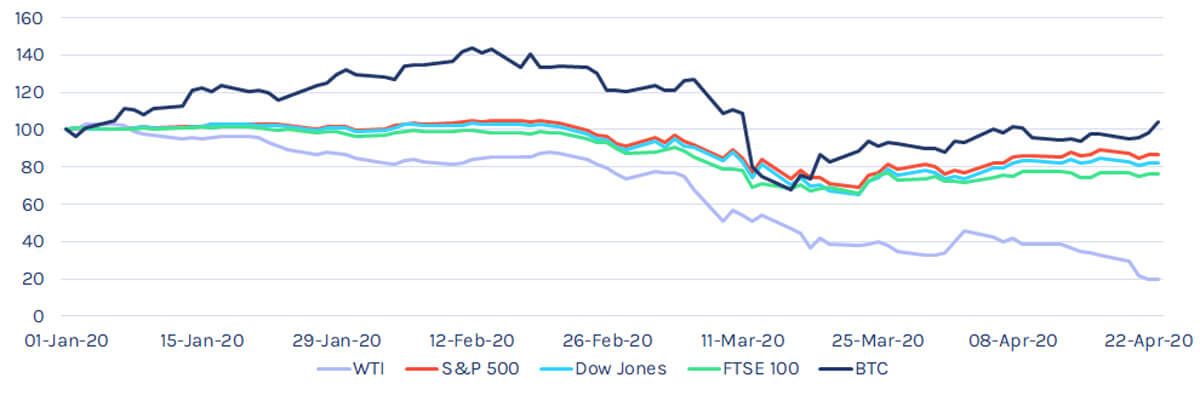
Financial MarketsSource: All data from Bloomberg, indexed to 100. Note that benchmark indices are price return, WTI = United States Oil Fund LP (USO ETF), BTC = XBTUSD Currency.

When governments began implementing broad lockdowns across Europe and North America, effectively shuttering large swaths of their respective economies, panic hit pretty much every market which ignited a stampede for cash.
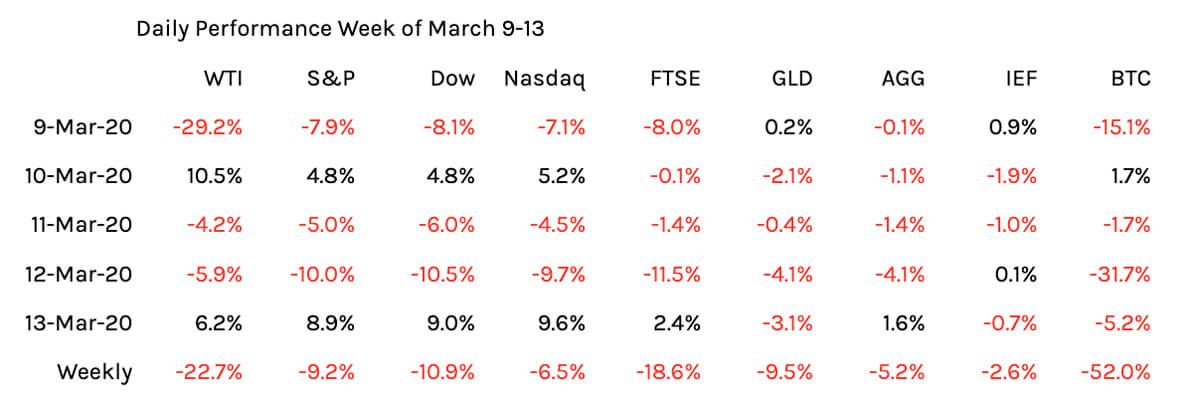
Daily Performance Week of March 9-13Source: All data from Bloomberg. Note that benchmark indices are price return, WTI = United States Oil Fund LP (USO ETF), GLD = SPDR Gold Trust, AGG = iShares Core U.S. Aggregate Bond ETF, IEF = iShares 7-10 Year Treasury Bond ETF, BTC = XBTUSD Currency.

Inflows into cash instruments reached record levels as investors rushed for the safety of the dollar. According to Bank of America, in the five days leading into March 11, investors piled $137bn into cash-like assets, the fourth largest move of its type ever (1).
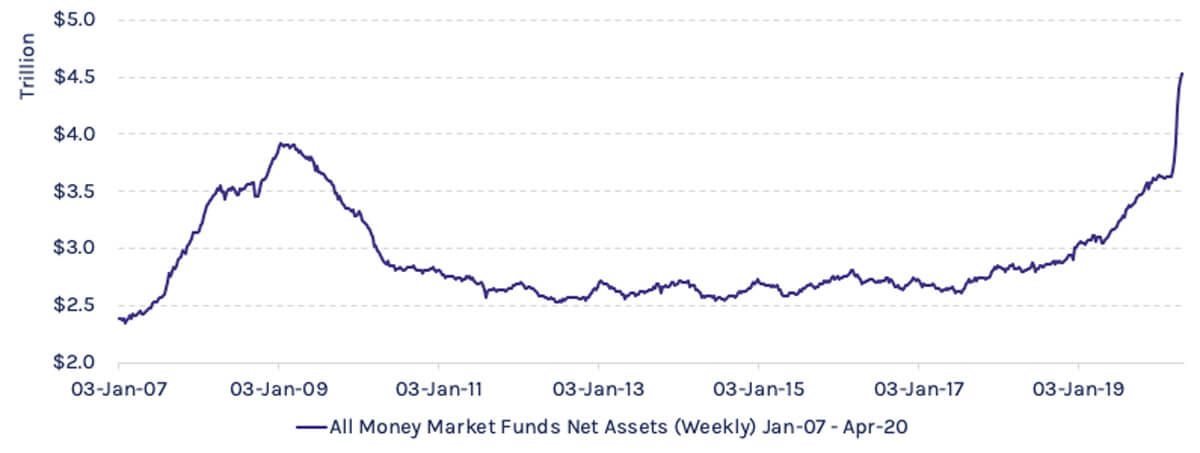
All Money Market Funds Net Assets (Weekly) Jan 07 - Apr 20Source: Bloomberg

Even the safest of havens faltered. On March 12, the worst performing day for bitcoin, both gold and US Treasuries fell by 4.1% in a single session. At the end of the week of March 9-13, gold (GLD) was down 9.5% and US Treasuries (IEF) 5.2%.
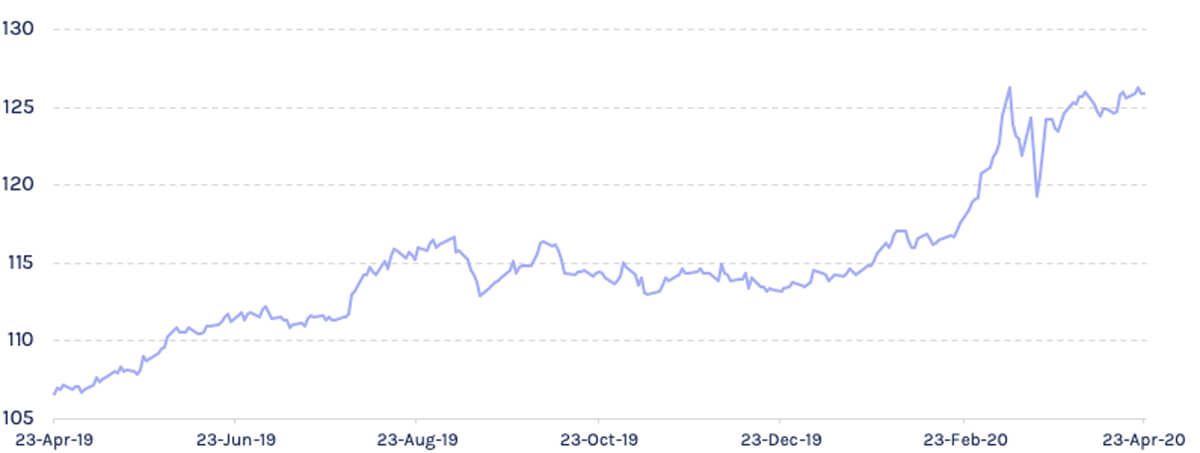
Bitcoin GraphSource: Bloomberg

Leverage Levels in Bitcoin Markets Makes Them Vulnerable to Shocks

Meanwhile, in bitcoin markets, leverage had been building in various forms. USD lending rates on margin platforms were elevated, and Long/Short (L/S) ratios at spot exchanges such as Bitfinex were hovering at abnormally high levels. Having come down from twin peaks of almost 12x in late December and early January, L/S ratios spiked back above 9x in the weeks leading up to March 11. By March 17, the ratio had dropped to less than 2x.
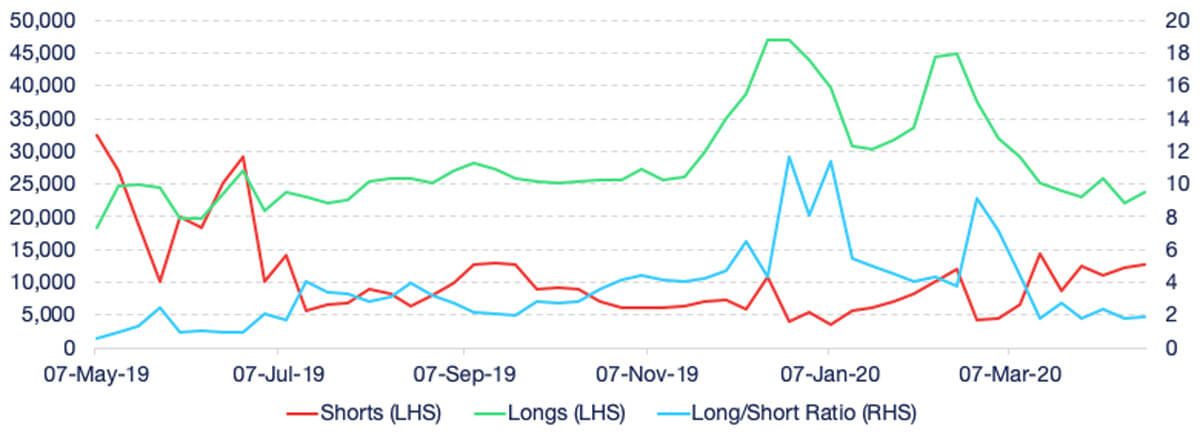
Bitcoin MarketsSource: datamish.com

The situation on derivatives exchanges did not help. Around mid-February, open interest reached more than $5bn, an all-time high. While about $1.7bn of these positions had been unwound before March 11, the real drop came between March 12 & 13. As spot prices were coming down, futures came down even harder, at certain points falling below spot. This caused a liquidation cascade, which wiped out $1.8bn worth of derivatives open interest in less than 48 hours. On BitMex alone, there were $863m and $798m worth of sell liquidations on March and 12 and 13, respectively, representing approximately 9% of total daily trading volume on both days.
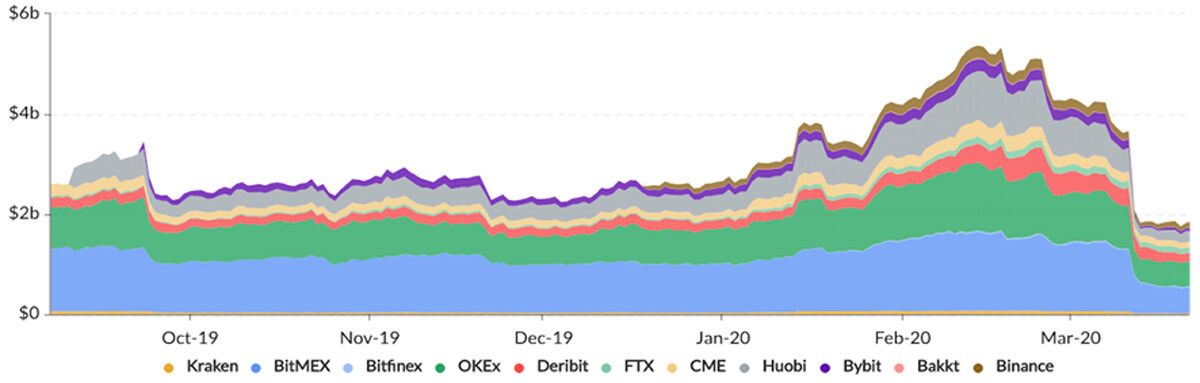
liquidation cascadeSource: skew.com

Leading directly into March 12, the amount of outstanding btc-collateralised loans on lending boks were also likely at all-time highs. The loan book of Genesis trading alone peaked at more than $1bn in late February. The combination of size and speed in the spot market drops caught many borrowers who had posted bitcoin as collateral for their positions off-guard. Even though most such loans are over-collateralised by as much as 40%, a price drop of 50% outpaced some borrowers ability to top up their bitcoin collateral with on-chain transactions (accessing bitcoin from cold-storage is sometimes a deliberately cumbersome process), causing at least $500m of loans to get auto-liquidated by lenders. This added another $500m of selling pressure on spot exchanges over a very short time-span.
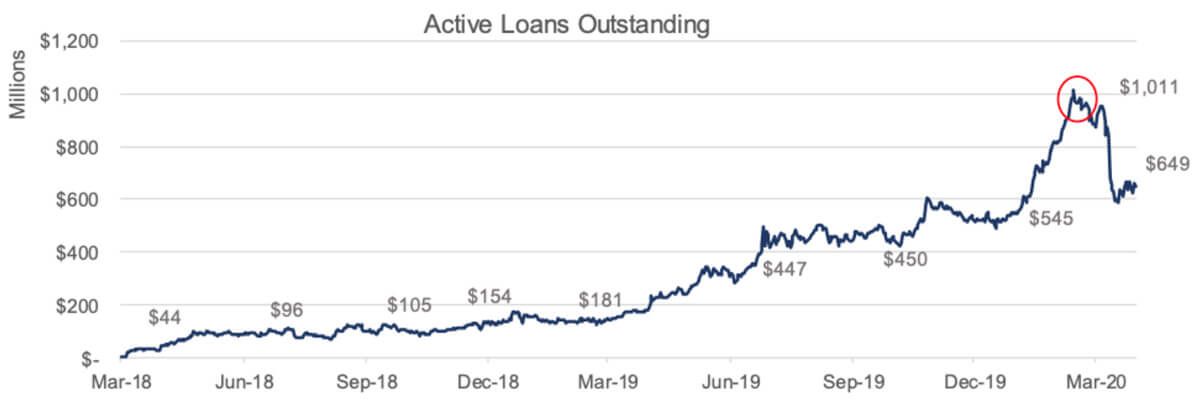
Active Loans OutstandingSource: Genesis Capital

However, markets eventually found a bottom between ~$3,500 and ~$4,000, depending on the exchange. The recovery was relatively swift and by March 20, prices were already flirting with $7,000-levels again. Overall, the v-shaped recovery shows that this was a short-term market dislocation, not a more broad-based revaluation.
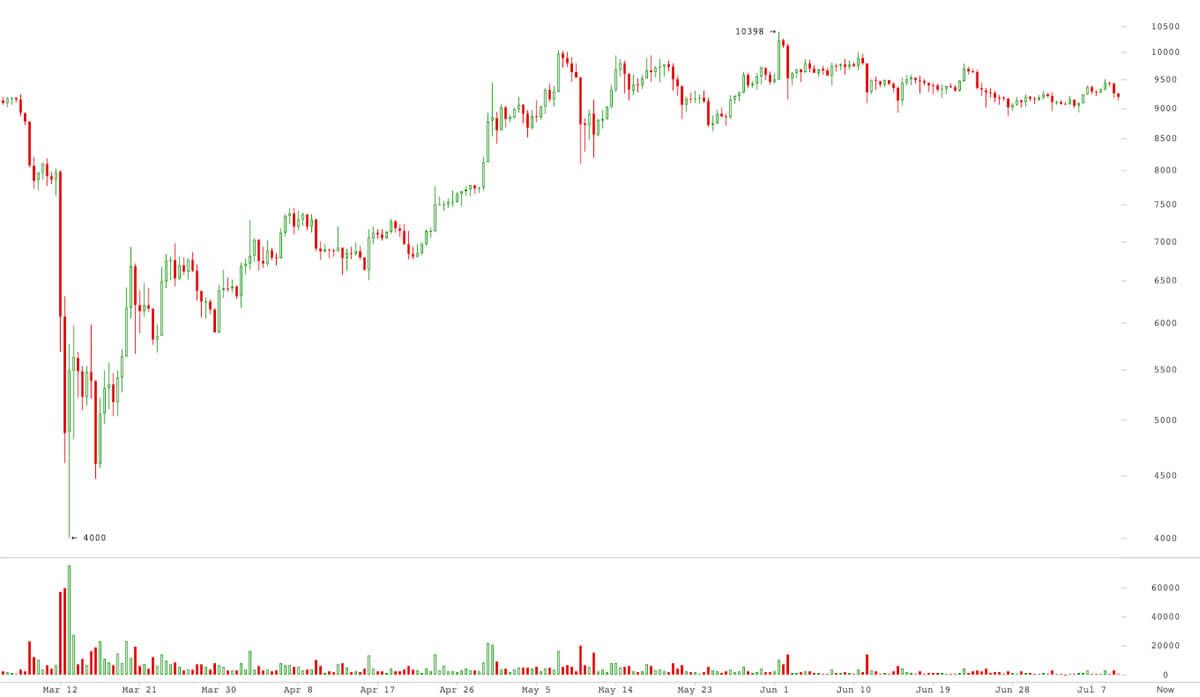
recoverySource: bitcoinwisdom.io (10 July 2020)

Monitoring Leverage Metrics Should Help in Gauging Ongoing Volatility Risk

Bitcoin’s recovery has been stronger and faster than almost all other markets. At the time of writing, bitcoin is trading around $9,200, up 130% from its bottom and up 28% since the start of the year. While the drop was historically large, the price eventually found support and stabilised itself without any need for external intervention.

Meanwhile, leverage levels have started to rebuild on both spot and derivatives exchanges. Open interest on derivatives exchanges has grown back above pre-March 12 levels and are re-approaching all-time highs. Of particular interest here is the observation that open interest on the CME is near record levels, having more than tripled since the start of the year.
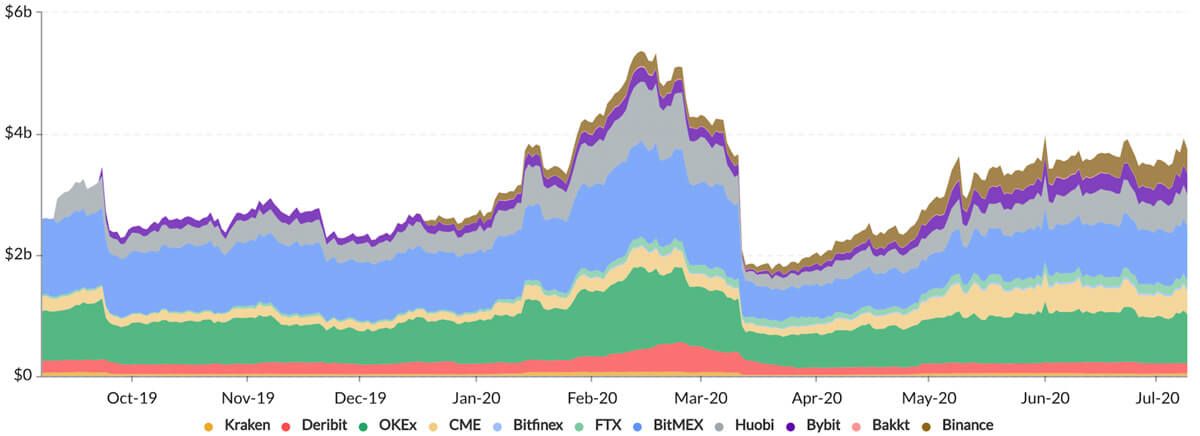
leverage levelsSource: skew.com (10 July 2020)

After bottoming right above 2x, Bitfinex L/S ratios have climbed back to 4.0x. While the ratio is markedly lower than at its twin-peak-level of almost 12x in late December and early January, 4.0x is still relatively high on a yearly basis.
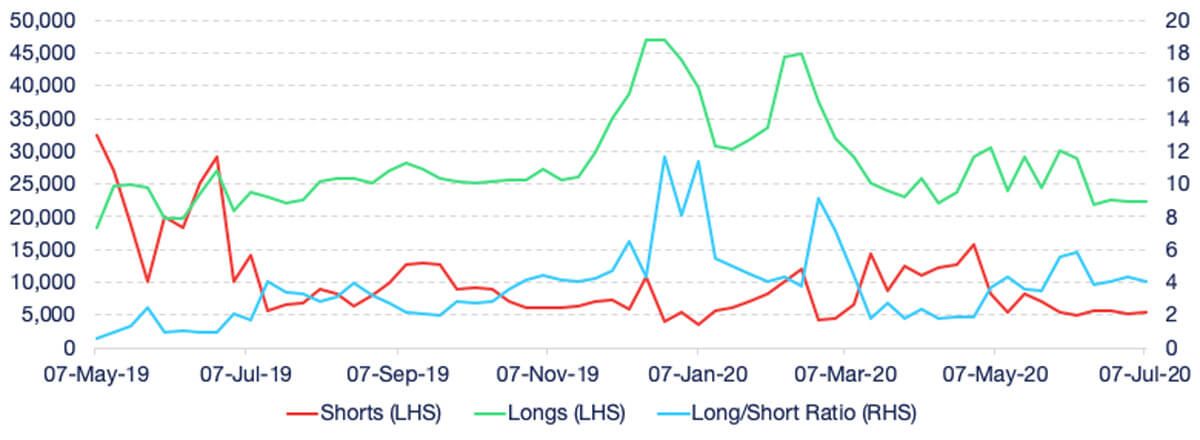
loan marketSource: datamish.com

The btc-collateralised loan market seems to have cooled down somewhat compared to pre-March levels, but it is recovering. Comprehensive data to quantify total current open interest between all lending desks has not been possible to gather, but lenders claim the market, while still some ways off of its peak levels, is growing steadily and stands poised to grow past previous records if market conditions remain relatively stable.

The continued and common usage of leverage in bitcoin markets means that the bitcoin price remains vulnerable to volatility spikes. If outside events of similar magnitude were to recur, it is not unlikely that bitcoin prices would behave in a similar way. Keeping an eye on these metrics should help in gauging ongoing volatility risk.

Veröffentlicht amJuli 16th, 2020

Schriftsteller
Leitet die Bitcoin-Research seit 2017.

Willkommen bei CoinShares

Personenbezogene Daten

0102

Wir verwenden Cookies, um Inhalte und Anzeigen zu personalisieren, um Funktionen für soziale Medien bereitzustellen und um unseren Datenverkehr zu analysieren. Wir geben auch Informationen über Ihre Nutzung unserer Website an unsere Partner für soziale Medien, Werbung und Analysen weiter, die diese mit anderen Informationen kombinieren können, die Sie ihnen zur Verfügung gestellt haben oder die sie aus Ihrer Nutzung ihrer Dienste gesammelt haben. Wenn Sie die Verwendung von Cookies akzeptieren, erklären Sie sich mit der in der Datenschutzrichtlinie und der Cookie-Richtlinie beschriebenen Verarbeitung dieser Daten einverstanden.


Wir verwenden Cookies auf unserer Website, um unsere Dienste zu optimieren. Erfahren Sie mehr über unsere EU-Cookie-Richtlinie oder unsere US-Cookie-Richtlinie.

  • Erforderlich
    Question circle icon
  • Präferenzen
    Question circle icon
  • Statistisch
    Question circle icon
  • Marketing
    Question circle icon
Notwendige Cookies helfen dabei, eine Website nutzbar zu machen, indem sie grundlegende Funktionen wie die Seitennavigation und den Zugang zu sicheren Bereichen der Website ermöglichen. Ohne diese Cookies kann die Website nicht richtig funktionieren.
Präferenz-Cookies ermöglichen es einer Website, Informationen zu speichern, die das Verhalten oder Aussehen der Website verändern, wie z. B. Ihre bevorzugte Sprache oder die Region, in der Sie sich befinden.
Statistik-Cookies helfen Website-Betreibern zu verstehen, wie Besucher mit Websites interagieren, indem sie Informationen anonym sammeln und melden.
Marketing-Cookies werden verwendet, um Besucher auf verschiedenen Websites zu verfolgen. Ziel ist es, Anzeigen zu schalten, die für den einzelnen Nutzer relevant und ansprechend sind und damit für Verlage und dritte Werbetreibende wertvoller sind.