This website uses cookies
We use cookies to personalise content and ads, to provide social media features and to analyse our traffic. We also share information about your use of our site with our social media, advertising and analytics partners who may combine it with other information that you’ve provided to them or that they’ve collected from your use of their services.
Consent Selection
Details
  • Necessary cookies help make a website usable by enabling basic functions like page navigation and access to secure areas of the website. The website cannot function properly without these cookies.

    • Learn more about this provideropens in a new window
      CookieConsentStores the user's cookie consent state for the current domain
      Maximum Storage Duration: 1 yearType: HTTP Cookie
    • Learn more about this provideropens in a new window
      bcookieUsed in order to detect spam and improve the website's security.
      Maximum Storage Duration: 1 yearType: HTTP Cookie
      li_gcStores the user's cookie consent state for the current domain
      Maximum Storage Duration: 180 daysType: HTTP Cookie
    • Learn more about this provideropens in a new window
      datadomeUsed in context with the website's BotManager. The BotManager detects, categorizes and compiles reports on potential bots trying to access the website.
      Maximum Storage Duration: 1 yearType: HTTP Cookie
    • _pk_testcookie_domainThis cookie determines whether the browser accepts cookies.
      Maximum Storage Duration: 1 dayType: HTTP Cookie
    • __cf_bm [x3]This cookie is used to distinguish between humans and bots. This is beneficial for the website, in order to make valid reports on the use of their website.
      Maximum Storage Duration: 1 dayType: HTTP Cookie
  • Preference cookies enable a website to remember information that changes the way the website behaves or looks, like your preferred language or the region that you are in.
    • Learn more about this provideropens in a new window
      lidcRegisters which server-cluster is serving the visitor. This is used in context with load balancing, in order to optimize user experience.
      Maximum Storage Duration: 1 dayType: HTTP Cookie
  • Statistic cookies help website owners to understand how visitors interact with websites by collecting and reporting information anonymously.
    • Learn more about this provideropens in a new window
      guestRegisters data on visitors' website-behaviour. This is used for internal analysis and website optimization.
      Maximum Storage Duration: 1 monthType: HTTP Cookie
    • Learn more about this provideropens in a new window
      personalization_idThis cookie is set by Twitter - The cookie allows the visitor to share content from the website onto their Twitter profile.
      Maximum Storage Duration: 400 daysType: HTTP Cookie
    • _pk_uidUsed by Piwik Analytics Platform to identify the visitor on repeat visits to the website.
      Maximum Storage Duration: 1 yearType: HTTP Cookie
      _pk_id#Collects statistics on the user's visits to the website, such as the number of visits, average time spent on the website and what pages have been read.
      Maximum Storage Duration: 1 yearType: HTTP Cookie
      _pk_ses#Used by Piwik Analytics Platform to track page requests from the visitor during the session.
      Maximum Storage Duration: 1 dayType: HTTP Cookie
    • FPGSIDRegisters statistical data on users' behaviour on the website. Used for internal analytics by the website operator.
      Maximum Storage Duration: 1 dayType: HTTP Cookie
      FPIDRegisters statistical data on users' behaviour on the website. Used for internal analytics by the website operator.
      Maximum Storage Duration: 400 daysType: HTTP Cookie
      FPLCRegisters a unique ID that is used to generate statistical data on how the visitor uses the website.
      Maximum Storage Duration: 1 dayType: HTTP Cookie
    • _gaRegisters a unique ID that is used to generate statistical data on how the visitor uses the website.
      Maximum Storage Duration: 2 yearsType: HTTP Cookie
      _ga_#Used by Google Analytics to collect data on the number of times a user has visited the website as well as dates for the first and most recent visit.
      Maximum Storage Duration: 2 yearsType: HTTP Cookie
  • Marketing cookies are used to track visitors across websites. The intention is to display ads that are relevant and engaging for the individual user and thereby more valuable for publishers and third party advertisers.
    • Learn more about this provideropens in a new window

      Some of the data collected by this provider is for the purposes of personalization and measuring advertising effectiveness. The provider may use the IP Addresses for ads measurement and ads personalization.

      ads/ga-audiencesUsed by Google AdWords to re-engage visitors that are likely to convert to customers based on the visitor's online behaviour across websites.
      Maximum Storage Duration: SessionType: Pixel Tracker
    • Learn more about this provideropens in a new window
      userRefererDetermines how the user accessed the website. This information is used by the website operator in order to measure the efficiency of their marketing.
      Maximum Storage Duration: 1 monthType: HTTP Cookie
    • Learn more about this provideropens in a new window
      #:session-dataTracks the individual sessions on the website, allowing the website to compile statistical data from multiple visits. This data can also be used to create leads for marketing purposes.
      Maximum Storage Duration: PersistentType: HTML Local Storage
      eng_mtTracks the conversion rate between the user and the advertisement banners on the website - This serves to optimise the relevance of the advertisements on the website.
      Maximum Storage Duration: PersistentType: HTML Local Storage
      t_gidThis cookie assigns a specific visitor ID, when the visitor interacts with ads or content from the website - this allows the website to target the visitor with similar ads or content.
      Maximum Storage Duration: 1 yearType: HTTP Cookie
      t_pt_gidCollects information on user preferences and/or interaction with web-campaign content - This is used on CRM-campaign-platform used by website owners for promoting events or products.
      Maximum Storage Duration: 1 yearType: HTTP Cookie
      taboola global:user-idSets a unique ID for the visitor, that allows third party advertisers to target the visitor with relevant advertisement. This pairing service is provided by third party advertisement hubs, which facilitates real-time bidding for advertisers.
      Maximum Storage Duration: PersistentType: HTML Local Storage
      taboola_session_idThis cookie is used to collect information on a visitor. This information will become an ID string with information on a specific visitor – ID information strings can be used to target groups with similar preferences, or can be used by third-party domains or ad-exchanges.
      Maximum Storage Duration: SessionType: HTTP Cookie
    • Learn more about this provideropens in a new window
      1/i/adsct [x2]Collects data on user behaviour and interaction in order to optimize the website and make advertisement on the website more relevant.
      Maximum Storage Duration: SessionType: Pixel Tracker
      muc_adsCollects data on user behaviour and interaction in order to optimize the website and make advertisement on the website more relevant.
      Maximum Storage Duration: 400 daysType: HTTP Cookie
      guest_idCollects data related to the user's visits to the website, such as the number of visits, average time spent on the website and which pages have been loaded, with the purpose of personalising and improving the Twitter service.
      Maximum Storage Duration: 400 daysType: HTTP Cookie
      guest_id_adsCollects information on user behaviour on multiple websites. This information is used in order to optimize the relevance of advertisement on the website.
      Maximum Storage Duration: 400 daysType: HTTP Cookie
      guest_id_marketingCollects information on user behaviour on multiple websites. This information is used in order to optimize the relevance of advertisement on the website.
      Maximum Storage Duration: 400 daysType: HTTP Cookie
    • _gcl_auUsed by Google AdSense for experimenting with advertisement efficiency across websites using their services.
      Maximum Storage Duration: 3 monthsType: HTTP Cookie
      _gcl_lsTracks the conversion rate between the user and the advertisement banners on the website - This serves to optimise the relevance of the advertisements on the website.
      Maximum Storage Duration: PersistentType: HTML Local Storage
    • pardot [x2]Used in context with Account-Based-Marketing (ABM). The cookie registers data such as IP-addresses, time spent on the website and page requests for the visit. This is used for retargeting of multiple users rooting from the same IP-addresses. ABM usually facilitates B2B marketing purposes.
      Maximum Storage Duration: SessionType: HTTP Cookie
  • Unclassified cookies are cookies that we are in the process of classifying, together with the providers of individual cookies.
    • cs_analytics_ip_blockedPending
      Maximum Storage Duration: SessionType: HTTP Cookie
      user_tokenPending
      Maximum Storage Duration: 1 yearType: HTTP Cookie
    • _twpidPending
      Maximum Storage Duration: SessionType: HTTP Cookie
Cookie declaration last updated on 8/20/26 by Cookiebot
[#IABV2_TITLE#]
[#IABV2_BODY_INTRO#]
[#IABV2_BODY_LEGITIMATE_INTEREST_INTRO#]
[#IABV2_BODY_PREFERENCE_INTRO#]
[#IABV2_BODY_PURPOSES_INTRO#]
[#IABV2_BODY_PURPOSES#]
[#IABV2_BODY_FEATURES_INTRO#]
[#IABV2_BODY_FEATURES#]
[#IABV2_BODY_PARTNERS_INTRO#]
[#IABV2_BODY_PARTNERS#]
About
Cookies are small text files that can be used by websites to make a user's experience more efficient.

The law states that we can store cookies on your device if they are strictly necessary for the operation of this site. For all other types of cookies we need your permission.

This site uses different types of cookies. Some cookies are placed by third party services that appear on our pages.

You can at any time change or withdraw your consent from the Cookie Declaration on our website.

Learn more about who we are, how you can contact us and how we process personal data in our Privacy Policy.

Please state your consent ID and date when you contact us regarding your consent.
Image Litecoin-Leitfaden

Litecoin-Leitfaden

Timer7 Min. Lesezeit

  • Altcoins

Litecoin: eine ossifizierte Bitcoin-Fork

Die wichtigsten Zahlen:

  • Start: 13. Oktober 2011

  • Transaktionen pro Tag: An drei Tagen im November 2023 wurden eine Million Transaktionen pro Tag abgewickelt. Im Mai waren es noch 800.000.

Litecoin auf einen Blick 

  • Allein im Jahr 2023 wurden 67 Mio. Transaktionen verzeichnet, was einer Verdoppelung der 39 Mio. Transaktionen von 2022 entspricht, wobei am 14. November die Grenze von 1 Mio. Transaktionen pro Tag überschritten wurde. 

  • Die in LTC ausgewiesenen Gebühren sind so hoch wie seit Anfang Januar 2022 nicht mehr, was auf die höhere Transaktionszahl zurückzuführen ist.

Die wichtigsten Zahlen

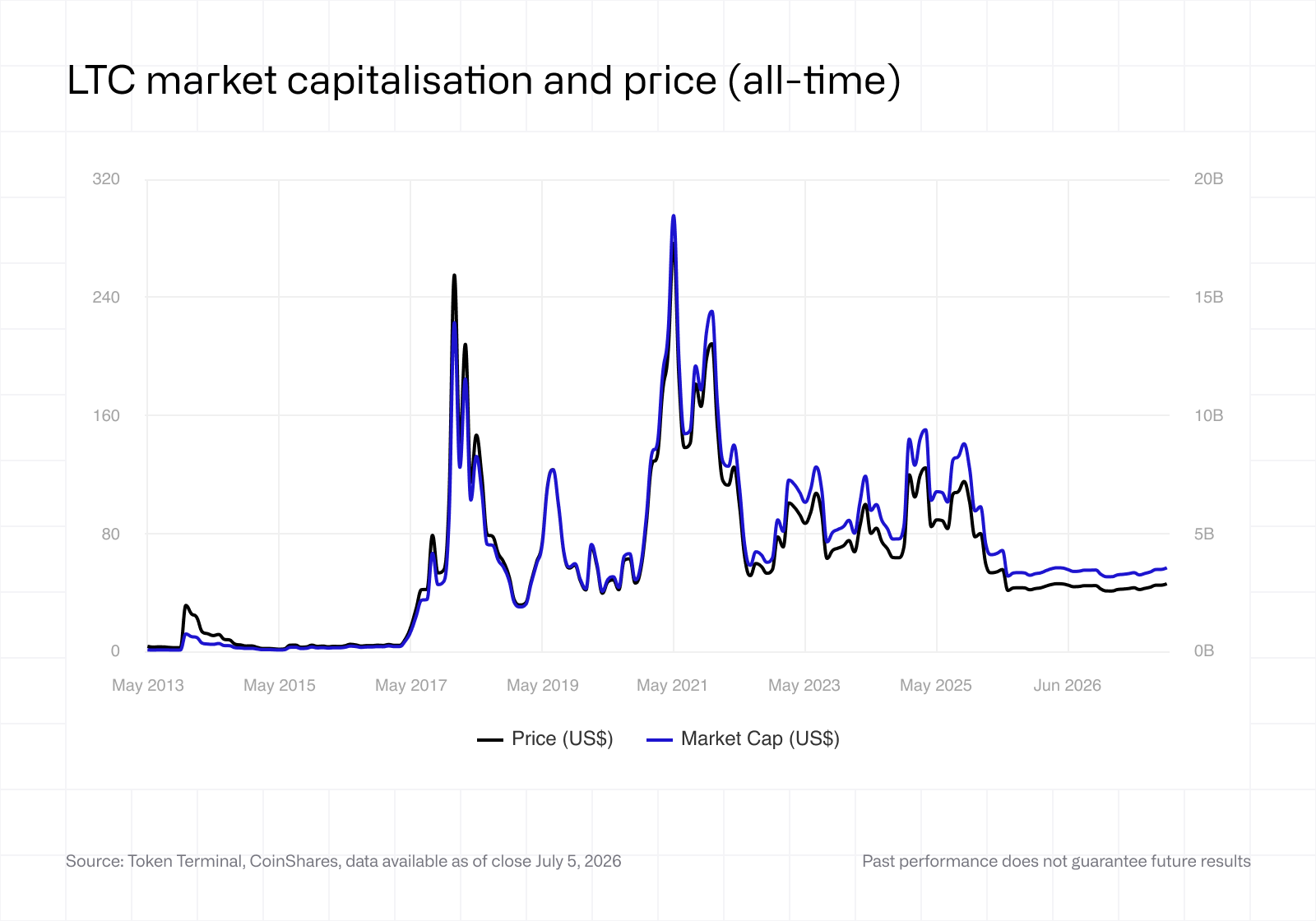
LTC price evolutions

Protokoll-Mechanismus

Scrypt, ausgesprochen „Ess Crypt“, ist ein Sicherheitstool, das ursprünglich für Online-Backups entwickelt wurde. Sein Hauptzweck besteht darin, groß angelegte Angriffe mit kundenspezifischer Hardware teuer und schwierig zu machen, da es viel Speicherplatz erfordert. Es wird auch für das Mining digitaler Währungen verwendet und ist nicht kompatibel mit Bitcoin-Mining-ASICs, die SHA-256 verwenden. Dadurch wird sichergestellt, dass Bitcoin und Währungen, die Scrypt verwenden, wie Litecoin, nicht um dieselben Mining-Ressourcen konkurrieren.

Geschichte 

Wichtige Meilensteine

  • Das anfängliche Wachstum des Litecoin wurde durch seine zunehmende Verfügbarkeit und Liquidität an den ersten Exchanges begünstigt.

  • Dogecoin entstand im Dezember 2013 als Abspaltung des Litecoin.

  • Litecoin führte im Mai 2017 vor Bitcoin die SegWit-Softfork ein, die es ermöglichte, Signaturen in einem eigenen Abschnitt eines Blocks aufzuzeichnen und zu verifizieren, wo Daten mit einem Preisnachlass hinzugefügt werden konnten. SegWit erhöhte zwar die Blockgröße, aber auf eine Art und Weise, die die Nutzer nicht dazu zwang, ihre Software-Regeln zu aktualisieren.

  • Im Mai 2022 wurde das MWEB-Upgrade (Mimblewimble Extension Blocks) im Litecoin-Netzwerk als Softfork aktiviert. Dieses Upgrade bietet Nutzern die Möglichkeit, vertrauliche Litecoin-Transaktionen zu senden, bei denen der gesendete Betrag nur dem Sender und dem Empfänger bekannt ist.

  • Am 2. August 2023 fand das dritte erfolgreiche Litecoin-Halving statt, bei dem die Blockprämie von 12,5 LTC auf 6,25 LTC reduziert wurde.

Wie geht es weiter / Künftige Upgrades 

  • Zukünftige Upgrades sind sehr schwer vorherzusehen. Ein führender Litecoin-Entwickler namens Losh hat zuvor erwähnt, dass die Entwicklung in privaten Repositories stattfindet und dann auf den Master-Branch oder einen bestimmten Branch gepusht wird, wenn das Projekt zur Überprüfung bereit ist, oder wenn es sicher ist, darauf aufzubauen. Öffentliche Updates zu einem der wichtigsten Softforks wurden im Juni 2023 eingestellt, was jedoch nicht bedeutet, dass die Entwicklung eingestellt wurde.

  • Nach den öffentlichen GitHub-Aktivitäten von Core Dev, Losh und David Burkett, scheint es sich bei einigen Entwicklungen um Fehlerbehebungen zu handeln (hier und hier). Viele der Pull-Requests in gängigen Repositories sind seit Monaten oder Jahren nicht mehr aktiv.

CoinShares Meinung zu Litecoin

Der Litecoin ist ein echtes Krypto-Urgestein mit einer der längsten Erfolgsgeschichten aller Kryptowährungen auf dem Markt. Während die meisten frühen Altcoins unter Bugs, Designfehlern und mangelnder Unterstützung durch die Community litten, kann der Litecoin dank seines kontinuierlichen Betriebs ohne nennenswerte Unterbrechung der Protokollfunktion eine starke Erfolgsbilanz aufweisen. Wie die meisten anderen Kryptowährungen muss aber auch der Litecoin seinen realen Nutzen, die Sicherheit und die Dezentralisierung verbessern, um seine Attraktivität langfristig zu steigern.

Strength iconStärken

  • Die im Vergleich zum Bitcoin höhere Blockfrequenz des Litecoin eignet sich besser für Zahlungen, da Transaktionen in durchschnittlich 15 Minuten sicher abgewickelt werden (6 Bestätigungen), im Gegensatz zu einer Stunde beim Bitcoin. 

Weakness iconSchwächen

  • Der Markt hat entschieden, dass der Litecoin schlechtere Eigenschaften und Merkmale als der Bitcoin besitzt, daraus resultieren die viel geringere Marktkapitalisierung, Sicherheit, Dezentralisierung und das geringere Interesse. Daher ist das Potenzial für die Verbreitung begrenzt.

Opportunities iconChancen 

  • Der Ordinals-Trend könnte für Miner sehr viel profitabler sein, was die Hashrate und die Sicherheit des Ledgers erhöht und die Attraktivität des Minings steigert, was sich wiederum auf die Dezentralisierung der Hardware auswirkt. Am 2. Mai führte die Litecoin-Community mit der Einführung von LTC-20, einer Abwandlung von BRC-20, Ordinal-Inschriften ein. Bis September stieg die Zahl der Litecoin-Ordinals auf über 6 Millionen. Diese Dynamik setzte sich fort, und im November wurden dem Litecoin-Netzwerk an nur einem Tag die Rekordzahl von 1,32 Millionen Inschriften hinzugefügt. Im Dezember überstieg die Gesamtzahl der in Litecoin eingetragenen Ordinals die Marke von 14 Millionen.

Threats iconGefahren 

  • Aufgrund der niedrigeren Hashrate und des weniger entwickelten und dezentralisierten Mining-Marktes besteht ein wesentlich höheres Risiko von Protokollunsicherheiten, was sich auch im Token-Preis widerspiegelt und somit die Attraktivität des Minings und der Nutzung des Netzwerks einschränkt. Die Verbreitung des Litecoin stagniert wahrscheinlich in bedeutendem Maß.

Veröffentlicht amApr 11th, 2024

Willkommen bei CoinShares

Personenbezogene Daten

0102

Wir verwenden Cookies, um Inhalte und Anzeigen zu personalisieren, um Funktionen für soziale Medien bereitzustellen und um unseren Datenverkehr zu analysieren. Wir geben auch Informationen über Ihre Nutzung unserer Website an unsere Partner für soziale Medien, Werbung und Analysen weiter, die diese mit anderen Informationen kombinieren können, die Sie ihnen zur Verfügung gestellt haben oder die sie aus Ihrer Nutzung ihrer Dienste gesammelt haben. Wenn Sie die Verwendung von Cookies akzeptieren, erklären Sie sich mit der in der Datenschutzrichtlinie und der Cookie-Richtlinie beschriebenen Verarbeitung dieser Daten einverstanden.


Wir verwenden Cookies auf unserer Website, um unsere Dienste zu optimieren. Erfahren Sie mehr über unsere EU-Cookie-Richtlinie oder unsere US-Cookie-Richtlinie.

  • Erforderlich
    Question circle icon
  • Präferenzen
    Question circle icon
  • Statistisch
    Question circle icon
  • Marketing
    Question circle icon
Notwendige Cookies helfen dabei, eine Website nutzbar zu machen, indem sie grundlegende Funktionen wie die Seitennavigation und den Zugang zu sicheren Bereichen der Website ermöglichen. Ohne diese Cookies kann die Website nicht richtig funktionieren.
Präferenz-Cookies ermöglichen es einer Website, Informationen zu speichern, die das Verhalten oder Aussehen der Website verändern, wie z. B. Ihre bevorzugte Sprache oder die Region, in der Sie sich befinden.
Statistik-Cookies helfen Website-Betreibern zu verstehen, wie Besucher mit Websites interagieren, indem sie Informationen anonym sammeln und melden.
Marketing-Cookies werden verwendet, um Besucher auf verschiedenen Websites zu verfolgen. Ziel ist es, Anzeigen zu schalten, die für den einzelnen Nutzer relevant und ansprechend sind und damit für Verlage und dritte Werbetreibende wertvoller sind.