
This website uses cookies
We use cookies to personalise content and ads, to provide social media features and to analyse our traffic. We also share information about your use of our site with our social media, advertising and analytics partners who may combine it with other information that you’ve provided to them or that they’ve collected from your use of their services.
Consent Selection
Details
  • Necessary cookies help make a website usable by enabling basic functions like page navigation and access to secure areas of the website. The website cannot function properly without these cookies.

    • Learn more about this provideropens in a new window
      CookieConsentStores the user's cookie consent state for the current domain
      Maximum Storage Duration: 1 yearType: HTTP Cookie
    • Learn more about this provideropens in a new window
      bcookieUsed in order to detect spam and improve the website's security.
      Maximum Storage Duration: 1 yearType: HTTP Cookie
      li_gcStores the user's cookie consent state for the current domain
      Maximum Storage Duration: 180 daysType: HTTP Cookie
    • Learn more about this provideropens in a new window
      datadomeUsed in context with the website's BotManager. The BotManager detects, categorizes and compiles reports on potential bots trying to access the website.
      Maximum Storage Duration: 1 yearType: HTTP Cookie
    • _pk_testcookie_domainThis cookie determines whether the browser accepts cookies.
      Maximum Storage Duration: 1 dayType: HTTP Cookie
    • __cf_bm [x3]This cookie is used to distinguish between humans and bots. This is beneficial for the website, in order to make valid reports on the use of their website.
      Maximum Storage Duration: 1 dayType: HTTP Cookie
  • Preference cookies enable a website to remember information that changes the way the website behaves or looks, like your preferred language or the region that you are in.
    • Learn more about this provideropens in a new window
      lidcRegisters which server-cluster is serving the visitor. This is used in context with load balancing, in order to optimize user experience.
      Maximum Storage Duration: 1 dayType: HTTP Cookie
  • Statistic cookies help website owners to understand how visitors interact with websites by collecting and reporting information anonymously.
    • Learn more about this provideropens in a new window
      guestRegisters data on visitors' website-behaviour. This is used for internal analysis and website optimization.
      Maximum Storage Duration: 1 monthType: HTTP Cookie
    • Learn more about this provideropens in a new window
      personalization_idThis cookie is set by Twitter - The cookie allows the visitor to share content from the website onto their Twitter profile.
      Maximum Storage Duration: 400 daysType: HTTP Cookie
    • _pk_uidUsed by Piwik Analytics Platform to identify the visitor on repeat visits to the website.
      Maximum Storage Duration: 1 yearType: HTTP Cookie
      _pk_id#Collects statistics on the user's visits to the website, such as the number of visits, average time spent on the website and what pages have been read.
      Maximum Storage Duration: 1 yearType: HTTP Cookie
      _pk_ses#Used by Piwik Analytics Platform to track page requests from the visitor during the session.
      Maximum Storage Duration: 1 dayType: HTTP Cookie
    • FPGSIDRegisters statistical data on users' behaviour on the website. Used for internal analytics by the website operator.
      Maximum Storage Duration: 1 dayType: HTTP Cookie
      FPIDRegisters statistical data on users' behaviour on the website. Used for internal analytics by the website operator.
      Maximum Storage Duration: 400 daysType: HTTP Cookie
      FPLCRegisters a unique ID that is used to generate statistical data on how the visitor uses the website.
      Maximum Storage Duration: 1 dayType: HTTP Cookie
    • _gaRegisters a unique ID that is used to generate statistical data on how the visitor uses the website.
      Maximum Storage Duration: 2 yearsType: HTTP Cookie
      _ga_#Used by Google Analytics to collect data on the number of times a user has visited the website as well as dates for the first and most recent visit.
      Maximum Storage Duration: 2 yearsType: HTTP Cookie
  • Marketing cookies are used to track visitors across websites. The intention is to display ads that are relevant and engaging for the individual user and thereby more valuable for publishers and third party advertisers.
    • Learn more about this provideropens in a new window

      Some of the data collected by this provider is for the purposes of personalization and measuring advertising effectiveness. The provider may use the IP Addresses for ads measurement and ads personalization.

      ads/ga-audiencesUsed by Google AdWords to re-engage visitors that are likely to convert to customers based on the visitor's online behaviour across websites.
      Maximum Storage Duration: SessionType: Pixel Tracker
    • Learn more about this provideropens in a new window
      userRefererDetermines how the user accessed the website. This information is used by the website operator in order to measure the efficiency of their marketing.
      Maximum Storage Duration: 1 monthType: HTTP Cookie
    • Learn more about this provideropens in a new window
      #:session-dataTracks the individual sessions on the website, allowing the website to compile statistical data from multiple visits. This data can also be used to create leads for marketing purposes.
      Maximum Storage Duration: PersistentType: HTML Local Storage
      eng_mtTracks the conversion rate between the user and the advertisement banners on the website - This serves to optimise the relevance of the advertisements on the website.
      Maximum Storage Duration: PersistentType: HTML Local Storage
      t_gidThis cookie assigns a specific visitor ID, when the visitor interacts with ads or content from the website - this allows the website to target the visitor with similar ads or content.
      Maximum Storage Duration: 1 yearType: HTTP Cookie
      t_pt_gidCollects information on user preferences and/or interaction with web-campaign content - This is used on CRM-campaign-platform used by website owners for promoting events or products.
      Maximum Storage Duration: 1 yearType: HTTP Cookie
      taboola global:user-idSets a unique ID for the visitor, that allows third party advertisers to target the visitor with relevant advertisement. This pairing service is provided by third party advertisement hubs, which facilitates real-time bidding for advertisers.
      Maximum Storage Duration: PersistentType: HTML Local Storage
      taboola_session_idThis cookie is used to collect information on a visitor. This information will become an ID string with information on a specific visitor – ID information strings can be used to target groups with similar preferences, or can be used by third-party domains or ad-exchanges.
      Maximum Storage Duration: SessionType: HTTP Cookie
    • Learn more about this provideropens in a new window
      1/i/adsct [x2]Collects data on user behaviour and interaction in order to optimize the website and make advertisement on the website more relevant.
      Maximum Storage Duration: SessionType: Pixel Tracker
      muc_adsCollects data on user behaviour and interaction in order to optimize the website and make advertisement on the website more relevant.
      Maximum Storage Duration: 400 daysType: HTTP Cookie
      guest_idCollects data related to the user's visits to the website, such as the number of visits, average time spent on the website and which pages have been loaded, with the purpose of personalising and improving the Twitter service.
      Maximum Storage Duration: 400 daysType: HTTP Cookie
      guest_id_adsCollects information on user behaviour on multiple websites. This information is used in order to optimize the relevance of advertisement on the website.
      Maximum Storage Duration: 400 daysType: HTTP Cookie
      guest_id_marketingCollects information on user behaviour on multiple websites. This information is used in order to optimize the relevance of advertisement on the website.
      Maximum Storage Duration: 400 daysType: HTTP Cookie
    • _gcl_auUsed by Google AdSense for experimenting with advertisement efficiency across websites using their services.
      Maximum Storage Duration: 3 monthsType: HTTP Cookie
      _gcl_lsTracks the conversion rate between the user and the advertisement banners on the website - This serves to optimise the relevance of the advertisements on the website.
      Maximum Storage Duration: PersistentType: HTML Local Storage
    • pardot [x2]Used in context with Account-Based-Marketing (ABM). The cookie registers data such as IP-addresses, time spent on the website and page requests for the visit. This is used for retargeting of multiple users rooting from the same IP-addresses. ABM usually facilitates B2B marketing purposes.
      Maximum Storage Duration: SessionType: HTTP Cookie
  • Unclassified cookies are cookies that we are in the process of classifying, together with the providers of individual cookies.
    • cs_analytics_ip_blockedPending
      Maximum Storage Duration: SessionType: HTTP Cookie
      user_tokenPending
      Maximum Storage Duration: 1 yearType: HTTP Cookie
    • _twpidPending
      Maximum Storage Duration: SessionType: HTTP Cookie
Cookie declaration last updated on 8/20/26 by Cookiebot
[#IABV2_TITLE#]
[#IABV2_BODY_INTRO#]
[#IABV2_BODY_LEGITIMATE_INTEREST_INTRO#]
[#IABV2_BODY_PREFERENCE_INTRO#]
[#IABV2_BODY_PURPOSES_INTRO#]
[#IABV2_BODY_PURPOSES#]
[#IABV2_BODY_FEATURES_INTRO#]
[#IABV2_BODY_FEATURES#]
[#IABV2_BODY_PARTNERS_INTRO#]
[#IABV2_BODY_PARTNERS#]
About
Cookies are small text files that can be used by websites to make a user's experience more efficient.

The law states that we can store cookies on your device if they are strictly necessary for the operation of this site. For all other types of cookies we need your permission.

This site uses different types of cookies. Some cookies are placed by third party services that appear on our pages.

You can at any time change or withdraw your consent from the Cookie Declaration on our website.

Learn more about who we are, how you can contact us and how we process personal data in our Privacy Policy.

Please state your consent ID and date when you contact us regarding your consent.
Image Investiere in den Aufbau: Die Finanzinfrastruktur, die Deutschland noch besitzen kann

Investiere in den Aufbau: Die Finanzinfrastruktur, die Deutschland noch besitzen kann

Timer6 Min. Lesezeit

  • Finanzen
  • Altcoins

Deutschland hat einen Infrastrukturwandel verpasst. Das ist kein Vorwurf – sondern eine anerkannte Tatsache. Langsame Breitbandverbindungen, stockende Digitalisierung, verpasste Chancen beim Aufbau digitaler Infrastruktur. Wolfgang Münchau beschreibt es treffend¹: Während andere Länder die digitalen Grundlagen geschaffen haben, wartete Deutschland auf perfekte Bedingungen.

Heute entsteht neue Infrastruktur – und diesmal ist das Zeitfenster noch offen. Die Finanzinfrastruktur wird neu aufgebaut. Deutsche Bank, Visa, Circle – sie bauen bereits hier.

Der Unterschied zu früheren Wellen: Diese Infrastruktur ist direkt investierbar. Nicht die Anwendungen. Die Infrastruktur selbst.

Das Muster erkennen

Jeder Infrastrukturzyklus folgt demselben Muster. Die Schicht wird aufgebaut, bevor sie breit besessen wird. So war es bei Internetprotokollen in den 1990er-Jahren. So war es beim Cloud Computing in den 2010ern. Die Finanzinfrastruktur folgt derselben Logik.

Historisch entstanden die höchsten Renditen meist während der Aufbauphase. Investoren, die dieses Muster früh erkannten – etwa beim Kauf von Cisco-Aktien oder durch Exposure zu AWS – konnten die Infrastrukturprämie abschöpfen.

Blockchain-basierte Abwicklungsinfrastruktur befindet sich genau in dieser Phase. Keine Spekulation mehr, sondern produktive Infrastruktur.

Die neue Finanzinfrastruktur

Traditionelle Finanzinfrastruktur funktioniert wie ein komplexes Postsystem. Wenn Sie eine Zahlung von Frankfurt nach München senden, erfolgt sie nicht direkt. Sie läuft über mehrere Intermediäre: Ihre Bank, Korrespondenzbanken, Clearingstellen und Abwicklungsnetzwerke. Jeder Schritt verursacht Zeitverzögerung, Kosten und Gegenparteirisiken. Das System funktioniert – erfordert aber Vertrauen in mehrere Institutionen und arbeitet nur zu Geschäftszeiten.

Man kann es sich vorstellen wie einen Brief, der mehrere Postämter durchlaufen muss, bevor er ankommt. Jede Station prüft, stempelt, verlangt Gebühren und kann Verzögerungen verursachen.

Millionen Transaktionen täglich, Hunderte Milliarden Euro gesichert

Blockchain-Finanzinfrastruktur funktioniert eher wie E-Mail – direkt, programmierbar und rund um die Uhr verfügbar. Eine Transaktion auf Ethereum wird direkt zwischen Parteien über selbst ausführende Smart Contracts abgewickelt. Keine Intermediäre. Keine Geschäftszeiten. Keine manuelle Abstimmung.

Ethereum verarbeitet täglich über 2,3 Millionen Transaktionen² – jede davon ein programmierbarer Finanzvertrag, der automatisch ausgeführt wird. Das ist keine theoretische Kapazität, sondern aktuelles Produktionsvolumen.

Während einige noch über „Krypto als Zukunftstechnologie“ diskutieren, ist die Realität bereits da. 279 Milliarden € sind in Ethereum-Smart-Contracts gebunden³. Reale Werte, gesichert und verwaltet durch Code statt durch traditionelle Institutionen.

Visa testet Stablecoin-Abwicklung. PayPal verarbeitet Zahlungen. Deutsche Bank baut auf diesen Systemen. Die Infrastrukturprüfung ist abgeschlossen. Diese Systeme funktionieren bereits.

Doch es geht nicht nur um Zahlungen. Blockchain-Infrastruktur ermöglicht programmierbare Finanzen – Geld mit eingebauter Logik. Verträge, die automatisch ausgeführt werden. Kredite, deren Zinssätze sich in Echtzeit anpassen. Versicherungen, die automatisch auszahlen.

Traditionelle Finanzsysteme benötigen große Backoffice-Teams für Abstimmung, Compliance und Abwicklung. Blockchain-Infrastruktur erledigt das automatisch, transparent und kontinuierlich.

Eine passende Analogie: Traditionelle Finanzsysteme sind wie manuelle Telefonzentralen. Blockchain-Finanzsysteme sind Direktwahl – automatisiert, schneller und jederzeit verfügbar.

Wem gehört diese Infrastruktur?

Diese Infrastrukturebene wird aufgebaut und erprobt, während institutionelle Adoption noch am Anfang steht. Die Nutzung wächst deutlich, aber viele Institutionen haben noch nicht direkt in die Infrastruktur investiert, da sie sie weiterhin evaluieren.

Diese Lücke zwischen funktionierender Infrastruktur und breitem Besitz stellt das Investitionsfenster dar. Infrastrukturinvestoren kennen dieses Muster: 5G im Jahr 2013, nicht 2023. Die Infrastruktur funktioniert bereits – das Wachstum beginnt erst.

Deutsche Infrastrukturkompetenz

Deutsche Infrastrukturinvestoren verstehen Timing und Bewertung. Sie investieren in der Aufbauphase, um Wachstum zu erfassen – nicht nach der Reife, um Dividenden zu kassieren. Sie identifizieren die unsichtbare Ebene, die eine Branche ermöglicht, und besitzen sie.

Der Typ Investor, der ASML statt Apple gekauft hat. Infineon statt Tesla. Nicht das Endprodukt, sondern die zugrunde liegende Infrastruktur.

Genau dieses Muster zeigt sich nun in der Finanzinfrastruktur. Was ASML für Halbleiter ist, was die Autobahn für Mobilität bedeutet und was Xetra für Kapitalmärkte liefert – das sind Ethereum, Solana und Hyperliquid für die Finanzwelt.

Drei Ebenen, ein System

Die Abwicklungsebene: Ethereum
Die Basisschicht, auf der Werte gesichert und Verträge ausgeführt werden. Das Fundament digitaler Finanzen. 279 Milliarden € Total Value Locked (Stand April 2026). Deutsche Bank, Visa und PayPal bauen darauf auf. Ethereum ist für DeFi das, was ASML für Halbleiter ist – unsichtbar für den Nutzer, unverzichtbar für alle, die darauf aufbauen.

Die Durchsatzebene: Solana
Die Hochgeschwindigkeitsinfrastruktur, die Volumen verarbeitet. Geschwindigkeit und Kapazität als Infrastrukturwert. Als Visa Stablecoin-Abwicklung testete, fiel die Wahl auf Solana aufgrund des Durchsatzes.

Die Trading-Infrastruktur: Hyperliquid
Die Börsenebene über der Infrastruktur. Hier entstehen Preisfindung und Liquidität. Das Xetra von DeFi. 2,8 Billionen USD kumuliertes Handelsvolumen seit Gründung⁴. Vollständig On-Chain-Orderbuch. Richtungsunabhängiges Erlösmodell – wie Nasdaq verdient es an jedem Trade.

Das Investitionsfenster

Die Nutzung wächst deutlich. Die institutionelle Durchdringung ist noch früh. Die Infrastruktur ist bewiesen – 279 Milliarden € sind allein auf Ethereum gesichert – doch wir stehen erst am Anfang der Adoptionskurve.

Diese Lücke zwischen funktionierender Infrastruktur und breiter Nutzung ist die Chance. Infrastrukturinvestoren erkennen dieses Muster: 5G im Jahr 2013, nicht 2023. Die Infrastruktur funktioniert – das Wachstum beginnt erst.

Das ist das Investitionsfenster.

Warum jetzt?

Im Gegensatz zu Plattformökonomien, die von US-Tech-Giganten dominiert wurden, ist diese Infrastruktur offen und investierbar. Jeder kann teilnehmen – als Entwickler, Nutzer oder Investor.

Deutschland hat strukturelle Vorteile für diese Allokation:

  • Nach 1 Jahr Haltedauer steuerfreie Gewinne: struktureller Anreiz für langfristige Positionierung (abhängig von individuellen Umständen und geltendem Steuerrecht zum Verkaufszeitpunkt)

  • Institutioneller Zugang seit 2020: etablierter regulatorischer Rahmen

  • Wachsende Krypto-Adoption: positive Trends über Demografien hinweg

  • 2,5 Milliarden € Nettozuflüsse im Jahr 2025⁵: steigende Dynamik

Dieser Markt optimiert Allokationen – er entdeckt nicht mehr Bitcoin. Die Frage ist nicht, ob man in Krypto investiert; dieser Moment liegt hinter uns. Die Frage ist, wie man die Infrastruktur während ihrer Aufbauphase besitzt.

Bitte beachten Sie, dass Investitionen in Krypto-Assets mit erheblichen Risiken verbunden sind. Der Wert von Krypto-Assets kann stark schwanken, und es besteht die Möglichkeit eines vollständigen Kapitalverlusts. Frühere Wertentwicklungen und Marktanalogien sind kein verlässlicher Indikator für zukünftige Ergebnisse.
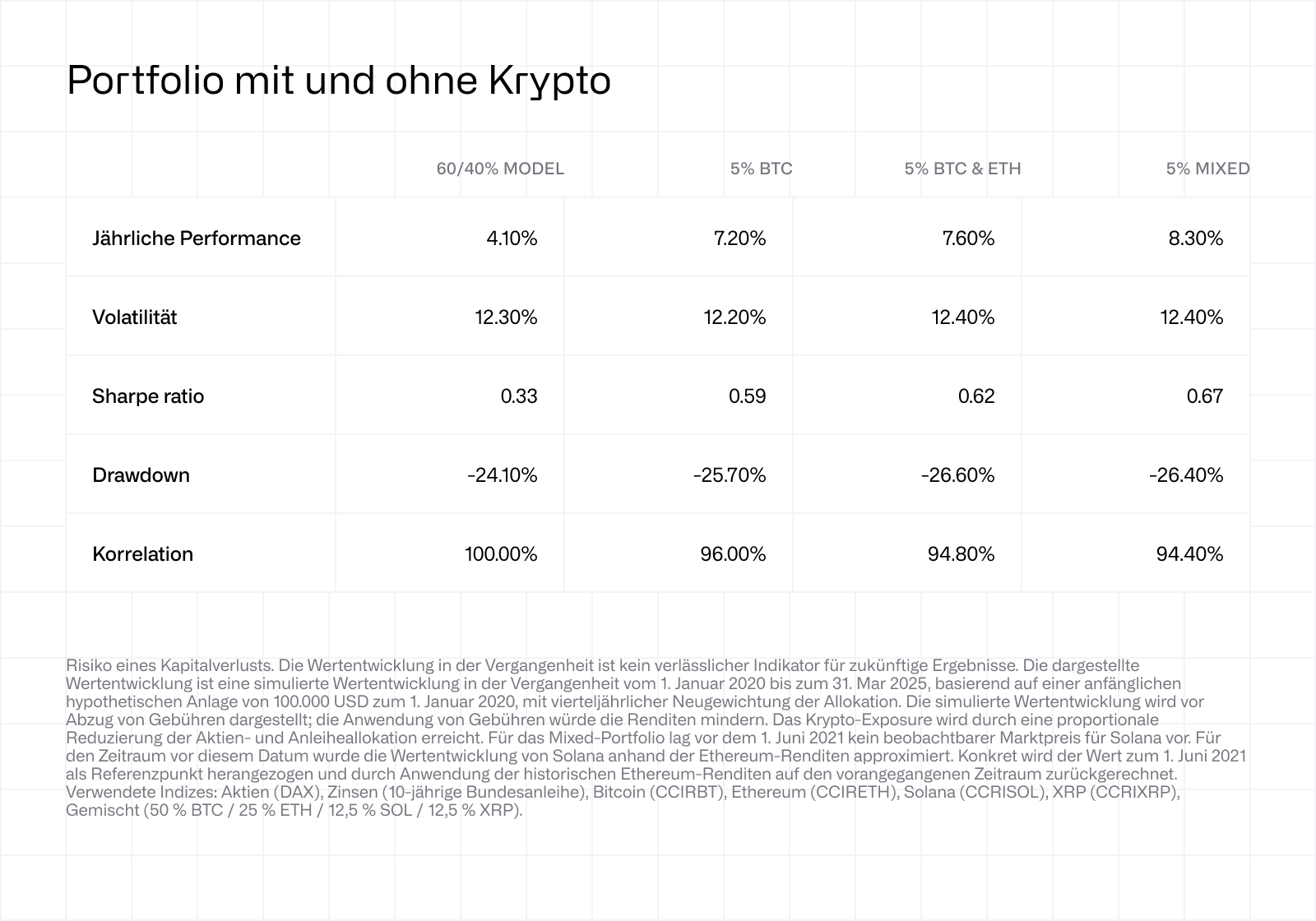
Portfolio mit und ohne Krypto

Dieses Mal ist es anders

Dieses Mal kann Deutschland die Infrastruktur besitzen, während sie aufgebaut wird. Dieses Mal ist das Investitionsfenster noch offen. Dieses Mal ist die Infrastruktur direkt zugänglich: keine Intermediäre, kein Gatekeeping, keine geschlossenen Türen. Bewertungsmodelle existieren. Institutionelle Validierung ist vorhanden.

Ethereum. Solana. Hyperliquid. Drei Ebenen. Ein System. Dieselbe Chance.

¹ Kaput: The End of the German Miracle, 2024
² Token Terminal, April 2026
³ Token Terminal, April 2026
⁴ Token Terminal, April 2026
⁵ Bloomberg, Januar 2026

Veröffentlicht amMai 4th, 2026