



What does it mean to treat computing power as an asset class?
 11 min de lecture
- Finance
- Technologie
- Données
Compute is computing capacity available to rent by the hour. Prices in dollars per GPU-hour help buyers compare costs and agree contracts. Contracts can support financing, but an investable asset also needs reliable prices and enforceable claims on customer payments.
A graphics processing unit, or GPU, trains and runs artificial intelligence (AI) models. A GPU-hour measures one hour of GPU access, providing a pricing unit much as the kilowatt-hour does for electricity.
Four layers carry different assets and obligations:
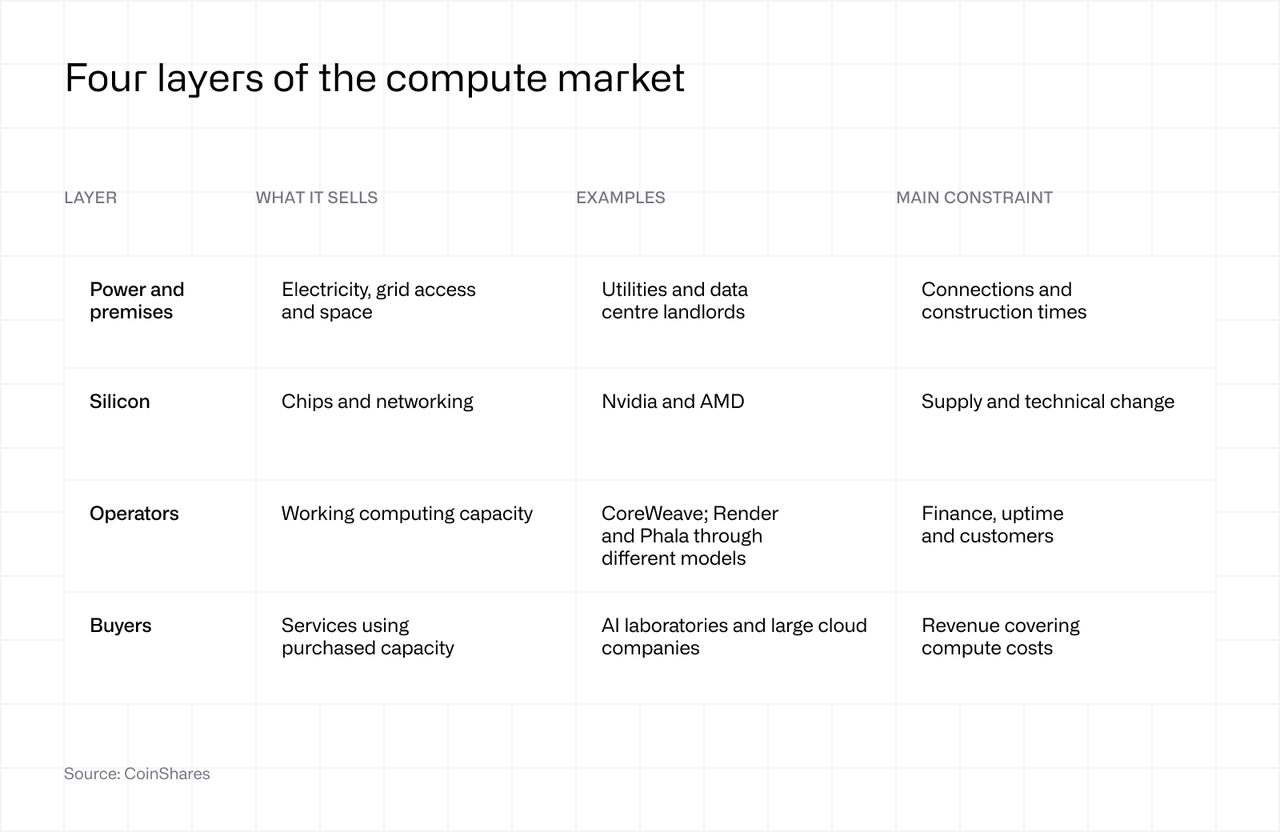 Neoclouds assemble GPUs, networking and data centre space to sell AI computing capacity. Leasing premises and financing chips lowers upfront equity needs but creates rent and debt payments. Hyperscalers, the largest cloud providers, can buy neocloud capacity while competing for cloud customers.
Crypto networks use tokens, transferable digital assets, to organise services and reward suppliers:
Render: The Render Foundation describes a network supplying computing power for 3D graphics and AI. Customer payments fund purchases of tokens, which are permanently removed, or “burned”. New tokens are also issued, so total supply may still grow. Burning tokens pays no income to holders.
Phala: Phala’s documentation describes services protecting sensitive data during computing tasks. Intel TDX and Nvidia H100/H200 hardware create protected spaces called trusted execution environments. Customers can check the protection before outsourcing work, reducing reliance on the operator while still trusting hardware security.
Bittensor: It is less a compute marketplace than a market for AI output. Bittensor’s documentation describes specialised groups called subnets. Some groups use computing power to produce AI answers or predictions; others supply computing power directly. Participants earn TAO or subnet tokens as rewards. Token rewards alone do not prove customers are funding income for holders.
CoinShares’ DePIN guide explains token-coordinated infrastructure.
The spending behind cloud services shows the scale of the physical infrastructure. Amazon’s 2025 annual report records $128.3B in capital spending, mainly on technology infrastructure, chiefly supporting the AWS cloud business, and facilities for fulfilling retail orders. The total extends beyond AI.
Can you buy and sell compute like a commodity?
Compute can be rented immediately, reserved or bought through negotiated forward agreements. Exchange futures would give buyers and suppliers a standardised way to protect against changes in GPU rental prices. Building that market is more complicated, however, because the computing power and service terms behind each GPU-hour can differ.
The motivation is familiar from electricity, oil and shipping, where buyers want greater certainty over future costs while suppliers want more predictable revenue.
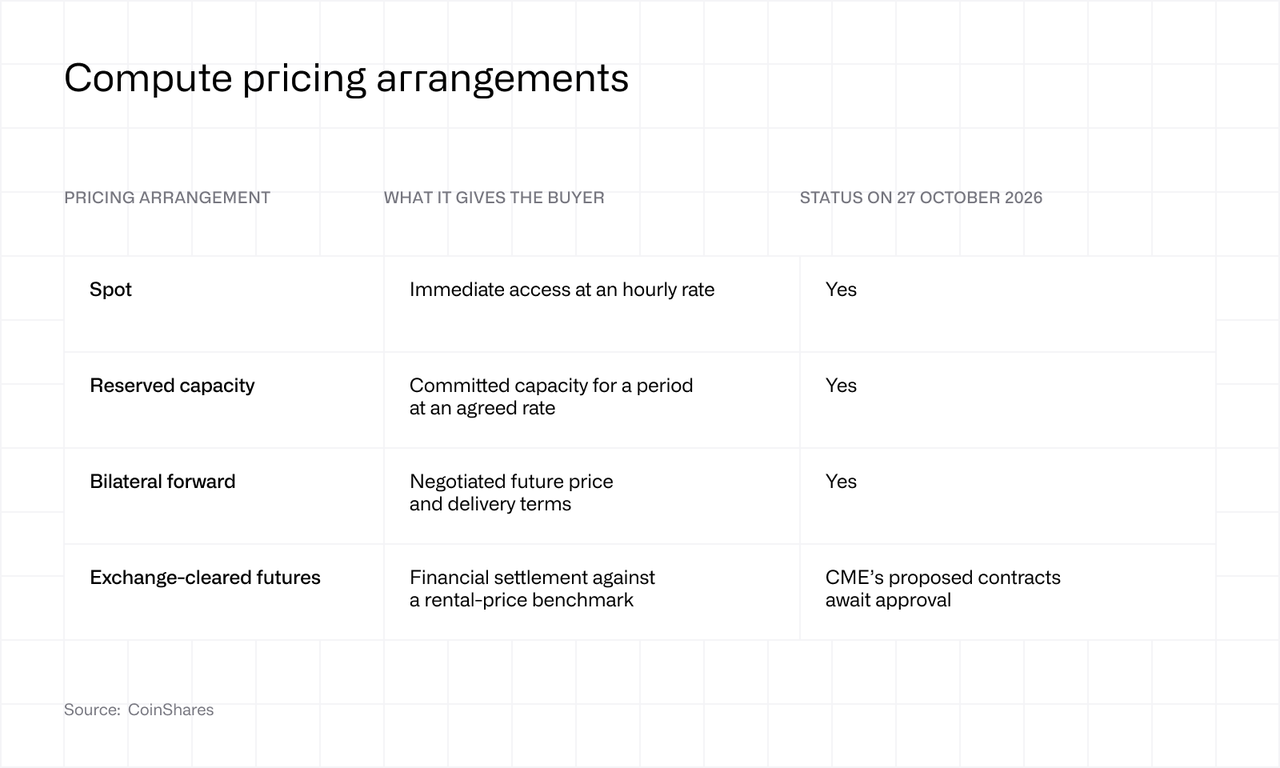 Reservation rates across durations can imply forward prices, provided hardware, location and service terms are comparable. On 11 August 2026, CME Group announced H100 and B200 rental-index futures, later postponing launch pending regulatory review. The CFTC extended the review to 8 January 2027. Approval would guarantee neither active trading nor a close match to customers’ computing bills.
CoreWeave said in September 2026 that new compute contracts had commanded higher prices since June. Three-to-six-month contracts were priced at around $40M per megawatt, calculated as annualised revenue divided by cluster power requirements. The measure expresses compute revenue relative to power capacity, which means compute is being priced as power.
While customer contracts put a dollar price on computing capacity, token networks approach the problem from the other direction; Bittensor’s token rewards do not provide an equivalent rental-price benchmark. Exchange-cleared futures would help finance directors hedge GPU costs. Fees paid to holders or token buybacks can connect customer spending to holder benefits, while TAO’s supply cap alone grants no customer income. For now, the contract is what gives compute a price. The futures market will show whether that price can trade.
How are AI data centres financed, and what secures the debt?
AI data centres use equity and debt to pay for buildings, chips and networks before customers generate enough cash to cover the investment. Security can include the equipment and contracts to buy its output. Customer credit, payment obligations and contract length help determine borrowing terms. Because chips lose value every quarter while a signed contract does not, the customer's credit increasingly sets the terms.
An offtake agreement commits a customer to buy computing capacity. Like shipping charters or power purchase agreements, customer contracts give lenders future payments to assess alongside equipment values, subject to delivery of the agreed service.
In March 2026, CoreWeave closed a facility secured by computing infrastructure and a customer contract, anchored by Blackstone Credit & Insurance. Borrowing capacity starts at about $7.5B and can reach $8.5B as assets stabilise. CoreWeave described it as the first investment-grade rated GPU-backed financing, and Bloomberg reported that the contract behind it is with Meta.The rating followed the customer more than the chip.
GPU-backed lending also uses crypto funding. USD.AI pools blockchain deposits for GPU loans governed by conventional legal agreements. USD.AI’s documentation describes sUSDai as a yield-bearing token drawing returns from GPU loans and Treasury bills held against unlent reserves. USD.AI’s current underwriting scores the operator, the customer’s credit and the strength of the offtake contract; the combined score sets the loan’s pricing tier and structure. USD.AI’s Compute IQ page uses a different operator, customer and contract scoring grid. Published pricing categories do not commit USD.AI to lend at the stated terms.
USD.AI’s published structure and borrower documentation describe lender protections:
Separate assets: A special purpose vehicle, a separate company designed to isolate assets from parent bankruptcy, holds GPUs, contracts and revenue accounts. Lenders have first-priority security over vehicle assets and a pledge of vehicle ownership.
Limited parent recourse: The parent generally owes no repayment, except for losses covered by a limited guarantee, including voluntary bankruptcy filings.
Equity and repayment: Documentation cites 70.0% to 80.0% loan-to-value. Principal falls in equal steps, typically over three years, with longer terms available. USD.AI’s pages describe the reserve as either one to three months of peak loan payments or about 10.0% of the loan amount.
Physical verification: Independent checks confirm working servers before funds leave escrow. Monitoring continues after lending begins because blockchain records alone cannot verify physical machines.
These terms come from public documentation, not signed loan agreements.
What are the biggest risks to the AI infrastructure buildout?
The main risks are hardware losing economic value faster than expected, customers failing to honour contracts, and capacity growing faster than profitable demand. A chip can remain useful while earning less than its owner needs to repay debt, so continued use alone does not establish investment value. Shorter accounting lives accelerate depreciation and reduce earnings. New GPU generations can weaken older equipment’s competitiveness before physical failure.
Amazon’s 2024 annual report, filed in 2025, shortened useful lives for some servers and networking equipment from six years to five from January 2025. Separately, early retirements led to approximately $920M in accelerated depreciation and related charges in Q4 2024.
Stojkovic and colleagues model how computing tasks affect replacement timing, while Ornn, a commercial GPU data and rental provider, finds older GPUs economical for some tasks. Neither study determines how long owners should depreciate GPUs. Limited power can favour continued use or replacement with more efficient chips.
This is where depreciation meets financing. At 70.0% to 80.0% loan-to-value, falling GPU prices can leave server sales unable to repay the loan. Non-recourse terms generally prevent lenders pursuing the parent, increasing reliance on customer payments. Where included, USD.AI’s Barkr warranty may cover server resale shortfalls, but protection can be suspended during market-wide shocks. Conventional and blockchain-funded lenders share hardware risk.
The Richmond Fed's account of the telecom bust describes fibre capacity outpacing paying demand, followed by falling prices and bankruptcies. The networks offered useful, cheaper capacity to other businesses. Necessary infrastructure can still destroy investor capital.
Frequently asked questions
Does a GPU-hour buy a chip?
No. It buys temporary access, not ownership.
Does a compute token track rental prices?
Not automatically. Token incentives differ from contracts tied to rental benchmarks.
Does an offtake agreement remove credit risk?
No. It moves the risk onto the customer, whose solvency and contract terms decide whether payment arrives.
Does older hardware have no value?
No. Value depends on revenue, costs and competing capacity.
Watch for exchange contracts attracting volume, operators shortening useful lives, and customer commitments lengthening. Credit quality matters alongside duration.