

This website uses cookies
We use cookies to personalise content and ads, to provide social media features and to analyse our traffic. We also share information about your use of our site with our social media, advertising and analytics partners who may combine it with other information that you’ve provided to them or that they’ve collected from your use of their services.
Consent Selection
Details
  • Necessary cookies help make a website usable by enabling basic functions like page navigation and access to secure areas of the website. The website cannot function properly without these cookies.

    • Learn more about this provideropens in a new window
      CookieConsentStores the user's cookie consent state for the current domain
      Maximum Storage Duration: 1 yearType: HTTP Cookie
    • Learn more about this provideropens in a new window
      bcookieUsed in order to detect spam and improve the website's security.
      Maximum Storage Duration: 1 yearType: HTTP Cookie
      li_gcStores the user's cookie consent state for the current domain
      Maximum Storage Duration: 180 daysType: HTTP Cookie
    • Learn more about this provideropens in a new window
      datadomeUsed in context with the website's BotManager. The BotManager detects, categorizes and compiles reports on potential bots trying to access the website.
      Maximum Storage Duration: 1 yearType: HTTP Cookie
    • _pk_testcookie_domainThis cookie determines whether the browser accepts cookies.
      Maximum Storage Duration: 1 dayType: HTTP Cookie
    • __cf_bm [x3]This cookie is used to distinguish between humans and bots. This is beneficial for the website, in order to make valid reports on the use of their website.
      Maximum Storage Duration: 1 dayType: HTTP Cookie
  • Preference cookies enable a website to remember information that changes the way the website behaves or looks, like your preferred language or the region that you are in.
    • Learn more about this provideropens in a new window
      lidcRegisters which server-cluster is serving the visitor. This is used in context with load balancing, in order to optimize user experience.
      Maximum Storage Duration: 1 dayType: HTTP Cookie
  • Statistic cookies help website owners to understand how visitors interact with websites by collecting and reporting information anonymously.
    • Learn more about this provideropens in a new window
      guestRegisters data on visitors' website-behaviour. This is used for internal analysis and website optimization.
      Maximum Storage Duration: 1 monthType: HTTP Cookie
    • Learn more about this provideropens in a new window
      personalization_idThis cookie is set by Twitter - The cookie allows the visitor to share content from the website onto their Twitter profile.
      Maximum Storage Duration: 400 daysType: HTTP Cookie
    • _pk_uidUsed by Piwik Analytics Platform to identify the visitor on repeat visits to the website.
      Maximum Storage Duration: 1 yearType: HTTP Cookie
      _pk_id#Collects statistics on the user's visits to the website, such as the number of visits, average time spent on the website and what pages have been read.
      Maximum Storage Duration: 1 yearType: HTTP Cookie
      _pk_ses#Used by Piwik Analytics Platform to track page requests from the visitor during the session.
      Maximum Storage Duration: 1 dayType: HTTP Cookie
    • FPGSIDRegisters statistical data on users' behaviour on the website. Used for internal analytics by the website operator.
      Maximum Storage Duration: 1 dayType: HTTP Cookie
      FPIDRegisters statistical data on users' behaviour on the website. Used for internal analytics by the website operator.
      Maximum Storage Duration: 400 daysType: HTTP Cookie
      FPLCRegisters a unique ID that is used to generate statistical data on how the visitor uses the website.
      Maximum Storage Duration: 1 dayType: HTTP Cookie
    • _gaRegisters a unique ID that is used to generate statistical data on how the visitor uses the website.
      Maximum Storage Duration: 2 yearsType: HTTP Cookie
      _ga_#Used by Google Analytics to collect data on the number of times a user has visited the website as well as dates for the first and most recent visit.
      Maximum Storage Duration: 2 yearsType: HTTP Cookie
  • Marketing cookies are used to track visitors across websites. The intention is to display ads that are relevant and engaging for the individual user and thereby more valuable for publishers and third party advertisers.
    • Learn more about this provideropens in a new window

      Some of the data collected by this provider is for the purposes of personalization and measuring advertising effectiveness. The provider may use the IP Addresses for ads measurement and ads personalization.

      ads/ga-audiencesUsed by Google AdWords to re-engage visitors that are likely to convert to customers based on the visitor's online behaviour across websites.
      Maximum Storage Duration: SessionType: Pixel Tracker
    • Learn more about this provideropens in a new window
      userRefererDetermines how the user accessed the website. This information is used by the website operator in order to measure the efficiency of their marketing.
      Maximum Storage Duration: 1 monthType: HTTP Cookie
    • Learn more about this provideropens in a new window
      #:session-dataTracks the individual sessions on the website, allowing the website to compile statistical data from multiple visits. This data can also be used to create leads for marketing purposes.
      Maximum Storage Duration: PersistentType: HTML Local Storage
      eng_mtTracks the conversion rate between the user and the advertisement banners on the website - This serves to optimise the relevance of the advertisements on the website.
      Maximum Storage Duration: PersistentType: HTML Local Storage
      t_gidThis cookie assigns a specific visitor ID, when the visitor interacts with ads or content from the website - this allows the website to target the visitor with similar ads or content.
      Maximum Storage Duration: 1 yearType: HTTP Cookie
      t_pt_gidCollects information on user preferences and/or interaction with web-campaign content - This is used on CRM-campaign-platform used by website owners for promoting events or products.
      Maximum Storage Duration: 1 yearType: HTTP Cookie
      taboola global:user-idSets a unique ID for the visitor, that allows third party advertisers to target the visitor with relevant advertisement. This pairing service is provided by third party advertisement hubs, which facilitates real-time bidding for advertisers.
      Maximum Storage Duration: PersistentType: HTML Local Storage
      taboola_session_idThis cookie is used to collect information on a visitor. This information will become an ID string with information on a specific visitor – ID information strings can be used to target groups with similar preferences, or can be used by third-party domains or ad-exchanges.
      Maximum Storage Duration: SessionType: HTTP Cookie
    • Learn more about this provideropens in a new window
      1/i/adsct [x2]Collects data on user behaviour and interaction in order to optimize the website and make advertisement on the website more relevant.
      Maximum Storage Duration: SessionType: Pixel Tracker
      muc_adsCollects data on user behaviour and interaction in order to optimize the website and make advertisement on the website more relevant.
      Maximum Storage Duration: 400 daysType: HTTP Cookie
      guest_idCollects data related to the user's visits to the website, such as the number of visits, average time spent on the website and which pages have been loaded, with the purpose of personalising and improving the Twitter service.
      Maximum Storage Duration: 400 daysType: HTTP Cookie
      guest_id_adsCollects information on user behaviour on multiple websites. This information is used in order to optimize the relevance of advertisement on the website.
      Maximum Storage Duration: 400 daysType: HTTP Cookie
      guest_id_marketingCollects information on user behaviour on multiple websites. This information is used in order to optimize the relevance of advertisement on the website.
      Maximum Storage Duration: 400 daysType: HTTP Cookie
    • _gcl_auUsed by Google AdSense for experimenting with advertisement efficiency across websites using their services.
      Maximum Storage Duration: 3 monthsType: HTTP Cookie
      _gcl_lsTracks the conversion rate between the user and the advertisement banners on the website - This serves to optimise the relevance of the advertisements on the website.
      Maximum Storage Duration: PersistentType: HTML Local Storage
    • pardot [x2]Used in context with Account-Based-Marketing (ABM). The cookie registers data such as IP-addresses, time spent on the website and page requests for the visit. This is used for retargeting of multiple users rooting from the same IP-addresses. ABM usually facilitates B2B marketing purposes.
      Maximum Storage Duration: SessionType: HTTP Cookie
  • Unclassified cookies are cookies that we are in the process of classifying, together with the providers of individual cookies.
    • cs_analytics_ip_blockedPending
      Maximum Storage Duration: SessionType: HTTP Cookie
      user_tokenPending
      Maximum Storage Duration: 1 yearType: HTTP Cookie
    • _twpidPending
      Maximum Storage Duration: SessionType: HTTP Cookie
Cookie declaration last updated on 8/20/26 by Cookiebot
[#IABV2_TITLE#]
[#IABV2_BODY_INTRO#]
[#IABV2_BODY_LEGITIMATE_INTEREST_INTRO#]
[#IABV2_BODY_PREFERENCE_INTRO#]
[#IABV2_BODY_PURPOSES_INTRO#]
[#IABV2_BODY_PURPOSES#]
[#IABV2_BODY_FEATURES_INTRO#]
[#IABV2_BODY_FEATURES#]
[#IABV2_BODY_PARTNERS_INTRO#]
[#IABV2_BODY_PARTNERS#]
About
Cookies are small text files that can be used by websites to make a user's experience more efficient.

The law states that we can store cookies on your device if they are strictly necessary for the operation of this site. For all other types of cookies we need your permission.

This site uses different types of cookies. Some cookies are placed by third party services that appear on our pages.

You can at any time change or withdraw your consent from the Cookie Declaration on our website.

Learn more about who we are, how you can contact us and how we process personal data in our Privacy Policy.

Please state your consent ID and date when you contact us regarding your consent.
Image Casi d’uso di Solana: come e perché utilizzare Solana

Casi d’uso di Solana: come e perché utilizzare Solana

Timer7 minuti di lettura

  • Altcoins

Solana non è solo stablecoin. La scalabilità del protocollo le ha permesso di affermarsi in alcuni dei casi d’uso più dinamici e promettenti del Web3, dalla tokenization degli asset reali (RWA) alle reti di infrastrutture fisiche decentralizzate (DePIN). Prima di analizzare l’impatto di queste applicazioni, è opportuno domandarsi perché la velocità e l’efficienza di Solana sono così importanti.

Alla velocità di Solana

La maggior parte delle blockchain è progettata per essere sicura e decentralizzata, ma spesso ha difficoltà in termini di scalabilità. Con l’aumentare dell’utilizzo, le transazioni possono diventare lente e costose. Solana è stata costruita per risolvere questo compromesso, offrendo un throughput elevato e commissioni molto basse.

Perché è così importante? Perché le applicazioni moderne, specialmente nella finanza e nei servizi ai consumatori, necessitano di un’infrastruttura veloce, economica e affidabile. Pagamenti, negoziazione ad alta frequenza, exchange decentralizzati, gaming e reti globali di condivisione di file non possono prosperare su una blockchain in grado di gestire solamente una manciata di transazioni al secondo.

Elaborando decine di migliaia di transazioni al secondo in condizioni reali e limitando i costi a pochi centesimi, Solana è una delle blockchain più veloci, aprendo la strada ad applicazioni Web3 che funzionano con la stessa fluidità delle loro controparti Web2. Ciò spiega il motivo per cui sviluppatori e istituzioni stanno scegliendo sempre di più Solana per costruire e scalare. 

Stimolare la crescita della finanza decentralizzata (DeFi)

Solana è la seconda blockchain più grande per Total Value Locked (10,4 miliardi di euro a settembre 2025), un indicatore utilizzato per calcolare l’importo dei fondi depositati su app decentralizzate (dApp). Gli investitori monitorano il TVL perché è indicativo della fiducia in un protocollo, nonché della sua liquidity e solidità finanziaria.
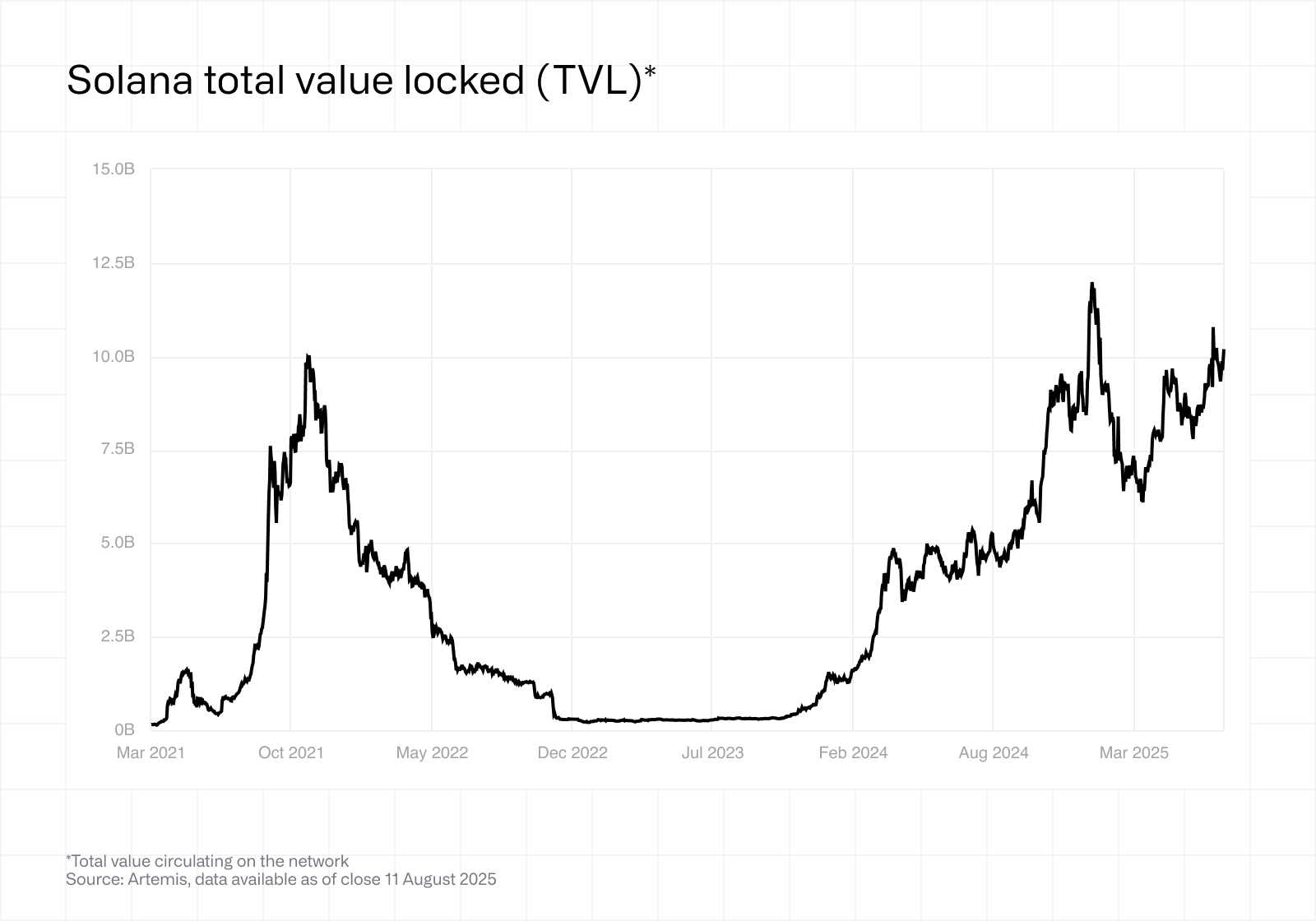
Solana total value locked (TVL)* A dominare sono due applicazioni di punta:

  • Jupiter (TVL: ≈2,9 miliardi di euro), un exchange decentralizzato per swap di token, negoziazione, prestiti e futures perpetui.

  • Jito Network (TVL: ≈3 miliardi di euro), una piattaforma di liquid staking che distribuisce ricompense di staking ed emette token che rappresentano SOL in staking affinché possano essere utilizzati in app DeFi.

Al di là della DeFi, Solana sta diventando un centro per gli asset reali (RWA) tokenizzati, un mercato che, secondo le stime, raggiungerà 1.700 miliardi di euro entro il 2030. Solana ospita già 421 milioni di euro di RWA tokenizzati, cifra che sale a 9,7 miliardi di euro se si includono le stablecoin.

Gli RWA sono strumenti finanziari tradizionali o asset tangibili emessi come token di una blockchain. Su Solana includono:

  • Titoli di Stato statunitensi tokenizzati, che offrono agli investitori accesso 24 ore su 24, 7 giorni su 7, a rendimenti in dollari senza dover passare attraverso una banca o un intermediario.

  • Fondi monetari, dove le istituzioni sfruttano la velocità e i costi bassi di Solana per emettere prodotti con regolamento in tempo reale.

  • Stablecoin, che rappresentano la principale categoria di RWA, con Solana che gestisce ogni giorno miliardi in trasferimenti di USDC e USDT.

Perché sono così importanti? Gli RWA connettono la finanza tradizionale alle blockchain, offrendo agli investitori una maggiore accessibilità, un regolamento istantaneo e costi potenzialmente più bassi rispetto alle infrastrutture tradizionali. Per quanto riguarda gli emittenti, la scalabilità di Solana garantisce che milioni di transazioni, dal pagamento delle cedole al trasferimento di proprietà, avvengano in maniera rapida ed economica.

Le istituzioni che stanno sperimentando con la tokenization degli RWA su Solana non sono solo startup fintech, ma anche banche globali e gestori di asset. Dalle obbligazioni tokenizzate di Société Générale alla scelta di BlackRock di esplorare l’emissione di fondi monetari, Solana è diventata una delle sedi preferite perché il suo throughput permette di gestire volumi istituzionali su larga scala.

Leader delle DePIN

Un altro caso d’uso che sta stimolando l’attività del protocollo, in cui Solana è già leader, sono le DePIN, piattaforme peer-to-peer dove gli individui e le aziende possono contribuire con risorse, come potenza di calcolo, larghezza di banda o spazio di archiviazione, e guadagnare ricompense per averlo fatto. Un utente, per esempio, può dare in prestito la propria larghezza di banda a una persona che ha bisogno di una connessione internet e ricevere ricompense sotto forma di token digitali.

Si tratta di uno degli esempi più chiari del fatto che le commissioni basse e il throughput elevato di Solana ne permettono l’adozione reale su larga scala.

Su Solana, i progetti DePIN stanno già facendo scalpore:

  • Render Network: un marketplace decentralizzato per la condivisione di GPU, dove creatori, produttori di videogiochi e persino case di produzione di Hollywood noleggiano potenza di calcolo inutilizzata per attività come il rendering 3D o l’addestramento dell’IA. Paramount Game Studio ha già utilizzato Render, dimostrandone l’attrattiva anche al di là del mondo delle criptovalute.

  • Helium: una rete wireless decentralizzata dove le persone possono creare hotspot economici per fornire Wi-Fi e ricevere ricompense in cambio. È già in attività a livello globale, offrendo a Solana una visibilità concreta nel settore delle telecomunicazioni.

  • Hivemapper: un servizio di mappatura basato su crowdsourcing che permette di guadagnare token condividendo le riprese della dash cam della propria auto. Col tempo, questo servizio potrebbe competere con i fornitori di mappe tradizionali, offrendo un’alternativa decentralizzata.

Solana è inoltre una delle poche reti ad aver prodotto il proprio hardware. Seeker è uno smartphone Android che offre funzionalità Web3, come un caveau per proteggere le chiavi private di un portafoglio digitale (necessarie per effettuare transazioni in criptovalute) e l’accesso allo store di app di Solana.

“Sviluppare dispositivi e store di app esclusivi per gli utenti cripto e addebitare commissioni molto più basse rispetto alle piattaforme tradizionali potrebbe aprire nuove strade nel monopolio dei giganti”, ha spiegato a PA News il fondatore di Solana, Anatoly Yakovenko. 

Questi esempi dimostrano la profonda importanza della capacità di Solana di elaborare migliaia di microtransazioni a costi bassi. Le DePIN richiedono piccoli pagamenti costanti (ricompense per i contributi in termini di dati, larghezza di banda o potenza di calcolo). Con una blockchain più lenta o costosa, questo modello non funzionerebbe. L’architettura di Solana lo rende possibile, rendendo questa blockchain la colonna portante di una nuova classe di infrastrutture su scala internet.

La finanziarizzazione di SOL

Ci sono diversi ETP negoziati in mercati europei, con asset in gestione per un totale di 2,2 miliardi di euro (a settembre 2025), che forniscono esposizione all’innovazione di Solana. Questi prodotti permettono di accedere a SOL più facilmente rispetto all’acquisto diretto su un exchange di criptovalute, poiché vengono negoziati sulle principali piattaforme di intermediazione. Ciò significa che possono essere inseriti in un portafoglio insieme ad asset tradizionali e contribuire ai rendimenti complessivi.

Solana sta inoltre registrando una crescente adozione istituzionale, un evento che in passato ha rappresentato un segnale fortemente positivo per Bitcoin. A settembre 2025, nei bilanci delle aziende si trovavano SOL per un valore di 850 milioni di euro. Due dei principali detentori sono DeFi Development Corp, uno sviluppatore di tecnologie per il settore immobiliare, e l’aggregatore di dati Upexi. Entrambe le società sono quotate in borsa, pertanto le loro azioni possono fungere da proxy di SOL.   

Conclusioni

La velocità e le commissioni di transazione ridotte di Solana hanno attirato gli utenti verso svariati casi d’uso promettenti, tra cui la tokenization degli RWA e le DePIN, rendendolo uno dei protocolli più grandi per TVL. Questo slancio ha aiutato SOL, il token nativo del protocollo, ad avvicinarsi al suo massimo storico a settembre 2025 (ma le performance passate non garantiscono risultati futuri). Sebbene gli investitori possano esporsi a SOL acquistando direttamente il token, delle soluzioni più accessibili sono gli ETP negoziati in borse tradizionali e le azioni di società con SOL nella propria tesoreria.  

Pubblicato ilOtt 1st, 2025

Scrittore
CoinShares Author Logo
CoinShares

Articoli correlati

Benvenuto to CoinShares

Dati personali

0102

Quando visiti il sito web di CoinShares, i cookie migliorano la tua esperienza. Ci aiutano a mostrarti contenuti più pertinenti. Alcuni cookie sono necessari per il funzionamento del sito e saranno sempre attivi. Bloccare alcuni tipi di cookie potrebbe influire sulla tua esperienza del sito web e sui servizi che offriamo sul nostro sito.

Utilizziamo i cookie sul nostro sito per ottimizzare i nostri servizi. Scopri di più sulla nostra politica sui cookie per l’UE o sulla nostra politica sui cookie per gli Stati Uniti.

  • Necessari
    Question circle icon
  • Preferences
    Question circle icon
  • Statistici
    Question circle icon
  • Marketing
    Question circle icon
I cookie necessari aiutano a rendere un sito web utilizzabile abilitando funzioni di base come la navigazione tra le pagine e l'accesso alle aree protette del sito. Il sito web non può funzionare correttamente senza questi cookie.
I cookie di preferenza permettono a un sito web di ricordare informazioni che modificano il modo in cui il sito si comporta o appare, come la lingua preferita o la regione in cui ti trovi.
I cookie statistici aiutano i proprietari del sito web a capire come i visitatori interagiscono con i siti raccogliendo e riportando informazioni in modo anonimo.
I cookie di marketing vengono utilizzati per tracciare i visitatori attraverso i siti web. L'intento è di mostrare annunci pertinenti e coinvolgenti per l'utente individuale, rendendoli così più preziosi per gli editori e gli inserzionisti di terze parti.