

This website uses cookies
We use cookies to personalise content and ads, to provide social media features and to analyse our traffic. We also share information about your use of our site with our social media, advertising and analytics partners who may combine it with other information that you’ve provided to them or that they’ve collected from your use of their services.
Consent Selection
Details
  • Necessary cookies help make a website usable by enabling basic functions like page navigation and access to secure areas of the website. The website cannot function properly without these cookies.

    • Learn more about this provideropens in a new window
      CookieConsentStores the user's cookie consent state for the current domain
      Maximum Storage Duration: 1 yearType: HTTP Cookie
    • Learn more about this provideropens in a new window
      bcookieUsed in order to detect spam and improve the website's security.
      Maximum Storage Duration: 1 yearType: HTTP Cookie
      li_gcStores the user's cookie consent state for the current domain
      Maximum Storage Duration: 180 daysType: HTTP Cookie
    • Learn more about this provideropens in a new window
      datadomeUsed in context with the website's BotManager. The BotManager detects, categorizes and compiles reports on potential bots trying to access the website.
      Maximum Storage Duration: 1 yearType: HTTP Cookie
    • _pk_testcookie_domainThis cookie determines whether the browser accepts cookies.
      Maximum Storage Duration: 1 dayType: HTTP Cookie
    • __cf_bm [x3]This cookie is used to distinguish between humans and bots. This is beneficial for the website, in order to make valid reports on the use of their website.
      Maximum Storage Duration: 1 dayType: HTTP Cookie
  • Preference cookies enable a website to remember information that changes the way the website behaves or looks, like your preferred language or the region that you are in.
    • Learn more about this provideropens in a new window
      lidcRegisters which server-cluster is serving the visitor. This is used in context with load balancing, in order to optimize user experience.
      Maximum Storage Duration: 1 dayType: HTTP Cookie
  • Statistic cookies help website owners to understand how visitors interact with websites by collecting and reporting information anonymously.
    • Learn more about this provideropens in a new window
      guestRegisters data on visitors' website-behaviour. This is used for internal analysis and website optimization.
      Maximum Storage Duration: 1 monthType: HTTP Cookie
    • Learn more about this provideropens in a new window
      personalization_idThis cookie is set by Twitter - The cookie allows the visitor to share content from the website onto their Twitter profile.
      Maximum Storage Duration: 400 daysType: HTTP Cookie
    • _pk_uidUsed by Piwik Analytics Platform to identify the visitor on repeat visits to the website.
      Maximum Storage Duration: 1 yearType: HTTP Cookie
      _pk_id#Collects statistics on the user's visits to the website, such as the number of visits, average time spent on the website and what pages have been read.
      Maximum Storage Duration: 1 yearType: HTTP Cookie
      _pk_ses#Used by Piwik Analytics Platform to track page requests from the visitor during the session.
      Maximum Storage Duration: 1 dayType: HTTP Cookie
    • FPGSIDRegisters statistical data on users' behaviour on the website. Used for internal analytics by the website operator.
      Maximum Storage Duration: 1 dayType: HTTP Cookie
      FPIDRegisters statistical data on users' behaviour on the website. Used for internal analytics by the website operator.
      Maximum Storage Duration: 400 daysType: HTTP Cookie
      FPLCRegisters a unique ID that is used to generate statistical data on how the visitor uses the website.
      Maximum Storage Duration: 1 dayType: HTTP Cookie
    • _gaRegisters a unique ID that is used to generate statistical data on how the visitor uses the website.
      Maximum Storage Duration: 2 yearsType: HTTP Cookie
      _ga_#Used by Google Analytics to collect data on the number of times a user has visited the website as well as dates for the first and most recent visit.
      Maximum Storage Duration: 2 yearsType: HTTP Cookie
  • Marketing cookies are used to track visitors across websites. The intention is to display ads that are relevant and engaging for the individual user and thereby more valuable for publishers and third party advertisers.
    • Learn more about this provideropens in a new window

      Some of the data collected by this provider is for the purposes of personalization and measuring advertising effectiveness. The provider may use the IP Addresses for ads measurement and ads personalization.

      ads/ga-audiencesUsed by Google AdWords to re-engage visitors that are likely to convert to customers based on the visitor's online behaviour across websites.
      Maximum Storage Duration: SessionType: Pixel Tracker
    • Learn more about this provideropens in a new window
      userRefererDetermines how the user accessed the website. This information is used by the website operator in order to measure the efficiency of their marketing.
      Maximum Storage Duration: 1 monthType: HTTP Cookie
    • Learn more about this provideropens in a new window
      #:session-dataTracks the individual sessions on the website, allowing the website to compile statistical data from multiple visits. This data can also be used to create leads for marketing purposes.
      Maximum Storage Duration: PersistentType: HTML Local Storage
      eng_mtTracks the conversion rate between the user and the advertisement banners on the website - This serves to optimise the relevance of the advertisements on the website.
      Maximum Storage Duration: PersistentType: HTML Local Storage
      t_gidThis cookie assigns a specific visitor ID, when the visitor interacts with ads or content from the website - this allows the website to target the visitor with similar ads or content.
      Maximum Storage Duration: 1 yearType: HTTP Cookie
      t_pt_gidCollects information on user preferences and/or interaction with web-campaign content - This is used on CRM-campaign-platform used by website owners for promoting events or products.
      Maximum Storage Duration: 1 yearType: HTTP Cookie
      taboola global:user-idSets a unique ID for the visitor, that allows third party advertisers to target the visitor with relevant advertisement. This pairing service is provided by third party advertisement hubs, which facilitates real-time bidding for advertisers.
      Maximum Storage Duration: PersistentType: HTML Local Storage
      taboola_session_idThis cookie is used to collect information on a visitor. This information will become an ID string with information on a specific visitor – ID information strings can be used to target groups with similar preferences, or can be used by third-party domains or ad-exchanges.
      Maximum Storage Duration: SessionType: HTTP Cookie
    • Learn more about this provideropens in a new window
      1/i/adsct [x2]Collects data on user behaviour and interaction in order to optimize the website and make advertisement on the website more relevant.
      Maximum Storage Duration: SessionType: Pixel Tracker
      muc_adsCollects data on user behaviour and interaction in order to optimize the website and make advertisement on the website more relevant.
      Maximum Storage Duration: 400 daysType: HTTP Cookie
      guest_idCollects data related to the user's visits to the website, such as the number of visits, average time spent on the website and which pages have been loaded, with the purpose of personalising and improving the Twitter service.
      Maximum Storage Duration: 400 daysType: HTTP Cookie
      guest_id_adsCollects information on user behaviour on multiple websites. This information is used in order to optimize the relevance of advertisement on the website.
      Maximum Storage Duration: 400 daysType: HTTP Cookie
      guest_id_marketingCollects information on user behaviour on multiple websites. This information is used in order to optimize the relevance of advertisement on the website.
      Maximum Storage Duration: 400 daysType: HTTP Cookie
    • _gcl_auUsed by Google AdSense for experimenting with advertisement efficiency across websites using their services.
      Maximum Storage Duration: 3 monthsType: HTTP Cookie
      _gcl_lsTracks the conversion rate between the user and the advertisement banners on the website - This serves to optimise the relevance of the advertisements on the website.
      Maximum Storage Duration: PersistentType: HTML Local Storage
    • pardot [x2]Used in context with Account-Based-Marketing (ABM). The cookie registers data such as IP-addresses, time spent on the website and page requests for the visit. This is used for retargeting of multiple users rooting from the same IP-addresses. ABM usually facilitates B2B marketing purposes.
      Maximum Storage Duration: SessionType: HTTP Cookie
  • Unclassified cookies are cookies that we are in the process of classifying, together with the providers of individual cookies.
    • cs_analytics_ip_blockedPending
      Maximum Storage Duration: SessionType: HTTP Cookie
      user_tokenPending
      Maximum Storage Duration: 1 yearType: HTTP Cookie
    • _twpidPending
      Maximum Storage Duration: SessionType: HTTP Cookie
Cookie declaration last updated on 8/20/26 by Cookiebot
[#IABV2_TITLE#]
[#IABV2_BODY_INTRO#]
[#IABV2_BODY_LEGITIMATE_INTEREST_INTRO#]
[#IABV2_BODY_PREFERENCE_INTRO#]
[#IABV2_BODY_PURPOSES_INTRO#]
[#IABV2_BODY_PURPOSES#]
[#IABV2_BODY_FEATURES_INTRO#]
[#IABV2_BODY_FEATURES#]
[#IABV2_BODY_PARTNERS_INTRO#]
[#IABV2_BODY_PARTNERS#]
About
Cookies are small text files that can be used by websites to make a user's experience more efficient.

The law states that we can store cookies on your device if they are strictly necessary for the operation of this site. For all other types of cookies we need your permission.

This site uses different types of cookies. Some cookies are placed by third party services that appear on our pages.

You can at any time change or withdraw your consent from the Cookie Declaration on our website.

Learn more about who we are, how you can contact us and how we process personal data in our Privacy Policy.

Please state your consent ID and date when you contact us regarding your consent.
Image Come esporsi alle criptovalute

Come esporsi alle criptovalute

Timer10 minuti di lettura

  • Finanza

Una volta deciso di aggiungere le criptovalute al vostro portafoglio, il passo successivo è scegliere come ottenere tale esposizione. Per gli investitori europei esistono tre principali modalità: l’acquisto a pronti (spot) tramite exchange, i derivati su criptovalute e gli Exchange-Traded Products (ETP). Ognuna presenta diversi livelli di regolamentazione, sicurezza e semplicità operativa.

Quali sono i principali modi per investire in criptovalute?

Oggi gli investitori europei hanno più opzioni che mai per accedere agli asset digitali. Le tre principali modalità sono:

  1. Proprietà diretta tramite exchange — acquistare e detenere personalmente criptovalute

  2. Derivati — contratti il cui valore deriva dal prezzo delle criptovalute

  3. Exchange-Traded Products (ETP) — strumenti finanziari regolamentati che replicano l’andamento dei prezzi delle criptovalute

La scelta più adatta dipende dai vostri obiettivi di investimento, dal livello di familiarità tecnica e dal grado di responsabilità che desiderate assumervi in termini di custodia e sicurezza.

Come funziona l’acquisto diretto di criptovalute sugli exchange?

Gli exchange di criptovalute consentono di acquistare e vendere direttamente asset digitali. Quando acquistate Bitcoin o Ethereum su un exchange, detenete l’asset sottostante — questa è definita esposizione diretta.

Tuttavia, la proprietà diretta comporta responsabilità significative:

  • Rischio di custodia: siete responsabili della sicurezza dei vostri asset, sia che siano conservati sull’exchange sia in un wallet personale

  • Gestione delle chiavi: se utilizzate l’auto-custodia (wallet privato), la perdita delle chiavi private comporta la perdita permanente delle vostre criptovalute

  • Rischio della piattaforma: gli exchange possono subire attacchi informatici, interruzioni operative o insolvenza

La detenzione diretta di criptovalute richiede quindi la gestione della custodia, la comprensione della sicurezza dei wallet e la capacità di gestire la complessità tecnica delle transazioni su blockchain.

Cosa è cambiato con MiCA?

Il quadro normativo per gli exchange di criptovalute in Europa è cambiato radicalmente nel 2024–2025. Il regolamento sui mercati delle cripto-attività (MiCA) è diventato pienamente applicabile il 30 dicembre 2024, imponendo a tutti i fornitori di servizi per cripto-attività (CASP) — inclusi gli exchange — di ottenere un’autorizzazione per operare nell’UE.

In base a MiCA, gli exchange devono ora:

  • Ottenere licenze dalle autorità nazionali competenti

  • Rispettare requisiti patrimoniali e standard di governance

  • Conformarsi agli obblighi antiriciclaggio (AML)

  • Fornire informazioni chiare e trasparenti ai clienti

Si tratta di un miglioramento significativo rispetto al periodo pre-MiCA, quando gli standard normativi variavano notevolmente tra le diverse giurisdizioni. Il crollo di FTX nel 2022 — in cui un exchange offshore ha gestito impropriamente i fondi dei clienti, lasciando gli investitori senza accesso ai propri asset — ha evidenziato i rischi legati a piattaforme scarsamente regolamentate.

Spot trading on crypto exchanges

E per quanto riguarda i derivati su criptovalute?

I derivati sono contratti finanziari il cui valore si basa su un asset sottostante — in questo caso, una criptovaluta. Esistono due principali canali: derivati over-the-counter (OTC) e derivati quotati.

Derivati OTC

I derivati OTC sono negoziati privatamente tra le parti anziché su mercati regolamentati. Strumenti come i perpetual swap non hanno una data di scadenza, consentendo ai trader di mantenere le posizioni a tempo indeterminato.

Tuttavia, i derivati OTC sono generalmente scambiati su piattaforme offshore con trasparenza limitata. L’investitore è esposto al rischio di controparte — se l’altra parte non adempie ai propri obblighi, la posizione può andare perduta.

Derivati quotati

I derivati quotati sono negoziati su mercati regolamentati come il Chicago Mercantile Exchange (CME). Sono soggetti alla vigilanza di autorità come la Commodity Futures Trading Commission (CFTC) negli Stati Uniti o la Financial Conduct Authority (FCA) nel Regno Unito.

I derivati quotati offrono maggiori tutele — le operazioni sono garantite da una clearing house che funge da controparte per entrambe le parti, riducendo il rischio di default. Tuttavia, si tratta di strumenti complessi, generalmente adatti a investitori esperti.

Crypto assets derivatives

Cosa sono gli ETP crypto e perché gli investitori europei li utilizzano?

Gli Exchange-Traded Products (ETP) rappresentano una terza modalità: ottenere esposizione alle criptovalute tramite strumenti finanziari regolamentati negoziati su borse valori tradizionali.

Un ETP è uno strumento finanziario che replica il prezzo di un asset sottostante — in questo caso criptovalute come Bitcoin o Ethereum — senza richiedere che l’investitore possieda o custodisca direttamente l’asset.

Perché ETP e non ETF in Europa?

Potreste aver sentito parlare del lancio degli ETF su Bitcoin negli Stati Uniti nel gennaio 2024. In Europa, il termine “ETP” è più corretto rispetto a “ETF” a causa delle differenze normative.

Secondo la normativa UCITS dell’UE, un fondo non può essere basato su un singolo asset. Ciò significa che Bitcoin o Ethereum non possono essere strutturati come ETF in Europa. I prodotti crypto europei sono generalmente strutturati come Exchange-Traded Commodities (ETC) o Exchange-Traded Notes (ETN) — entrambi rientranti nella categoria più ampia degli ETP. Non si tratta di una specificità delle criptovalute: ad esempio, anche l’oro utilizza la stessa struttura.

In definitiva, gli ETP crypto europei svolgono la stessa funzione degli ETF crypto statunitensi: offrire un accesso regolamentato e pratico ai prezzi degli asset digitali.

Quali sono i vantaggi degli ETP crypto?

  1. Regolamentazione e vigilanza

    Gli ETP sono strumenti regolamentati e supervisionati dalle autorità finanziarie nazionali. Sono negoziati su borse valori regolamentate insieme agli asset tradizionali. Gli ETP Physical di CoinShares, ad esempio, sono quotati su importanti mercati europei, tra cui Xetra (Germania), Euronext (Francia e Paesi Bassi) e SIX Swiss Exchange (Svizzera).

  2. Nessun onere di custodia

    Con un ETP fisicamente collateralizzato, l’emittente acquista e custodisce la criptovaluta sottostante per vostro conto. Gli asset sono detenuti presso custodi di livello istituzionale, eliminando la complessità tecnica legata alla gestione dei wallet e delle chiavi private.

  3. Proof of reserves

    Gli emittenti affidabili di ETP forniscono una verifica trasparente che ogni prodotto sia supportato da criptovalute effettive. Gli ETP CoinShares, ad esempio, sono verificati in modo indipendente da The Network Firm, con riserve consultabili pubblicamente in tempo reale.

  4. Integrazione nel portafoglio

    Gli ETP possono essere acquistati tramite il vostro broker, banca o piattaforma di investimento abituale. Sono integrati accanto agli altri investimenti — azioni, obbligazioni, fondi — in un unico conto, facilitando monitoraggio e ribilanciamento.

  5. Varietà di prodotti

    Gli ETP consentono l’esposizione a singoli asset (Bitcoin, Ethereum, Solana) o a panieri diversificati tramite prodotti indicizzati. Alcuni ETP offrono anche ricompense da staking integrate, condividendo con gli investitori il rendimento generato dalle criptovalute basate su proof-of-stake.

Crypto ETPs

Quali sono le limitazioni?

A differenza degli exchange crypto (operativi 24 ore su 24, 7 giorni su 7), gli ETP possono essere negoziati solo quando la borsa su cui sono quotati è aperta. Questa finestra di negoziazione più limitata è coerente con quella degli altri asset finanziari tradizionali. Sebbene alcuni possano considerarlo uno svantaggio, noi lo riteniamo una caratteristica positiva, in quanto limita reazioni impulsive ai movimenti di mercato.

Come scegliere l’approccio più adatto?

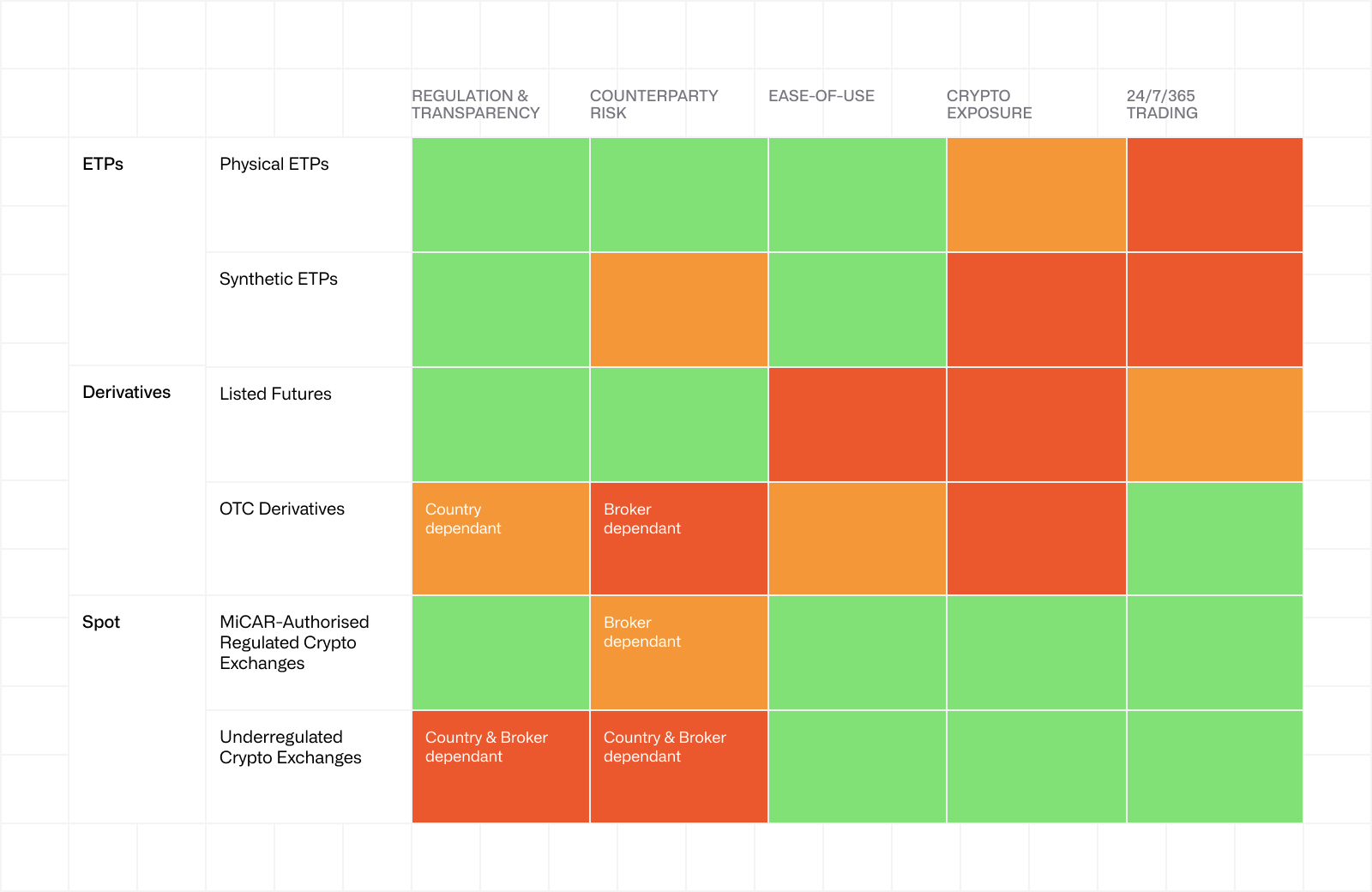
Il metodo migliore dipende dalle vostre priorità:
Crypto opportunities
Per gli investitori che desiderano un’esposizione semplice senza gestire custodia, sicurezza o complessità tecniche della blockchain, gli ETP rappresentano una soluzione efficace. Offrono i benefici dell’esposizione ai prezzi delle criptovalute all’interno di un quadro regolamentato e familiare.

Per coloro che desiderano controllo diretto, la possibilità di utilizzare le criptovalute per pagamenti o applicazioni DeFi, oppure l’accesso a una gamma più ampia di asset, la proprietà diretta tramite un exchange regolamentato MiCA può essere appropriata — a condizione di essere pronti ad assumersi le responsabilità legate alla custodia.

Conclusione

Il mondo degli investimenti in criptovalute offre molteplici punti di ingresso, ciascuno con compromessi distinti tra controllo, praticità e sicurezza.

Il contesto normativo europeo è maturato significativamente. MiCA fornisce ora un quadro completo per exchange e fornitori di servizi, mentre gli ETP continuano a rappresentare un ponte regolamentato tra finanza tradizionale e asset digitali. Gli investitori europei hanno accesso agli ETP crypto sin dal 2015 — offrendo alla regione un vantaggio iniziale nei prodotti crypto regolamentati.

Qualunque sia il percorso scelto, è fondamentale comprendere i rischi e le normative associate a ciascuna opzione. La vostra decisione dovrebbe essere coerente con i vostri obiettivi di investimento, il vostro livello di competenza tecnica e il tempo che intendete dedicare alla gestione dell’esposizione alle criptovalute.

Per esplorare la gamma di ETP crypto di CoinShares, visitate il nostro catalogo prodotti.

Pubblicato ilFeb 18th, 2026

Scrittore
CoinShares Author Logo
CoinShares

Benvenuto to CoinShares

Dati personali

0102

Quando visiti il sito web di CoinShares, i cookie migliorano la tua esperienza. Ci aiutano a mostrarti contenuti più pertinenti. Alcuni cookie sono necessari per il funzionamento del sito e saranno sempre attivi. Bloccare alcuni tipi di cookie potrebbe influire sulla tua esperienza del sito web e sui servizi che offriamo sul nostro sito.

Utilizziamo i cookie sul nostro sito per ottimizzare i nostri servizi. Scopri di più sulla nostra politica sui cookie per l’UE o sulla nostra politica sui cookie per gli Stati Uniti.

  • Necessari
    Question circle icon
  • Preferences
    Question circle icon
  • Statistici
    Question circle icon
  • Marketing
    Question circle icon
I cookie necessari aiutano a rendere un sito web utilizzabile abilitando funzioni di base come la navigazione tra le pagine e l'accesso alle aree protette del sito. Il sito web non può funzionare correttamente senza questi cookie.
I cookie di preferenza permettono a un sito web di ricordare informazioni che modificano il modo in cui il sito si comporta o appare, come la lingua preferita o la regione in cui ti trovi.
I cookie statistici aiutano i proprietari del sito web a capire come i visitatori interagiscono con i siti raccogliendo e riportando informazioni in modo anonimo.
I cookie di marketing vengono utilizzati per tracciare i visitatori attraverso i siti web. L'intento è di mostrare annunci pertinenti e coinvolgenti per l'utente individuale, rendendoli così più preziosi per gli editori e gli inserzionisti di terze parti.