


What is Zcash - ZEC guide
 10 Min. Lesezeit
- Altcoins
What is Zcash (ZEC)?
Bitcoin made value transfer permissionless but left every transaction in public view. Zcash set out to keep the monetary design and remove the transparency, then made the privacy optional.
Zcash is a layer-1 blockchain, a base-level network that processes its own transactions rather than settling on another chain. It launched in October 2016, forked from the Bitcoin codebase, and was built by a team led by Zooko Wilcox-O'Hearn at the company now known as the Electric Coin Company. Its native token is ZEC.
The design goal was narrow. Zcash keeps Bitcoin's monetary properties and adds the ability to hide who paid whom and how much. The pitch is sound money, but private. Its foundation is a 2014 academic paper, Zerocash, written by cryptographers at Johns Hopkins, MIT, the Technion and Tel Aviv University, which set out how a blockchain could verify a transaction without seeing its contents. That mechanism, the zero-knowledge proof, is what makes Zcash work.
Privacy on Zcash is a choice. In its default mode it behaves almost exactly like Bitcoin: open, auditable, transparent. Privacy has to be switched on, and most of the argument about whether Zcash works follows from that decision.
Technical features
Proof of work and monetary design
Zcash inherited most of Bitcoin's monetary architecture: a hard cap of 21 million ZEC, of which roughly 16.78 million are in circulation according to Token Terminal data; proof of work, so miners expend electricity and are paid in new issuance plus fees; and a halving every 1,680,000 blocks, roughly four years, which most recently cut the block reward to 1.5625 ZEC in November 2024.
One difference matters. Since the NU6 upgrade, 20% of each block subsidy goes not to miners but to protocol development: 8% to Zcash Community Grants and 12% to a lockbox that the NU6.1 upgrade turned into a Coinholder-Controlled Fund, spendable by coinholder vote with a quorum of 420,000 ZEC. A fifth of the security budget buys development rather than hashrate, and ZEC holders decide where it goes.
Zcash uses Equihash rather than Bitcoin's SHA-256, so the two hashrates are measured in different units and cannot be compared. The comparison that works is economic. Token Terminal data shows miners received around $117M in block subsidy across 2025, a small fraction of Bitcoin's security budget, which makes the chain cheaper to attack and is the substance behind the claim that ZEC offers weaker settlement assurances.
Transparent and shielded addresses
Zcash has two kinds of address. Transparent addresses, or t-addresses, work like Bitcoin addresses: sender, receiver and amount are all published. Shielded addresses hide all three. So a transaction can run transparent to transparent, transparent to shielded (opting in), shielded to shielded (fully private), or shielded to transparent (opting out).
What makes a shielded transaction private is the zero-knowledge proof. The network needs to confirm that the sender owns the funds and is not spending them twice. The proof demonstrates both without revealing the sender, the receiver or the amount. The network verifies the maths and learns nothing else.
Zcash also supports viewing keys. A holder can transact privately and separately give an auditor or tax authority the ability to inspect one specific transaction, so a fund can show a single trade without exposing the rest of its book.
The shielded pools
A shielded pool is a shared cryptographic set that every private transaction draws on. Shield funds and they join one anonymity set; any later spend proves it is drawing validly from that set without revealing which part. Zcash has run four generations, each introduced by a network upgrade, and each is a separate pool with its own separate anonymity set.
Sprout was slow and barely used. Sapling made shielded transactions practical. Both relied on a trusted setup, a one-time ceremony generating secret parameters that could in principle have been kept and used to forge proofs. Orchard, built on the Halo 2 proving system, eliminated that risk rather than mitigating it: it was the first Zcash pool needing no trusted setup at all.
Ironwood, activated in July 2026, reuses Orchard's circuit and proof system. Its significance is that it seals Orchard. It shipped with a machine-checked proof of more than 2,700 theorems establishing that no undetectable counterfeiting bugs exist in the pool's mathematics, though its authors are explicit that this is not an end-to-end proof of the deployed software.
The Orchard vulnerability
Ironwood exists because of an incident in mid-2026.
In late May, a security researcher auditing the protocol for Shielded Labs found a soundness bug in Orchard's proof circuit that had been live since 2022. Soundness is the guarantee that a network only accepts valid transactions; this flaw meant Orchard could have accepted invalid ones, and a working exploit generated undetectable counterfeit ZEC in a test environment. Because shielded transactions hide their contents by design, nobody could have seen it happening.
Developers disabled Orchard through an emergency soft fork and activated a corrected circuit the next day. The fix shipped before the flaw was disclosed publicly on 4 June. The market sold the disclosure anyway, and ZEC fell around 50% in roughly 48 hours.
The 21 million cap was never at risk, thanks to a mechanism called the turnstile, which enforces that no more value can leave a pool than legitimately entered it. Value could have been forged inside Orchard; it could not have escaped into circulation. There is no evidence it ever was. This was not the first counterfeiting flaw Zcash has patched, though: an earlier one, found in 2018, was quietly remediated by Sapling.
What the fix could not do was prove a negative. Because Orchard's contents are hidden, nobody can demonstrate that no counterfeit ZEC was ever minted there. Ironwood resolves this by sealing the pool: funds can only leave, through the turnstile, and once they have, anyone running a node can verify that circulating ZEC does not exceed what it should.
How much of Zcash is actually private
Around 4.36 million ZEC sits in shielded addresses, roughly a quarter of circulating supply. The other three quarters are transparent. That share has climbed steeply from about 8% in early 2024 and peaked above 30% in May 2026, just before the Orchard disclosure prompted holders to withdraw.
The subtler point is that shielded supply is split four ways, and only one pool is a live destination: Ironwood, which held nothing at all before July. A zero-knowledge proof hides a transaction among everything in its own pool, so pool size is privacy, and the migration that made Zcash's supply verifiable also shrank the crowd a shielded user hides in. There is a second limit too. Because shielding is optional, moving funds in and out can leak information through timing and amount patterns. Neither the cryptography nor the upgrade cadence is the binding constraint on Zcash privacy. User behaviour is.
Market position
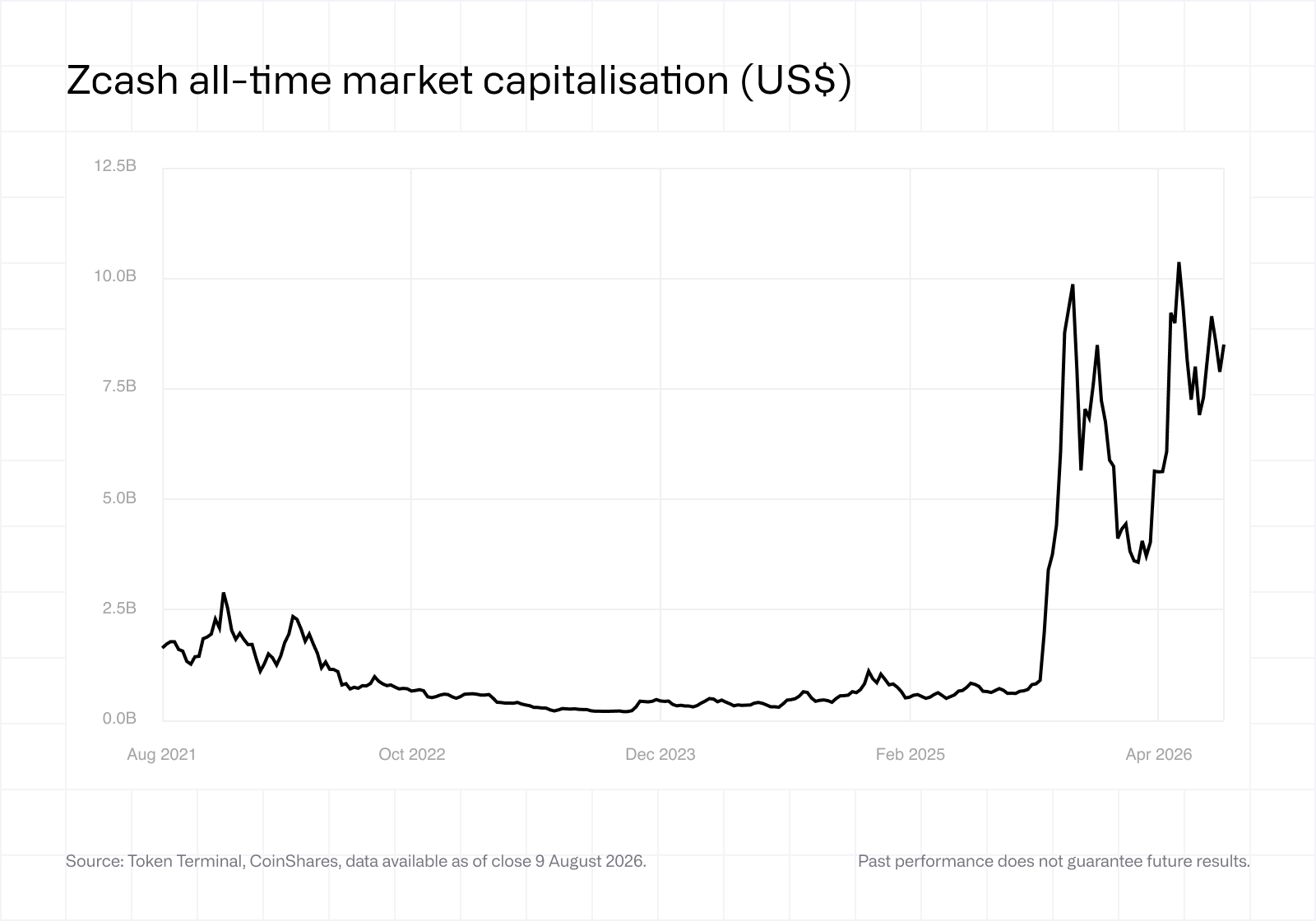
ZEC's market capitalisation is roughly $8.6B against Bitcoin's $1.30T, or about 0.66% of Bitcoin's size. The figure that frames everything else is fees: Token Terminal data shows users paid around $430,000 in transaction fees across 2025, while miners received about $117M in new issuance. Usage contributes almost nothing to the cost of securing this chain; issuance does nearly all of it. The same is true of Bitcoin, but at Bitcoin's scale. Exchange and custody support is also narrower, for regulatory reasons covered below.
ZEC use cases
ZEC is not a cash-flow asset. There is no staking yield, no fee burn, no buyback and no protocol revenue accruing to holders. That leaves three uses. Fees are paid in ZEC to miners, who also receive 80% of new issuance. Shielded addresses conceal sender, receiver and amount from everyone, including the miners processing the transaction, which is the only function Zcash offers that Bitcoin does not. And viewing keys allow a holder to prove one transaction's contents to a chosen party without publishing anything on the chain, which for an institution needing confidentiality from competitors and legibility to auditors is the most commercially interesting property Zcash has.
Where Zcash can be bought
Regulatory treatment is a first-order determinant of liquidity for a privacy asset, and it is uneven.
In the European Union, MiCA Article 76(3) requires trading platforms to prevent the admission of crypto-assets with an inbuilt anonymisation function, unless the platform can identify holders and their transaction history. That is a conditional admission control, not an outright ban, and venues that still list ZEC rely on the conditional clause. In practice EU exchanges have diverged: some removed ZEC, others list it while restricting deposits and withdrawals to transparent addresses. MiCA does not ban the protocol or the token, and holding ZEC or transacting transparently remains lawful.
A second instrument sits ahead. From 10 July 2027, Article 79 of the EU Anti-Money Laundering Regulation prohibits credit institutions, financial institutions and crypto-asset service providers from keeping anonymous crypto-asset accounts, or any account that allows the account holder to be anonymised or transactions to be anonymised or obscured, including through anonymity-enhancing coins. The AMLR defines those coins as crypto-assets with built-in features designed to make transfer information anonymous, systematically or optionally, so an opt-in privacy asset such as ZEC falls within the definition although the restriction applies to the accounts regulated intermediaries may keep, not to individuals holding the token.
Outside the EU, Zcash's optionality has kept it on a wider set of regulated venues than Monero, notably in the United States. In the UK and Switzerland, neither bound by these rules, availability depends on venue policy.Since 28 October 2026, it is now possible to get exposure to the ZCash token with a regulated product listed on regulated venues with the CoinShares ZCash ETP.
FAQ
What is Zcash?
Zcash is a layer-1 blockchain launched in 2016 as a fork of Bitcoin, designed to let users transact privately. It shares Bitcoin's monetary design, a 21 million supply cap, proof of work and four-yearly halvings, and adds shielded addresses that hide the sender, receiver and amount using zero-knowledge proofs. ZEC is its native token.
Is Zcash actually anonymous?
Only when you choose to make it so. Privacy is opt-in, so a default transaction is as visible as a Bitcoin transaction. Shielded transactions do conceal sender, receiver and amount, but only about a quarter of ZEC sits in shielded addresses, and that supply is split across four separate pools, so the crowd a user hides in is much smaller than the total. Moving funds in and out of shielded addresses can also leak information through timing and amount patterns.
What is the difference between Zcash and Monero?
Monero is private by default; Zcash privacy is optional. Monero therefore has no transparent majority diluting its privacy, which is also why regulated exchanges have removed it almost everywhere. A Zcash shielded transaction hides among a whole pool rather than a fixed ring of decoys, so it conceals more per transaction, while Monero conceals more consistently. Zcash viewing keys also disclose a single transaction, where Monero's expose a whole incoming history.
Can you buy Zcash in Europe?
It depends on the venue. MiCA Article 76(3) conditions the listing of assets with an inbuilt anonymisation function on the platform being able to identify holders and their transaction history, so some EU exchanges removed ZEC while others list it with shielded deposits and withdrawals restricted. Holding ZEC and transacting transparently remain lawful. The EU Anti-Money Laundering Regulation's restrictions apply to intermediaries from 10 July 2027. There is now a regulated and traditional way to get exposure to Zcash through ETPs.
Veröffentlicht amOkt 28th, 2026
