



What is Tezos - XTZ guide
 15 min read
- Altcoins
- Technology
The materials on this website or any third-party websites accessed herein are not associated with and have not been reviewed or approved by: (i) Valkyrie Funds LLC dba CoinShares, its products, or the distributor of its products, or (ii) CoinShares Co., its products, or the marketing agent of its products.
Tezos: The self-amending blockchain
Tezos is a Layer 1 (L1) blockchain, like Ethereum and Solana, and it uses a variation of the proof of stake consensus mechanism to process transactions and secure the network. What sets it apart from other blockchains is its unique governance, which allows the protocol to update automatically.
Key figures
Launch date: 2018
Total value locked (TVL): between $21M and $28M as of mid-2026
Market capitalisation: $220,3M (as of 30 June 2026)
Daily transactions: 112K (including internal transactions, as of December 2025)
Tezos at a glance
Governance: Tezos is a ‘self-amending’ blockchain. Once holders of its native token (XTZ) vote to approve a network upgrade, it happens automatically. This approach prevents splits in the chain, which would create a new cryptocurrency (as happened with bitcoin cash), known as a ‘hard fork’. The mechanism has now delivered twenty-one protocol upgrades since 2018, which is the strongest evidence available that it works as advertised.
Durability: Since launching in 2018, the network’s uptime- how long it has remained online without disruptions due to technical faults- is 99.99%. This uptime is comparable to Bitcoin, which is considered a highly resilient blockchain.
Generative art: Tezos has established itself as a major supporter of computer-generated art, driven by the launch of pioneering marketplace FXHash in 2021, followed by platforms such as Objkt and Verse.
Protocol mechanism
PoS requires participants known as validators to deposit or ‘stake’ a certain amount of the blockchain’s native token for the right to process transactions. In return for this service, they receive rewards in the form of freshly minted tokens, while the network punishes dishonest behaviour with financial penalties.
The Tezos version is called liquid PoS. ‘Bakers’ must stake 8,000 XTZ (worth roughly $1,620 as of 30 June 2026) to participate. If you don’t meet this threshold, you can delegate your tokens to other bakers and earn a share of the rewards. The term ‘liquid’ refers to the ability to use your delegated tokens elsewhere, for instance to generate a return from a decentralised finance (DeFi) app like a lending protocol.
Market performance
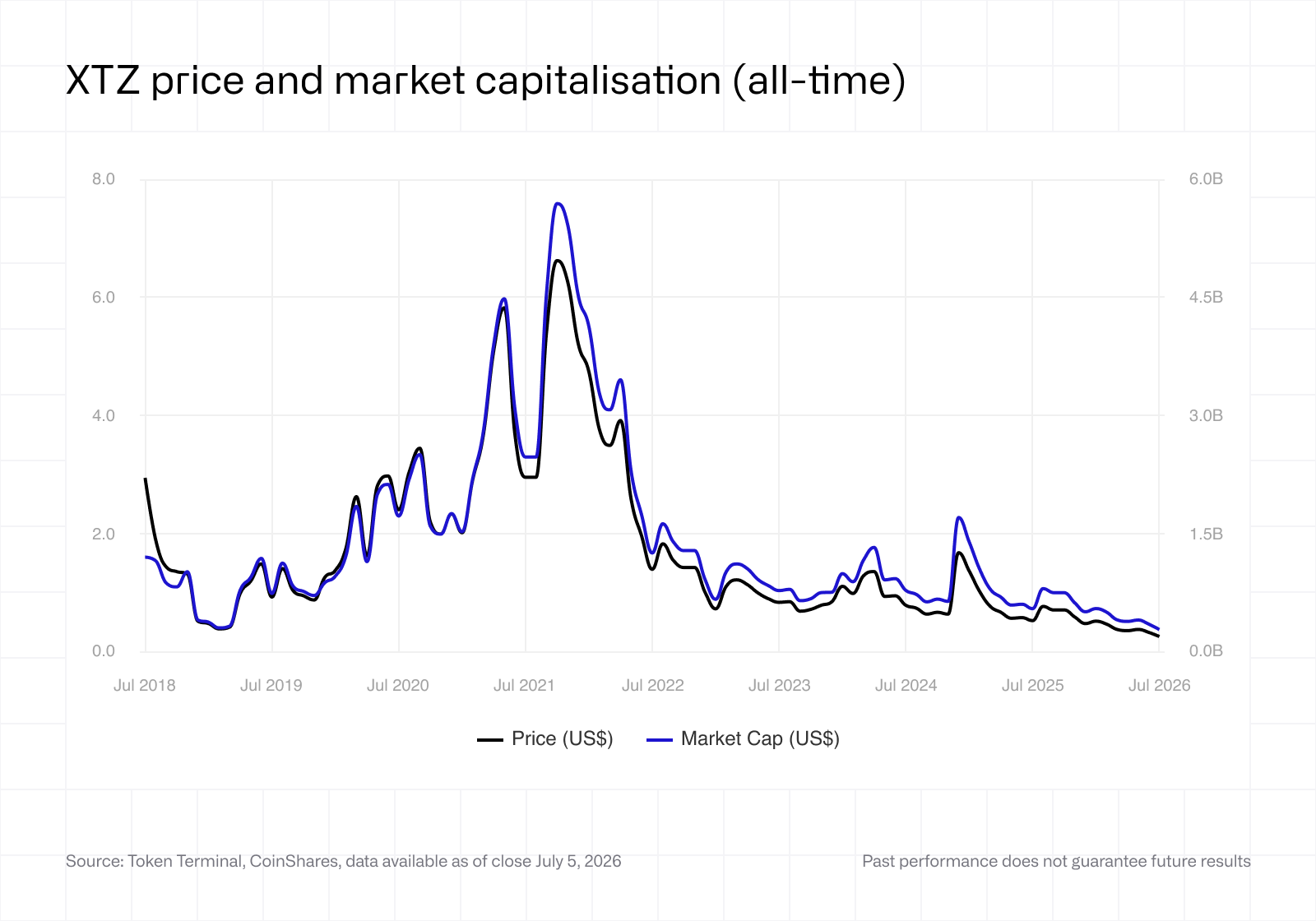
XTZ traded at $0,202 on 30 June 2026, giving a circulating market capitalisation of $220,3M across 1,09 billion tokens. The token fell 63,7% across 2025 and a further 60,0% in the first half of 2026. Against the October 2021 peak of $8,55, XTZ is down about 98%. Past performance is not a guide to future returns.
History
Spouses team Arthur and Kathleen Breitman created Tezos in 2014 and raised funds through an initial coin offering (ICO), the crypto version of a public listing, in 2017. The ICO raised $232M, a record at the time, and the blockchain went live in September 2018.
Key milestones
May 2019: The Athens update reduced the minimum roll to 8,000 XTZ, making participation in the consensus mechanism more accessible.
March 2020: The Carthage update increased Tezos’ capacity to process transactions by 30%.
February 2021: The Edo upgrade enhanced privacy by introducing Zero-Knowledge Proofs, which allow one party to prove something to another without revealing the exact information (a bit like proving you’re over 18 to a bouncer without having to show ID).
September 2022: The Kathmandu update prepared the protocol for rollups, which reduce congestion by processing transactions on a Layer 2 (L2) network, another important step for scalability.
March 2023: The Mumbai update activated the rollups.
June 2024: The Paris update reduced the network’s block time, the average time it takes to produce a new block of transactions, to 10 seconds, further enhancing scalability.
January 2025: The Quebec update reduced the block time to eight seconds.
February 2025: Tezos launched Etherlink, its own L2 network, which is compatible with the Ethereum virtual machine, the software powering Ethereum.
May 2025: The Rio update, the 18th upgrade, shortened cycles to one day and cut the unstaking wait from ten days to four.
September 2025: The Seoul update, the 19th upgrade, added protocol-native multisig for Tezos accounts, aimed squarely at institutional custody requirements.
2026: Two further upgrades followed,reducing block time to six seconds and moving to an all-bakers attestation model, and raising Data Availability Layer bandwidth to 10 MB/s.
What's next
In June 2024, Tezos published its vision for the protocol’s future, which it calls Tezos X. Instead of relying on a multitude of L2s (like Ethereum), Tezos X aims to create a single L2 that can handle every transaction processed on the L1 blockchain, with the target of processing 1M transactions per second (TPS). For context, Visa has a TPS of up to 83K. To support interoperability (interaction between different blockchains), developers will be able to use a variety of programming languages to build smart contracts, programmes which automatically execute when preconditions are met (comparable to a vending machine). Smart contracts serve as the building blocks for decentralised applications (dApps).
As for Etherlink, in an interview with CoinShares conducted in April 2025, co-founder Arthur Breitman explained that the early momentum is coming from DeFi apps like decentralised exchanges and lending protocols, along with memecoins and gaming. Tezos is trying to incentivise participation in its DeFi ecosystem with a rewards program called Apple Farm. The first ‘season’ generated $50M in TVL, a metric used to measure the value of funds deposited by users in the network’s dApps. The second season launched in July 2025 with a reward pool of $3M.
A year on, the Etherlink numbers tell a clear story about incentivised TVL. Etherlink TVL climbed from $1,5M at the end of 2024 to a peak of $83,3M on 2 November 2025, then fell to $16,7M by 30 June 2026, a decline of about 80% from the peak.2 Deposits arrived while rewards were being paid and left afterwards. That is not unique to Tezos, and it is the normal outcome of liquidity mining.
CoinShares’ analysis
Tezos benefits from a strong governance model and a durable network. However, while Etherlink grew quickly and then gave most of it back, and Tezos faces stiff competition from rival blockchains that have already gained greater traction.
Strengths
Tezos’ unique governance mechanism prevents potentially disruptive ‘hard forks’, avoiding the creation of a new token and splits in the community. This also provides consistency for dApp developers. Twenty-one upgrades in eight years, none of them contentious enough to fork the chain, is a significant result.
The Tezos network has proven to be highly durable and resilient since launching in 2018, with an uptime of 99.99%.
Weaknesses
By Arthur Breitman’s own admission, Tezos didn’t evolve fast enough in the early days and fell behind rivals in 2019 and 2020. He feels the blockchain is still catching up.
Breitman also acknowledges that Tezos struggles with low adoption (reflected in its market cap). The network collected $50,711 in total transaction fees across the whole of 2025 and $10,615 over the first half of 2026.
Opportunities
Etherlink gives Tezos an EVM-compatible surface, which lowers the cost of porting existing Ethereum applications across.
One DeFi use case where Tezos has something of a head start is the tokenisation of real-world assets (a sector potentially worth up to $30T). Tokenised uranium started trading on Tezos in December 2024.
Threats
Tezos may struggle to grow its market share due to competition from rivals, which have already achieved significant adoption.
If Tezos fails to realise its ambitious vision for the future, it could raise long-term questions about its viability.
Published onFeb 26th, 2024