



What is Avalanche - AVAX guide
 7 min read
- Altcoins
The materials on this website or any third-party websites accessed herein are not associated with and have not been reviewed or approved by: (i) Valkyrie Funds LLC dba CoinShares, its products, or the distributor of its products, or (ii) CoinShares Co., its products, or the marketing agent of its products.
The beginnings of Avalanche
Avalanche is a Layer‑1 blockchain launched in 2020 by Ava Labs, a team spun out of research led by Cornell professor Emin Gün Sirer.
Avalanche aims to provide consumer‑grade speed and low fees while letting apps launch their own application‑specific blockchains (now called Avalanche L1s, and originally subnets), a design that appeals to enterprises, games, and tokenized‑asset platforms that need predictable performance and custom rule sets.
Key technical features
The project introduced a new family of consensus protocols (“Snow,” “Snowman”) designed for high throughput and fast finality.
Snow / Snowman consensus is Avalanche’s way of getting all the computers on its network to agree on what’s true in the fastest way possible. Instead of every computer talking to all the others (like in older blockchains), they take quick “random polls” of a small group of other computers over and over. If the same answer keeps coming back, the network locks it in as final. The result is seconds‑level time‑to‑finality distinct from raw TPS metrics.
Avalanche could be characterized as a layer-0, or a settlement layer of networks, since the main layer validates Avalanche L1s, sovereign chains that share Avalanche’s validator set economics and can be customized (permissioned/permissionless, custom gas tokens, Ethereum Virtual Machine or other virtual machines). It allows Avalanche to scale horizontally through many L1s with native cross‑communication between networks, while keeping low finality times and EVM compatibility for developer familiarity.
Avalanche emphasizes time to finality (TTF) in seconds and elastic throughput as load increases across L1s; the builder docs explicitly separate TPS from finality to avoid apples‑to‑oranges claims. Regarding this standard metric, it is quite pointless to measure Avalanche C-Chain TPS since its main use is to settle L1s, each with its own performance, activity.
What is AVAX for?
Gas & fees: AVAX is used to pay transaction fees on the primary network and can be used as gas on certain L1s (others may set their own gas tokens).
Staking & security: validators stake AVAX to secure the network and earn rewards.
Governance/config: protocol parameters and upgrade tracks are influenced through on‑chain governance proposals and foundation programs. L1 rules are decided by their respective developers.
Special uses: on enterprise/permissioned subnets L1s, AVAX may play roles in staking, fees, or collateral depending on subnet configuration.
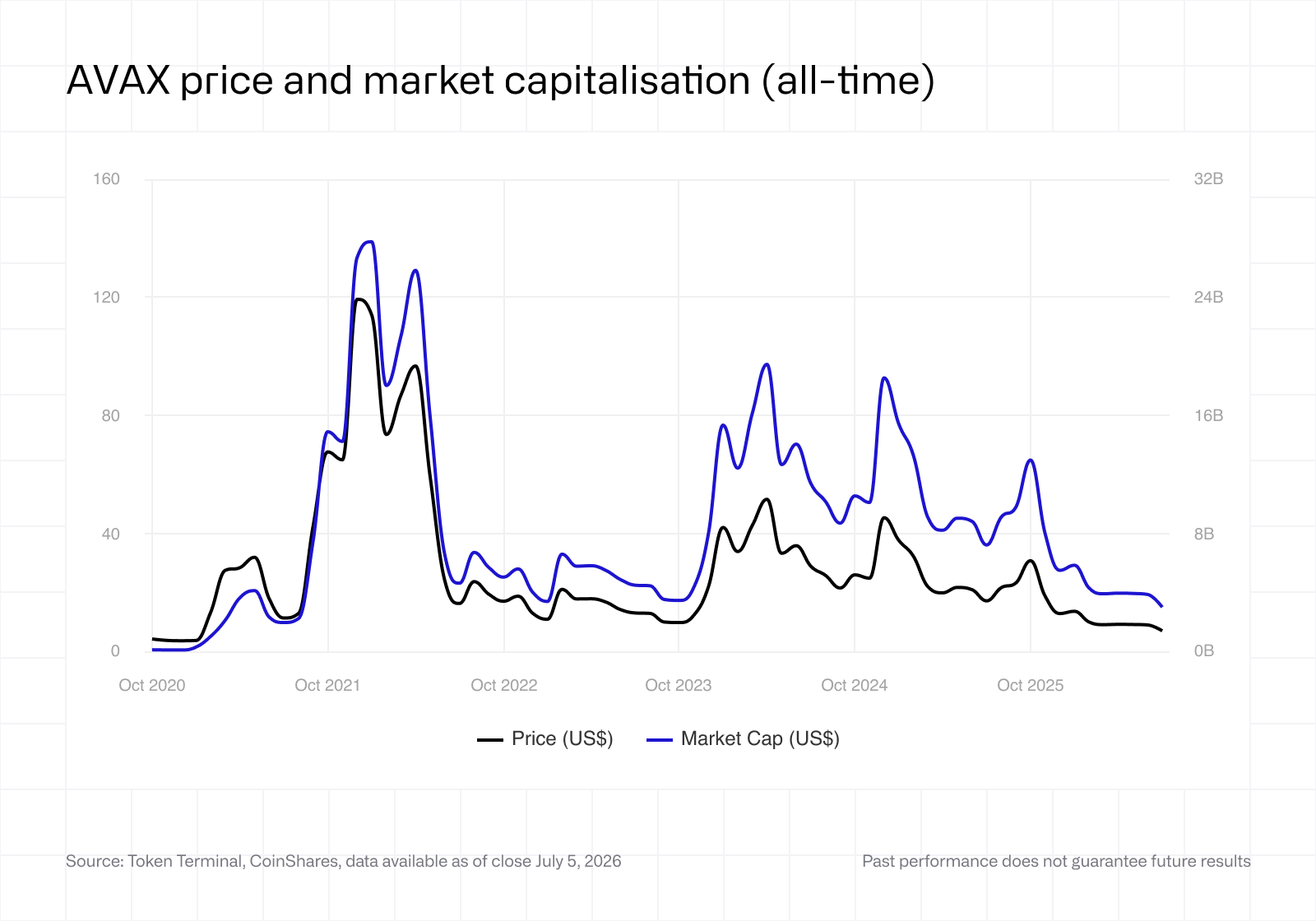
AVAX traded at $6,52 on 30 June 2026, for a circulating market capitalisation of $2,82 billion across 432 million tokens in circulation.
Ecosystem and use cases
Avalanche supports a diverse and expanding ecosystem that spans decentralized finance (DeFi), non-fungible tokens (NFTs), blockchain-based gaming, and critical infrastructure projects. In DeFi, the network’s low transaction fees and near-instant finality enable fast, cost-efficient trading, lending, and asset management solutions. Although this activity decreased this year, NFT platforms have leveraged Avalanche’s scalability to launch collections, marketplaces, and creative applications without the bottlenecks often seen on more congested networks.Gaming has also emerged as a particularly strong growth area, with many developers opting to build on Avalanche’s subnets to take advantage of dedicated performance, predictable operating costs, and the ability to customize rules and environments for their applications. This flexible architecture allows projects to deliver smooth user experiences while isolating their activity from congestion elsewhere in the network. For instance, the international football league FIFA has selected Avalanche for its dedicated layer-1 created to power its FIFA Collect digital collectibles platform.
Interoperability is also a core pillar of Avalanche’s design. The platform facilitates movement of assets, such as stablecoins, across different chains within its ecosystem through native interoperability features. L1s can also communicate directly with each other using a messaging protocol. This enables sovereign networks to exchange data, trigger cross-subnet transactions, and coordinate without relying on third-party bridges, improving both speed and security.
Activity on the network has stepped up sharply, and not briefly. Average daily active addresses ran between 31,000 and 100,000 a month through 2025, ending December at 31,260. They then rose to 362,631 in January 2026 and have held between 617,000 and 628,000 every month from February to June 2026, reaching 649,489 on 30 June. That is roughly a twentyfold increase sustained across five months.
The cost side moved in the opposite direction. C-Chain fees fell from $8,30M across 2025 to $1,01M in the first half of 2026. Cheaper transactions and far more of them is a coherent outcome of the Avalanche9000 and Granite upgrades rather than a contradiction, but it does mean the C-Chain is now earning very little from a much larger user base. Note also that this figure covers the C-Chain only and excludes activity on Avalanche L1s, which is where the network directs most application traffic.
Finally, Avalanche has been chosen by major financial players as a platform to issue real-world assets, most notably Franklin Templeton, which launched its BENJI money market on it; VanEck which introduced its tokenized U.S. treasury fund VBILL; and the platform Centrifuge which partnered with the protocol Grove to issue two Janus Henderson products on Avalanche.
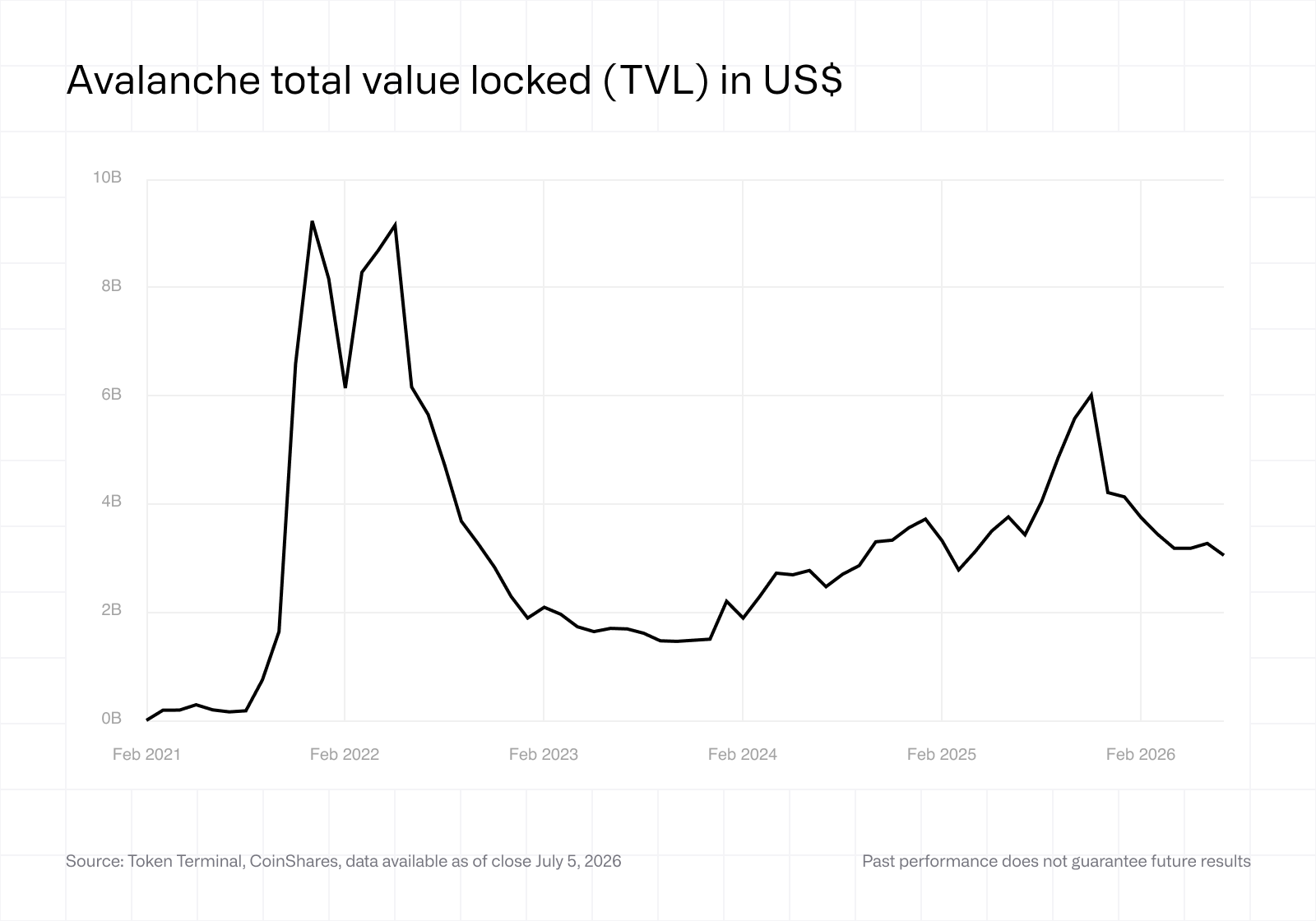
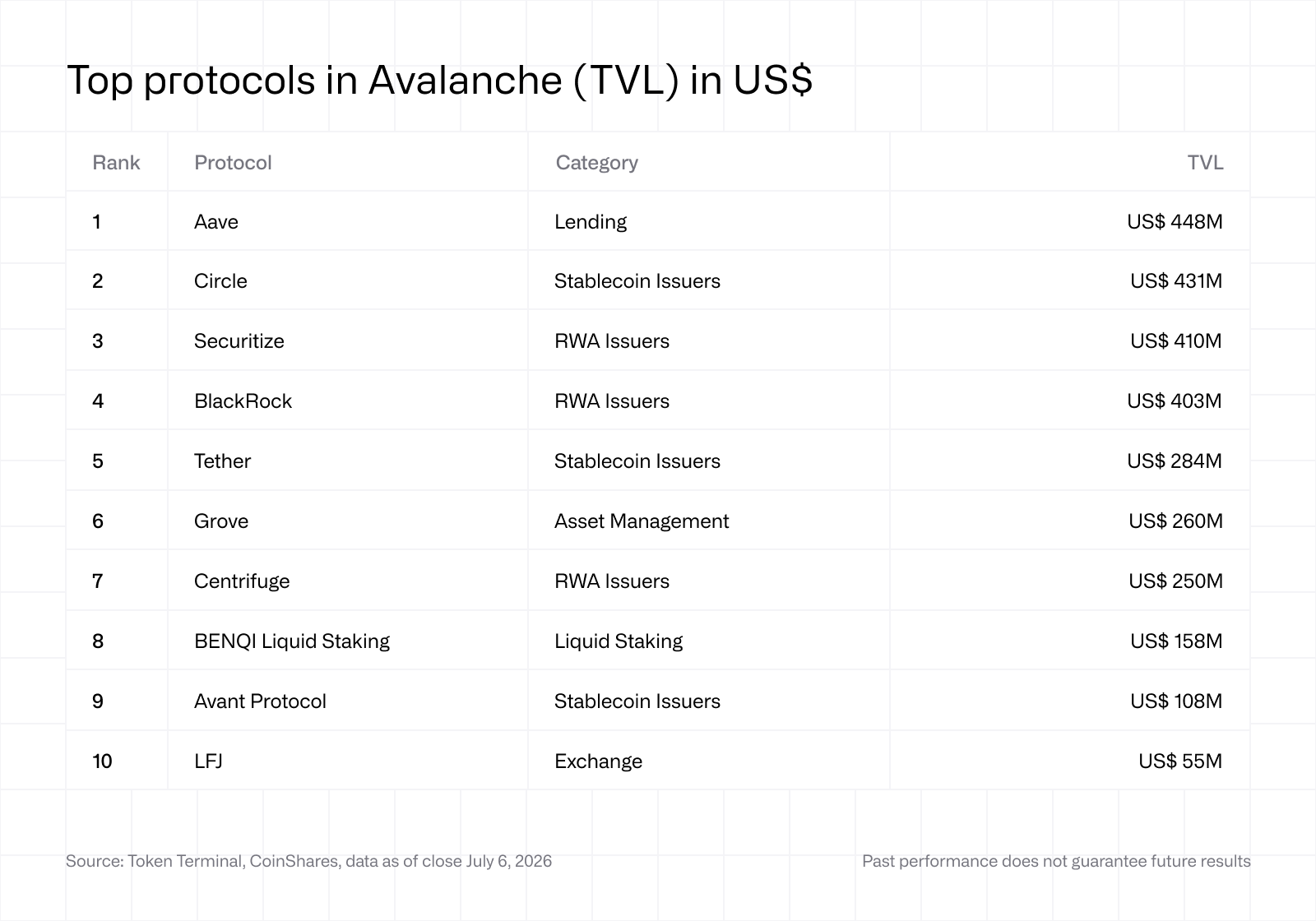 The tokenised-asset business is now measurable. Of the ten largest protocols on Avalanche by value locked, four are real-world asset issuers and three are stablecoin issuers: Aave leads at $448M, followed by Circle at $431M, Securitize at $410M, BlackRock at $403M, Tether at $284M, Grove at $260M and Centrifuge at $250M. Total value locked across the network stood at $3,05 billion on 30 June 2026, with $926M of that in stablecoins.
Pros and cons
Pros
Instant finality, scalability through L1s, low fees, and strong EVM compatibility attract developers and users.
The ecosystem continues to mature, backed by substantial grants and active dApp growth across sectors.
Demonstrated institutional adoption: four of the ten largest protocols on Avalanche by value locked are real-world asset issuers, including BlackRock and Securitize.
Cons
AVAX’s price volatility: down 67,3% in 2025 and 51,8% in the first half of 2026.
No shared security across L1s
Competition with other settlement layers’ ecosystems
Weak fee capture at the settlement layer: C-Chain fees fell to $1,01M in the first half of 2026 from $8,30M across 2025, even as active addresses rose roughly twentyfold. Activity is growing on chains whose fees do not accrue to the C-Chain.
Main takeaways
Avalanche bridges the gap between high-speed, customisable infrastructure and mainstream-friendly usability. It complements Ethereum by offering high performance and flexibility while maintaining EVM compatibility, making it a valuable ally rather than a direct competitor. The adoption by traditional finance is no longer only a prospect: real-world asset and stablecoin issuers now account for seven of the ten largest protocols on the network by value locked.6 The gap to close is between that adoption and the token, which fell 67,3% in 2025 and 51,8% again in the first half of 2026 while usage rose sharply.3 AVAX remains considerably more volatile than Bitcoin, Ethereum or Solana.
Published onSept 22nd, 2025
