



What is Sei - SEI guide
 7 min read
- Finance
Sei’s backstory
Sei is a specialized Layer 1 blockchain designed to optimize decentralised trading applications. It aims to provide a high-performance infrastructure tailored for trading apps, addressing the limitations of existing blockchain platforms in handling high-frequency and high-volume trading.
It was founded in 2022 with notable support from high-profile investors such as Coinbase, GSR, Flow Traders, and later, Circle. Its core development team, Sei Labs, is based in San Francisco, while the Sei Foundation is driving its global decentralisation through various funds and grants, most notably in Japan.
Key features of Sei
Sei introduces several innovations to enhance trading efficiency. Its Twin Turbo consensus mechanism reduces block finality time to approximately 300 milliseconds, making it one of the fastest blockchains available. This speed is achieved through intelligent block propagation and optimistic block processing, which streamline transaction validation and consensus. Overall, Sei claims a maximum transactional throughput of 12,500 transactions per second, over Solana (10,000 TPS) and Ethereum (15 TPS).
The blockchain also incorporates a native order-matching engine at the Layer 1 level. This feature allows decentralised exchanges (DEXs) built on Sei to operate more efficiently by handling order placements and executions directly on-chain, reducing latency and improving user experience.
Additionally, Sei employs market-based parallelisation, enabling the simultaneous processing of multiple transactions. This approach increases throughput and ensures that the network can handle a high volume of trading activities without congestion.
Sei native token: SEI
SEI is the native token of the Sei network and serves multiple purposes:
It is the fee token, used to pay for transaction fees on the network, the same way ETH is paying for Ethereum transactions or SOL is paying for transactions on Solana.
It also acts as a governance token, enabling holders to participate in decisions that shape the network’s development.
SEI also underpins the network’s security, as validators stake the token to help secure and stabilize the system.
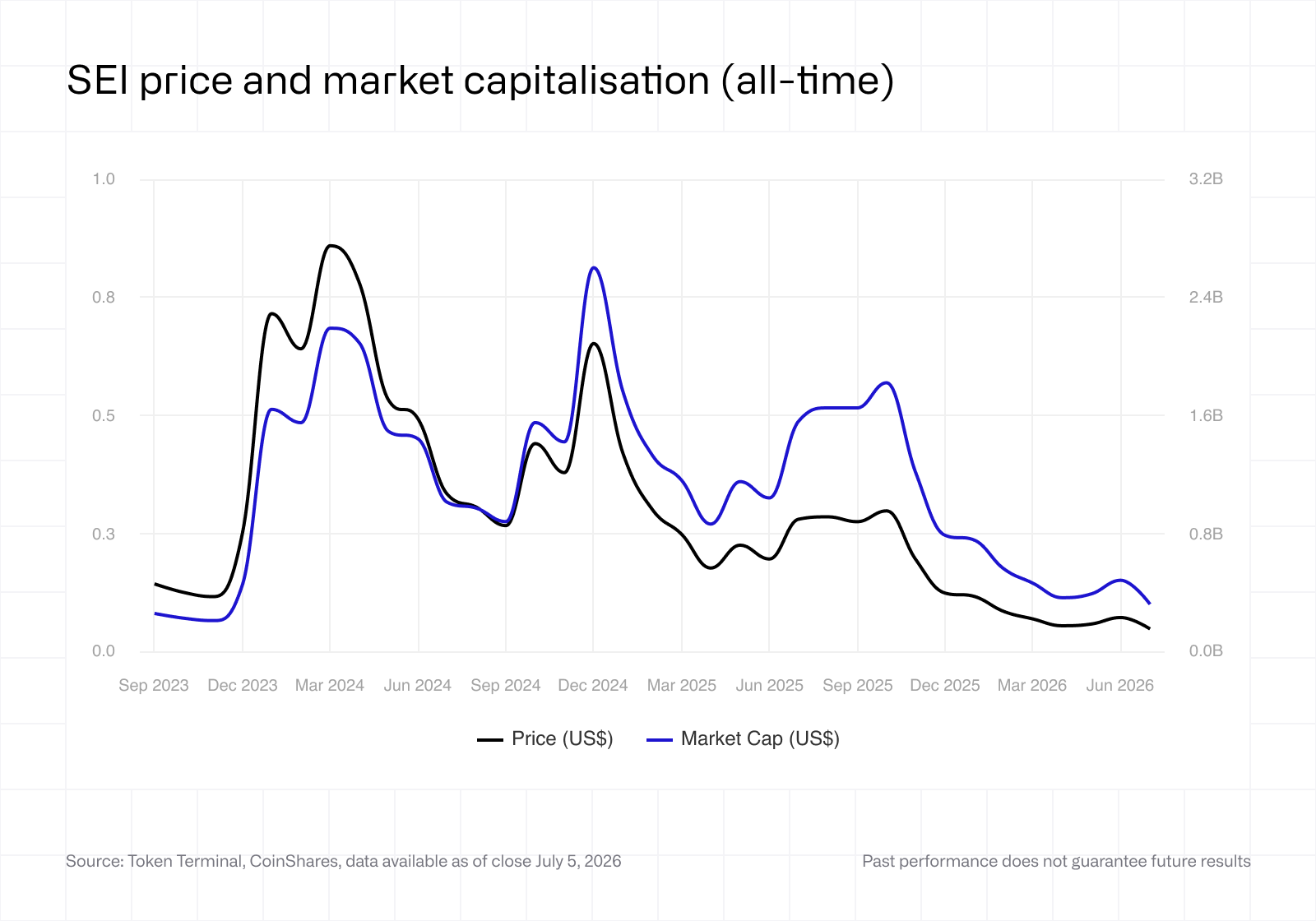
SEI traded at $0,0473 on 30 June 2026, for a circulating market capitalisation of $318,7 million across 6,73 billion tokens in circulation.1
Ecosystem and development
Sei’s ecosystem is expanding, with a variety of decentralised applications (dApps) and services being developed to take advantage of its high-speed infrastructure. Decentralised exchanges (DEXs) and lending protocols are the most prominent dApps on the network, with examples including the money market platform Yei Finance and the trading platform Sailor.finance. Sei supports smart contracts written in Rust, offering developers a robust and secure environment for building applications. Over the past year, gaming activity on the network has also seen a significant surge, succeeding where many other networks have struggled: hosting gaming hits such as World of Dypians, which averaged 61,220 daily transactions on Sei in the first quarter of 20254.
The Sei team has also focused on interoperability, ensuring that the blockchain can interact seamlessly with other networks
In 2024, Sei launched its v2 upgrade to deploy the first-ever parallelized EVM, making it fully interoperable with Ethereum and other EVM network decentralised applications.
Bridging assets from other blockchains to Sei is facilitated through various third-party bridges recommended within the Sei application. These bridges support the transfer of stablecoins and other tokens, often offering features such as “gas on arrival” to provide users with the necessary SEI tokens to cover transaction fees upon arrival.
It is important to highlight that, in June 2025, Sei’s community advanced a proposal to deprecate support for the Cosmos architecture in order to focus solely on its EVM-based design. That transition has since been carried out. The community approved deprecating the Cosmos layer in May 2025, and the rollout ran in stages through 2026: staking moved to the EVM in January, inbound IBC transfers were disabled in February, and Sei's native oracle was removed from the codebase in March.2 Remaining Cosmos transaction support and CosmWasm contracts were shut down between 6 and 8 April 2026, with exchanges and custodians required to complete their own migration by 15 June 2026.2 Sei is now an EVM-only chain, and the work clears the way for its next architecture, Sei Giga.2
Metrics
The picture across Sei's usage metrics has changed materially since mid-2025. Total value locked stood at $257,6 million on 30 June 2026, against the $600 million the network carried a year earlier.1 Stablecoin supply on the network was $51,7 million.1 Network fees, which Sei retains in full, came to over $133,000 across the whole of 2025 and roughly $42,000 over the first half of 2026, so the chain earns very little from the activity it processes.1
Activity figures for 2026 need reading carefully, because the basis changed mid-year. Sei averaged roughly 992,000 daily active addresses over the first half of 2026 and over 575,000 across 2025, but the half-year average conceals a break within June: over 432,219 addresses on 1 June, 3,450 on 15 June and 5,285 on 30 June.1 That break falls on the deadline Sei set for exchanges and custodians to finish migrating to its EVM under SIP-3, after which Cosmos-side activity was no longer processed or counted.2 The drop therefore reflects the architecture change rather than users leaving. The practical consequence for anyone tracking the network is that figures either side of June 2026 measure different things and should not be compared directly.
In summary
Sei could represent a significant advancement in blockchain technology, specifically tailored for decentralised trading applications. Its emphasis on speed, efficiency, and interoperability positions it as a promising platform for developers and users seeking a high-performance trading environment, as well as a potential secure network capable of supporting high-demand use cases such as video games. The case remains a technical one. What the last year has not produced is evidence that the speed translates into durable usage, and the market has priced that accordingly.
Pros:
Designed to be a highly scalable blockchain capable of reducing latency for real-world use cases such as trading and gaming applications.
An interoperable network compatible with the most widely used EVM protocols.
Cons:
Launched in 2022 with major upgrades since, Sei is still a relatively new blockchain without the maturity and long-term stability track record of older chains like Ethereum or Solana
Smaller ecosystem compared to major chains, which still lags behind larger Layer 1 networks in terms of the number of dApps, integrations, and developer tooling.
Sei completed its move to an EVM-only architecture in 2026, retiring the Cosmos layer its early design depended on.2 That removes a source of complexity, but it is a large change to a live network and the migration reset how activity on the chain is measured, which makes historical comparisons harder.

Published onJul 29th, 2025
