



What is Solana - SOL guide
 13 min read
- Altcoins
- Technology
The materials on this website or any third-party websites accessed herein are not associated with and have not been reviewed or approved by: (i) Valkyrie Funds LLC dba CoinShares, its products, or the distributor of its products, or (ii) CoinShares Co., its products, or the marketing agent of its products.
Solana is a Layer-1 blockchain: a base-level network designed to process transactions directly, without relying on another chain underneath it. It launched in March 2020, built by Solana Labs and co-founded by Anatoly Yakovenko, a former Qualcomm engineer whose background in distributed systems shaped Solana's core design. The goal from the start was to solve what most blockchains get wrong at scale: as they get busier, they slow down and fees go up. Solana was built to handle high volumes without that trade-off.
It's become one of the most active blockchains in crypto, used for everything from stablecoin payments to DeFi trading to consumer apps. Its native token is SOL, used to pay transaction fees, participate in staking, and engage with applications built on the network.
Technical features
Proof of Stake
Like most modern blockchains, Solana uses proof of stake to decide who validates transactions and adds new blocks. Validators (the nodes that run the network) put up SOL as collateral. In return for doing their job honestly, they earn rewards. If they misbehave, they risk losing part of their stake. SOL holders who don't want to run a validator themselves can delegate their tokens to one and earn a share of the rewards.
This is more energy-efficient than proof of work (used by Bitcoin), which requires validators to compete by burning electricity. On Solana, the competition is replaced by an economic stake.
Proof of History
This is Solana's most distinctive technical feature, and the one most guides get wrong by making it sound more complicated than it needs to be.
The problem it solves: on most blockchains, validators need to constantly communicate with each other to agree on the order that transactions happened in. That back-and-forth takes time and limits how fast the network can move.
Solana's solution is to encode a timestamp directly into the chain itself. Before a transaction is even broadcast, the network has a cryptographically provable record of when it happened, like a receipt that's already been signed. Validators can check this record without having to consult each other first, which removes a significant bottleneck.
Think of it like GPS versus asking for directions. GPS gives you verified location data instantly; asking for directions requires a conversation. Proof of History gives validators verified time data instantly, rather than requiring them to negotiate consensus on ordering.
Validators and transaction processing
Dozens of computers around the world — called validators — run the Solana network simultaneously, each keeping an identical copy of the transaction record. When you send a transaction, it gets confirmed across this network in under a second. That's not a minor improvement since most blockchains take several seconds to several minutes. It's what makes Solana genuinely usable for things like payments or trading, where waiting even a few seconds feels broken.
Performance
Throughput and transaction speed
Under real-world conditions, Solana handles around 1,000 transactions per second, with capacity for significantly more under optimal load. Fees are minimal — typically fractions of a cent — and don't spike with network demand the way they do on Ethereum. For applications that need to process a high volume of small transactions — payments, trading, gaming — this combination of speed and low cost is difficult to match on any other major Layer-1.
Trade-offs and network constraints
Speed at this scale comes with trade-offs that are worth understanding honestly. Solana has experienced network outages. The most significant occurred in 2021 and 2022, with a further incident in February 2024 that halted the network for roughly five hours. Between late 2024 and early 2025, independent monitoring services detected at least nine service disruptions that were never officially acknowledged by the Solana Foundation. Solana's design deliberately prioritises safety over availability, meaning when something goes wrong, the network halts entirely rather than risk processing inconsistent transactions. That's the right call for protecting user funds, but it means outages are visible and disruptive when they occur. A second trade-off is validator concentration. Solana's validator count fell from a peak of around 3,000 to under 1,000 through 2025, partly due to a deliberate pruning of underperforming operators. The remaining validators are higher quality, but a significant portion of staked SOL remains concentrated among a smaller set of operators. The Firedancer validator client — a ground-up rewrite developed independently by Jump Crypto — launched in 2025, introducing true client diversity and significantly reducing the risk of a single software bug taking down the entire network.
These are known issues the ecosystem is actively working on, not existential risks — but they're relevant context for anyone building on or investing in the network.
Market value
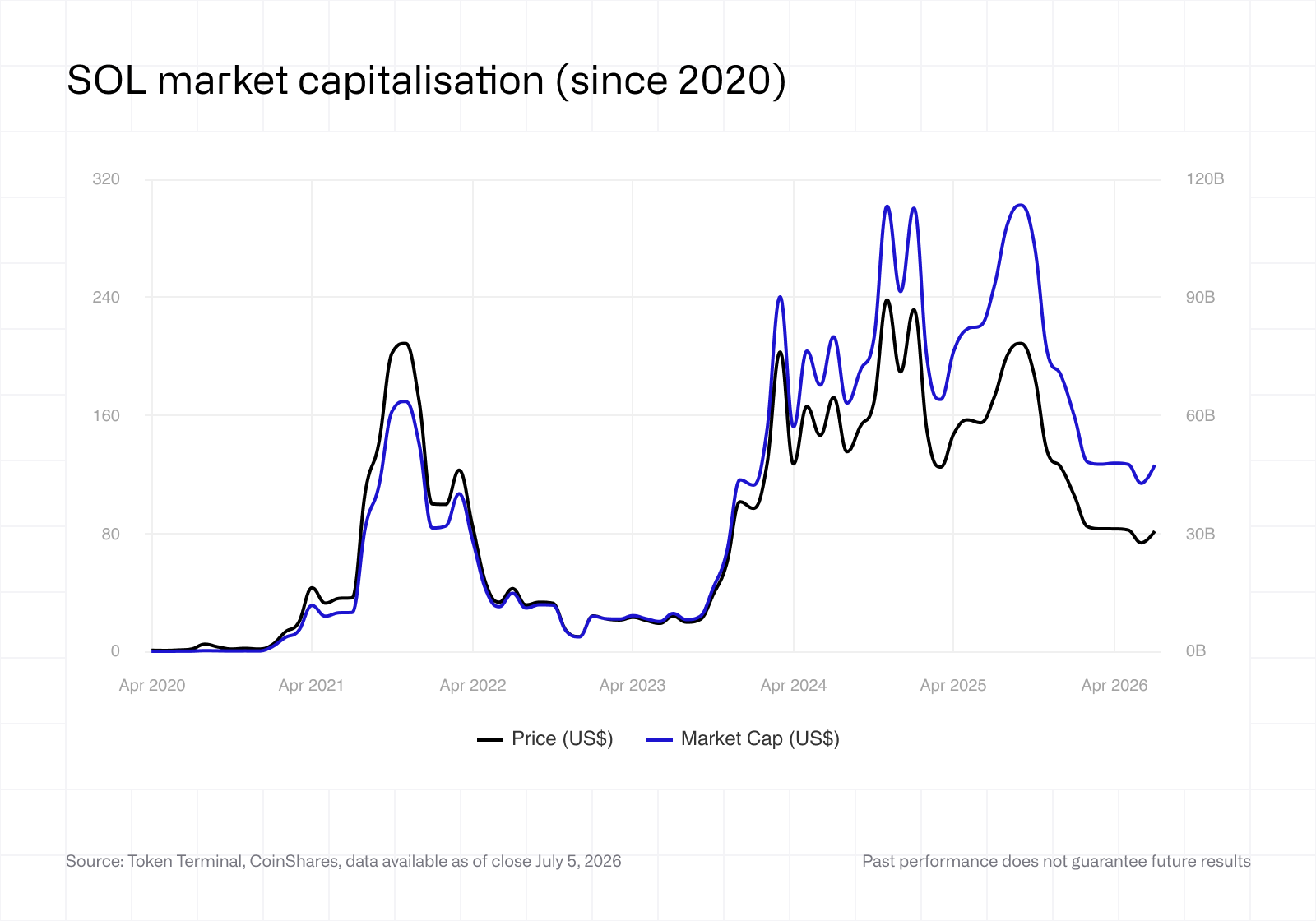
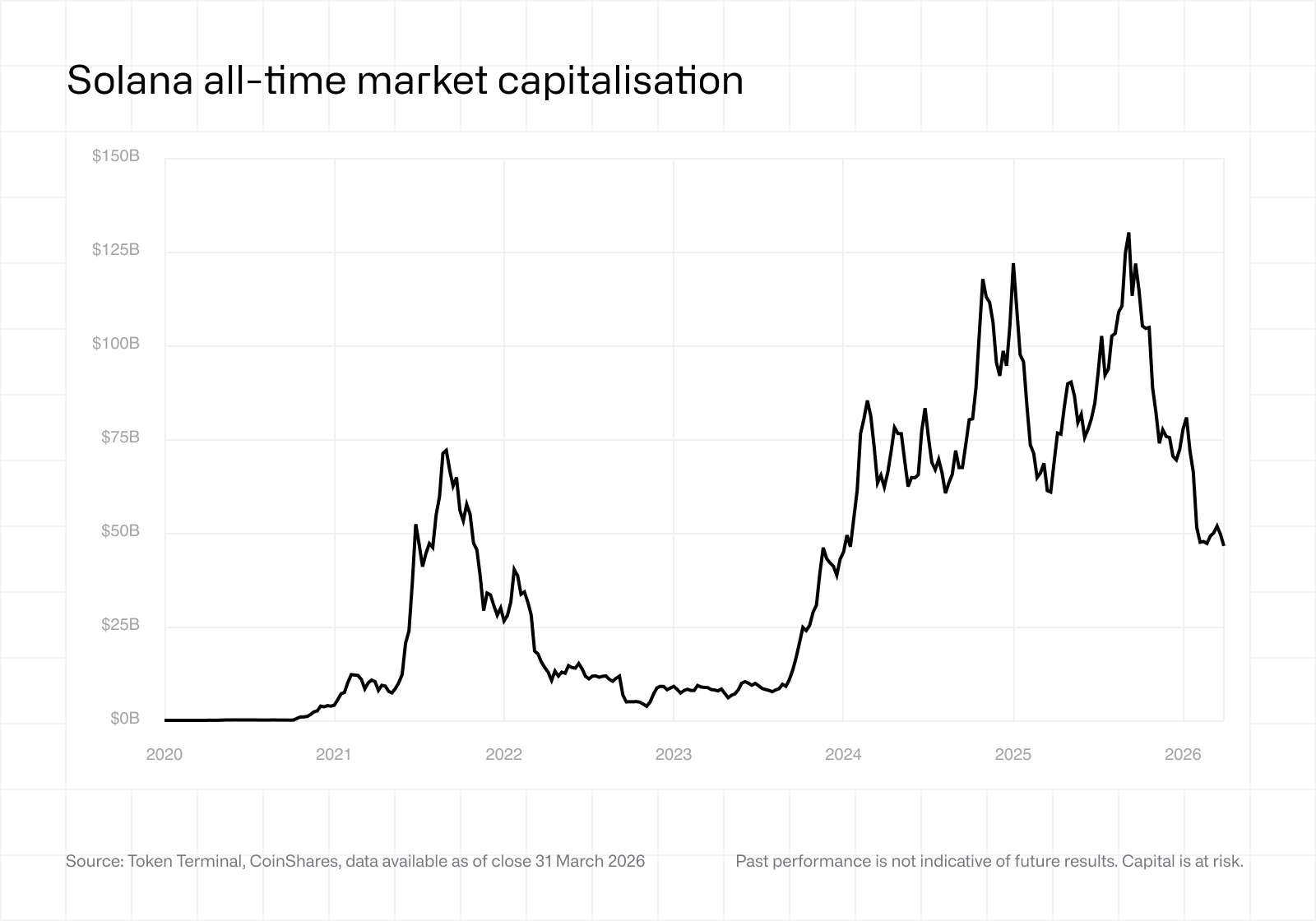
SOL's market capitalisation stood at $42,7B on 30 June 2026, with SOL trading at $73,52. That is a long way below the cycle peak of $134,3B set on 18 September 2025. Worth holding both numbers at once: the network's throughput and fee structure did not change between those two dates, but its market value fell by roughly two thirds. SOL is priced on adoption expectations and broad crypto risk appetite, not on the chain's technical characteristics.
Solana and Ethereum: a brief comparison
Solana and Ethereum are both programmable blockchains with large DeFi ecosystems, but they make different trade-offs.
Ethereum is the more established network, with deeper liquidity, a larger developer base, and more battle-tested infrastructure. Its fees can be high during periods of congestion, and its base layer is slower, though a large ecosystem of Layer-2 networks built on top of it partially addresses this.
Solana offers faster base-layer transactions and lower fees, making it better suited for applications that need to process high volumes cheaply. The trade-off is a younger ecosystem and a history of occasional network instability, which Ethereum's more conservative design largely avoids.
The two networks are increasingly complementary rather than directly competitive — different protocols attract different types of applications, and many projects consider both. For a deeper comparison, see our Ethereum guide.
SOL use cases
SOL is the native token of the Solana network. It has three core functions.
Transaction fees
Every transaction on Solana requires a small fee paid in SOL. These fees are typically a fraction of a cent and don't increase significantly with network activity, a deliberate design choice that makes Solana predictable for high-volume use cases. A portion of each fee is burned (permanently removed from supply), and the rest goes to validators as rewards. Solana's base layer collected $679,9M in transaction fees across 2025, and a further $110,7M in the first half of 2026. Fees generated by the applications running on Solana are an order of magnitude larger: $6,10B in 2025 and $872,5M in H1 2026. That gap is the design working as intended. The chain itself stays cheap; the economic value accumulates in what gets built on top of it.
Staking and network security
By staking SOL, either by running a validator or delegating to one, holders contribute to the security of the network and earn rewards in return. There's no minimum stake to delegate, and no mandatory lock-up period, though unstaking takes a few days to process. As of 30 June 2026, 441,3M SOL was staked, worth $32,4B and equal to roughly 76% of circulating supply. That is an unusually high participation rate for a major Layer-1, and it cuts both ways: strong security, but a large share of supply whose economics depend on an inflation schedule that steps down every year. Native staking yields sit in the region of 5,9% to 7,5% APY depending on the validator and whether MEV rewards are included. Past performance is not a guide to future returns.
CoinShares offers a Solana Staking ETP that provides regulated, exchange-listed exposure to SOL with staking rewards passed through to investors — accessible via a standard brokerage account without needing to manage wallets or validators.
Participation in the validator economy
Validators are the backbone of Solana's network, and SOL is the collateral that makes the system work. The more SOL staked with a validator, the more likely that validator is to be selected to produce blocks, and the more influence that stake has over the network's direction. Delegating to a validator is the most direct way for regular SOL holders to participate in this economy, aligning their interests with the health of the network.
Ecosystem
Decentralised finance
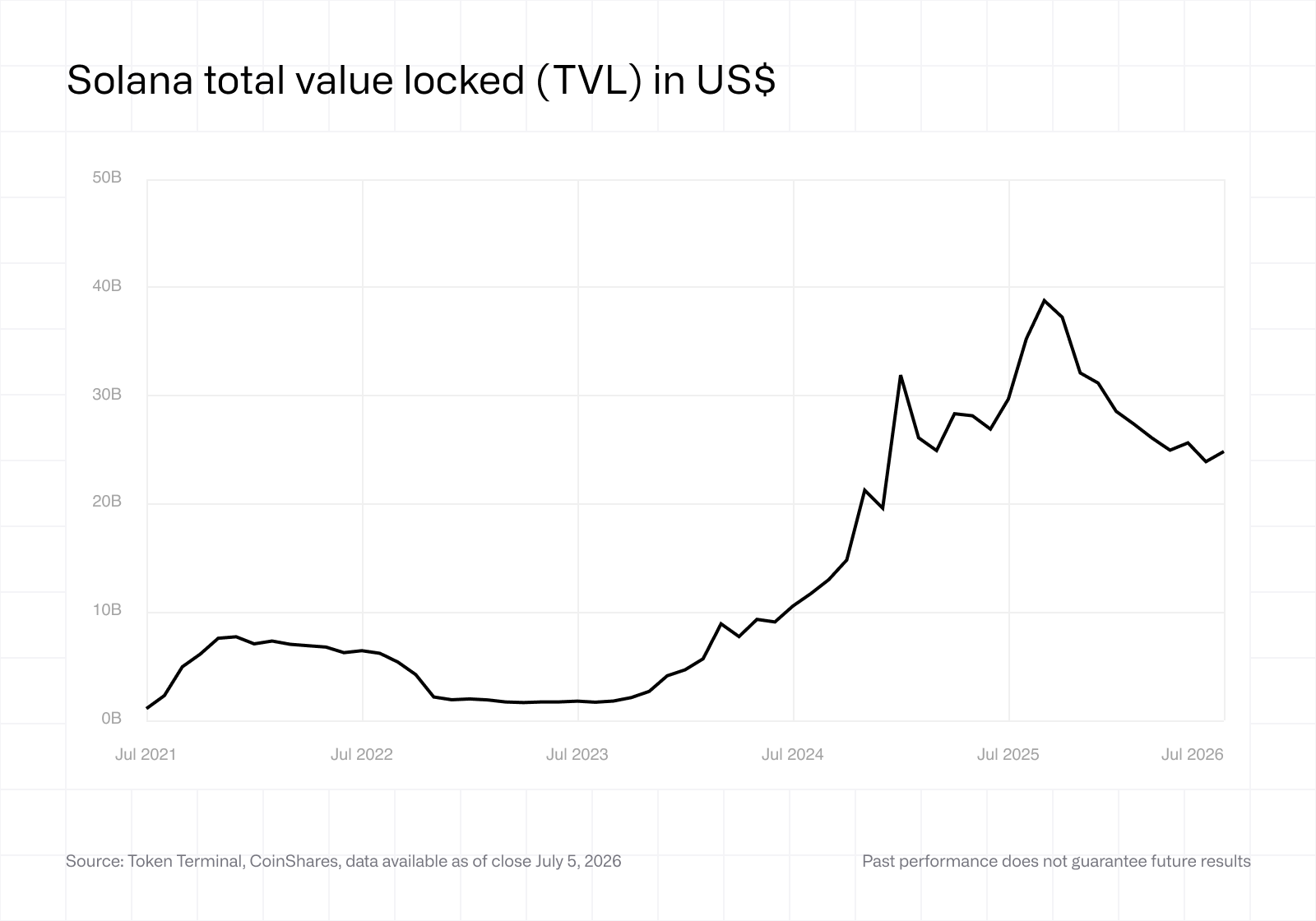
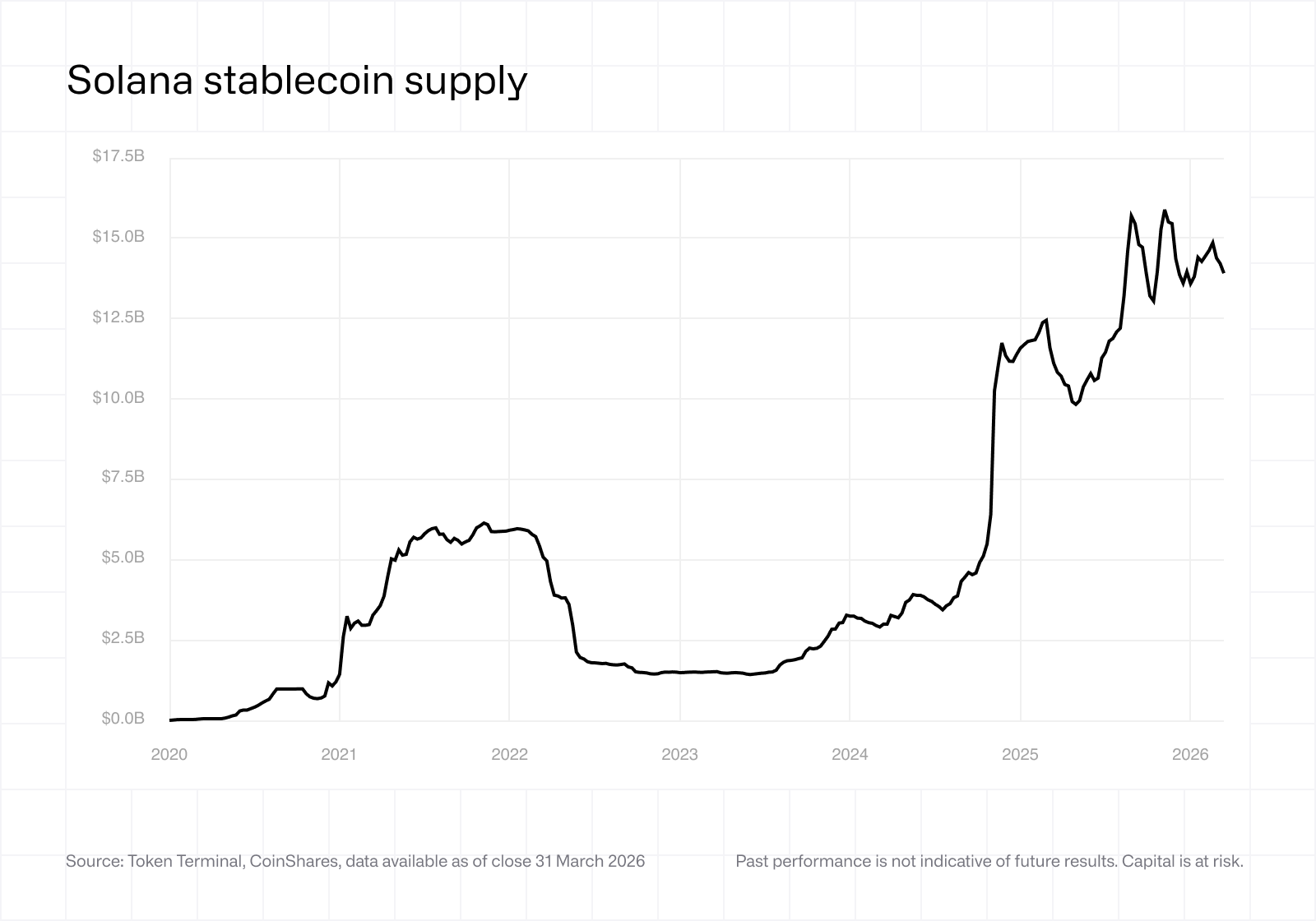
Solana has become one of the most active DeFi environments in crypto. Total value locked on the network stood at $24,0B on 30 June 2026, down from an all-time high of $42,9B on 8 October 2025. DEX trading volume across the ecosystem reached $806,0B in 2025 and $129,8B in the first half of 2026, with Orca ($46,2B), Meteora ($33,3B) and Raydium ($28,4B) the three largest venues over that half. The stablecoin picture is a different story from the trading one: $4,54T in USDC transfers and $529,4B in USDT transfers on Solana across 2025, a combined $5,07T, followed by $3,21T and $374,2B respectively in H1 2026 alone. Stablecoin supply on the network sat at $14,1B on 30 June 2026. Trading volume fell through the first half of 2026; payment volume did not.
 The DeFi stack has also matured beyond the speculative trading activity that dominated earlier cycles. Kamino Finance and Jito have become anchor protocols in lending and liquid staking respectively, with institutional-grade tooling and audited codebases. The ecosystem now runs lending vaults, yield optimisation, liquid staking, and perpetuals; infrastructure that looks less like an experiment and more like a parallel financial system.
The honest caveat: this growth came with growing pains. In April 2026, Drift (one of Solana's leading perpetuals and trading platforms) suffered a $280 million exploit tied to an admin key compromise. It was a reminder that speed of ecosystem expansion and security maturity don't always move in lockstep. Bridge risk also remains a real consideration — assets moving between Solana and other chains depend on third-party protocols that have historically been among the most common vectors for large-scale losses in crypto.
NFT platforms and digital assets
Solana's NFT ecosystem has had a genuinely eventful few years — worth understanding rather than glossing over.
Magic Eden launched in September 2021 as a Solana-only marketplace and within months controlled over 90% of Solana NFT trading volume. Tensor emerged as a serious competitor, winning over professional traders with its more advanced trading tools and analytics, and the two platforms have competed closely for volume ever since.
The broader NFT market contracted sharply from its 2021–22 peaks, and Solana was not immune. Q4 2025 NFT sales volumes dropped 30% quarter-on-quarter to $1.25 billion globally, and Magic Eden's own Solana volume fell to $61 million for the quarter. In early 2026, Magic Eden made a significant strategic pivot: it wound down its Ethereum, Bitcoin, and Polygon marketplaces entirely (internal data showed Solana accounted for over 85% of volume anyway) and refocused on Solana NFTs and a new gambling product.
Two things are worth noting from all this. First, despite the market contraction, Solana remains one of the most active chains for NFT activity, its speed and near-zero minting costs make it structurally well-suited for digital collectibles at scale. Second, native token issuance on Solana doesn't require smart contracts: tokens and NFTs are first-class citizens of the ledger, which reduces complexity and removes a category of risk that Ethereum-based NFTs carry. The infrastructure is solid; the question is whether broader NFT market appetite returns.
Consumer applications
This is where Solana's speed and fee structure translates most directly into something people actually use day-to-day, and where the network's case for real-world relevance is strongest.
Helium is the clearest example. It's a decentralised wireless network that runs on Solana, where anyone can plug in a hotspot device and earn tokens for providing mobile or IoT coverage in their area. By the end of 2025, the network had over 600,000 mobile sign-ups, more than 2 million daily active users, up from 250,000 at the start of the year, and 120,000+ active hotspots across the US and Mexico, with Brazil expansion underway. Major carriers including AT&T, T-Mobile, and Movistar offload traffic onto the network, meaning their customers are already using Helium without knowing it. Solana's throughput and low transaction costs are what make this economically viable: rewards flow to hotspot operators via millions of micropayments that would be unworkable on a slower, more expensive chain.
The Seeker smartphone takes a different angle: instead of asking users to learn crypto, this Android phone integrates Solana into a consumer product they already know how to use. Phone plan, wallet, and app ecosystem in one device, with no seed phrases required. Early uptake was meaningful enough to directly accelerate Helium Mobile subscriber growth in Q4 2025.
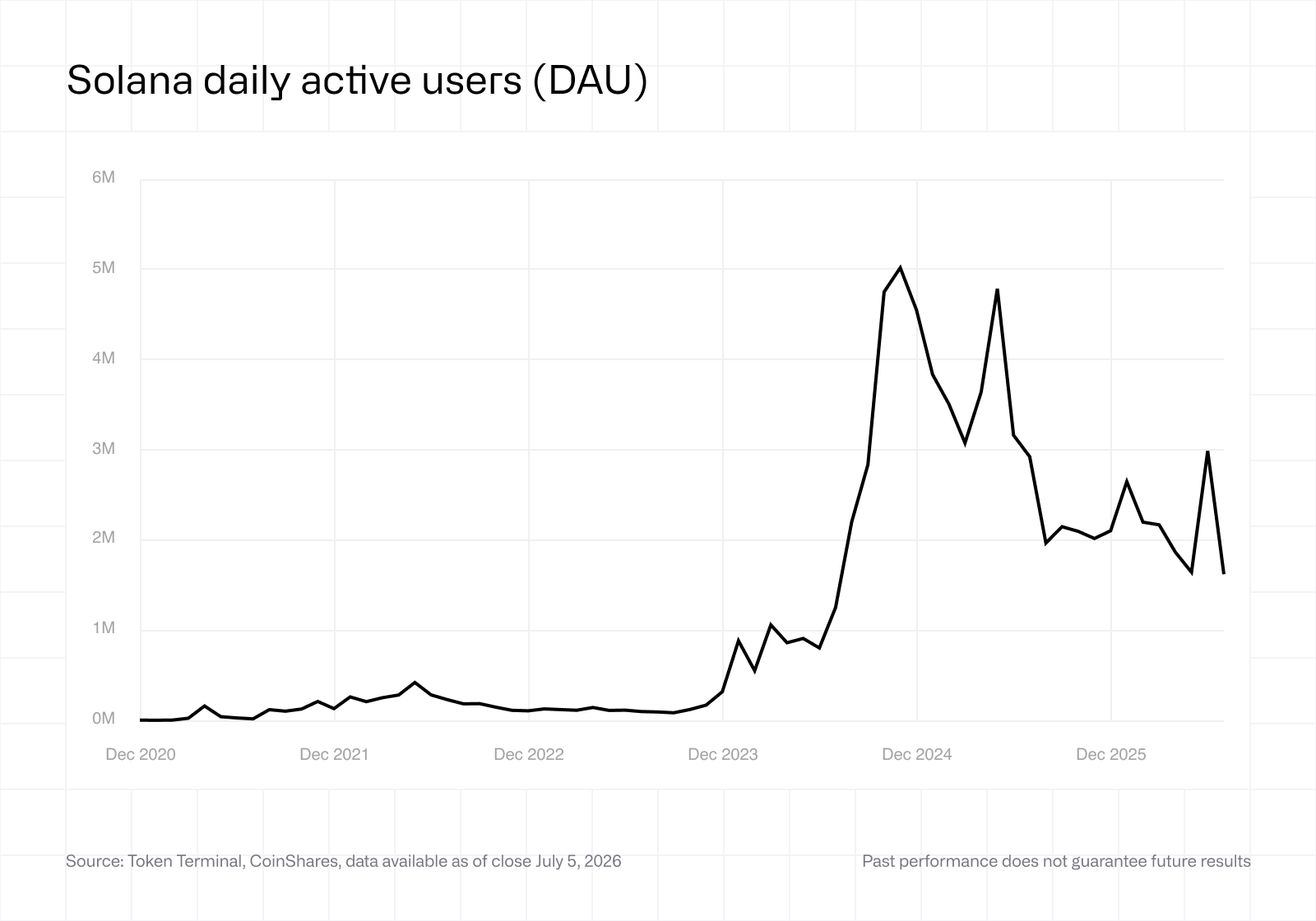
Activity on the network as a whole is measurable, and it has cooled. Solana averaged 3,21 million daily active addresses across 2025, easing to 2,41 million in Q1 2026 and 2,00 million in Q2.1 The all-time high of 8,82 million was set on 22 October 2024. One caveat on how to read that: the metric counts unique fee-paying addresses, not people, and a single user can hold many addresses. What the figure does establish is scale of throughput. Millions of fee-paying transactions a day is only economically possible on a chain where each one costs a fraction of a cent.
 Stablecoin payments round out the consumer picture. According to Token Terminal data, Solana processed $5,07T in USDC and USDT transfers across 2025, and a further $3,58T in the first half of 2026 alone, much of it peer-to-peer and cross-border. Western Union has announced plans to issue a US dollar stablecoin on Solana targeting H1 2026 launch. For cross-border payments in particular, Solana's sub-second finality and fractional fees make it one of the few blockchains where the technology genuinely improves on the existing alternative rather than simply replicating it on-chain.
FAQ
What is Solana crypto?
Solana is a Layer-1 blockchain — a foundational network designed to process transactions quickly, cheaply, and at scale. It launched in 2020 and has grown into one of the most active blockchains in the world, used for DeFi, stablecoin payments, NFTs, gaming, and consumer applications. SOL is its native cryptocurrency, used to pay for transactions, stake to earn rewards, and interact with the network's ecosystem of apps.
What is SOL used for?
SOL has three main uses. First, it pays for transactions on the Solana network — fees are tiny, typically fractions of a cent. Second, it can be staked to earn rewards and help secure the network. Roughly 76% of circulating SOL was staked as of 30 June 2026. Third, it's the collateral that validators put up to participate in running the network — the more SOL staked, the more influence a validator has over block production. SOL is also widely used as a base asset in DeFi applications, as collateral in lending protocols, and as a trading pair on decentralised exchanges.
Why is Solana considered fast?
Thanks to its infrastructure, Solana can handle multiple at the same time rather than queuing them sequentially. The result is sub-second finality under normal conditions and fees that stay low even when the network is busy. The trade-off is that this architecture has historically been more prone to outages than slower, more conservative blockchains — though stability has improved significantly since 2022.
Published onMay 12th, 2026