



Vad är Ethereum? En komplett guide till ETH och smarta kontrakt
 26 min läsning
- Ethereum
- Teknik
Bitcoin visade att pengar kan fungera utan bank. Ethereum ställde en bredare fråga: vad mer skulle kunna fungera på det sättet? Ett decennium senare är Ethereum avvecklingslagret för merparten av det värde som rör sig på publika blockkedjor.
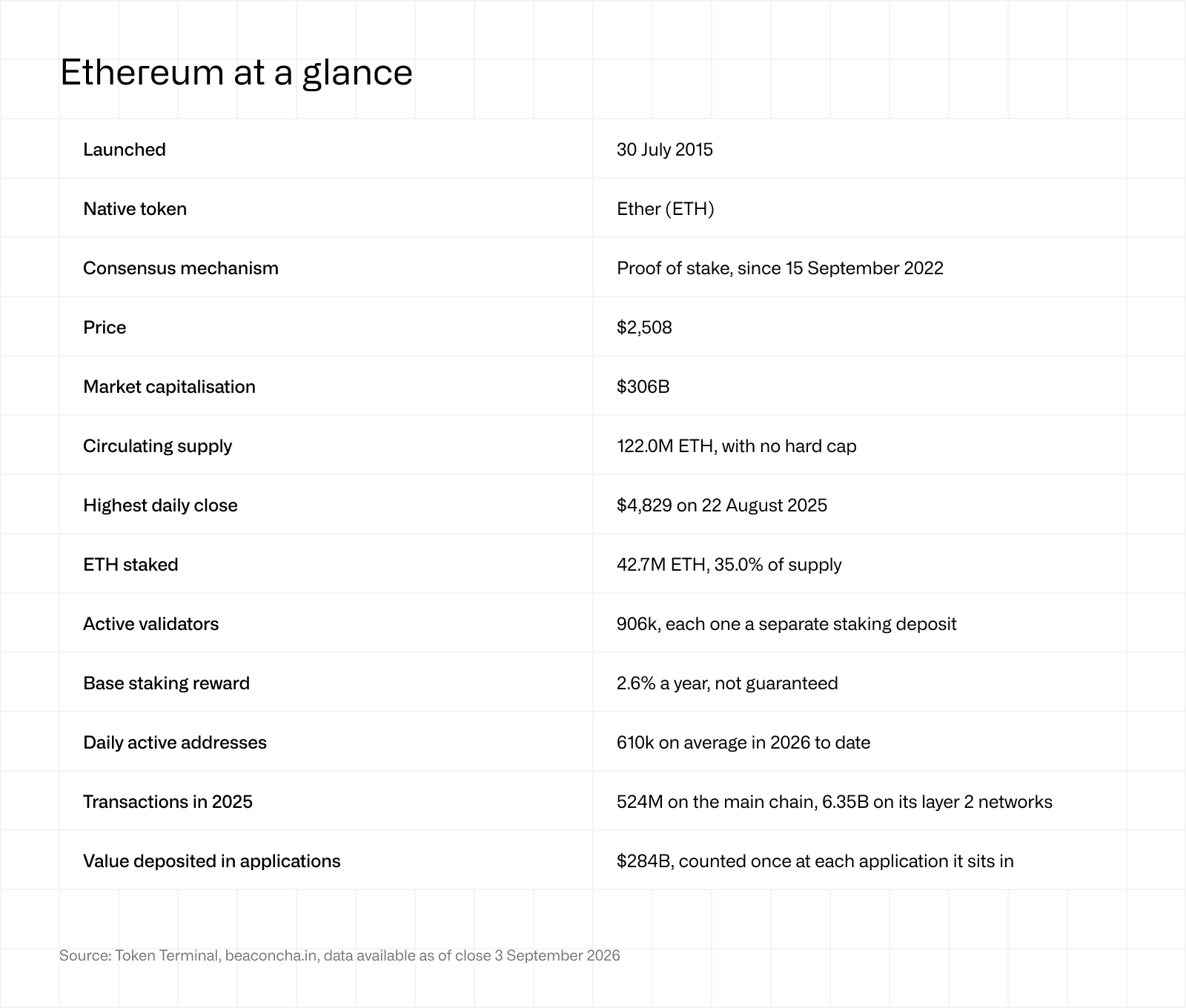
Ethereum är en blockkedja, en delad databas som tusentals oberoende datorer håller synkroniserad utan att något enskilt företag styr den. Nätverket lanserades i juli 2015 och dess egen token heter ether (ticker: ETH).
Bitcoin gör en enda sak extremt bra: flyttar och lagrar värde. Ethereum byggdes för att köra programvara. Vem som helst, var som helst, kan publicera ett program på Ethereum, och det körs exakt som det är skrivet så länge nätverket finns, utan att något företag kan ändra eller stänga av det. Sådana program kallas smarta kontrakt, och det är de som skiljer Ethereum från alla blockkedjor som kom före.
Om Bitcoin ofta kallas digitalt guld ligger Ethereum närmare digital olja: inte värdebevararen i sig, utan bränslet som ett bredare finansiellt system drivs av. Den 3 september 2026 handlas ETH till 2 508 dollar med ett marknadsvärde på 306 miljarder dollar. Det gör ETH till den näst största digitala tillgången efter Bitcoin, knappt en femtedel så stor.1
Viktiga punkter
Ethereum är den ledande plattformen för smarta kontrakt. Nätverket står för 58,7 % av det samlade marknadsvärdet i de tolv största blockkedjorna för smarta kontrakt och för drygt tre femtedelar av allt kapital som placerats i decentraliserade finansapplikationer, alltså de tjänster för utlåning, upplåning och handel som fungerar utan mellanhand.1
Ethereum gick i september 2022 från proof of work (arbetsbevis), där datorer tävlar genom att förbruka el, till proof of stake (insatsbevis), där deltagarna i stället ställer egen ETH som säkerhet. Bitcoin använder fortfarande proof of work. Det är den enskilt viktigaste tekniska skillnaden mellan de två.
42,7 miljoner ETH, 35,0 % av all ether som finns, är stakad: låst som denna säkerhet i utbyte mot en belöning som just nu ligger på 2,6 % per år. Stakingbelöningar är inte garanterade och varierar.2
Merparten av aktiviteten i Ethereum har flyttat från huvudkedjan till layer 2-nätverk, separata och långt billigare nätverk som buntar ihop transaktioner och skickar tillbaka en sammanfattning till Ethereum. Hittills under 2026 har de burit nära nio av tio transaktioner i Ethereums ekosystem.1
Du kan få reglerad exponering mot ETH, inklusive stakingbelöningar, genom CoinShares Ethereum Staking ETP (ETHE), en börshandlad produkt som köps via ett vanligt depåkonto och som tar ut 0,00 % i förvaltningsavgift.3
Key takeaways
Ethereum is the leading smart contract platform. It accounts for 58.7% of the combined market value of the twelve largest smart contract blockchains, and for just over three fifths of all the money deposited in decentralised finance applications, the lending, borrowing and trading services that operate without a bank in the middle.1
Ethereum switched in September 2022 from proof of work, where computers compete by burning electricity, to proof of stake, where participants put up their own ETH as a security deposit instead. Bitcoin still uses proof of work. This is the single most important technical difference between the two.
42.7M ETH, 35.0% of all ether in existence, is staked: locked up as that security deposit in exchange for a reward currently running at 2.6% a year. Staking rewards are not guaranteed and vary.2
Most Ethereum activity has moved off the main chain and onto layer 2 networks, separate and far cheaper networks that bundle transactions together and post a summary back to Ethereum. In 2026 to date they have carried close to nine in ten of all transactions in the Ethereum ecosystem.1
You can get regulated exposure to ETH, with staking rewards included, through the CoinShares Ethereum Staking ETP (ETHE), an exchange traded product bought through an ordinary brokerage account, which charges 0.00% management fees.3
Så fungerar Ethereum
Proof of stake
Varje blockkedja behöver ett sätt för främlingar att enas om vilka transaktioner som är äkta utan att lita på varandra. Metoden kallas konsensusmekanism.
Bitcoin använder proof of work, där specialiserade datorer förbrukar el i en kapplöpning om att lösa ett pussel, och vinnaren lägger till nästa omgång transaktioner. Ethereum använde samma metod fram till september 2022 och ersatte den sedan i en uppgradering känd som The Merge.
Ethereum använder i dag proof of stake. I stället för att förbruka el riskerar deltagarna egen ETH som insats. Nätverket väljer slumpmässigt ut en av dem att föreslå nästa omgång transaktioner, ett så kallat block, medan övriga kontrollerar arbetet. Den som agerar ärligt får betalt. Den som agerar oärligt får en del av sin insats förstörd av nätverket, ett straff som kallas slashing.
Energibesparingen var dramatisk. Crypto Carbon Ratings Institute mätte att Ethereums elförbrukning över en natt föll med mer än 99,98 %, från omkring 23 miljoner megawattimmar per år till drygt 2 600. En megawattimme motsvarar ungefär vad ett europeiskt hushåll förbrukar på en månad. Ethereum gick alltså från att dra lika mycket el som ett medelstort land till ungefär lika mycket som en småstad.4
Validatorer och insatsen på 32 ETH
En validator är en enskild enhet av stakad ETH som utför kontrollarbetet. Att driva en egen kräver 32 ETH, värt omkring 80 000 dollar till dagens pris, plus en dator som alltid är uppkopplad.
Det finns för närvarande 906 000 aktiva validatorer.2 Siffran är inte detsamma som antalet personer som stakar, och den föll kraftigt under 2026 i stället för att stiga. Orsaken är uppgraderingen Pectra från 2025, som lät en enskild validator hålla upp till 2 048 ETH i stället för att vara begränsad till 32. Stora aktörer slog samman hundratals små validatorer till några få stora, vilket fick det redovisade antalet validatorer att sjunka samtidigt som mängden stakad ETH steg. Antalet validatorer är inte längre ett bra mått på hur många deltagare som säkrar Ethereum.
Staking och belöningar
Staking innebär att låsa ETH för att bidra till att säkra nätverket i utbyte mot en belöning. Det krävs ingen egen validator. De flesta stakar via en exchange, en stakingtjänst eller en reglerad investeringsprodukt som sköter det åt dem.
I början av september 2026 var 42,7 miljoner ETH stakad, 35,0 % av all ether som finns och värd 107 miljarder dollar. Grundbelöningen ligger på 2,6 % per år.2
Den nivån är inte fast. Den faller när mer ETH stakas, eftersom samma belöningspott delas mellan fler deltagare, och den stiger med nätverksaktiviteten, eftersom validatorer också får en andel av transaktionsavgifterna. Efterfrågan på staking är för närvarande så hög att nya insättningar får vänta i kö: 2,1 miljoner ETH står i kö för att börja stakas, med en väntetid på 36 dagar.2 Stakingbelöningar är inte garanterade och kan variera.
Gas och avgifter
Varje åtgärd på Ethereum kostar en avgift som betalas i ETH och kallas gas. Gas mäter hur mycket beräkningsarbete en åtgärd kräver: en enkel överföring kostar lite, en komplex affär kostar mer. Avgifterna anges normalt i gwei, som är en miljarddels ETH.
Två saker händer med en gas fee. En del som kallas basavgift (base fee) förstörs, eller bränns, och försvinner permanent ur utbudet. Resten går till validatorn som en prioriteringsavgift. Uppdelningen infördes i augusti 2021 genom protokolländringen EIP-1559.
Avgifterna har rasat i takt med att aktiviteten flyttat till layer 2-nätverk. Snittavgiften för att använda Ethereums huvudkedja har fallit med fyra femtedelar på ett år, från 1,00 dollar per transaktion under hela 2025 till 0,20 dollar hittills under 2026. Räknat i pengar betalade användarna 526 miljoner dollar i avgifter på huvudkedjan under hela 2025 och 113 miljoner dollar hittills under 2026.1
Minskar utbudet?
Ethereum har inget fast utbudstak, till skillnad från Bitcoins gräns på 21 miljoner. Ny ETH skapas löpande för att betala validatorer och bränns löpande via basavgiften.
Sedan avgiftsbränningen inleddes i augusti 2021 har 4,6 miljoner ETH förstörts. Samtidigt har mer getts ut än bränts, så det cirkulerande utbudet har ändå vuxit, från 117,0 miljoner till 122,0 miljoner.1
Det The Merge förändrade var takten. Under de tretton månaderna dessförinnan växte utbudet med 2,7 % per år även efter bränningen, eftersom även utvinnarna fick betalt. Under de fyra åren sedan dess har det vuxit med 0,3 % per år. Ethereum är inte tillförlitligt deflationärt, och att beskriva det så är fel. Utbudet är nära oförändrat, vilket är ett annat och mer hållbart påstående.
Vad smarta kontrakt är och vad de möjliggör
Ett smart kontrakt är ett program som lagras på blockkedjan och körs automatiskt när dess villkor uppfylls. Standardliknelsen är en varuautomat: lägg i rätt mynt, tryck på rätt knapp och automaten lämnar ut varan. Ingen behöver godkänna det, och ingen kan välja att låta bli.
Smarta kontrakt bygger på enkel om-då-logik. Om den här betalningen kommer in, frigör då de här tokens. När koden väl är publicerad är den synlig för alla och kan inte ändras i tysthet. Det är charmen, och det är också risken: ett fel i ett smart kontrakt är permanent, och ett misstag kan utnyttjas av vem som helst som upptäcker det.
Fyra saker byggda på den idén är värda att känna till. Den första är decentraliserad finans, oftast förkortat DeFi: utlåning, upplåning och handel utan mellanhand. 284 miljarder dollar i värde ligger i applikationer på Ethereum, drygt tre femtedelar av totalen över samtliga blockkedjor. Den totalen är summan av vad varje applikation håller och är inte justerad för dubbelräkning: en insättning i en applikation som sedan pantsätts som säkerhet i en annan räknas i båda, så siffran är större än det belopp som faktiskt satts in.1
Den andra är stablecoins, tokens konstruerade för att hålla ett stabilt värde, vanligen en amerikansk dollar, och som backas upp av reserver. Stablecoins för 163 miljarder dollar är utgivna på Ethereum, mer än på alla andra blockkedjor tillsammans.1
Den tredje är tokenization: penningmarknadsfonder, obligationer och privata krediter som ges ut som tokens på en blockkedja i stället för som poster i ett värdepappersregister, vilket gör att de kan avvecklas på minuter i stället för dagar. Den fjärde är ägarregister av andra slag, från NFT:er, tokens som är individuellt unika i stället för utbytbara och som används för digital konst och samlarobjekt, till DAO:er, organisationer där besluten fattas genom omröstning bland tokeninnehavare och verkställs automatiskt av kontrakt.
Ethereum och Bitcoin: vad skiljer dem åt?
Bitcoin och Ethereum kompletterar varandra snarare än konkurrerar. Bitcoin är en monetär tillgång med fast utbud. Ethereum är en plattform att bygga på.
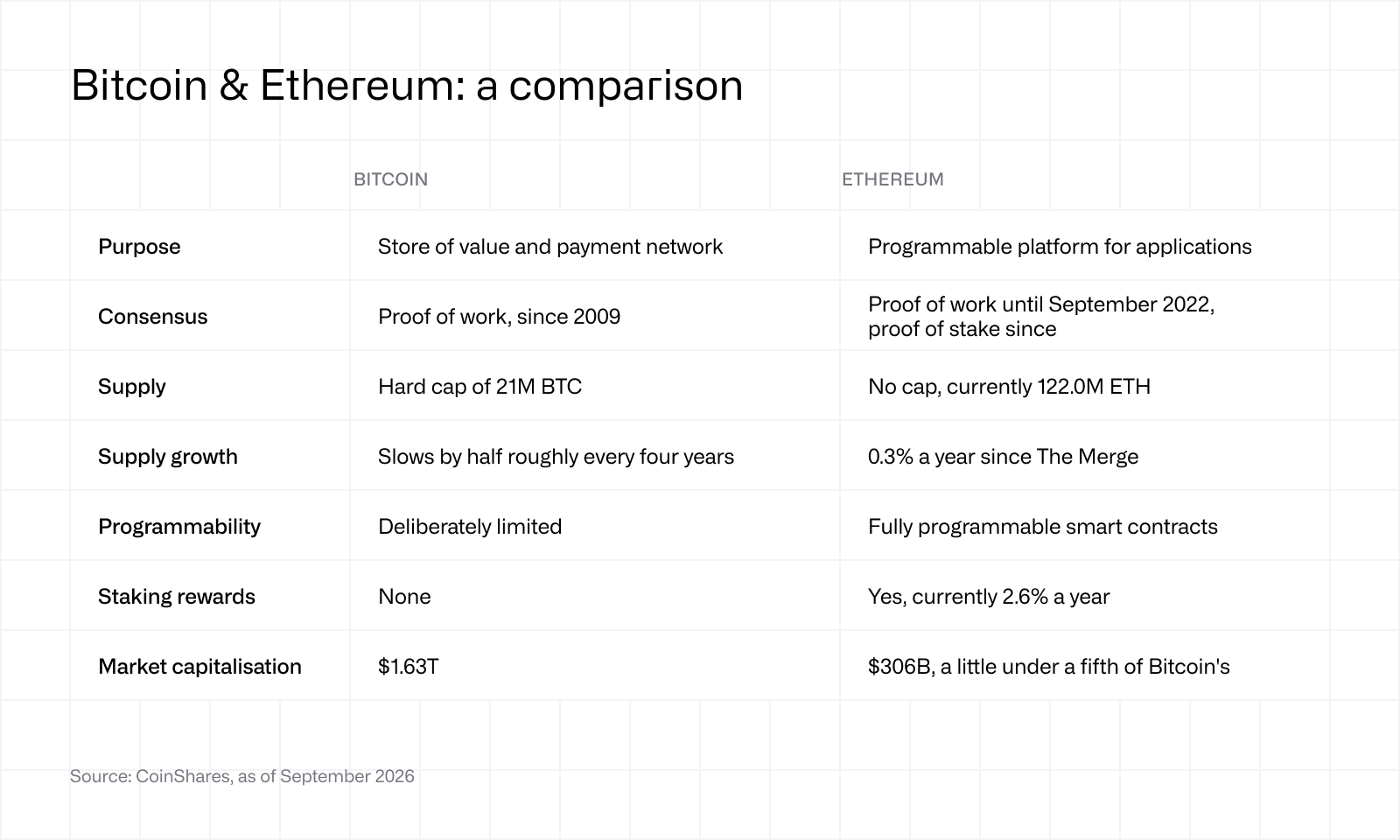
Raden om konsensus är den som oftast återges fel, även i tidigare versioner av den här guiden. För att vara otvetydig: Bitcoin använder proof of work. Ethereum använde proof of work fram till den 15 september 2022 och har använt proof of stake sedan dess. Det är alltså inte så att båda använder proof of stake.
Den praktiska följden är att ETH kan generera en belöning bara genom att innehas och stakas, vilket BTC inte kan. Det gör ETH till det som ligger närmast en avkastande tillgång bland digitala tillgångar, med den viktiga reservationen att belöningen betalas i ETH och är värd vad ETH är värd.
Layer 2: där Ethereums aktivitet faktiskt sker
Ett layer 2 är ett separat nätverk som behandlar transaktioner billigt och snabbt och med jämna mellanrum skickar tillbaka en komprimerad redovisning av vad det gjort till Ethereum. Ethereum förblir domaren och det slutgiltiga registret. Layer 2-nätverket tar hand om trafiken.
Liknelsen som fungerar är ett kortbetalningsnätverk. Enskilda köp clearas i ett snabbt sidosystem under dagen, och nettopositionen avvecklas mot bankerna vid dagens slut. Ethereum är avvecklingslagret. Layer 2-nätverken är där köpen sker.
Förskjutningen har varit avgörande. Under 2025 behandlade de tio största layer 2-nätverken tillsammans 6,35 miljarder transaktioner, mot 524 miljoner på Ethereums huvudkedja. 92,4 % av all aktivitet i Ethereums ekosystem skedde alltså någon annanstans än på Ethereum självt. Under de första åtta månaderna av 2026 har andelen sjunkit till 87,8 % när volymerna på huvudkedjan återhämtat sig, vilket fortfarande innebär nära nio av tio transaktioner på ett layer 2.1
Störst med bred marginal är Base, lanserat av Coinbase, som ensamt hanterade omkring 3,7 miljarder transaktioner under 2025, mer än hälften av hela layer 2-volymen. Arbitrum, OP Mainnet, Starknet, World Chain, Unichain, zkSync, Linea och Scroll utgör större delen av resten.1
Avgifterna är förklaringen. En transaktion som kostar några cent på huvudkedjan kostar normalt en bråkdel av en cent på ett layer 2. Det möjliggjordes av uppgraderingen Dencun i mars 2024, som skapade ett billigt tillfälligt datautrymme, kallat blobs, som layer 2-nätverk kan lägga sina redovisningar.
Det finns en avvägning som är värd att förstå. Layer 2-nätverk ärver Ethereums säkerhet för registret över vem som äger vad, men de flesta förlitar sig fortfarande på en enda operatör för att avgöra i vilken ordning transaktioner behandlas, och flera behåller möjligheten att ändra sin egen kod. De kräver alltjämt att användaren litar på en operatör, på ett sätt som huvudkedjan inte gör.
Historik och milstolpar
År 2013 publicerade den nittonårige programmeraren Vitalik Buterin en rapport där han hävdade att Bitcoins konstruktion var för snäv och att samma idé kunde bära en dator för allmänna ändamål i stället för enbart en valuta. Utvecklingen inleddes året därpå och nätverket lanserades 2015.
2015. Ethereum lanseras, efter en offentlig tokenförsäljning och bildandet av Ethereum Foundation.
2016. En angripare tömmer ett stort smart kontrakt vid namn The DAO. Gemenskapen röstar för att återställa det, vilket delar kedjan i två. Den återställda kedjan är det Ethereum vi använder i dag; den andra fortsätter som Ethereum Classic.
2017. Enterprise Ethereum Alliance startar med medlemmar som Accenture, Intel, JP Morgan och Microsoft.
2020. Beacon Chain lanseras i december och kör proof of stake parallellt medan huvudkedjan fortfarande använder proof of work.
2021. EIP-1559 inför avgiftsbränningen i augusti. ETH sätter i november vad som då var en rekordnotering.
2022. The Merge, den 15 september. Ethereum överger proof of work och går helt över till proof of stake, vilket minskar energiförbrukningen med mer än 99,98 %.4
2024. Dencun i mars inför blobs och sänker layer 2-kostnaderna med en tiopotens. Börshandlade spotprodukter för Ethereum börjar handlas i USA i juli.
2025. ETH sätter rekord för en dagsstängning på 4 829 dollar den 22 augusti.1
2026. Stakad ETH passerar 35,0 % av utbudet för första gången. Den 17 mars publicerar SEC och CFTC ett gemensamt tolkningsmeddelande om när staking faller utanför amerikansk värdepapperslagstiftning.
Nästa steg i färdplanen
Nästa planerade uppgradering är Glamsterdam, som väntas nå huvudkedjan i slutet av 2026 efter repetitioner på testnätverk från slutet av september. De viktigaste förändringarna är tekniska snarare än synliga för användaren: en omarbetning av hur block byggs och föreslås, och en betydande höjning av nätverkets kapacitetsmål.5
Därutöver publicerade Vitalik Buterin i juli 2026 en plan han kallar Lean Ethereum, ett tre till fyra år långt program som omfattar större delen av protokollet. Målet är att flytta tillbaka betydligt mer kapacitet till huvudkedjan, med ett långsiktigt mål om tusentals transaktioner per sekund direkt på Ethereum i stället för enbart på dess layer 2-nätverk. Tiden innan en transaktion blir oåterkallelig ska kortas till mellan tio och tjugo sekunder. Kryptografi som en framtida kvantdator skulle kunna knäcka ska ersättas. Och integritet ska byggas in, så att en transaktion på Ethereum inte längre innebär att hela den egna finansiella historiken publiceras.
Detta är mål, inte åtaganden. Ethereum har en lång historia av att leverera uppgraderingar sent, och flera ledande utvecklare har offentligt hävdat att tidsplanen är för långsam. Se färdplanen som riktning snarare än tidtabell.
Så får du exponering mot Ethereum
Det finns tre praktiska vägar.
Köp ETH direkt på en exchange. Du äger tillgången och kan staka den själv, men ansvarar för att förvara den säkert, för att skydda de privata nycklar som styr den och som inte kan återställas om de tappas bort, och för skatterapporteringen.
Köp en Exchange Traded Product (ETP). En ETP är ett värdepapper noterat på en börs som följer priset på en tillgång. Den köps via en vanlig depå eller ett bankkonto, tillsammans med aktier och fonder, och det finns inga plånböcker eller nycklar att hantera. En fysiskt uppbackad ETP äger verklig ETH hos ett reglerat förvaringsinstitut, det specialiserade bolag som förvarar tillgången för investerarnas räkning, i stället för att följa priset via derivat.
Köp en staking-ETP. Vissa ETP:er stakar den ETH de äger och för belöningen vidare till investerarna. Det är den enda vägen som ger en traditionell investerare stakingbelöningen utan att behöva driva något själv.
CoinShares Ethereum Staking ETP (ticker ETHE, ISIN GB00BLD4ZM24) är till 100 % fysiskt uppbackad av ETH som förvaras hos ett institutionellt förvaringsinstitut, tar ut 0,00 % i förvaltningsavgift och betalar en stakingbelöning på 1,25 % per år, som inte är garanterad och kan variera. Produkten lanserades i februari 2021 och hade 403 miljoner dollar i förvaltat kapital per den 28 augusti 2026. Den är noterad på Xetra i Tyskland, Euronext Paris och Amsterdam, SIX i Schweiz, London Stock Exchange och Borsa Italiana, så de flesta europeiska investerare kan köpa den via en mäklare de redan använder.3
Reserverna bakom varje CoinShares-ETP publiceras och verifieras oberoende, så innehavare kan när som helst kontrollera att produkten äger den ETH den uppger sig äga.3
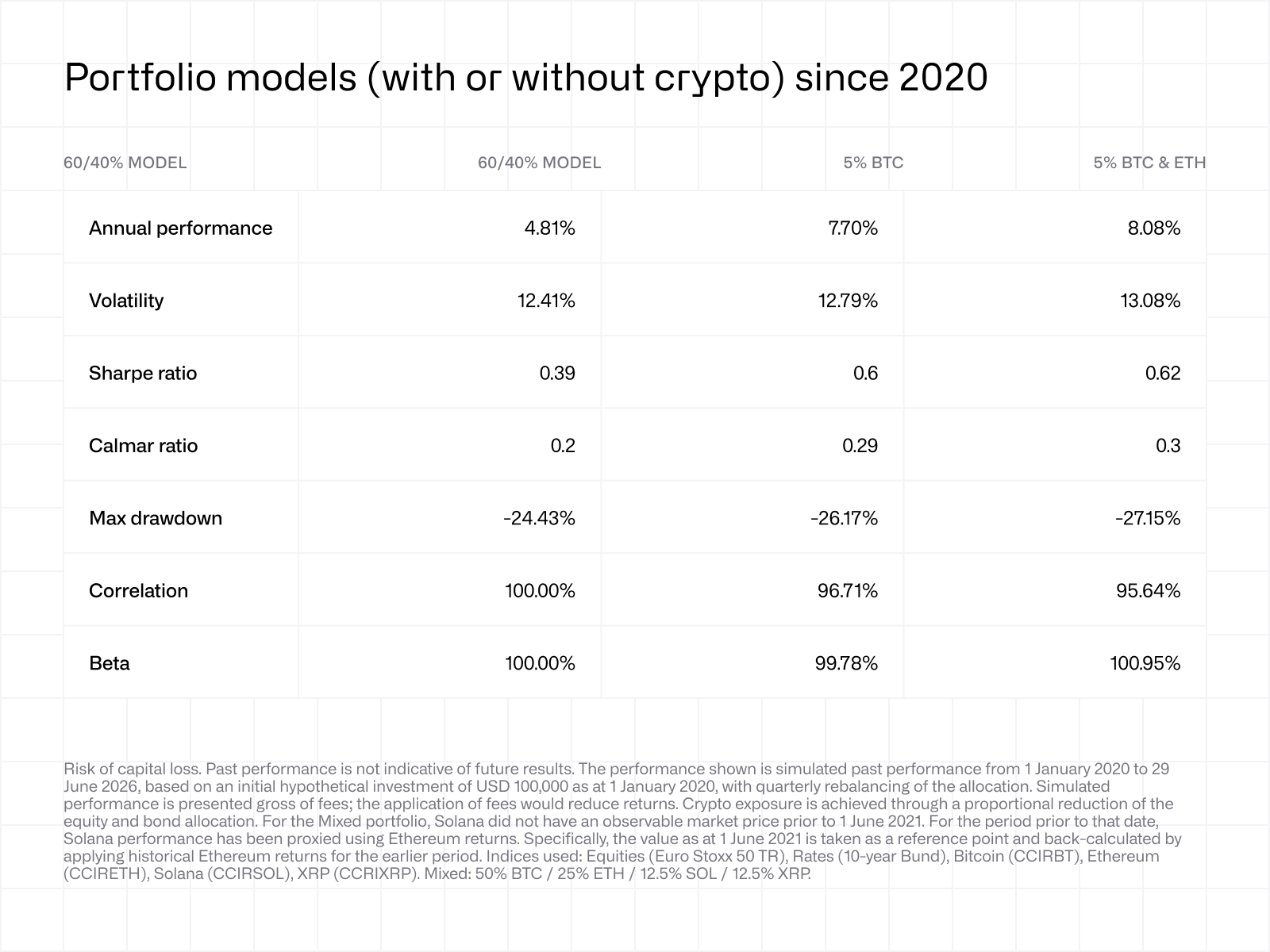
När det gäller storleken på innehavet undersöker CoinShares allokeringsmodell vad en liten öronmärkt andel digitala tillgångar gör med en traditionell portfölj. Detta är simulerade resultat, inte faktisk historisk avkastning. I simuleringen skulle en allokering på 5 %, fördelad mellan bitcoin och ether, ha lyft den årliga avkastningen från 4,8 % till 8,7 % och Sharpekvoten, ett mått på avkastning per enhet risk, från 0,39 till 0,70, samtidigt som den största nedgången från topp till botten vidgades från 24,1 % till 26,6 %. Poängen är inte att allokeringen är gratis. Poängen är att den extra avkastningen vid 5 % historiskt har varit större än den extra nedgången.
Investerarnas kapital är utsatt för risk och de kan förlora delar av eller hela sin investering. Kryptovaluta-ETP:er är komplexa produkter och kan vara svåra att förstå. Historisk avkastning är ingen tillförlitlig indikation på framtida avkastning. Stakingbelöningar är inte garanterade och kan variera. Läs prospektet och relevanta faktablad innan du investerar.
CoinShares analys
Styrkor
Ethereums etablerade ställning har slutat urholkas. Nätverket stod för 78,7 % av det samlade marknadsvärdet i de tolv största blockkedjorna för smarta kontrakt vid utgången av 2020 och föll till 55,9 % vid utgången av 2024. Sedan dess har raset stannat av: andelen ligger i dag på 58,7 %.1 Den långa nedgång som präglade kommentarerna i åratal har planat ut.
Viktigare är att Ethereum är där pengarna finns. Drygt tre femtedelar av allt värde som placerats i decentraliserad finans över samtliga blockkedjor ligger på Ethereum, och fler stablecoins ges ut på Ethereum än på alla andra blockkedjor tillsammans.1 Andel av marknadsvärdet är en sak; andelen av de tillgångar som människor faktiskt låter ligga kvar är betydligt trögrörligare. Bakom det finns branschens största utvecklarbas, som tillförde fler nya utvecklare under 2025 än någon annan blockkedja.7
Och staking ger ETH en inbyggd intäktsström som saknar motsvarighet i Bitcoin. Den betalas i ETH snarare än kontant och är inte garanterad, men den är en verklig ekonomisk skillnad mellan de två största digitala tillgångarna.
Möjligheter
Den tydligaste möjligheten på kort sikt är reglerade stakingprodukter. SEC:s och CFTC:s gemensamma tolkningsmeddelande av den 17 mars 2026 slår fast att staking faller utanför amerikansk värdepapperslagstiftning när leverantören agerar som kundens ombud, inte utövar något eget bestämmande över de stakade tillgångarna och inte garanterar belöningen.6 Därmed försvann det främsta värdepappersrättsliga hindret för staking inom amerikanska börshandlade produkter, på världens största marknad. Förändringen är snävare än kommentarerna runt den antydde: den handlar om hur en produkt är strukturerad, inte om att avgöra stakingens status i allmänhet. Europeiska staking-ETP:er har funnits i åratal och USA kommer först nu i kapp, och flödena brukar följa produkterna.
Den långsammare och större möjligheten är tokenization. Penningmarknadsfonder, statsobligationer och privata krediter ges i allt högre grad ut på en blockkedja i stället för i ett värdepappersregister, och Ethereum är den självklara platsen för de institutioner som gör det. Adoptionskurvan är lång, men det är den som troligen gör Ethereum till infrastruktur som den vanliga finansbranschen är beroende av. Det är också därför kapacitetsarbetet spelar roll: både Dencun och Fusaka levererade påtagliga kostnadssänkningar i stället för att skjutas upp på nytt, och Glamsterdam siktar på en betydande kapacitetsökning på själva huvudkedjan.
Svagheter
Den svåraste frågan för investeringscaset är att layer 2-nätverkens framgång har kannibaliserat huvudkedjan. Nära nio av tio transaktioner sker i dag på nätverk som betalar Ethereum mycket lite för förmånen. Avgiftsintäkterna på huvudkedjan föll från 526 miljoner dollar under 2025 till 113 miljoner dollar under de första åtta månaderna av 2026, och den brända mängden föll ännu mer.1 Skalningen fungerade, och den flyttade intäkterna någon annanstans. Om Ethereum kan ta betalt för avveckling i närheten av vad nätverket en gång tog betalt för trängsel är olöst, och den som köper ETH tar ställning i den frågan.
Det leder till ett andra problem: berättelsen om deflation håller inte. Utbudet har vuxit, inte krympt, sedan bränningen inleddes, och det växer snabbare när bränningen minskar.1 Varje argument som vilar på att ETH blir knappare över tid motsägs av data.
Ytterligare två svagheter är strukturella snarare än ekonomiska. Kod som inte kan ändras är kod som inte kan lagas, så risken i smarta kontrakt är permanent: attacker mot applikationer byggda på Ethereum har kostat användarna miljardbelopp i dollar, och nätverket självt återställer dem inte. Och dussintals layer 2-nätverk, vart och ett med egna avgifter, egen token och eget sätt att flytta pengar in och ut, gör upplevelsen genuint förvirrande för en nykomling på ett sätt som Bitcoin inte är.
Hot
Koncentrationen inom staking är det som bör bevakas. En tredjedel av all ETH är stakad, och en stor del av den går via en handfull stora operatörer och via tjänster som ger ut ett handelsbart bevis för stakad ETH. Det är en fråga om styrning och censur snarare än en stöldrisk, men den är verklig.
Det finns också priskonkurrens: Solana, BNB Chain och andra är snabbare och billigare på sina egna huvudkedjor och har tagit betydande andelar av privatpersoners aktivitet. Det finns den regulatoriska klassificeringen, omtvistad i ett decennium och avgjord i vissa jurisdiktioner men inte i andra. Det amerikanska tolkningsmeddelandet från mars 2026 hjälper, men det gäller bara stakingupplägg som uppfyller dess villkor, det tar inte upp ETH:s egen status och det avgör inte frågan utanför USA. Och det finns en koncentration i bolagens balansräkningar: flera noterade bolag håller i dag ETH-positioner på miljontals mynt, finansierade genom att ge ut aktier. Det har varit en källa till efterfrågan, och det kan bli en källa till tvingat utbud om deras finansieringsvillkor vänder.
Vad det i slutändan handlar om
Ethereum är varken billigt eller enkelt att äga, och layer 2-frågan är skälet till att en försiktig investerare skulle tveka. Men svårigheten och argumentet är samma sak. Ethereum gjorde sig självt billigt nog att använda, och det som nu byggs på nätverket ser mindre ut som spekulation och mer som rörsystem: osynligt, tråkigt och nödvändigt. Stablecoins som flyttar fler dollar än alla andra blockkedjor tillsammans, och fonder och obligationer som avvecklas på minuter i stället för dagar. Om liknelsen med digital olja håller spelar priset på bränslet mindre roll över tid än hur mycket maskineri som till slut drivs av det. Det är vad som bör bevakas, och det ställer frågan om storleken på innehavet snarare än besvarar den: vilken siffra en investerare än landar på bör den vara liten nog att det går att överleva att ha haft fel, vilket är hela logiken bakom den 5-procentiga allokeringen i modellen ovan.
Vanliga frågor
Vad är Ethereum, enkelt uttryckt?
Ethereum är en offentlig dator som ingen äger. Det är en blockkedja, ett delat register som hålls synkroniserat av tusentals oberoende maskiner, och som kan köra program lika väl som flytta pengar. Dess token heter ether (ETH). Vem som helst kan publicera ett program på den, och när det väl är publicerat körs det som det är skrivet, och ingen enskild part kan stänga av det.
Är Ethereum en bra investering?
Det beror helt på de egna förutsättningarna och risktoleransen, och inget här är rådgivning. Vad som faktiskt kan sägas är att ETH är mycket volatil, saknar tak för sitt utbud, för närvarande ger en stakingbelöning på 2,6 % per år och handlas 48,1 % under sin rekordnotering för en dagsstängning i augusti 2025. Kapitalet är utsatt för risk.
Hur mycket kan man tjäna på att staka Ethereum?
Nätverkets grundbelöning ligger för närvarande på 2,6 % per år och betalas i ETH.2 Nivån faller när mer ETH stakas och stiger med nätverksaktiviteten, så den ändras hela tiden. Produkter som stakar åt investeraren och för vidare en del efter kostnader: CoinShares Ethereum Staking ETP betalar 1,25 % per år med 0,00 % i förvaltningsavgift.3 Stakingbelöningar är inte garanterade och kan variera.
Varför är Ethereum så mycket billigare att använda än tidigare?
Två uppgraderingar, Dencun i mars 2024 och Fusaka i december 2025, skapade och utvidgade sedan ett billigt datautrymme för layer 2-nätverk. Layer 2-nätverken hanterar nu nära nio av tio Ethereum-transaktioner till en bråkdel av en cent styck, och mindre trängsel på huvudkedjan har dragit ned även avgifterna där, från i snitt 1,00 dollar per transaktion under 2025 till 0,20 dollar hittills under 2026.1
Har Ethereum ett maximalt utbud?
Nej. Bitcoin är begränsad till 21 miljoner mynt; Ethereum har ingen motsvarande gräns. Ny ETH ges ut löpande för att betala validatorer, och en del av varje avgift förstörs. Sedan avgiftsbränningen inleddes 2021 har bränningen inte hållit jämna steg med utgivningen, så utbudet har vuxit, men med 0,3 % per år sedan 2022 i stället för 2,7 % dessförinnan.1
Vad är skillnaden mellan Ethereum och ether?
Ethereum är nätverket. Ether, eller ETH, är den token som används för att betala för att använda nätverket och för att staka. I vardagligt tal säger man ”Ethereum” om båda, och exchanges listar token under tickern ETH.
Källor
1 Token Terminal, samtliga uppgifter per den 3 september 2026.
2 Beaconcha.in, per den 4 september 2026.
3 CoinShares Ethereum Staking ETP (ETHE), produktsida och produktblad, nyckelinformation per den 28 augusti 2026.
4 Crypto Carbon Ratings Institute (CCRI)
5 Ethereum Foundation
6 US Securities and Exchange Commission och Commodity Futures Trading Commission, gemensamt tolkningsmeddelande om stakingverksamhet, 17 mars 2026. Electric Capital, Developer Report 2025.
Publicerad denSept 14th, 2026