


The convergence of Bitcoin mining and AI: from crypto niche to digital power infrastructure
 8 min read
- Finance
- Technology
Bitcoin miners spent a decade building exactly what the AI economy now needs most: large-scale, power-dense computing facilities. That overlap is reshaping an entire industry, and how investors should think about it.
Bitcoin mining is the process by which new BTC enters circulation and transactions are validated on the network. Miners compete to solve computational puzzles, and the winner earns newly minted bitcoin as a block reward. This proof-of-work mechanism is what secures the largest and most battle-tested decentralised network in digital assets.
But mining has also matured into a standalone industry, with its own economics, supply chain, energy strategy and publicly listed companies. And over the past two years, that industry has undergone its most significant transformation yet: a structural convergence with artificial intelligence and high-performance computing (HPC). What was once a pure-play bet on bitcoin is becoming something broader, a category we would describe as digital power infrastructure.
The economics of mining, briefly
Mining economics rest on three variables: the bitcoin price, the block reward, and energy costs. The April 2024 halving cut the block reward from 6.25 to 3.125 BTC, and newly issued bitcoin still accounts for over 99% of miner revenue, with transaction fees making up the small remainder.1 At the same time, competition has never been fiercer. Hashrate, the combined computing power miners deploy on the network, crossed 1 zettahash per second for the first time in 2025 and remains near record levels.2 That is a one followed by 21 zeros. If every person on Earth performed one calculation per second, it would take humanity roughly 4,000 years to match what the network now processes every second.
Miners therefore face a business where revenue per unit of computation is programmatically squeezed every four years while the cost of competing keeps rising. The winners have always been energy arbitrageurs: operators who secure cheap electricity, often from renewable, stranded or curtailed sources, and convert it into a globally tradeable digital asset.
That pressure explains what happened next. When a new customer arrived willing to pay premium, contracted, dollar-denominated rates for the exact assets miners already owned, the industry listened.
Why AI came knocking
The explosion of demand for AI has created a structural shortage of data centre capacity. The International Energy Agency projects that global data centre electricity consumption will roughly double from around 485 terawatt-hours (TWh) in 2025 to about 950 TWh by 2030, with AI the most important driver. For scale, by 2030 data centres alone would consume slightly more electricity than the whole of Japan does today, and in the United States they are expected to account for almost half of all electricity demand growth to 2030.3
The binding constraint is no longer chips. It is energised land: sites with secured grid connections, high-voltage infrastructure, cooling capability and power purchase agreements. These take years to permit and build from scratch. Bitcoin miners, as it happens, have spent the past decade assembling exactly this portfolio. Mining facilities are large-scale computing sites optimised for power density and heat management, with utility relationships and energy expertise that transfer directly to AI hosting.
From pivot to proof
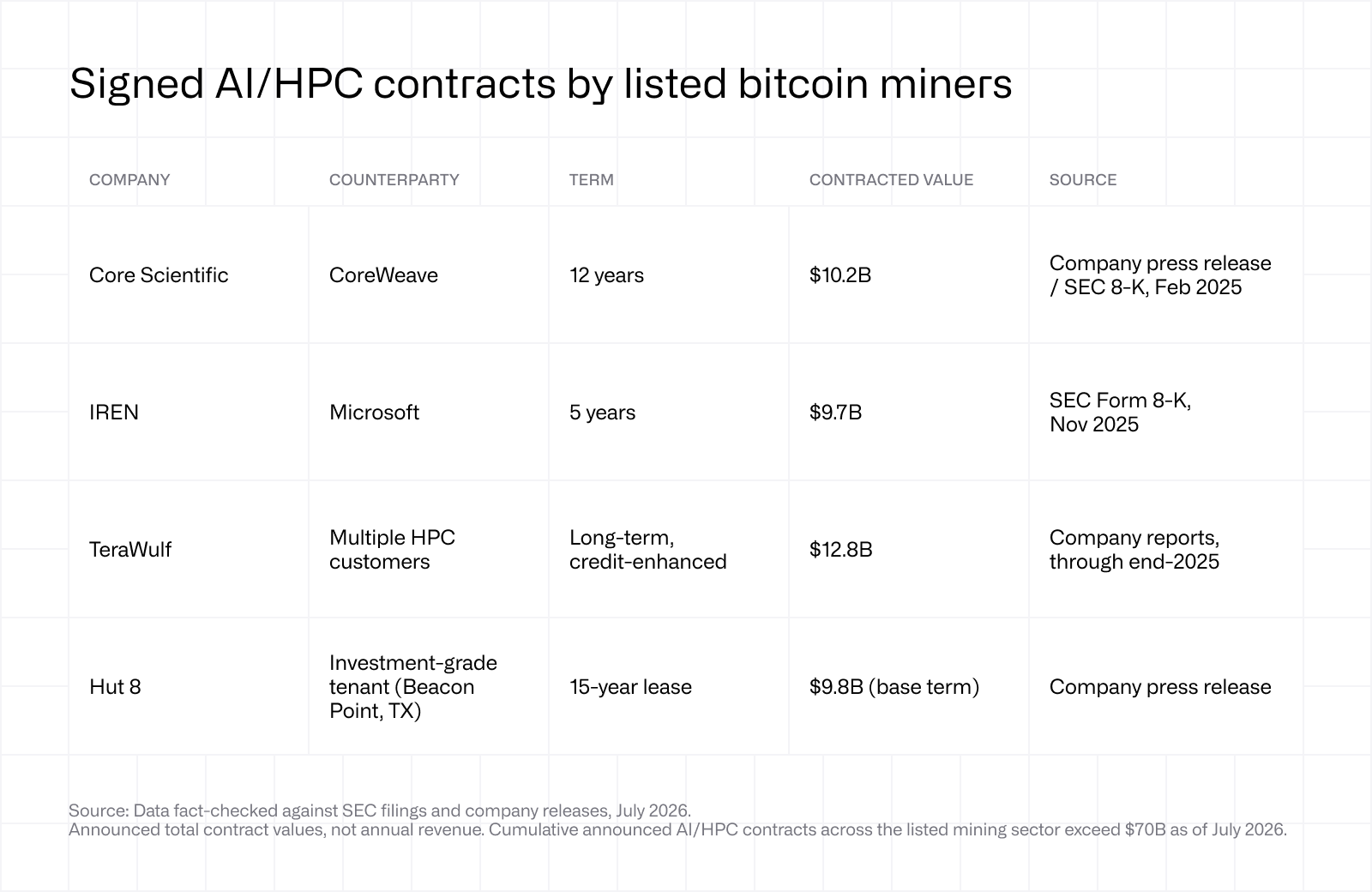
What began as a speculative narrative has hardened into contracted revenue. Core Scientific has signed 12-year hosting agreements with AI cloud provider CoreWeave worth $10.2B in total contract value.4 IREN secured a five-year, $9.7B AI cloud contract with Microsoft covering NVIDIA GB300 deployments at its Childress, Texas campus.5 TeraWulf has announced over $12B in long-term HPC hosting contracts, and its HPC leasing revenue overtook its bitcoin mining income for the first time in the first quarter of 2026.6 Hut 8 signed a 15-year lease for its Beacon Point campus in Texas reported at $9.8B.7
Across the listed mining sector, cumulative announced AI and HPC contracts now exceed $70B.8 For a group of companies whose combined annual mining revenue is a fraction of that figure, this is not diversification at the margin. It is a re-founding of the business model around two demand engines: bitcoin block rewards and contracted AI compute.
Energy as the common denominator
The deeper logic of the convergence is energy. Bitcoin mining pioneered a model of energy commoditisation: monetising power at the source, regardless of location or grid connectivity, including flared gas and surplus renewable output. Many mining operations also act as demand-response assets, curtailing consumption when grids are stressed and earning revenue for doing so.
AI data centres now compete for the same scarce resource, but with a different profile: they need firm, always-on power and pay for reliability rather than flexibility. Companies that control cheap, scalable energy capacity can therefore arbitrage between three markets at once: mining bitcoin, hosting AI workloads, and selling flexibility back to the grid. As global power demand accelerates, driven by AI, electrification and data growth, that optionality is the industry's most durable asset.
What this means for WGMI
This transformation is why the CoinShares Bitcoin Mining ETF (WGMI) has updated its strategy. The Fund now invests at least 80% of its net assets in securities of Bitcoin Mining and Digital Power Companies, replacing its prior focus solely on bitcoin mining companies.9
The definition of eligible companies has been expanded to reflect the convergence described above. It now includes companies operating hyperscale data centres designed to support AI and other applications; companies engaged in the design, manufacture or supply of components for data centre operations and AI applications, including semiconductors; companies involved in power generation, energy infrastructure equipment and storage solutions essential to data centre operations; and companies involved in high-performance and quantum computing technologies supporting AI workloads.9 The Fund retains flexibility to invest up to 20% of its net assets in companies with broader bitcoin or digital infrastructure exposure.9
The Fund's investable universe has been redrawn to match where the industry itself has gone: from bitcoin mining as a crypto niche to bitcoin mining as one application of a larger digital power and compute infrastructure theme.
What should investors keep in mind?
The convergence does not remove risk; it changes its shape. Mining equities remain operationally leveraged to the bitcoin price and can fall more sharply than bitcoin itself in drawdowns. The AI hosting business introduces new exposures: customer concentration around a small number of AI counterparties, execution risk on multi-year construction timelines, and financing needs that have grown with ambition. And AI infrastructure demand itself, while structural, will not move in a straight line.
But for investors who previously saw mining stocks as a one-dimensional bitcoin proxy, that framing is now out of date. The sector today offers a multi-thematic case: exposure to bitcoin's supply dynamics, to the buildout of AI computing capacity, and to the ongoing transformation of how energy is sourced, priced and consumed. Few industries sit at that intersection. Fewer still arrived there already holding the right assets.
Sources
1 Token Terminal, Bitcoin miner revenue data, as of 11 July 2026
2 Hashrate Index / CoinWarz network data, July 2026
3 International Energy Agency, Energy and AI report, 2026 update
4 Core Scientific / CoreWeave hosting agreements, company announcements
5 IREN, SEC Form 8-K, November 2025
6 TeraWulf, company reports, Q1 2026
7 Hut 8, company announcement, Beacon Point campus lease
8 Aggregate of announced sector contracts, company disclosures, as of July 2026
9 CoinShares Bitcoin Mining ETF (WGMI), prospectus
Published onAug 18th, 2026

