

This website uses cookies
We use cookies to personalise content and ads, to provide social media features and to analyse our traffic. We also share information about your use of our site with our social media, advertising and analytics partners who may combine it with other information that you’ve provided to them or that they’ve collected from your use of their services.
Consent Selection
Details
  • Necessary cookies help make a website usable by enabling basic functions like page navigation and access to secure areas of the website. The website cannot function properly without these cookies.

    • Learn more about this provideropens in a new window
      CookieConsentStores the user's cookie consent state for the current domain
      Maximum Storage Duration: 1 yearType: HTTP Cookie
    • Learn more about this provideropens in a new window
      bcookieUsed in order to detect spam and improve the website's security.
      Maximum Storage Duration: 1 yearType: HTTP Cookie
      li_gcStores the user's cookie consent state for the current domain
      Maximum Storage Duration: 180 daysType: HTTP Cookie
    • Learn more about this provideropens in a new window
      datadomeUsed in context with the website's BotManager. The BotManager detects, categorizes and compiles reports on potential bots trying to access the website.
      Maximum Storage Duration: 1 yearType: HTTP Cookie
    • _pk_testcookie_domainThis cookie determines whether the browser accepts cookies.
      Maximum Storage Duration: 1 dayType: HTTP Cookie
    • __cf_bm [x3]This cookie is used to distinguish between humans and bots. This is beneficial for the website, in order to make valid reports on the use of their website.
      Maximum Storage Duration: 1 dayType: HTTP Cookie
  • Preference cookies enable a website to remember information that changes the way the website behaves or looks, like your preferred language or the region that you are in.
    • Learn more about this provideropens in a new window
      lidcRegisters which server-cluster is serving the visitor. This is used in context with load balancing, in order to optimize user experience.
      Maximum Storage Duration: 1 dayType: HTTP Cookie
  • Statistic cookies help website owners to understand how visitors interact with websites by collecting and reporting information anonymously.
    • Learn more about this provideropens in a new window
      guestRegisters data on visitors' website-behaviour. This is used for internal analysis and website optimization.
      Maximum Storage Duration: 1 monthType: HTTP Cookie
    • Learn more about this provideropens in a new window
      personalization_idThis cookie is set by Twitter - The cookie allows the visitor to share content from the website onto their Twitter profile.
      Maximum Storage Duration: 400 daysType: HTTP Cookie
    • _pk_uidUsed by Piwik Analytics Platform to identify the visitor on repeat visits to the website.
      Maximum Storage Duration: 1 yearType: HTTP Cookie
      _pk_id#Collects statistics on the user's visits to the website, such as the number of visits, average time spent on the website and what pages have been read.
      Maximum Storage Duration: 1 yearType: HTTP Cookie
      _pk_ses#Used by Piwik Analytics Platform to track page requests from the visitor during the session.
      Maximum Storage Duration: 1 dayType: HTTP Cookie
    • FPGSIDRegisters statistical data on users' behaviour on the website. Used for internal analytics by the website operator.
      Maximum Storage Duration: 1 dayType: HTTP Cookie
      FPIDRegisters statistical data on users' behaviour on the website. Used for internal analytics by the website operator.
      Maximum Storage Duration: 400 daysType: HTTP Cookie
      FPLCRegisters a unique ID that is used to generate statistical data on how the visitor uses the website.
      Maximum Storage Duration: 1 dayType: HTTP Cookie
    • _gaRegisters a unique ID that is used to generate statistical data on how the visitor uses the website.
      Maximum Storage Duration: 2 yearsType: HTTP Cookie
      _ga_#Used by Google Analytics to collect data on the number of times a user has visited the website as well as dates for the first and most recent visit.
      Maximum Storage Duration: 2 yearsType: HTTP Cookie
  • Marketing cookies are used to track visitors across websites. The intention is to display ads that are relevant and engaging for the individual user and thereby more valuable for publishers and third party advertisers.
    • Learn more about this provideropens in a new window

      Some of the data collected by this provider is for the purposes of personalization and measuring advertising effectiveness. The provider may use the IP Addresses for ads measurement and ads personalization.

      ads/ga-audiencesUsed by Google AdWords to re-engage visitors that are likely to convert to customers based on the visitor's online behaviour across websites.
      Maximum Storage Duration: SessionType: Pixel Tracker
    • Learn more about this provideropens in a new window
      userRefererDetermines how the user accessed the website. This information is used by the website operator in order to measure the efficiency of their marketing.
      Maximum Storage Duration: 1 monthType: HTTP Cookie
    • Learn more about this provideropens in a new window
      #:session-dataTracks the individual sessions on the website, allowing the website to compile statistical data from multiple visits. This data can also be used to create leads for marketing purposes.
      Maximum Storage Duration: PersistentType: HTML Local Storage
      eng_mtTracks the conversion rate between the user and the advertisement banners on the website - This serves to optimise the relevance of the advertisements on the website.
      Maximum Storage Duration: PersistentType: HTML Local Storage
      t_gidThis cookie assigns a specific visitor ID, when the visitor interacts with ads or content from the website - this allows the website to target the visitor with similar ads or content.
      Maximum Storage Duration: 1 yearType: HTTP Cookie
      t_pt_gidCollects information on user preferences and/or interaction with web-campaign content - This is used on CRM-campaign-platform used by website owners for promoting events or products.
      Maximum Storage Duration: 1 yearType: HTTP Cookie
      taboola global:user-idSets a unique ID for the visitor, that allows third party advertisers to target the visitor with relevant advertisement. This pairing service is provided by third party advertisement hubs, which facilitates real-time bidding for advertisers.
      Maximum Storage Duration: PersistentType: HTML Local Storage
      taboola_session_idThis cookie is used to collect information on a visitor. This information will become an ID string with information on a specific visitor – ID information strings can be used to target groups with similar preferences, or can be used by third-party domains or ad-exchanges.
      Maximum Storage Duration: SessionType: HTTP Cookie
    • Learn more about this provideropens in a new window
      1/i/adsct [x2]Collects data on user behaviour and interaction in order to optimize the website and make advertisement on the website more relevant.
      Maximum Storage Duration: SessionType: Pixel Tracker
      muc_adsCollects data on user behaviour and interaction in order to optimize the website and make advertisement on the website more relevant.
      Maximum Storage Duration: 400 daysType: HTTP Cookie
      guest_idCollects data related to the user's visits to the website, such as the number of visits, average time spent on the website and which pages have been loaded, with the purpose of personalising and improving the Twitter service.
      Maximum Storage Duration: 400 daysType: HTTP Cookie
      guest_id_adsCollects information on user behaviour on multiple websites. This information is used in order to optimize the relevance of advertisement on the website.
      Maximum Storage Duration: 400 daysType: HTTP Cookie
      guest_id_marketingCollects information on user behaviour on multiple websites. This information is used in order to optimize the relevance of advertisement on the website.
      Maximum Storage Duration: 400 daysType: HTTP Cookie
    • _gcl_auUsed by Google AdSense for experimenting with advertisement efficiency across websites using their services.
      Maximum Storage Duration: 3 monthsType: HTTP Cookie
      _gcl_lsTracks the conversion rate between the user and the advertisement banners on the website - This serves to optimise the relevance of the advertisements on the website.
      Maximum Storage Duration: PersistentType: HTML Local Storage
    • pardot [x2]Used in context with Account-Based-Marketing (ABM). The cookie registers data such as IP-addresses, time spent on the website and page requests for the visit. This is used for retargeting of multiple users rooting from the same IP-addresses. ABM usually facilitates B2B marketing purposes.
      Maximum Storage Duration: SessionType: HTTP Cookie
  • Unclassified cookies are cookies that we are in the process of classifying, together with the providers of individual cookies.
    • cs_analytics_ip_blockedPending
      Maximum Storage Duration: SessionType: HTTP Cookie
      user_tokenPending
      Maximum Storage Duration: 1 yearType: HTTP Cookie
    • _twpidPending
      Maximum Storage Duration: SessionType: HTTP Cookie
Cookie declaration last updated on 8/20/26 by Cookiebot
[#IABV2_TITLE#]
[#IABV2_BODY_INTRO#]
[#IABV2_BODY_LEGITIMATE_INTEREST_INTRO#]
[#IABV2_BODY_PREFERENCE_INTRO#]
[#IABV2_BODY_PURPOSES_INTRO#]
[#IABV2_BODY_PURPOSES#]
[#IABV2_BODY_FEATURES_INTRO#]
[#IABV2_BODY_FEATURES#]
[#IABV2_BODY_PARTNERS_INTRO#]
[#IABV2_BODY_PARTNERS#]
About
Cookies are small text files that can be used by websites to make a user's experience more efficient.

The law states that we can store cookies on your device if they are strictly necessary for the operation of this site. For all other types of cookies we need your permission.

This site uses different types of cookies. Some cookies are placed by third party services that appear on our pages.

You can at any time change or withdraw your consent from the Cookie Declaration on our website.

Learn more about who we are, how you can contact us and how we process personal data in our Privacy Policy.

Please state your consent ID and date when you contact us regarding your consent.
Image What is Algorand - ALGO guide

What is Algorand - ALGO guide

Timer11 min read

  • Altcoins
  • Technology

Algorand: built for scalability 

Algorand is a core blockchain like Ethereum and Solana- known as a Layer 1 in the crypto community- which uses a variation of the proof of stake (PoS) consensus mechanism called ‘pure’ PoS to process transactions and secure the network. The protocol is built for scalability, capable of handling up to 10K transactions per second (TPS) while charging low fees. 

Key figures

  • Launch date: 2019

  • Total value locked (TVL): $31,0M (as of 30 June 2026)

  • Daily active users: 12,760 (as of 30 June 2026)

  • Market capitalisation: $740,1M (as of 30 June 2026)

  • Network fees: $153,380 across the whole of 2025

Algorand at a glance

Consensus mechanism: Algorand’s pure PoS encourages participation by allowing holders with as little as one ALGO (the protocol’s native token) to earn block rewards. What’s more, it doesn’t require you to lock up your stake.     

Scalability: Algorand claims it can process up to 10K TPS, although its highest recorded volume according to Chainspect is 5,716 (as of December 2025). The network’s finality, the time it takes for a transaction to be recorded on the blockchain and become irreversible, is nearly instant.  

Low cost: Algorand’s transaction fee is 0.001 ALGO, which at $0,0828 per ALGO on 30 June 2026 is under one hundredth of a cent, ranking it among the most cost-efficient blockchains. That said, fees may rise during periods of network congestion.

Worth being straight about what that cheapness reflects. Algorand collected $153,380 in total network fees across 2025 and $23,153 over the first half of 2026. Fees this low are partly a design choice and partly a demand problem: there is very little competition for Algorand's blockspace.

Sustainable: Algorand claims to be more environmentally friendly than other PoS networks thanks to the lottery system it uses to select validators and the fact that they don’t have to compete to process transactions.

Protocol mechanism

PoS requires participants known as validators to deposit or ‘stake’ a certain amount of the blockchain’s native token for the right to process transactions. In return for this service, they receive block rewards in the form of freshly minted tokens.  

The minimum stake to become a validator in Algorand’s pure PoS is 30K ALGO, worth roughly $2,480 as of 30 June 2026. For context, Ethereum’s validators must stake 32 ETH, roughly $50,200 on the same date. However, even if you just hold one ALGO, you can participate by joining a staking pool. Staking pools combine your funds with others who can’t afford the minimum stake and run a validator on your behalf, sharing a portion of the block rewards.

You remain in control of your stake at all times, so you can use your tokens elsewhere, for instance to earn a return on a decentralised finance (DeFi) application. Another unique feature of pure PoS is it doesn’t penalise validators who underperform or behave dishonestly. Instead, they’re simply removed from the network and forgo rewards.

Market performance

ALGO traded at $0,0828 on 30 June 2026, for a circulating market capitalisation of $740,1M across 8,93 billion tokens in circulation. The token fell 67,0% across 2025 and a further 31,2% over the first half of 2026. Against the all-time high market capitalisation of $13,40B set on 12 November 2021, ALGO has lost roughly 94% of its market value. Past performance is not a guide to future returns.

The chart is worth reading carefully, because the story it tells is not simply a bear market. Algorand's market value peaked in late 2021 and has fallen in every subsequent year, including years when the broader crypto market rose. That is the signature of an asset losing relative ground rather than one moving with the cycle.
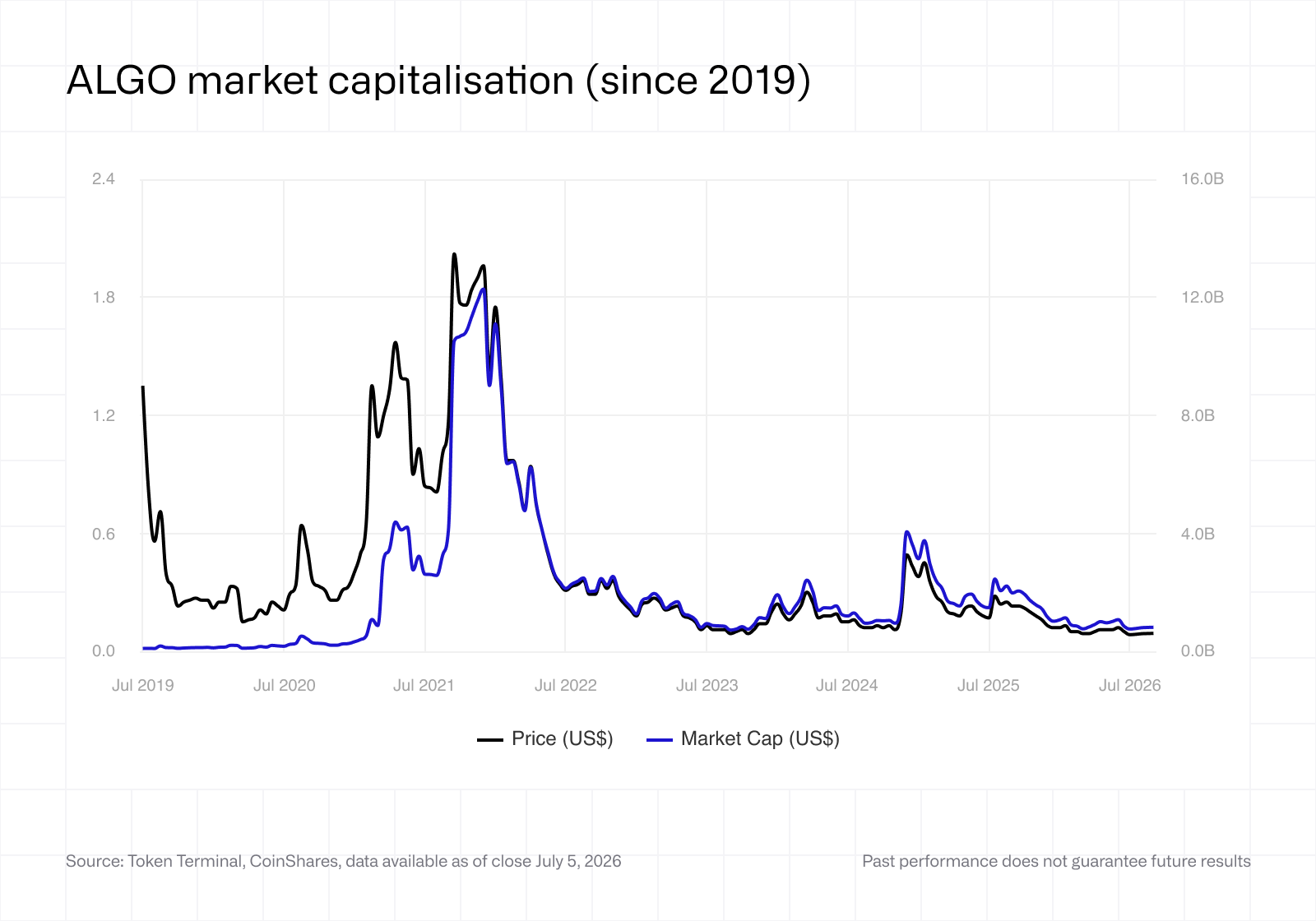
ALGO market capitalisation (since 2019)

History

Algorand was launched by Massachusetts Institute of Technology professor Silvio Micali in 2019. Micali has extensive experience in the world of cryptography, having invented several ground-breaking tools including zero-knowledge proofs (ZKP), which allow someone to verify something without revealing sensitive information (like proving you’re old enough to enter a club without having to show ID).

Key milestones

  • February 2018: Algorand’s first investment round raised $4M.

  • October 2018: It raised a further $62M.

  • June 2019: The Algorand Foundation launched the Global University Program to advance blockchain research.

  • December 2021: Algorand Community Governance launched, allowing ALGO holders to vote on network upgrades.

  • March 2022: Algorand’s smart contracts (programmes that automatically execute when preconditions are met, a bit like a vending machine) became composable, meaning they can interact with each other, enabling more complex use cases. 

  • June 2023: A network upgrade increased Algorand’s maximum TPS to 10K and decreased the block time (the average time it takes to produce a new block of transactions) to 3.3 seconds.

  • January 2024: The block time dropped below three seconds.

  • February 2024: TVL peaked at $319,1M, its highest level on record, driven largely by activity on DeFi platform Folks Finance.

  • January 2025: After the latest upgrade, block rewards went live on the network to boost security and decentralisation (replacing governance rewards).  

  • July 2025: The xGov Council launched, an elected group of Algorand experts responsible for evaluating and funding projects proposed by the community.

Algorand was also the first non-EVM blockchain to be chosen by Midas to issue its tokenised US Treasury certificate, mTBILL.
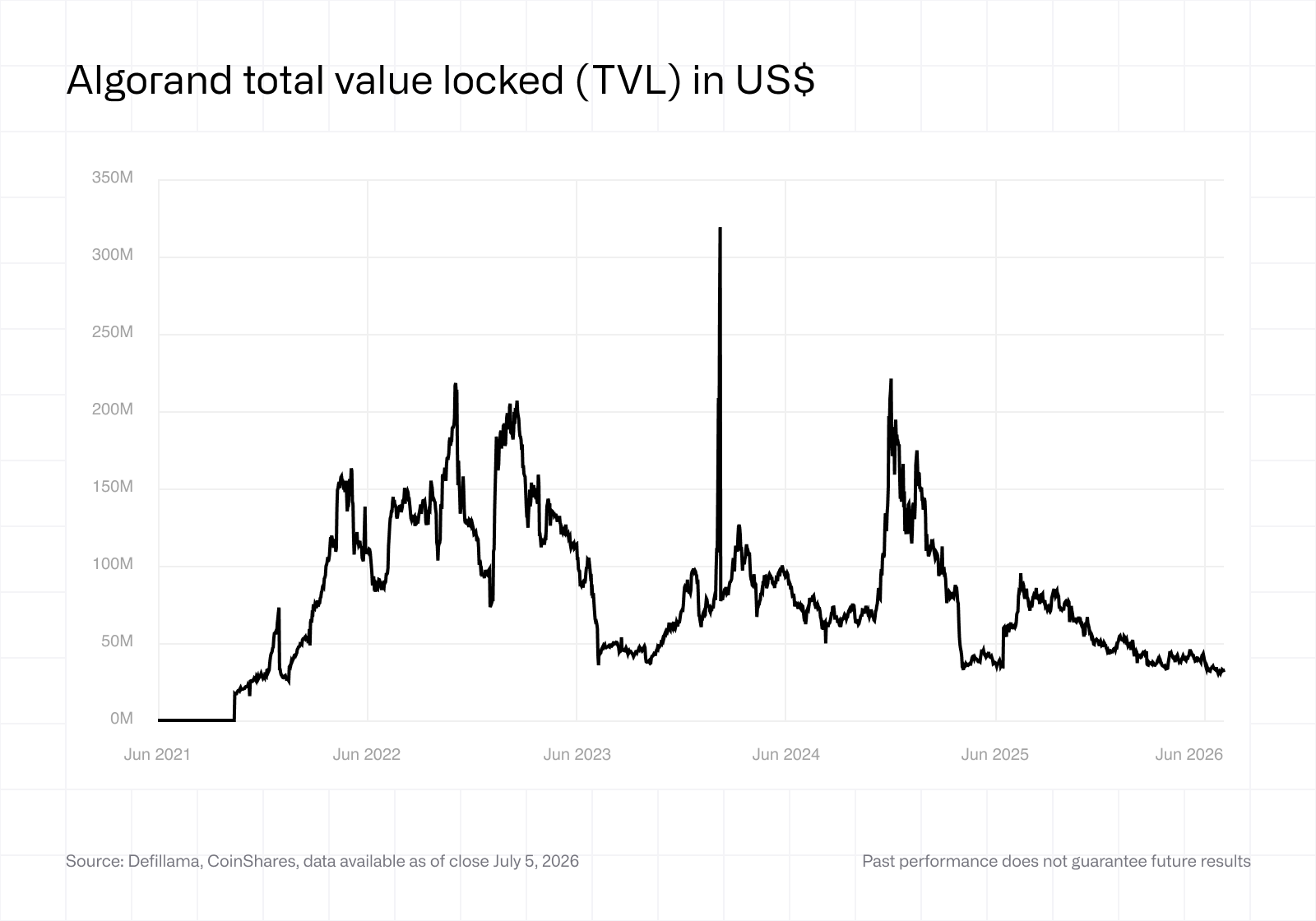
Algorand total value locked (TVL)

CoinShares’ analysis

Algorand’s scalability is its greatest strength, and the roadmap outlined above is designed to address its biggest challenge- real-world adoption. Tokenised RWAs could prove to be a particularly lucrative use case.

Strengths

  • The number of transactions Algorand can handle, its quick finality and low fees make it a highly scalable network.

  • Silvio Micali, Algorand’s founder, has strong credentials in the crypto sphere and a reputation for innovation, which should bode well for the network’s evolution.

  • The network has operated without significant disruption since 2019, and the January 2025 move from governance rewards to block rewards aligned incentives with securing the chain rather than with voting participation.

Weaknesses

  • Algorand has experienced relatively low adoption in terms of TVL ($31,0M as of 30 June 2026, down from $47,2M at the end of 2025 and $137,3M at the end of 2024). 

  • Daily active users averaged 67,868 across 2025 but only 15,562 over the first half of 2026, and stood at 12,760 on 30 June 2026.1 The 2025 average was inflated by one-off activity, notably TravelX issuing plane tickets as NFTs. Once that stopped, usage settled into the low tens of thousands.
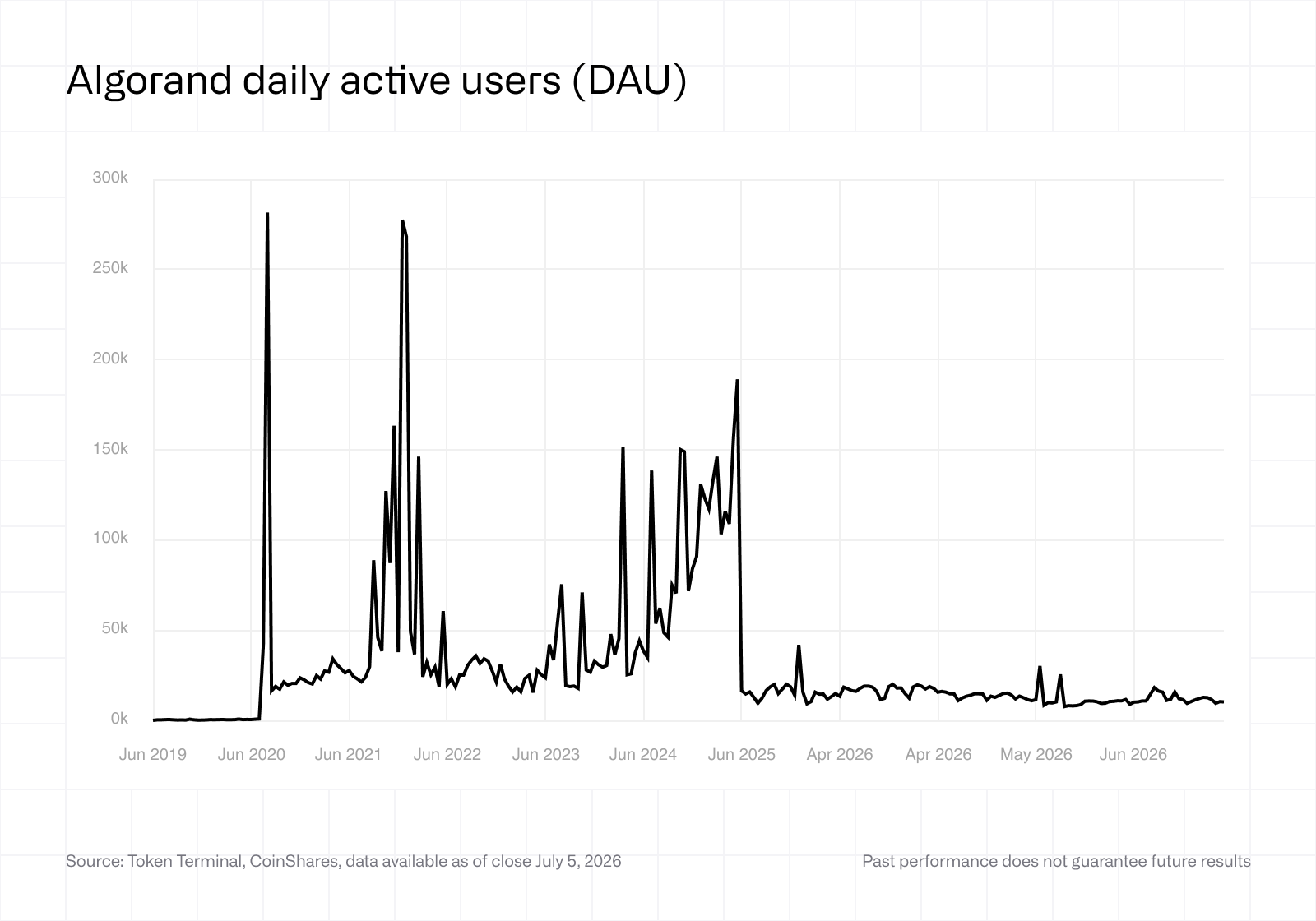
Algorand daily active users (DAU)

Opportunities

  • The focus on tokenisation of RWAs, primarily investments like shares and bonds to date, should drive adoption by financial institutions such as asset managers. The mTBILL listing and $147,1M of stablecoin supply on the chain are the early evidence that this channel exists.

Threats

  • Algorand faces competition from rival blockchains offering high scalability and low fees like Solana, and it may struggle to stand out from the crowd.

  • Lack of network effects due to slow adoption could impede Algorand’s growth.

Published onJan 12th, 2026

related articles

Welcome to CoinShares

Personal Data

0102

When you visit CoinShares website, cookies enhance your experience. They help us to show you more relevant content. Some cookies are necessary for the site to work and will always be active. Blocking some types of cookies may impact your experience of the website and the services which we offer on our website.

We use cookies on our site to optimize our services. Learn more about our EU cookie policy or US cookie policy.

  • Necessary
    Question circle icon
  • Preferences
    Question circle icon
  • Statistical
    Question circle icon
  • Marketing
    Question circle icon
Necessary cookies help make a website usable by enabling basic functions like page navigation and access to secure areas of the website. The website cannot function properly without these cookies.
Preference cookies enable a website to remember information that changes the way the website behaves or looks, like your preferred language or the region that you are in.
Statistic cookies help website owners to understand how visitors interact with websites by collecting and reporting information anonymously.
Marketing cookies are used to track visitors across websites. The intention is to display ads that are relevant and engaging for the individual user and thereby more valuable for publishers and third party advertisers.