
This website uses cookies
We use cookies to personalise content and ads, to provide social media features and to analyse our traffic. We also share information about your use of our site with our social media, advertising and analytics partners who may combine it with other information that you’ve provided to them or that they’ve collected from your use of their services.
Consent Selection
Details
  • Necessary cookies help make a website usable by enabling basic functions like page navigation and access to secure areas of the website. The website cannot function properly without these cookies.

    • Learn more about this provideropens in a new window
      CookieConsentStores the user's cookie consent state for the current domain
      Maximum Storage Duration: 1 yearType: HTTP Cookie
    • Learn more about this provideropens in a new window
      bcookieUsed in order to detect spam and improve the website's security.
      Maximum Storage Duration: 1 yearType: HTTP Cookie
      li_gcStores the user's cookie consent state for the current domain
      Maximum Storage Duration: 180 daysType: HTTP Cookie
    • Learn more about this provideropens in a new window
      datadomeUsed in context with the website's BotManager. The BotManager detects, categorizes and compiles reports on potential bots trying to access the website.
      Maximum Storage Duration: 1 yearType: HTTP Cookie
    • _pk_testcookie_domainThis cookie determines whether the browser accepts cookies.
      Maximum Storage Duration: 1 dayType: HTTP Cookie
    • __cf_bm [x3]This cookie is used to distinguish between humans and bots. This is beneficial for the website, in order to make valid reports on the use of their website.
      Maximum Storage Duration: 1 dayType: HTTP Cookie
  • Preference cookies enable a website to remember information that changes the way the website behaves or looks, like your preferred language or the region that you are in.
    • Learn more about this provideropens in a new window
      lidcRegisters which server-cluster is serving the visitor. This is used in context with load balancing, in order to optimize user experience.
      Maximum Storage Duration: 1 dayType: HTTP Cookie
  • Statistic cookies help website owners to understand how visitors interact with websites by collecting and reporting information anonymously.
    • Learn more about this provideropens in a new window
      guestRegisters data on visitors' website-behaviour. This is used for internal analysis and website optimization.
      Maximum Storage Duration: 1 monthType: HTTP Cookie
    • Learn more about this provideropens in a new window
      personalization_idThis cookie is set by Twitter - The cookie allows the visitor to share content from the website onto their Twitter profile.
      Maximum Storage Duration: 400 daysType: HTTP Cookie
    • _pk_uidUsed by Piwik Analytics Platform to identify the visitor on repeat visits to the website.
      Maximum Storage Duration: 1 yearType: HTTP Cookie
      _pk_id#Collects statistics on the user's visits to the website, such as the number of visits, average time spent on the website and what pages have been read.
      Maximum Storage Duration: 1 yearType: HTTP Cookie
      _pk_ses#Used by Piwik Analytics Platform to track page requests from the visitor during the session.
      Maximum Storage Duration: 1 dayType: HTTP Cookie
    • FPGSIDRegisters statistical data on users' behaviour on the website. Used for internal analytics by the website operator.
      Maximum Storage Duration: 1 dayType: HTTP Cookie
      FPIDRegisters statistical data on users' behaviour on the website. Used for internal analytics by the website operator.
      Maximum Storage Duration: 400 daysType: HTTP Cookie
      FPLCRegisters a unique ID that is used to generate statistical data on how the visitor uses the website.
      Maximum Storage Duration: 1 dayType: HTTP Cookie
    • _gaRegisters a unique ID that is used to generate statistical data on how the visitor uses the website.
      Maximum Storage Duration: 2 yearsType: HTTP Cookie
      _ga_#Used by Google Analytics to collect data on the number of times a user has visited the website as well as dates for the first and most recent visit.
      Maximum Storage Duration: 2 yearsType: HTTP Cookie
  • Marketing cookies are used to track visitors across websites. The intention is to display ads that are relevant and engaging for the individual user and thereby more valuable for publishers and third party advertisers.
    • Learn more about this provideropens in a new window

      Some of the data collected by this provider is for the purposes of personalization and measuring advertising effectiveness. The provider may use the IP Addresses for ads measurement and ads personalization.

      ads/ga-audiencesUsed by Google AdWords to re-engage visitors that are likely to convert to customers based on the visitor's online behaviour across websites.
      Maximum Storage Duration: SessionType: Pixel Tracker
    • Learn more about this provideropens in a new window
      userRefererDetermines how the user accessed the website. This information is used by the website operator in order to measure the efficiency of their marketing.
      Maximum Storage Duration: 1 monthType: HTTP Cookie
    • Learn more about this provideropens in a new window
      #:session-dataTracks the individual sessions on the website, allowing the website to compile statistical data from multiple visits. This data can also be used to create leads for marketing purposes.
      Maximum Storage Duration: PersistentType: HTML Local Storage
      eng_mtTracks the conversion rate between the user and the advertisement banners on the website - This serves to optimise the relevance of the advertisements on the website.
      Maximum Storage Duration: PersistentType: HTML Local Storage
      t_gidThis cookie assigns a specific visitor ID, when the visitor interacts with ads or content from the website - this allows the website to target the visitor with similar ads or content.
      Maximum Storage Duration: 1 yearType: HTTP Cookie
      t_pt_gidCollects information on user preferences and/or interaction with web-campaign content - This is used on CRM-campaign-platform used by website owners for promoting events or products.
      Maximum Storage Duration: 1 yearType: HTTP Cookie
      taboola global:user-idSets a unique ID for the visitor, that allows third party advertisers to target the visitor with relevant advertisement. This pairing service is provided by third party advertisement hubs, which facilitates real-time bidding for advertisers.
      Maximum Storage Duration: PersistentType: HTML Local Storage
      taboola_session_idThis cookie is used to collect information on a visitor. This information will become an ID string with information on a specific visitor – ID information strings can be used to target groups with similar preferences, or can be used by third-party domains or ad-exchanges.
      Maximum Storage Duration: SessionType: HTTP Cookie
    • Learn more about this provideropens in a new window
      1/i/adsct [x2]Collects data on user behaviour and interaction in order to optimize the website and make advertisement on the website more relevant.
      Maximum Storage Duration: SessionType: Pixel Tracker
      muc_adsCollects data on user behaviour and interaction in order to optimize the website and make advertisement on the website more relevant.
      Maximum Storage Duration: 400 daysType: HTTP Cookie
      guest_idCollects data related to the user's visits to the website, such as the number of visits, average time spent on the website and which pages have been loaded, with the purpose of personalising and improving the Twitter service.
      Maximum Storage Duration: 400 daysType: HTTP Cookie
      guest_id_adsCollects information on user behaviour on multiple websites. This information is used in order to optimize the relevance of advertisement on the website.
      Maximum Storage Duration: 400 daysType: HTTP Cookie
      guest_id_marketingCollects information on user behaviour on multiple websites. This information is used in order to optimize the relevance of advertisement on the website.
      Maximum Storage Duration: 400 daysType: HTTP Cookie
    • _gcl_auUsed by Google AdSense for experimenting with advertisement efficiency across websites using their services.
      Maximum Storage Duration: 3 monthsType: HTTP Cookie
      _gcl_lsTracks the conversion rate between the user and the advertisement banners on the website - This serves to optimise the relevance of the advertisements on the website.
      Maximum Storage Duration: PersistentType: HTML Local Storage
    • pardot [x2]Used in context with Account-Based-Marketing (ABM). The cookie registers data such as IP-addresses, time spent on the website and page requests for the visit. This is used for retargeting of multiple users rooting from the same IP-addresses. ABM usually facilitates B2B marketing purposes.
      Maximum Storage Duration: SessionType: HTTP Cookie
  • Unclassified cookies are cookies that we are in the process of classifying, together with the providers of individual cookies.
    • cs_analytics_ip_blockedPending
      Maximum Storage Duration: SessionType: HTTP Cookie
      user_tokenPending
      Maximum Storage Duration: 1 yearType: HTTP Cookie
    • _twpidPending
      Maximum Storage Duration: SessionType: HTTP Cookie
Cookie declaration last updated on 8/20/26 by Cookiebot
[#IABV2_TITLE#]
[#IABV2_BODY_INTRO#]
[#IABV2_BODY_LEGITIMATE_INTEREST_INTRO#]
[#IABV2_BODY_PREFERENCE_INTRO#]
[#IABV2_BODY_PURPOSES_INTRO#]
[#IABV2_BODY_PURPOSES#]
[#IABV2_BODY_FEATURES_INTRO#]
[#IABV2_BODY_FEATURES#]
[#IABV2_BODY_PARTNERS_INTRO#]
[#IABV2_BODY_PARTNERS#]
About
Cookies are small text files that can be used by websites to make a user's experience more efficient.

The law states that we can store cookies on your device if they are strictly necessary for the operation of this site. For all other types of cookies we need your permission.

This site uses different types of cookies. Some cookies are placed by third party services that appear on our pages.

You can at any time change or withdraw your consent from the Cookie Declaration on our website.

Learn more about who we are, how you can contact us and how we process personal data in our Privacy Policy.

Please state your consent ID and date when you contact us regarding your consent.

Crypto without the drawdowns

Timer7 minuti di lettura

  • Finanza
  • Bitcoin
  • Ethereum

CGCI (CoinShares Gold and Cryptoassets Index) has been designed to provide risk-managed exposure to cryptoassets without extreme volatility and downside risk.

Our research shows:

  • Low correlation with traditional asset classes which can enhance risk-adjusted returns in a wider portfolio.

  • Risk and return profile that has been superior to holding gold or cryptoassets alone.

  • Serves as an effective portfolio diversifier - adding 4% of CGCI did not impact on portfolio risk while enhancing annualized returns by 3%.

Cryptoassets for the more risk-averse investor remains a challenging prospect given the high volatility and historically large drawdowns. In the last 3 years, cryptoasset prices have seen a maximum peak to trough fall of 80%, however, we believe they present an opportunity to invest in a non-sovereign store of value which historically has not been correlated to traditional asset classes.

Cryptoassets have some similarities to gold, they typically have a fixed supply and are therefore likely to be scarce relative to fiat. There is also evidence of a link to inflation and some evolving into a store-of-value. The key difference between these two is that gold is a physical asset while cryptoassets are a digital asset derived from the growth in networks and the proliferation of the world wide web. Could gold and cryptoassets combined combine the merits of a safe-haven with diversification?

The CGCI (CoinShares Gold and Cryptoassets Index) was designed, in conjunction with Imperial College, with the aim of providing diversified exposure to alternative assets in a way that yields a superior risk-return profile when compared to holding such assets in isolation, while being de-correlated to traditional financial markets.

The CGCI utilises the concept of volatility harvesting, where two ideally uncorrelated assets, at least one of which is highly volatile, are periodically rebalanced. The resulting expected growth rate is typically greater than the average of the expected individual growth rates while the variance in returns is less than average of the individual variances. Put in simple terms, higher growth and lower volatility may be achieved when the two assets are combined.

Methodology

The CGCI is composed of a fixed number of constituents including five cryptoassets and physical gold. The cryptoasset constituents are the top five eligible cryptoassets based on the 6-month rolling average market capitalisation with the selection and rebalancing of the constituents occurring on a monthly basis. By restricting CGCI to the top five cryptoassets we are less likely to encounter liquidity issues.

To ensure stability and reputability of the index while remaining faithful to the cryptoasset concept each constituent must have at least a 6-month trading history on a reputable exchange and has been on its native blockchain for at least 6-months. Furthermore, it must trade in USD, not be linked to a fiat currency or be a privacy-focussed coin such as Monero or ZCash. We also check the cryptoasset has not suffered a major chain reorganisation in the last 6 months and is not subject to a forthcoming contentious hard fork before the next selection is due to take place.

The weights between the cryptoassets is equal weighted, while between gold it is determined by the weighted-risk allocation scheme detailed below.
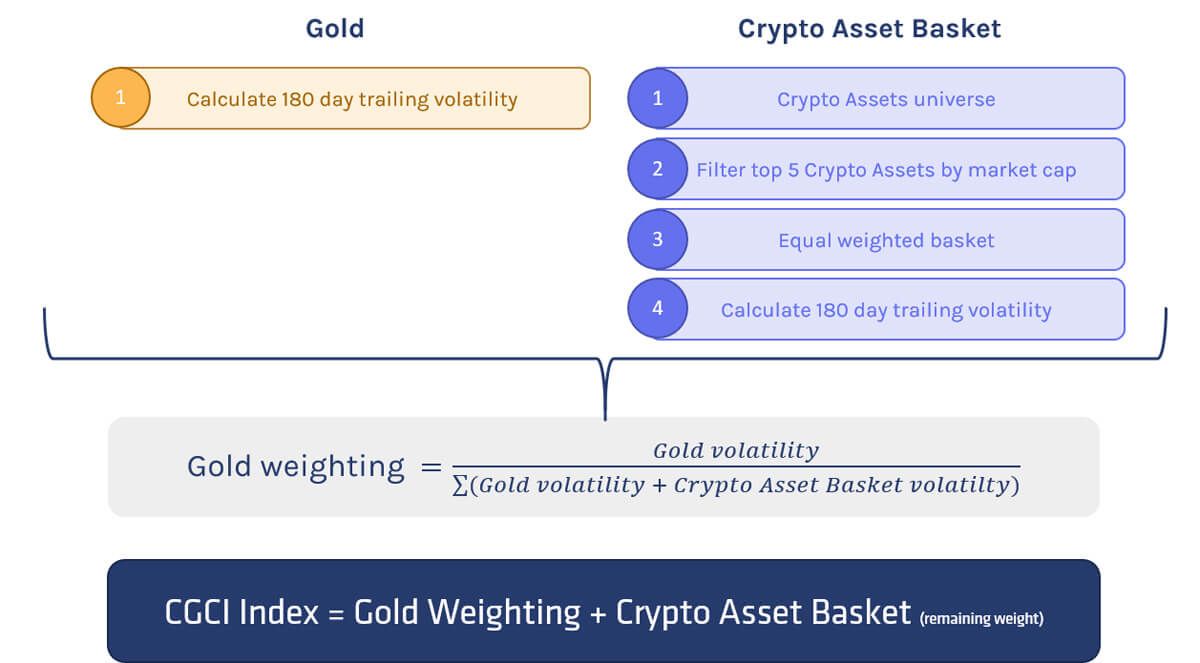
CGCI Index=Gold Weighting+Crypto Asset Basket (remaining weight)
Once the top five cryptoassets are defined, the 180-day trailing volatility of the equal weight crypto-basket is calculated. The weighting between gold and the crypto-basket is then calculated by dividing the 180-day gold volatility by the crypto-basket volatility.

Historically, this has led to cryptoassets comprising between 40% and 10% of the index.

Performance

When comparing the CGCI (since mid-2017) to Bitcoin or other multi-crypto indices it highlights almost double the returns to simply investing in gold alone. Crucially, CGCI reduces volatility to one quarter of Bitcoin volatility and other multi-crypto indices leaving the Sharpe ratio at 1.14, well above both gold and Bitcoin. One challenge as a portfolio manager investing in Bitcoin is the risk of being stopped-out (the execution of a stop-loss order), given Bitcoin’s annualised volatility of 78% the chances of this happening are much higher compared to traditional investments and consequently many investors reject Bitcoin as an investment.

Various asset Performance (since Jan-2017)
CGCI mitigates the risk of being stopped-out due to its much lower volatility, this can also be seen in its maximum-drawdown (the peak-trough decline), which is considerably lower at 26% decline relative to Bitcoin’s 83% and World equities at 34%.


CGCI in a portfolio

To test how CGCI would help or hinder a portfolio we created a database of daily returns starting from 2017, when there was sufficient data for all comparable indices. We created a traditional balanced portfolio with 60% equities and 40% bonds and then added a notional 4% CGCI, detracting from both equities and bonds equally. Our analysis, as indicated in the table below, highlights that CGCI has enhanced annualised returns by 1.1% relative to the 60/40 portfolio benchmark. The Sharpe ratio (volatility adjusted returns) is 0.76 while the correlation falls by 0.5%.
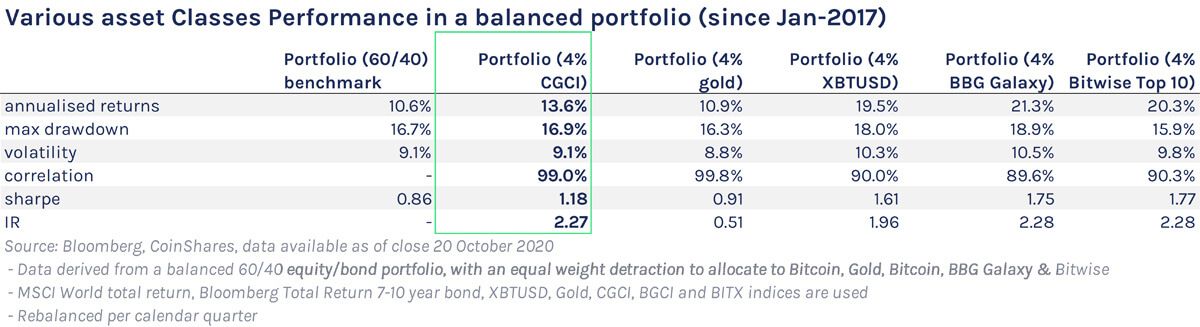
Various asset classes performance in a balanced portfolio (since Jan-2017)
As expected, there is negligible impact on drawdowns in the portfolio, particularly in comparison to its peers, such as the Bitwise 10 Large Cap Crypto Index. This highlights that a diversified crypto investment (across multiple cryptoassets) has not protected investors from high drawdowns due to their highly correlated nature.

By adding CGCI to a portfolio in incremental steps we can gauge how much impact it has on volatility of the overall portfolio. We find that it reduces risk in small weightings while significantly enhancing returns.
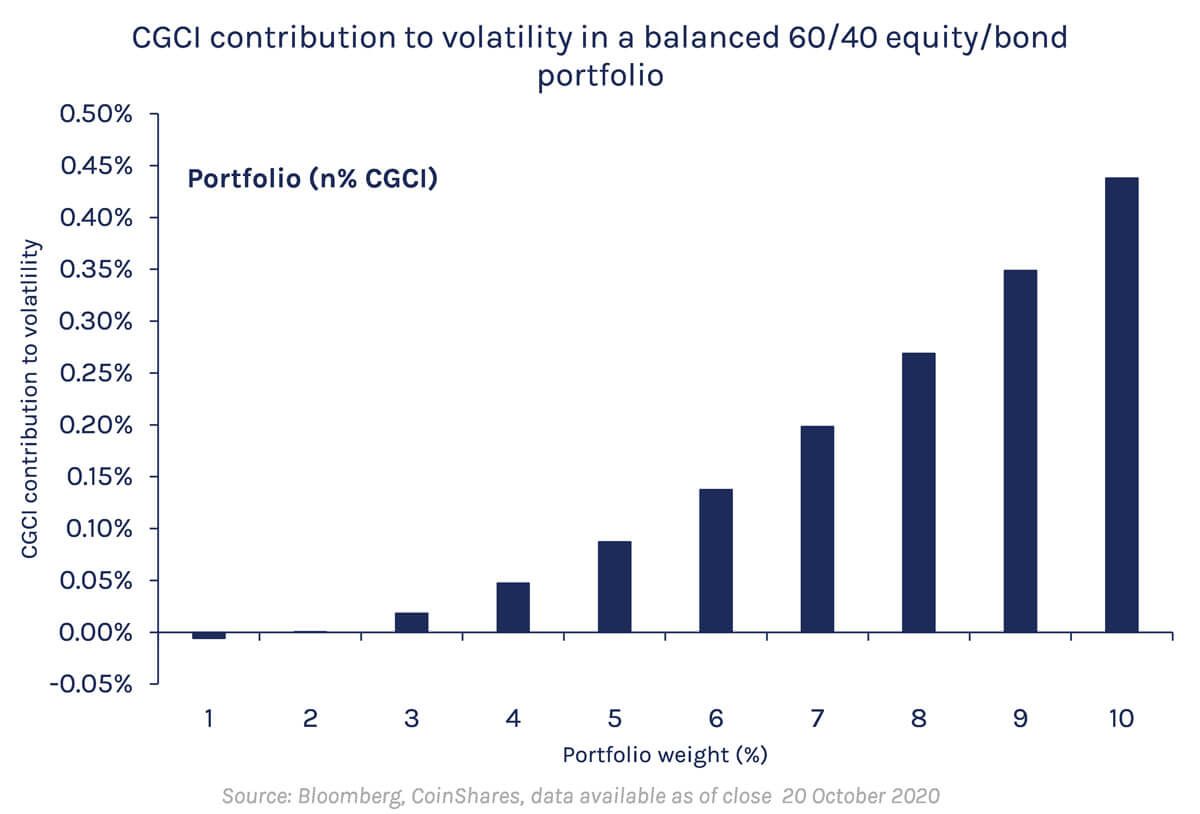
CGCI contribution to volatility in a balanced 60/40 equity/bond portfolio
This is not the case for cryptoassets on their own, which tend to increase overall portfolio volatility as more is added. Applying the same incremental approach but looking at the Sharpe ratio highlights that on a risk-adjusted basis pure cryptoasset investments have provided better performance over this time period.
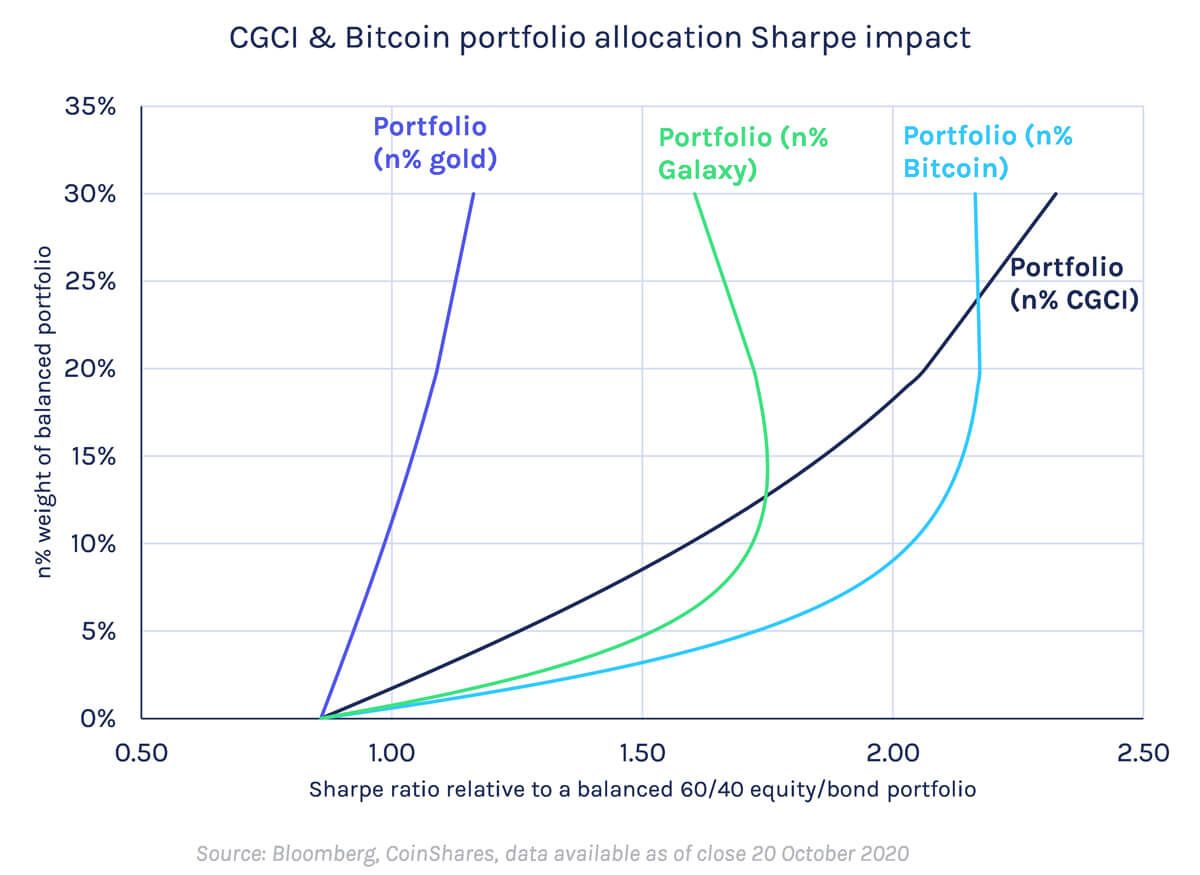
CGCI & Bitcoin portfolio allocation Sharpe impactWe also find similar results for correlation.
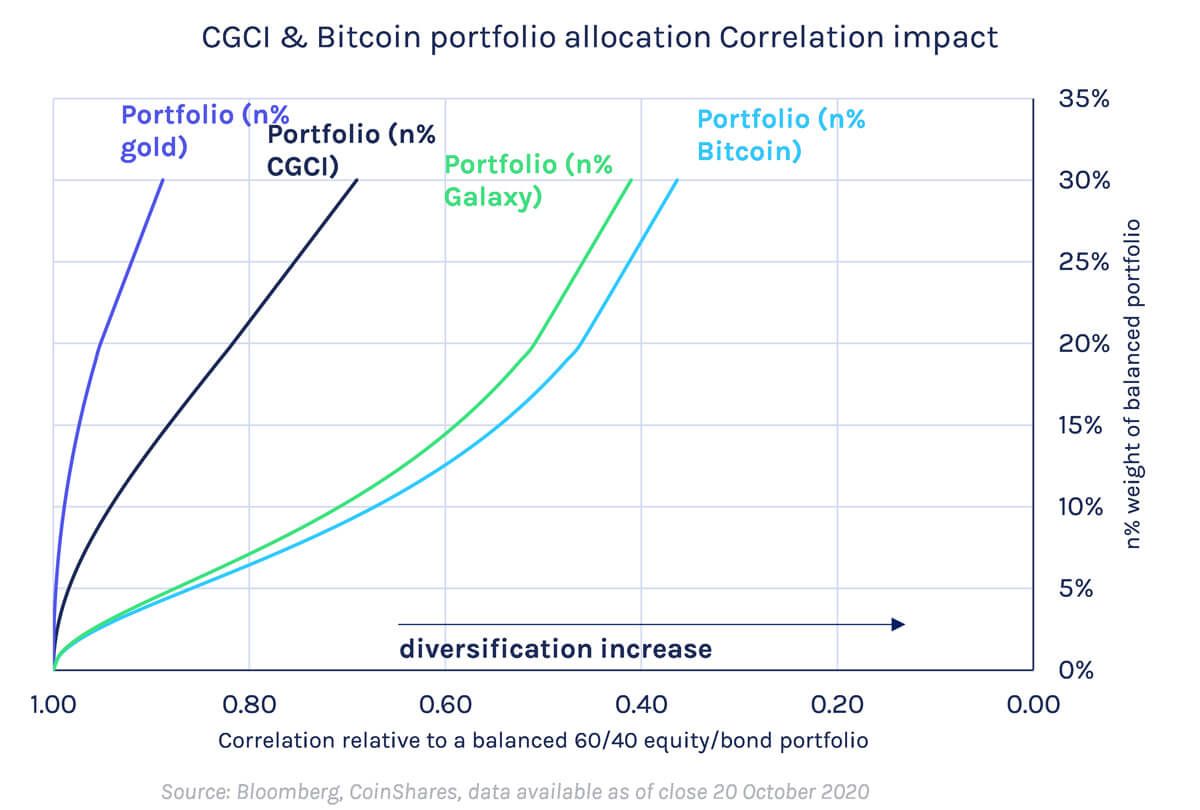
CGCI & Bitcoin portfolio allocation Correlation impact
It is important to note that while these charts suggest the CGCI index is not better on a risk-adjusted basis, or that it doesn’t diversify as well, it isn't considering maximum drawdowns. This is an important factor for investors as most will be stopped-out if their investment falls by 80%, CGCI is therefore not comparable to pure cryptoasset investments.

Sensitivity analysis

Understanding the sensitivities of CGCI is essential to gauge how it may perform in various economic scenarios. As we would expect it does have a high correlation to gold due to the high proportion of gold in the index, consequently it exhibits an inverse relationship with the US dollar.
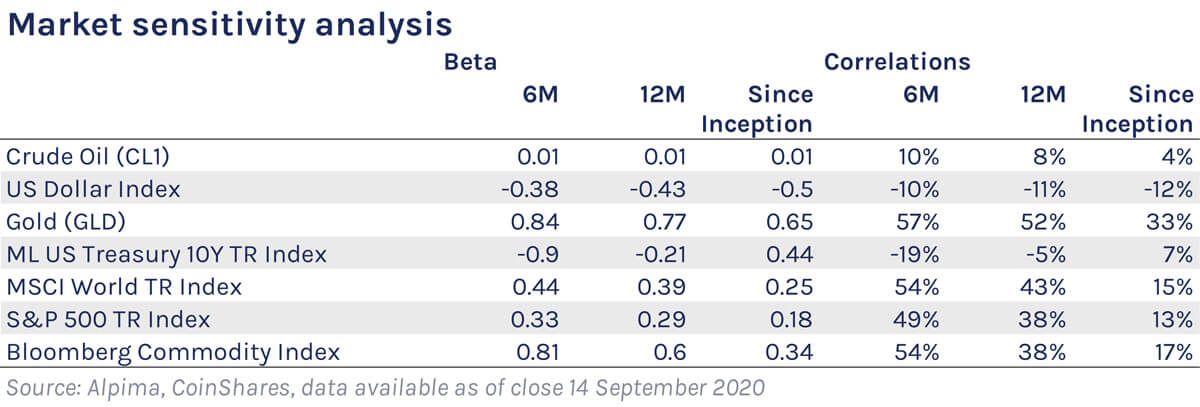
Market sensitivity analysis
The CGCI looks to have an inverse relationship with treasury prices although the results are mixed, with it being positively correlated since inception but more recently having an inverse relationship. Other analysis work on Bitcoin has highlighted a strong inverse relationship with 10-2yr treasury yield convexity. We expect this relationship to be the same for CGCI, acting as a safe-haven asset during periods of economic weakness.

Summary

CGCI has all the merits of a safe haven alternative asset, reducing risk in a portfolio (in small allocations) while enhancing returns. Although it does not diversify as well as pure cryptoassets it is better than safe havens such as gold. CGCI might just be the answer for investors who are keen to invest into the cryptoasset class but are fearful of the stop-losses that cryptoassets often trigger.

Pubblicato ilOtt 21st, 2021

Scrittore
Ex Responsabile della Ricerca presso ETF Securities, James guida il dipartimento Ricerca di CoinShares con una profonda esperienza in ambito azionario e nella gestione di fondi.

Benvenuto to CoinShares

Dati personali

0102

Quando visiti il sito web di CoinShares, i cookie migliorano la tua esperienza. Ci aiutano a mostrarti contenuti più pertinenti. Alcuni cookie sono necessari per il funzionamento del sito e saranno sempre attivi. Bloccare alcuni tipi di cookie potrebbe influire sulla tua esperienza del sito web e sui servizi che offriamo sul nostro sito.

Utilizziamo i cookie sul nostro sito per ottimizzare i nostri servizi. Scopri di più sulla nostra politica sui cookie per l’UE o sulla nostra politica sui cookie per gli Stati Uniti.

  • Necessari
    Question circle icon
  • Preferences
    Question circle icon
  • Statistici
    Question circle icon
  • Marketing
    Question circle icon
I cookie necessari aiutano a rendere un sito web utilizzabile abilitando funzioni di base come la navigazione tra le pagine e l'accesso alle aree protette del sito. Il sito web non può funzionare correttamente senza questi cookie.
I cookie di preferenza permettono a un sito web di ricordare informazioni che modificano il modo in cui il sito si comporta o appare, come la lingua preferita o la regione in cui ti trovi.
I cookie statistici aiutano i proprietari del sito web a capire come i visitatori interagiscono con i siti raccogliendo e riportando informazioni in modo anonimo.
I cookie di marketing vengono utilizzati per tracciare i visitatori attraverso i siti web. L'intento è di mostrare annunci pertinenti e coinvolgenti per l'utente individuale, rendendoli così più preziosi per gli editori e gli inserzionisti di terze parti.