
This website uses cookies
We use cookies to personalise content and ads, to provide social media features and to analyse our traffic. We also share information about your use of our site with our social media, advertising and analytics partners who may combine it with other information that you’ve provided to them or that they’ve collected from your use of their services.
Consent Selection
Details
  • Necessary cookies help make a website usable by enabling basic functions like page navigation and access to secure areas of the website. The website cannot function properly without these cookies.

    • Learn more about this provideropens in a new window
      CookieConsentStores the user's cookie consent state for the current domain
      Maximum Storage Duration: 1 yearType: HTTP Cookie
    • Learn more about this provideropens in a new window
      bcookieUsed in order to detect spam and improve the website's security.
      Maximum Storage Duration: 1 yearType: HTTP Cookie
      li_gcStores the user's cookie consent state for the current domain
      Maximum Storage Duration: 180 daysType: HTTP Cookie
    • Learn more about this provideropens in a new window
      datadomeUsed in context with the website's BotManager. The BotManager detects, categorizes and compiles reports on potential bots trying to access the website.
      Maximum Storage Duration: 1 yearType: HTTP Cookie
    • _pk_testcookie_domainThis cookie determines whether the browser accepts cookies.
      Maximum Storage Duration: 1 dayType: HTTP Cookie
    • __cf_bm [x3]This cookie is used to distinguish between humans and bots. This is beneficial for the website, in order to make valid reports on the use of their website.
      Maximum Storage Duration: 1 dayType: HTTP Cookie
  • Preference cookies enable a website to remember information that changes the way the website behaves or looks, like your preferred language or the region that you are in.
    • Learn more about this provideropens in a new window
      lidcRegisters which server-cluster is serving the visitor. This is used in context with load balancing, in order to optimize user experience.
      Maximum Storage Duration: 1 dayType: HTTP Cookie
  • Statistic cookies help website owners to understand how visitors interact with websites by collecting and reporting information anonymously.
    • Learn more about this provideropens in a new window
      guestRegisters data on visitors' website-behaviour. This is used for internal analysis and website optimization.
      Maximum Storage Duration: 1 monthType: HTTP Cookie
    • Learn more about this provideropens in a new window
      personalization_idThis cookie is set by Twitter - The cookie allows the visitor to share content from the website onto their Twitter profile.
      Maximum Storage Duration: 400 daysType: HTTP Cookie
    • _pk_uidUsed by Piwik Analytics Platform to identify the visitor on repeat visits to the website.
      Maximum Storage Duration: 1 yearType: HTTP Cookie
      _pk_id#Collects statistics on the user's visits to the website, such as the number of visits, average time spent on the website and what pages have been read.
      Maximum Storage Duration: 1 yearType: HTTP Cookie
      _pk_ses#Used by Piwik Analytics Platform to track page requests from the visitor during the session.
      Maximum Storage Duration: 1 dayType: HTTP Cookie
    • FPGSIDRegisters statistical data on users' behaviour on the website. Used for internal analytics by the website operator.
      Maximum Storage Duration: 1 dayType: HTTP Cookie
      FPIDRegisters statistical data on users' behaviour on the website. Used for internal analytics by the website operator.
      Maximum Storage Duration: 400 daysType: HTTP Cookie
      FPLCRegisters a unique ID that is used to generate statistical data on how the visitor uses the website.
      Maximum Storage Duration: 1 dayType: HTTP Cookie
    • _gaRegisters a unique ID that is used to generate statistical data on how the visitor uses the website.
      Maximum Storage Duration: 2 yearsType: HTTP Cookie
      _ga_#Used by Google Analytics to collect data on the number of times a user has visited the website as well as dates for the first and most recent visit.
      Maximum Storage Duration: 2 yearsType: HTTP Cookie
  • Marketing cookies are used to track visitors across websites. The intention is to display ads that are relevant and engaging for the individual user and thereby more valuable for publishers and third party advertisers.
    • Learn more about this provideropens in a new window

      Some of the data collected by this provider is for the purposes of personalization and measuring advertising effectiveness. The provider may use the IP Addresses for ads measurement and ads personalization.

      ads/ga-audiencesUsed by Google AdWords to re-engage visitors that are likely to convert to customers based on the visitor's online behaviour across websites.
      Maximum Storage Duration: SessionType: Pixel Tracker
    • Learn more about this provideropens in a new window
      userRefererDetermines how the user accessed the website. This information is used by the website operator in order to measure the efficiency of their marketing.
      Maximum Storage Duration: 1 monthType: HTTP Cookie
    • Learn more about this provideropens in a new window
      #:session-dataTracks the individual sessions on the website, allowing the website to compile statistical data from multiple visits. This data can also be used to create leads for marketing purposes.
      Maximum Storage Duration: PersistentType: HTML Local Storage
      eng_mtTracks the conversion rate between the user and the advertisement banners on the website - This serves to optimise the relevance of the advertisements on the website.
      Maximum Storage Duration: PersistentType: HTML Local Storage
      t_gidThis cookie assigns a specific visitor ID, when the visitor interacts with ads or content from the website - this allows the website to target the visitor with similar ads or content.
      Maximum Storage Duration: 1 yearType: HTTP Cookie
      t_pt_gidCollects information on user preferences and/or interaction with web-campaign content - This is used on CRM-campaign-platform used by website owners for promoting events or products.
      Maximum Storage Duration: 1 yearType: HTTP Cookie
      taboola global:user-idSets a unique ID for the visitor, that allows third party advertisers to target the visitor with relevant advertisement. This pairing service is provided by third party advertisement hubs, which facilitates real-time bidding for advertisers.
      Maximum Storage Duration: PersistentType: HTML Local Storage
      taboola_session_idThis cookie is used to collect information on a visitor. This information will become an ID string with information on a specific visitor – ID information strings can be used to target groups with similar preferences, or can be used by third-party domains or ad-exchanges.
      Maximum Storage Duration: SessionType: HTTP Cookie
    • Learn more about this provideropens in a new window
      1/i/adsct [x2]Collects data on user behaviour and interaction in order to optimize the website and make advertisement on the website more relevant.
      Maximum Storage Duration: SessionType: Pixel Tracker
      muc_adsCollects data on user behaviour and interaction in order to optimize the website and make advertisement on the website more relevant.
      Maximum Storage Duration: 400 daysType: HTTP Cookie
      guest_idCollects data related to the user's visits to the website, such as the number of visits, average time spent on the website and which pages have been loaded, with the purpose of personalising and improving the Twitter service.
      Maximum Storage Duration: 400 daysType: HTTP Cookie
      guest_id_adsCollects information on user behaviour on multiple websites. This information is used in order to optimize the relevance of advertisement on the website.
      Maximum Storage Duration: 400 daysType: HTTP Cookie
      guest_id_marketingCollects information on user behaviour on multiple websites. This information is used in order to optimize the relevance of advertisement on the website.
      Maximum Storage Duration: 400 daysType: HTTP Cookie
    • _gcl_auUsed by Google AdSense for experimenting with advertisement efficiency across websites using their services.
      Maximum Storage Duration: 3 monthsType: HTTP Cookie
      _gcl_lsTracks the conversion rate between the user and the advertisement banners on the website - This serves to optimise the relevance of the advertisements on the website.
      Maximum Storage Duration: PersistentType: HTML Local Storage
    • pardot [x2]Used in context with Account-Based-Marketing (ABM). The cookie registers data such as IP-addresses, time spent on the website and page requests for the visit. This is used for retargeting of multiple users rooting from the same IP-addresses. ABM usually facilitates B2B marketing purposes.
      Maximum Storage Duration: SessionType: HTTP Cookie
  • Unclassified cookies are cookies that we are in the process of classifying, together with the providers of individual cookies.
    • cs_analytics_ip_blockedPending
      Maximum Storage Duration: SessionType: HTTP Cookie
      user_tokenPending
      Maximum Storage Duration: 1 yearType: HTTP Cookie
    • _twpidPending
      Maximum Storage Duration: SessionType: HTTP Cookie
Cookie declaration last updated on 8/20/26 by Cookiebot
[#IABV2_TITLE#]
[#IABV2_BODY_INTRO#]
[#IABV2_BODY_LEGITIMATE_INTEREST_INTRO#]
[#IABV2_BODY_PREFERENCE_INTRO#]
[#IABV2_BODY_PURPOSES_INTRO#]
[#IABV2_BODY_PURPOSES#]
[#IABV2_BODY_FEATURES_INTRO#]
[#IABV2_BODY_FEATURES#]
[#IABV2_BODY_PARTNERS_INTRO#]
[#IABV2_BODY_PARTNERS#]
About
Cookies are small text files that can be used by websites to make a user's experience more efficient.

The law states that we can store cookies on your device if they are strictly necessary for the operation of this site. For all other types of cookies we need your permission.

This site uses different types of cookies. Some cookies are placed by third party services that appear on our pages.

You can at any time change or withdraw your consent from the Cookie Declaration on our website.

Learn more about who we are, how you can contact us and how we process personal data in our Privacy Policy.

Please state your consent ID and date when you contact us regarding your consent.
Image Cos'è Litecoin - Guida

Cos'è Litecoin - Guida

Timer6 minuti di lettura

  • Altcoins

Litecoin: un fork ossificato di Bitcoin

  • Data di lancio: 13 ottobre 2011

  • Indirizzi attivi: Litecoin ha registrato in media 221.605 indirizzi attivi giornalieri nella prima metà del 2026, contro 249.363 nel corso del 2025 e un picco di 1.354.473 il 20 dicembre 2023.

  • Capitalizzazione di mercato: 3,24 miliardi di dollari al 30 giugno 2026, con LTC a 41,87 dollari e 77,3 milioni di LTC in circolazione.

Litecoin in breve

  • L'attività di rete ha registrato un calo anziché una crescita. Il numero medio di indirizzi attivi giornalieri è sceso da 320.270 nel 2024 a 249.363 nel 2025, fino a 221.605 nella prima metà del 2026.

  • I ricavi da commissioni sono stabili e molto contenuti in termini assoluti: 372.371 dollari nel 2024, 378.335 dollari nel 2025 e 90.640 dollari nella prima metà del 2026.1 Per una rete dell'età e della notorietà di Litecoin, commissioni annuali inferiori a 400.000 dollari rappresentano l'indicatore più chiaro di quanto poca attività economica essa catturi.

  • Un ETF spot statunitense su Litecoin, il Canary Litecoin ETF (Nasdaq: LTCC), ha iniziato a essere negoziato il 27 ottobre 2025.

Dati chiave

Litecoin ha attraversato tre distinti cicli di prezzo nell'arco di quattordici anni, e ogni picco è stato inferiore al precedente rispetto al mercato più ampio. La rete funziona esattamente come progettato, e lo fa fin dal 2011. Ciò che non è riuscita a fare è catturare una quota crescente di alcunché.
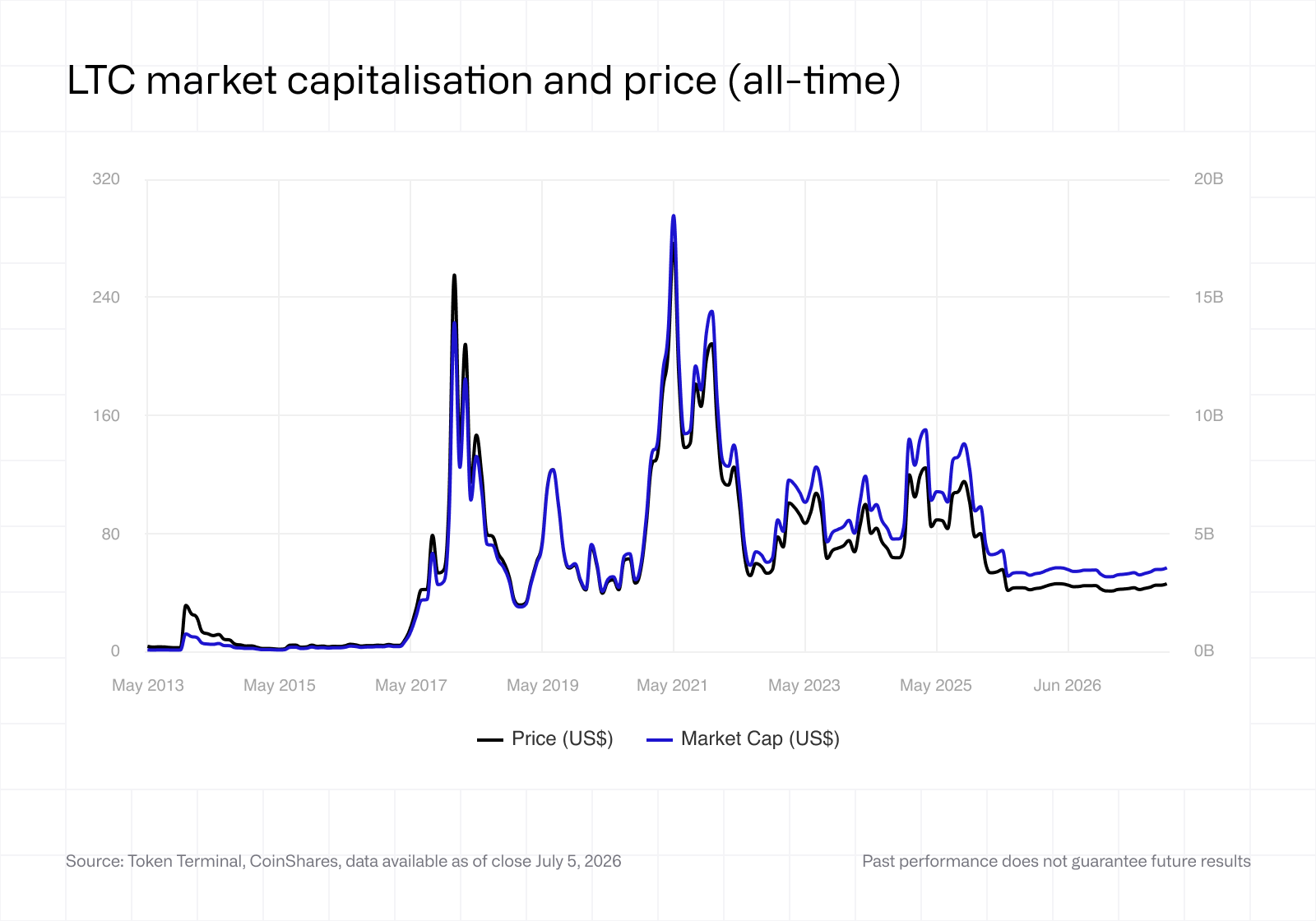
LTC market capitalisation and price (all-time)

Meccanismo del protocollo

Scrypt, pronunciato "ess-cript", è uno strumento di sicurezza inizialmente creato per il backup online. Il suo scopo principale è rendere costosi e difficili gli attacchi su larga scala che utilizzano hardware dedicato, richiedendo una grande quantità di memoria. Viene utilizzato anche nel mining di valute digitali, progettato per essere incompatibile con gli ASIC di mining di Bitcoin, che utilizzano SHA-256. Questo garantisce che Bitcoin e le valute che utilizzano Scrypt, come Litecoin, non competano per le stesse risorse di mining.

Nella pratica, questa separazione si è attenuata. La maggior parte dell'hashrate Scrypt proviene ormai dal merge mining con Dogecoin, il che significa che il budget di sicurezza di Litecoin è in parte sostenuto da un secondo asset che non controlla.

Storia

Tappe fondamentali

  • Dopo il lancio, la prima crescita di Litecoin è stata favorita dalla crescente disponibilità sugli exchange e dalla liquidità sulle prime piattaforme di scambio.

  • Dogecoin si è distaccato da Litecoin tramite fork nel dicembre 2013.

  • Litecoin ha implementato il soft fork SegWit prima di Bitcoin, nel maggio 2017, consentendo di registrare e verificare le firme in una sezione separata di un blocco, dove i dati potevano essere aggiunti a un costo ridotto. SegWit ha effettivamente aumentato la dimensione dei blocchi, ma lo ha fatto senza costringere gli utenti ad aggiornare le regole del proprio software.

  • Nel maggio 2022, l'aggiornamento MWEB (Mimblewimble Extension Blocks) è stato attivato sulla rete Litecoin come soft fork. Questo aggiornamento offre agli utenti la possibilità di inviare transazioni Litecoin riservate, in cui l'importo inviato è noto solo al mittente e al destinatario.

  • Il 2 agosto 2023 si è verificato il terzo halving di successo di Litecoin, che ha ridotto la block reward da 12,5 LTC a 6,25 LTC. Il quarto halving, a 3,125 LTC, è previsto per la metà del 2027.

  • Nell'ottobre 2025, il Canary Litecoin ETF (Nasdaq: LTCC) ha iniziato a essere negoziato, primo ETF spot statunitense a detenere Litecoin direttamente.

  • Nel marzo e aprile 2026, un attaccante ha sfruttato una falla di validazione in MWEB, generando un peg-out gonfiato di circa 85.000 LTC e, al secondo tentativo, una riorganizzazione della catena di 13 blocchi, che ha interessato circa 32 minuti di storico. Il bug è stato corretto.

Cosa aspettarsi

  • Vale la pena segnalare uno sviluppo. LitVM, un livello di esecuzione compatibile con EVM costruito per operare insieme a Litecoin, è stato presentato come una via verso gli smart contract e la DeFi su una chain che non li ha mai supportati.

Il punto di vista di CoinShares su Litecoin

Litecoin è un vero veterano delle crypto, con uno dei track record operativi più lunghi tra gli asset crypto presenti sul mercato. Mentre la maggior parte dei primi altcoin ha sofferto di bug, difetti di progettazione e scarso supporto della community, Litecoin ha mantenuto un funzionamento continuo e ininterrotto per i suoi primi quattordici anni. Questo primato deve ora essere ridimensionato: l'exploit di MWEB di marzo e aprile 2026 ha causato una riorganizzazione di 13 blocchi, e gli attacchi di double-spend contro i protocolli di swap cross-chain durante quella finestra sono costati a una controparte circa 600.000 dollari.4 Il bug è stato corretto e la chain si è ripresa, il che rappresenta l'esito desiderato. Ma l'affermazione "mai avuto un incidente" non è più sostenibile, e questa guida non dovrebbe più ripeterla. Come la maggior parte degli altri asset crypto, Litecoin deve rafforzare la propria utilità concreta, sicurezza e decentralizzazione per aumentare il proprio appeal nel lungo termine.


Strength IconPunti di forza

  • La maggiore frequenza dei blocchi di Litecoin rispetto a Bitcoin lo rende più adatto ai pagamenti, poiché le transazioni si concludono in modo sicuro (6 conferme) in una media di 15 minuti, contro un'ora per Bitcoin.

  • Quattordici anni di funzionamento continuo, oltre a un piano di offerta e una codebase rimasti pressoché invariati. Per una classe di asset in cui la maggior parte dei progetti riscrive i propri fondamentali a ogni ciclo, questa prevedibilità ha un certo valore.

WeaknessesPunti deboli

  • Il mercato ha stabilito che Litecoin presenta proprietà e caratteristiche peggiori rispetto a Bitcoin, da cui la capitalizzazione di mercato, la sicurezza, la decentralizzazione e l'interesse molto più bassi. Ciò limita, di conseguenza, il suo potenziale massimo di adozione.

  • La rete cattura quasi nessun valore economico. Le commissioni di transazione totali sono state pari a 378.335 dollari nell'intero 2025 e a 90.640 dollari nella prima metà del 2026.1 Le commissioni rappresentano il prezzo che gli utenti sono disposti a pagare per lo spazio di blocco, e su Litecoin tale prezzo è prossimo allo zero, poiché la domanda di quello spazio è a sua volta prossima allo zero.

  • L'attività è in calo, non stabile. Il numero medio di indirizzi attivi giornalieri è sceso in ciascuno degli ultimi due periodi, passando da 320.270 nel 2024 a 249.363 nel 2025, fino a 221.605 nel primo semestre 2026.1


Fonte

1 Token Terminal, metriche di rete e di mercato di Litecoin, tutti i dati rilevati al 30 giugno 2026, consultati il 24 agosto 2026

Pubblicato ilApr 11th, 2024

Benvenuto to CoinShares

Dati personali

0102

Quando visiti il sito web di CoinShares, i cookie migliorano la tua esperienza. Ci aiutano a mostrarti contenuti più pertinenti. Alcuni cookie sono necessari per il funzionamento del sito e saranno sempre attivi. Bloccare alcuni tipi di cookie potrebbe influire sulla tua esperienza del sito web e sui servizi che offriamo sul nostro sito.

Utilizziamo i cookie sul nostro sito per ottimizzare i nostri servizi. Scopri di più sulla nostra politica sui cookie per l’UE o sulla nostra politica sui cookie per gli Stati Uniti.

  • Necessari
    Question circle icon
  • Preferences
    Question circle icon
  • Statistici
    Question circle icon
  • Marketing
    Question circle icon
I cookie necessari aiutano a rendere un sito web utilizzabile abilitando funzioni di base come la navigazione tra le pagine e l'accesso alle aree protette del sito. Il sito web non può funzionare correttamente senza questi cookie.
I cookie di preferenza permettono a un sito web di ricordare informazioni che modificano il modo in cui il sito si comporta o appare, come la lingua preferita o la regione in cui ti trovi.
I cookie statistici aiutano i proprietari del sito web a capire come i visitatori interagiscono con i siti raccogliendo e riportando informazioni in modo anonimo.
I cookie di marketing vengono utilizzati per tracciare i visitatori attraverso i siti web. L'intento è di mostrare annunci pertinenti e coinvolgenti per l'utente individuale, rendendoli così più preziosi per gli editori e gli inserzionisti di terze parti.