

This website uses cookies
We use cookies to personalise content and ads, to provide social media features and to analyse our traffic. We also share information about your use of our site with our social media, advertising and analytics partners who may combine it with other information that you’ve provided to them or that they’ve collected from your use of their services.
Consent Selection
Details
  • Necessary cookies help make a website usable by enabling basic functions like page navigation and access to secure areas of the website. The website cannot function properly without these cookies.

    • Learn more about this provideropens in a new window
      CookieConsentStores the user's cookie consent state for the current domain
      Maximum Storage Duration: 1 yearType: HTTP Cookie
    • Learn more about this provideropens in a new window
      bcookieUsed in order to detect spam and improve the website's security.
      Maximum Storage Duration: 1 yearType: HTTP Cookie
      li_gcStores the user's cookie consent state for the current domain
      Maximum Storage Duration: 180 daysType: HTTP Cookie
    • Learn more about this provideropens in a new window
      datadomeUsed in context with the website's BotManager. The BotManager detects, categorizes and compiles reports on potential bots trying to access the website.
      Maximum Storage Duration: 1 yearType: HTTP Cookie
    • _pk_testcookie_domainThis cookie determines whether the browser accepts cookies.
      Maximum Storage Duration: 1 dayType: HTTP Cookie
    • __cf_bm [x3]This cookie is used to distinguish between humans and bots. This is beneficial for the website, in order to make valid reports on the use of their website.
      Maximum Storage Duration: 1 dayType: HTTP Cookie
  • Preference cookies enable a website to remember information that changes the way the website behaves or looks, like your preferred language or the region that you are in.
    • Learn more about this provideropens in a new window
      lidcRegisters which server-cluster is serving the visitor. This is used in context with load balancing, in order to optimize user experience.
      Maximum Storage Duration: 1 dayType: HTTP Cookie
  • Statistic cookies help website owners to understand how visitors interact with websites by collecting and reporting information anonymously.
    • Learn more about this provideropens in a new window
      guestRegisters data on visitors' website-behaviour. This is used for internal analysis and website optimization.
      Maximum Storage Duration: 1 monthType: HTTP Cookie
    • Learn more about this provideropens in a new window
      personalization_idThis cookie is set by Twitter - The cookie allows the visitor to share content from the website onto their Twitter profile.
      Maximum Storage Duration: 400 daysType: HTTP Cookie
    • _pk_uidUsed by Piwik Analytics Platform to identify the visitor on repeat visits to the website.
      Maximum Storage Duration: 1 yearType: HTTP Cookie
      _pk_id#Collects statistics on the user's visits to the website, such as the number of visits, average time spent on the website and what pages have been read.
      Maximum Storage Duration: 1 yearType: HTTP Cookie
      _pk_ses#Used by Piwik Analytics Platform to track page requests from the visitor during the session.
      Maximum Storage Duration: 1 dayType: HTTP Cookie
    • FPGSIDRegisters statistical data on users' behaviour on the website. Used for internal analytics by the website operator.
      Maximum Storage Duration: 1 dayType: HTTP Cookie
      FPIDRegisters statistical data on users' behaviour on the website. Used for internal analytics by the website operator.
      Maximum Storage Duration: 400 daysType: HTTP Cookie
      FPLCRegisters a unique ID that is used to generate statistical data on how the visitor uses the website.
      Maximum Storage Duration: 1 dayType: HTTP Cookie
    • _gaRegisters a unique ID that is used to generate statistical data on how the visitor uses the website.
      Maximum Storage Duration: 2 yearsType: HTTP Cookie
      _ga_#Used by Google Analytics to collect data on the number of times a user has visited the website as well as dates for the first and most recent visit.
      Maximum Storage Duration: 2 yearsType: HTTP Cookie
  • Marketing cookies are used to track visitors across websites. The intention is to display ads that are relevant and engaging for the individual user and thereby more valuable for publishers and third party advertisers.
    • Learn more about this provideropens in a new window

      Some of the data collected by this provider is for the purposes of personalization and measuring advertising effectiveness. The provider may use the IP Addresses for ads measurement and ads personalization.

      ads/ga-audiencesUsed by Google AdWords to re-engage visitors that are likely to convert to customers based on the visitor's online behaviour across websites.
      Maximum Storage Duration: SessionType: Pixel Tracker
    • Learn more about this provideropens in a new window
      userRefererDetermines how the user accessed the website. This information is used by the website operator in order to measure the efficiency of their marketing.
      Maximum Storage Duration: 1 monthType: HTTP Cookie
    • Learn more about this provideropens in a new window
      #:session-dataTracks the individual sessions on the website, allowing the website to compile statistical data from multiple visits. This data can also be used to create leads for marketing purposes.
      Maximum Storage Duration: PersistentType: HTML Local Storage
      eng_mtTracks the conversion rate between the user and the advertisement banners on the website - This serves to optimise the relevance of the advertisements on the website.
      Maximum Storage Duration: PersistentType: HTML Local Storage
      t_gidThis cookie assigns a specific visitor ID, when the visitor interacts with ads or content from the website - this allows the website to target the visitor with similar ads or content.
      Maximum Storage Duration: 1 yearType: HTTP Cookie
      t_pt_gidCollects information on user preferences and/or interaction with web-campaign content - This is used on CRM-campaign-platform used by website owners for promoting events or products.
      Maximum Storage Duration: 1 yearType: HTTP Cookie
      taboola global:user-idSets a unique ID for the visitor, that allows third party advertisers to target the visitor with relevant advertisement. This pairing service is provided by third party advertisement hubs, which facilitates real-time bidding for advertisers.
      Maximum Storage Duration: PersistentType: HTML Local Storage
      taboola_session_idThis cookie is used to collect information on a visitor. This information will become an ID string with information on a specific visitor – ID information strings can be used to target groups with similar preferences, or can be used by third-party domains or ad-exchanges.
      Maximum Storage Duration: SessionType: HTTP Cookie
    • Learn more about this provideropens in a new window
      1/i/adsct [x2]Collects data on user behaviour and interaction in order to optimize the website and make advertisement on the website more relevant.
      Maximum Storage Duration: SessionType: Pixel Tracker
      muc_adsCollects data on user behaviour and interaction in order to optimize the website and make advertisement on the website more relevant.
      Maximum Storage Duration: 400 daysType: HTTP Cookie
      guest_idCollects data related to the user's visits to the website, such as the number of visits, average time spent on the website and which pages have been loaded, with the purpose of personalising and improving the Twitter service.
      Maximum Storage Duration: 400 daysType: HTTP Cookie
      guest_id_adsCollects information on user behaviour on multiple websites. This information is used in order to optimize the relevance of advertisement on the website.
      Maximum Storage Duration: 400 daysType: HTTP Cookie
      guest_id_marketingCollects information on user behaviour on multiple websites. This information is used in order to optimize the relevance of advertisement on the website.
      Maximum Storage Duration: 400 daysType: HTTP Cookie
    • _gcl_auUsed by Google AdSense for experimenting with advertisement efficiency across websites using their services.
      Maximum Storage Duration: 3 monthsType: HTTP Cookie
      _gcl_lsTracks the conversion rate between the user and the advertisement banners on the website - This serves to optimise the relevance of the advertisements on the website.
      Maximum Storage Duration: PersistentType: HTML Local Storage
    • pardot [x2]Used in context with Account-Based-Marketing (ABM). The cookie registers data such as IP-addresses, time spent on the website and page requests for the visit. This is used for retargeting of multiple users rooting from the same IP-addresses. ABM usually facilitates B2B marketing purposes.
      Maximum Storage Duration: SessionType: HTTP Cookie
  • Unclassified cookies are cookies that we are in the process of classifying, together with the providers of individual cookies.
    • cs_analytics_ip_blockedPending
      Maximum Storage Duration: SessionType: HTTP Cookie
      user_tokenPending
      Maximum Storage Duration: 1 yearType: HTTP Cookie
    • _twpidPending
      Maximum Storage Duration: SessionType: HTTP Cookie
Cookie declaration last updated on 8/20/26 by Cookiebot
[#IABV2_TITLE#]
[#IABV2_BODY_INTRO#]
[#IABV2_BODY_LEGITIMATE_INTEREST_INTRO#]
[#IABV2_BODY_PREFERENCE_INTRO#]
[#IABV2_BODY_PURPOSES_INTRO#]
[#IABV2_BODY_PURPOSES#]
[#IABV2_BODY_FEATURES_INTRO#]
[#IABV2_BODY_FEATURES#]
[#IABV2_BODY_PARTNERS_INTRO#]
[#IABV2_BODY_PARTNERS#]
About
Cookies are small text files that can be used by websites to make a user's experience more efficient.

The law states that we can store cookies on your device if they are strictly necessary for the operation of this site. For all other types of cookies we need your permission.

This site uses different types of cookies. Some cookies are placed by third party services that appear on our pages.

You can at any time change or withdraw your consent from the Cookie Declaration on our website.

Learn more about who we are, how you can contact us and how we process personal data in our Privacy Policy.

Please state your consent ID and date when you contact us regarding your consent.
Image What is Hyperliquid and why does it matter

What is Hyperliquid and why does it matter

Timer9 min read

  • Ethereum
  • Altcoins

Hyperliquid emerged as one of the most talked-about projects in DeFi, and beyond, for its attempt to combine exchange-grade performance with on-chain decentralisation.

Touted as the first DEX to embody Satoshi Nakamoto’s principles, Hyperliquid runs on its native token, $HYPE, whose rapid appreciation brought it into the top 20 cryptocurrencies at the time of writing. 

But the exchange is only one part of the picture: Hyperliquid is also a Layer-1 blockchain, presented by its founders as next-generation infrastructure for global finance.

A DeFi network built by traders, for traders

The project was launched in May 2022 by a team of just eleven people, as co-founder Jeff Yan explained in an interview with the TBPN podcast in August 2025. “At the time, DeFi was still experimental”, he recalled. “Most products were bad, and we thought we could do it better.”

The collapse of FTX only strengthened their conviction that the market needed a truly decentralised, peer-to-peer, self-custodial exchange. That vision became Hyperliquid, a platform that reported significant revenue over the past year. Instead of raising funds through an ICO, Hyperliquid followed Bitcoin’s ethos. No venture capital firms were involved, and no one could purchase tokens before the launch. 

“Hyperliquid has a crypto-native approach,” explained Yan to the TBPN podcast. “It’s a neutral protocol - one that truly belongs to the community.”

In February 2023, Hyperliquid launched its closed alpha mainnet, attracting around 4,000 users and offering 28 trading pairs. The network went fully live in August that same year.

Since then, Hyperliquid has attracted over 820,000 users and processed more than $231 billion in deposits, ranking as the third-largest decentralised exchange, behind PancakeSwap and Uniswap.

Originally designed exclusively for perpetual futures trading, the team soon realised that Hyperliquid had the potential to become the foundation of an entirely new financial ecosystem.

“Our ambition is unlimited,” said Jeff Yan. “We’re building something that can ultimately host all of finance. Hyperliquid is a blockchain, not just an exchange.”

Today, the protocol thrives on community-driven growth, a model of decentralised virality where traders themselves have become the project’s most powerful advocates.

Tokenomics designed for the community

In November 2024, Hyperliquid made global headlines with an airdrop, distributed based on trading activity and early community participation and worth $1.6 billion at that time, one of the largest token launches in crypto history.

The airdrop reflected the founders’ philosophy of putting the community at the centre to achieve genuine decentralisation

As of November 2025, approximately 270.8 million $HYPE tokens are in circulation, out of a fixed one billion supply cap, giving the project a market capitalisation of around $10.7 billion.

A key element of Hyperliquid’s success is its aggressive buy-back strategy, which directs about 97% of collected fees toward supporting $HYPE’s price.

Hyperliquid currently accounts for nearly half of all token buy-backs in 2025, according to CoinGecko. It’s among the highest reported across major projects. As of mid-October, it had repurchased over 21.36 million HYPE tokens, worth about $644.6 million. The second-largest buyer, LayerZero, spent roughly $150 million, just a quarter of Hyperliquid’s total.

Some critics, however, argue that such buy-backs front-load demand rather than create lasting value. They caution that unless user activity and ecosystem fundamentals continue to grow at the same pace, the mechanism alone may not be sufficient to maintain long-term price stability.
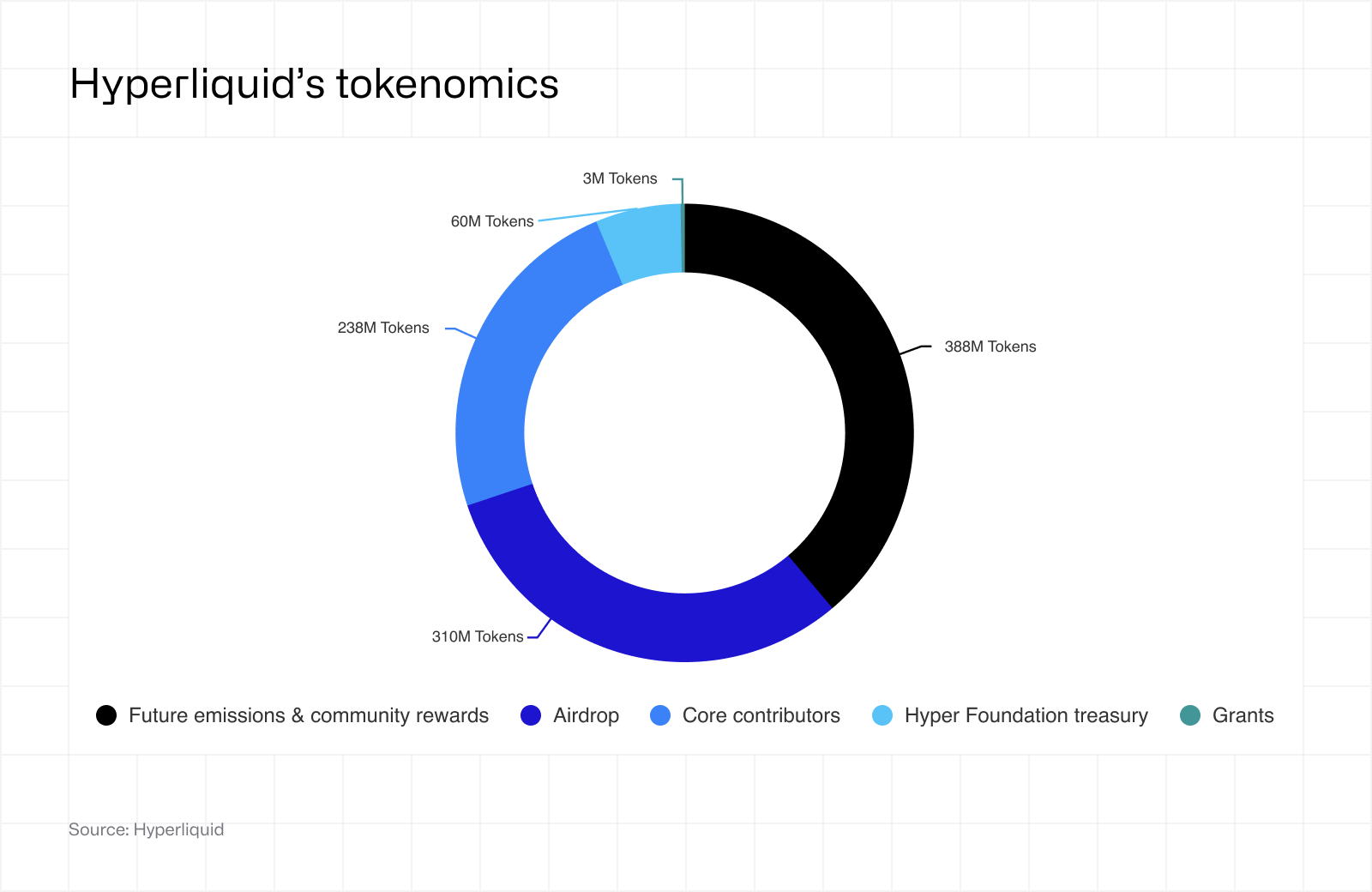
Hyperliquid's tokenomics

Token buybacks

The birth of HyperEVM

Hyperliquid opened a new chapter in February 2025 with the introduction of HyperEVM. This major upgrade makes the network fully compatible with the Ethereum Virtual Machine (EVM), marking a shift from a pure exchange layer to a programmable Layer 1 ecosystem.

One of the first visible changes is the ability to transfer the HYPE spot token onto HyperEVM, where it now functions as the native gas token.

This integration allows developers to deploy Ethereum-compatible smart contracts with significantly enhanced performance, directly linking DeFi applications to Hyperliquid’s core matching engine. 

By combining a low-latency order book with general-purpose smart contracts, Hyperliquid has evolved beyond a traditional decentralised exchange. It now functions as a comprehensive Layer-1 financial infrastructure, designed to host lending markets, structured products, synthetic assets, and advanced DeFi protocols within a seamless, composable ecosystem.

Regulatory challenges and centralisation concerns

As Hyperliquid expands, it faces both regulatory and structural risks. The implementation of MiCA in Europe and new U.S. rules on synthetic derivatives could reshape the compliance landscape for decentralised trading.

From a technical standpoint, integrating a high-frequency order-book exchange with an EVM-compatible Layer-1 chain introduces significant coordination and security challenges.

Centralisation remains one of Hyperliquid’s key structural risks. The network currently operates with 24 validators, which, though not directly controlled by developers, remain highly concentrated.

In its early stages, Hyperliquid also relied on external stablecoins such as USDC, bridged from other networks, primarily Arbitrum and Ethereum, creating a potential single point of failure. 

The bridge was governed by a small validator set and upgradeable contracts, concentrating trust in a few operators. Users depositing USDC received wrapped tokens on the Hyperliquid blockchain, effectively a redeemable claim dependent on the bridge administrators.

This dependence began to ease with the launch of USDH, Hyperliquid’s native stablecoin, last September. By issuing stablecoins on-chain, USDH reduces reliance on external custodians and mitigates bridge risks.

However, the Hyper Foundation still holds 60.5% of the total validator stake. While below the 66.7% threshold for full control, roughly 20% of the total stake has been redelegated to the same nodes through the Foundation’s own program, maintaining a high degree of concentration.

These vulnerabilities became evident last March, during the JELLY incident, when a trader allegedly manipulated the token’s price through coordinated on-chain activity, leading to $13.5 million in unrealised losses for the Hyperliquidity Provider (HLP) vault. 

Hyperliquid temporarily halted trading and manually settled positions at $0.0095, sparking community backlash. To restore confidence, the Hyperliquid Foundation refunded affected users at $0.037555, excluding flagged addresses.

The team has since pledged to reduce Foundation dominance through progressive delegation and onboarding of new independent validators.

Delegate the growth to third-parties

Another idea from the team to limit its own dominance is to let third-parties build on top of its infrastructure:- With builder codes, developers can create their own front-end on top of Hyperliquid and earn fees. This increases the platform’s distribution and user base. For instance, wallets such as Phantom, Rabby, and MetaMask have integrated Hyperliquid perp markets directly into their interfaces through builder codes. For instance, according to flowscan.xyz, as of 18 November 2025, Phantom has made over $10 million since the launch of this feature on the 8th July 2025. - With HIP-3, entities that stake 500,000 HYPE are allowed to launch and plug their own perp markets into Hyperliquid and benefit from its liquidity. These entities receive 50% of the revenue generated by their markets. As of 18 November 2025, HIP-3 markets have recorded over $100 million in volume.

As Hyperliquid continues to scale, its challenge will be to remain a platform of choice for the capital markets while competition rises — Lighter, Pacifica, EdgeX, and Extended, not to mention the rivalry from “traditional” CEXs that are wary of losing ground. On top of that, it remains to be seen whether Hyperliquid will stay bulletproof from a compliance standpoint, but if it does, it may be well-positioned to compete for institutional interest.

Published onDec 17th, 2025

Writer
CoinShares Author Logo
CoinShares

related articles

Welcome to CoinShares

Personal Data

0102

When you visit CoinShares website, cookies enhance your experience. They help us to show you more relevant content. Some cookies are necessary for the site to work and will always be active. Blocking some types of cookies may impact your experience of the website and the services which we offer on our website.

We use cookies on our site to optimize our services. Learn more about our EU cookie policy or US cookie policy.

  • Necessary
    Question circle icon
  • Preferences
    Question circle icon
  • Statistical
    Question circle icon
  • Marketing
    Question circle icon
Necessary cookies help make a website usable by enabling basic functions like page navigation and access to secure areas of the website. The website cannot function properly without these cookies.
Preference cookies enable a website to remember information that changes the way the website behaves or looks, like your preferred language or the region that you are in.
Statistic cookies help website owners to understand how visitors interact with websites by collecting and reporting information anonymously.
Marketing cookies are used to track visitors across websites. The intention is to display ads that are relevant and engaging for the individual user and thereby more valuable for publishers and third party advertisers.