This website uses cookies
We use cookies to personalise content and ads, to provide social media features and to analyse our traffic. We also share information about your use of our site with our social media, advertising and analytics partners who may combine it with other information that you’ve provided to them or that they’ve collected from your use of their services.
Consent Selection
Details
  • Necessary cookies help make a website usable by enabling basic functions like page navigation and access to secure areas of the website. The website cannot function properly without these cookies.

    • Learn more about this provideropens in a new window
      CookieConsentStores the user's cookie consent state for the current domain
      Maximum Storage Duration: 1 yearType: HTTP Cookie
    • Learn more about this provideropens in a new window
      bcookieUsed in order to detect spam and improve the website's security.
      Maximum Storage Duration: 1 yearType: HTTP Cookie
      li_gcStores the user's cookie consent state for the current domain
      Maximum Storage Duration: 180 daysType: HTTP Cookie
    • Learn more about this provideropens in a new window
      datadomeUsed in context with the website's BotManager. The BotManager detects, categorizes and compiles reports on potential bots trying to access the website.
      Maximum Storage Duration: 1 yearType: HTTP Cookie
    • _pk_testcookie_domainThis cookie determines whether the browser accepts cookies.
      Maximum Storage Duration: 1 dayType: HTTP Cookie
    • __cf_bm [x3]This cookie is used to distinguish between humans and bots. This is beneficial for the website, in order to make valid reports on the use of their website.
      Maximum Storage Duration: 1 dayType: HTTP Cookie
  • Preference cookies enable a website to remember information that changes the way the website behaves or looks, like your preferred language or the region that you are in.
    • Learn more about this provideropens in a new window
      lidcRegisters which server-cluster is serving the visitor. This is used in context with load balancing, in order to optimize user experience.
      Maximum Storage Duration: 1 dayType: HTTP Cookie
  • Statistic cookies help website owners to understand how visitors interact with websites by collecting and reporting information anonymously.
    • Learn more about this provideropens in a new window
      guestRegisters data on visitors' website-behaviour. This is used for internal analysis and website optimization.
      Maximum Storage Duration: 1 monthType: HTTP Cookie
    • Learn more about this provideropens in a new window
      personalization_idThis cookie is set by Twitter - The cookie allows the visitor to share content from the website onto their Twitter profile.
      Maximum Storage Duration: 400 daysType: HTTP Cookie
    • _pk_uidUsed by Piwik Analytics Platform to identify the visitor on repeat visits to the website.
      Maximum Storage Duration: 1 yearType: HTTP Cookie
      _pk_id#Collects statistics on the user's visits to the website, such as the number of visits, average time spent on the website and what pages have been read.
      Maximum Storage Duration: 1 yearType: HTTP Cookie
      _pk_ses#Used by Piwik Analytics Platform to track page requests from the visitor during the session.
      Maximum Storage Duration: 1 dayType: HTTP Cookie
    • FPGSIDRegisters statistical data on users' behaviour on the website. Used for internal analytics by the website operator.
      Maximum Storage Duration: 1 dayType: HTTP Cookie
      FPIDRegisters statistical data on users' behaviour on the website. Used for internal analytics by the website operator.
      Maximum Storage Duration: 400 daysType: HTTP Cookie
      FPLCRegisters a unique ID that is used to generate statistical data on how the visitor uses the website.
      Maximum Storage Duration: 1 dayType: HTTP Cookie
    • _gaRegisters a unique ID that is used to generate statistical data on how the visitor uses the website.
      Maximum Storage Duration: 2 yearsType: HTTP Cookie
      _ga_#Used by Google Analytics to collect data on the number of times a user has visited the website as well as dates for the first and most recent visit.
      Maximum Storage Duration: 2 yearsType: HTTP Cookie
  • Marketing cookies are used to track visitors across websites. The intention is to display ads that are relevant and engaging for the individual user and thereby more valuable for publishers and third party advertisers.
    • Learn more about this provideropens in a new window

      Some of the data collected by this provider is for the purposes of personalization and measuring advertising effectiveness. The provider may use the IP Addresses for ads measurement and ads personalization.

      ads/ga-audiencesUsed by Google AdWords to re-engage visitors that are likely to convert to customers based on the visitor's online behaviour across websites.
      Maximum Storage Duration: SessionType: Pixel Tracker
    • Learn more about this provideropens in a new window
      userRefererDetermines how the user accessed the website. This information is used by the website operator in order to measure the efficiency of their marketing.
      Maximum Storage Duration: 1 monthType: HTTP Cookie
    • Learn more about this provideropens in a new window
      #:session-dataTracks the individual sessions on the website, allowing the website to compile statistical data from multiple visits. This data can also be used to create leads for marketing purposes.
      Maximum Storage Duration: PersistentType: HTML Local Storage
      eng_mtTracks the conversion rate between the user and the advertisement banners on the website - This serves to optimise the relevance of the advertisements on the website.
      Maximum Storage Duration: PersistentType: HTML Local Storage
      t_gidThis cookie assigns a specific visitor ID, when the visitor interacts with ads or content from the website - this allows the website to target the visitor with similar ads or content.
      Maximum Storage Duration: 1 yearType: HTTP Cookie
      t_pt_gidCollects information on user preferences and/or interaction with web-campaign content - This is used on CRM-campaign-platform used by website owners for promoting events or products.
      Maximum Storage Duration: 1 yearType: HTTP Cookie
      taboola global:user-idSets a unique ID for the visitor, that allows third party advertisers to target the visitor with relevant advertisement. This pairing service is provided by third party advertisement hubs, which facilitates real-time bidding for advertisers.
      Maximum Storage Duration: PersistentType: HTML Local Storage
      taboola_session_idThis cookie is used to collect information on a visitor. This information will become an ID string with information on a specific visitor – ID information strings can be used to target groups with similar preferences, or can be used by third-party domains or ad-exchanges.
      Maximum Storage Duration: SessionType: HTTP Cookie
    • Learn more about this provideropens in a new window
      1/i/adsct [x2]Collects data on user behaviour and interaction in order to optimize the website and make advertisement on the website more relevant.
      Maximum Storage Duration: SessionType: Pixel Tracker
      muc_adsCollects data on user behaviour and interaction in order to optimize the website and make advertisement on the website more relevant.
      Maximum Storage Duration: 400 daysType: HTTP Cookie
      guest_idCollects data related to the user's visits to the website, such as the number of visits, average time spent on the website and which pages have been loaded, with the purpose of personalising and improving the Twitter service.
      Maximum Storage Duration: 400 daysType: HTTP Cookie
      guest_id_adsCollects information on user behaviour on multiple websites. This information is used in order to optimize the relevance of advertisement on the website.
      Maximum Storage Duration: 400 daysType: HTTP Cookie
      guest_id_marketingCollects information on user behaviour on multiple websites. This information is used in order to optimize the relevance of advertisement on the website.
      Maximum Storage Duration: 400 daysType: HTTP Cookie
    • _gcl_auUsed by Google AdSense for experimenting with advertisement efficiency across websites using their services.
      Maximum Storage Duration: 3 monthsType: HTTP Cookie
      _gcl_lsTracks the conversion rate between the user and the advertisement banners on the website - This serves to optimise the relevance of the advertisements on the website.
      Maximum Storage Duration: PersistentType: HTML Local Storage
    • pardot [x2]Used in context with Account-Based-Marketing (ABM). The cookie registers data such as IP-addresses, time spent on the website and page requests for the visit. This is used for retargeting of multiple users rooting from the same IP-addresses. ABM usually facilitates B2B marketing purposes.
      Maximum Storage Duration: SessionType: HTTP Cookie
  • Unclassified cookies are cookies that we are in the process of classifying, together with the providers of individual cookies.
    • cs_analytics_ip_blockedPending
      Maximum Storage Duration: SessionType: HTTP Cookie
      user_tokenPending
      Maximum Storage Duration: 1 yearType: HTTP Cookie
    • _twpidPending
      Maximum Storage Duration: SessionType: HTTP Cookie
Cookie declaration last updated on 8/20/26 by Cookiebot
[#IABV2_TITLE#]
[#IABV2_BODY_INTRO#]
[#IABV2_BODY_LEGITIMATE_INTEREST_INTRO#]
[#IABV2_BODY_PREFERENCE_INTRO#]
[#IABV2_BODY_PURPOSES_INTRO#]
[#IABV2_BODY_PURPOSES#]
[#IABV2_BODY_FEATURES_INTRO#]
[#IABV2_BODY_FEATURES#]
[#IABV2_BODY_PARTNERS_INTRO#]
[#IABV2_BODY_PARTNERS#]
About
Cookies are small text files that can be used by websites to make a user's experience more efficient.

The law states that we can store cookies on your device if they are strictly necessary for the operation of this site. For all other types of cookies we need your permission.

This site uses different types of cookies. Some cookies are placed by third party services that appear on our pages.

You can at any time change or withdraw your consent from the Cookie Declaration on our website.

Learn more about who we are, how you can contact us and how we process personal data in our Privacy Policy.

Please state your consent ID and date when you contact us regarding your consent.
Image Aptos (APT) guide

Aptos (APT) guide

Timer9 min read

  • Altcoins

Aptos was launched on October 18, 2022, by Aptos Labs, a team led by Mo Shaikh and Avery Ching, former Meta engineers involved in the Diem blockchain project. When Diem was discontinued, they repurposed much of the technology, including the Move programming language. The Move programming language is a smart contract language originally developed by Meta for its Diem blockchain and now used by Aptos (and Sui).

Aptos Labs raised $200 million in a seed round in March 2022 led by a16z Crypto with contributions from Multicoin Capital and others. 

Months later, on July 26, 2022, Aptos Labs completed a $150 million Series A round co‑led by FTX Ventures and Jump Crypto, bringing total capital raised to approximately $350 million.

Key technical features

Aptos is a Layer 1 blockchain designed to make Web3 feel like Web2. By reducing delays, minimizing failed transactions and improving better user experience. Aptos aims to close the performance and reliability gap that separates decentralized apps from the smoothness of traditional internet platforms. 

Through innovations like parallel execution, a safe-by-design programming language (Move), and a pipelined Proof-of-Stake consensus, Aptos offers developers a high-performance foundation for building the next generation of Web3 applications.

Aptos combines a parallel execution engine, the Move programming language, and a pipelined Byzantine Fault Tolerant (BFT) consensus protocol secured by Proof-of-Stake. This design accelerates transaction finality, enhances resilience under varying network loads, and lays the groundwork for advanced real-time applications.

Network performance

Aptos has demonstrated performance above 160,000 transactions per second (TPS) in controlled environments. In real-world, geo-distributed tests, it delivers around 20,000 TPS with sub-second latency.

Latency is kept low through a technique called Zaptos, which overlaps transaction execution, validation and storage with consensus operations. This reduces end-to-end delay between submitting a transaction and seeing confirmation.

Validators are globally distributed and designed to handle high throughput. However, fault injection studies show that Aptos is sensitive to local validator failures. 

Recovery can be slow if a few nodes go offline, highlighting room for improvement in redundancy.

If a few validators in one area fail or go offline, the network doesn’t bounce back quickly, it takes time to recover, which could slow down transactions or reduce network reliability in the short term.

Token utility: what is APT for?

The Aptos token (APT) launched with a total supply of 1 billion, split between the community (51%), core contributors (19%), foundation (16.5%) and investors (13.5%). 

While this might initially appear foundation-heavy, 82% of tokens are currently staked, most of which are locked and vest gradually over 4 to 10 years, limiting sudden sell pressure. 

The APT token powers the Aptos blockchain in multiple ways, from transaction processing to network security. While its primary role centers around operations on the mainnet, APT also plays a role in governance and ecosystem alignment. Aptos APT token is used for:

  • Transaction fees: APT is required to pay for sending transactions, interacting with smart contracts and moving assets across accounts.

  • Staking and validator security: APT can be staked directly or delegated to validators. In return, participants earn a share of network rewards, reinforcing honest behavior and securing the network.

  • Governance participation: while still limited, APT holders are beginning to shape protocol decisions through off-chain coordination, with formal voting mechanisms expected in future updates.

  • Incentive programs: APT is used to support ecosystem growth, aligning developers, users and projects through grants and incentives.

  • Not yet used for collateral: APT currently isn't used as collateral in subnets or advanced DeFi applications, but this could change as the ecosystem matures.

  • Token Economics: APT has a market cap in the low billions. However, a large portion of the supply remains locked. Scheduled unlocks may introduce volatility over time.

Aptos (APT) market cap

Ecosystem and Use Cases

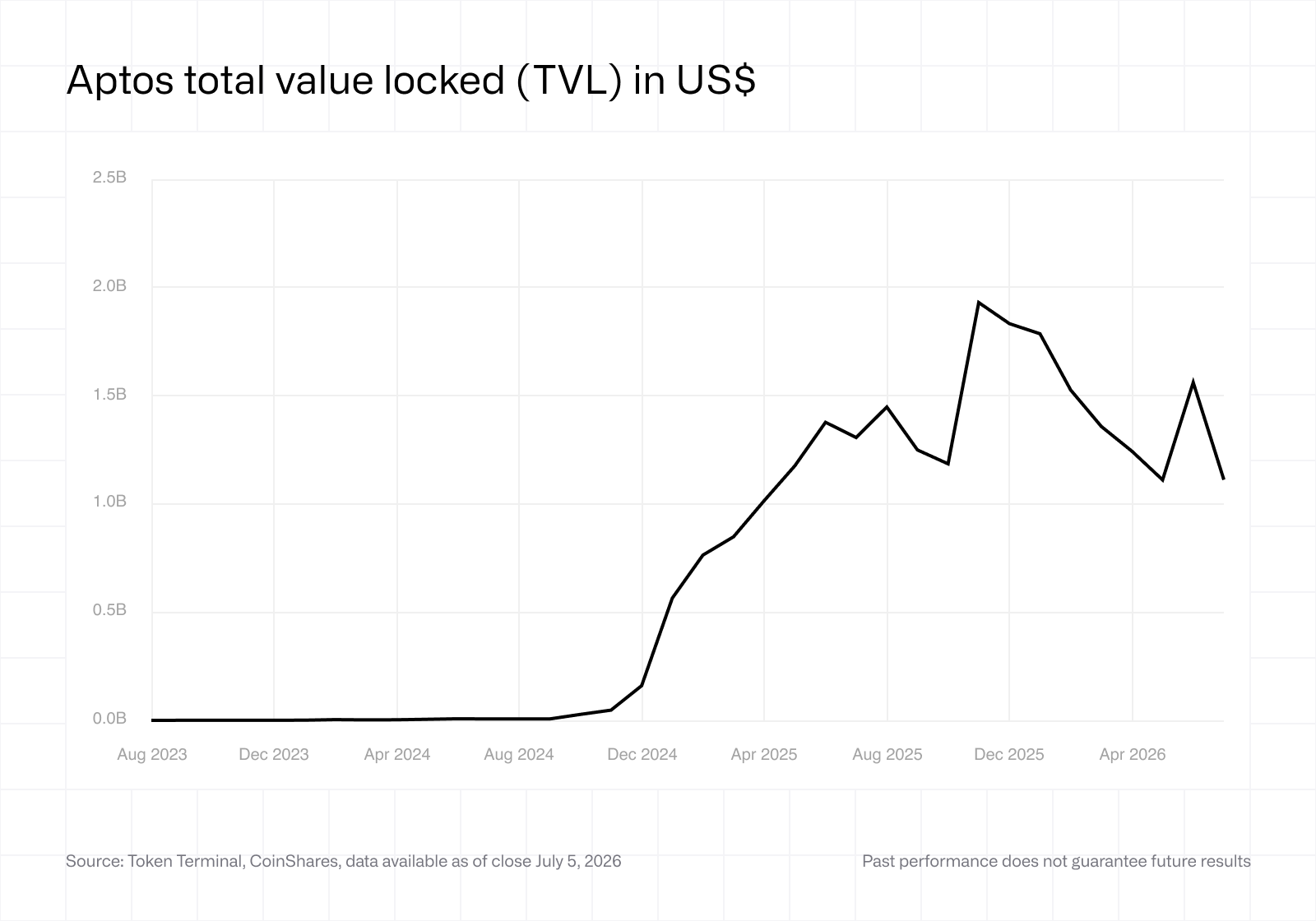
Aptos is a multi-sector Layer 1 blockchain, with adoption in DeFi, NFTs, gaming and infrastructure. Aptos attract developers who prioritize speed, safety and composability. However, despite technical promise, Aptos is still in a growth phase, with Total Value Locked (TVL) and user metrics trailing behind more mature ecosystems like Ethereum and Solana.

Aptos TVL

Aptos is showing strong early growth metrics despite being much younger and smaller than Ethereum and Solana. Aptos demonstrates healthy DeFi activity, competitive on-chain performance versus peers like Sui and relatively low operational costs. 

  • Aptos’ DeFi is growing, as shown by projects like Aries Markets (lending), AUX Exchange (order-book DEX), and LiquidSwap (AMM).

  • NFT platforms Topaz and Souffl3 support minting and trading Aptos-native assets, with activity peaking in Q1 2024. The Move language provides secure, non-replicable asset standards, ideal for gaming, where studios are now exploring Aptos for low-latency, reliable item and identity management.

Cross-Chain: Compatible but Not EVM

Aptos is not natively EVM-compatible—it uses the Move language instead—so Solidity-based dApps (most notably Ethereum’s ones) must be rewritten. However, interoperability is supported via secure bridges such as LayerZero, Wormhole, and Celer, which enable token transfers between Ethereum, Solana, and Aptos.

The Aptos Foundation continues to fuel adoption with grants and ecosystem programs aimed at onboarding developers from rival chains.

Pros and Cons

Aptos presents a mix of promising technical strengths and early-stage challenges, offering both upside potential and key risks for informed investors to weigh.

Pros

Aptos brings technical and architectural innovations that offer real advantages for a next-gen Layer 1 performance such as:

  • Parallel transaction execution: Enables high-throughput dApps with minimal congestion, ideal for DeFi and gaming scalability.

  • Move smart contract language: Offers built-in protections like resource-based security, significantly lowering smart contract exploit risk.

  • Strong VC and foundation backing: Backed by a16z, Binance Labs and others, offering sustained capital for long-term ecosystem development.

  • Low-latency consensus mechanism: Ensures near-instant transaction finality, improving UX and suitability for high-frequency apps.

  • Bridging to major chains: Interoperability via LayerZero, Wormhole, and Celer gives users exposure to Ethereum and Solana assets.

Cons

However, Aptos also faces growing pains typical of early-stage blockchains, including:.

  • Ongoing token unlocks: A large portion of APT remains locked and gradual releases which could introduce persistent sell pressure.

  • Validator set is relatively concentrated: Early network control is skewed toward insiders, raising decentralization and censorship-resistance concerns.

  • Ecosystem is still in its infancy: TVL, protocol variety, and mainstream traction remain small relative to Ethereum, Solana, or Sui.

  • Not EVM-compatible: Developers must learn Move and rewrite apps, creating a higher onboarding friction despite long-term safety benefits.

Conclusion

Aptos is a Layer-1 blockchain designed for performance at scale. It builds on lessons from Diem to create a faster, more secure smart contract platform.

Its design complements Bitcoin and Ethereum by offering faster execution and safer contract logic for use cases like finance, gaming, and NFTs. It does not aim to replace major chains but instead positions itself as a more advanced option for developers needing performance.

From a portfolio perspective, Aptos presents high-growth potential alongside early-stage risk. Its strong technical foundation and developer-friendly architecture make it worth monitoring, especially as applications mature and the validator set decentralizes.

Published onSept 1st, 2025

Writer
CoinShares Author Logo
CoinShares

related articles

Welcome to CoinShares

Personal Data

0102

When you visit CoinShares website, cookies enhance your experience. They help us to show you more relevant content. Some cookies are necessary for the site to work and will always be active. Blocking some types of cookies may impact your experience of the website and the services which we offer on our website.

We use cookies on our site to optimize our services. Learn more about our EU cookie policy or US cookie policy.

  • Necessary
    Question circle icon
  • Preferences
    Question circle icon
  • Statistical
    Question circle icon
  • Marketing
    Question circle icon
Necessary cookies help make a website usable by enabling basic functions like page navigation and access to secure areas of the website. The website cannot function properly without these cookies.
Preference cookies enable a website to remember information that changes the way the website behaves or looks, like your preferred language or the region that you are in.
Statistic cookies help website owners to understand how visitors interact with websites by collecting and reporting information anonymously.
Marketing cookies are used to track visitors across websites. The intention is to display ads that are relevant and engaging for the individual user and thereby more valuable for publishers and third party advertisers.