Bitcoin in France: live happy, live hidden
 9 min read
For the fifth year running, Paris has been named the world's most appealing city for tourism1, and it is not hard to see why. Few places pack so much heritage and culture into so tight a frame. The centre is among the densest on earth, compact enough that you can walk from the Louvre to the Opéra Bastille by way of Notre-Dame in a matter of minutes, on foot or by bike. It is an open-air museum laced with café terraces, the French art of living distilled into the image of the flâneur, cigarette in hand, sunglasses on. "Paris is a feast", as Ernest Hemingway put it when he first discovered the city as a young reporter in the 1920s. A place where music fills the streets on the summer solstice, where crowds pour in from across Europe, and where, when the heat rises, the canals fill up too.
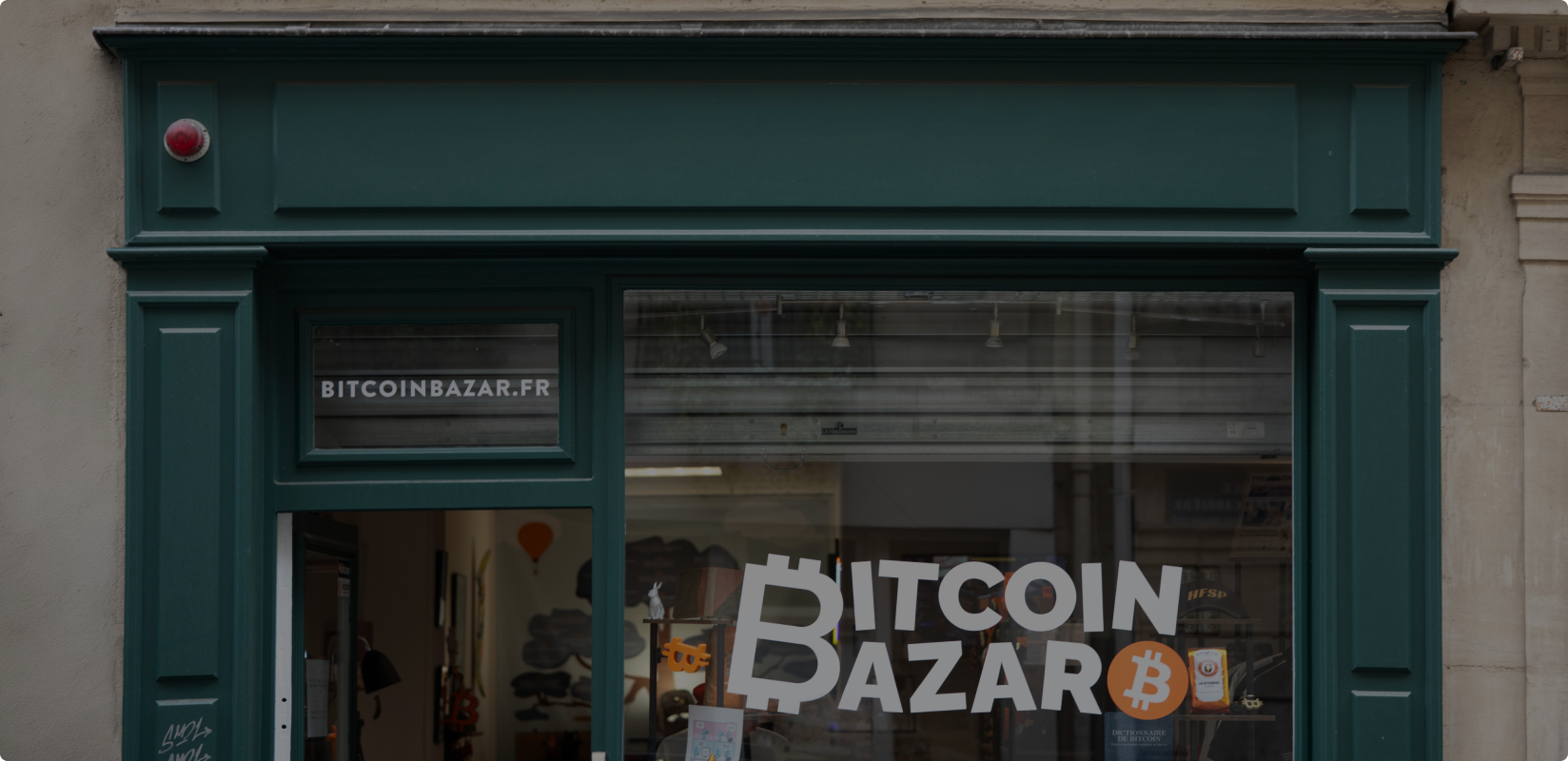
Lately, though, the feast has lost its flavour for a good many Parisians. Eugène is one of them. He runs Bitcoin Bazar, the only shop in the city devoted to the original cryptocurrency. A few steps from the Sacré-Coeur, or the notorious Lepic street spotlighted by the Tour de France, in the old Montmartre quarter whose endless staircases have become an urban playground for some of the best trail runners in the world, the shelves hold bitcoin wallets and security keys branded Ledger, Jade (made by Adam Back's firm Blockstream) and Coldcard, a small bookcase running from Milton Friedman and Frédéric Bastiat to Andreas Antonopoulos, mining machines, T-shirts stamped with the Bitcoin logo and every kind of trinket for the most devoted followers of the anonymous Satoshi Nakamoto's invention. Built like a corner grocery or a New York deli, the shop set out to be a landmark, modest but worthwhile by its very existence, for newcomers wanting to take their education in digital assets further and for old hands glad of a moment among peers. But on this grey May afternoon, the overcast sky above the 18th arrondissement sets the tone for our visit. Our host does not look cheerful, and for good reason: Bitcoin Bazar is about to close. Not for want of money, though Eugène admits the venture was always more a matter of conviction than profit, but for reasons of safety.
A few weeks earlier, six young men had been arrested over their suspected part in a string of violent robberies across the Paris region, all targeting cryptocurrency holders. The trend is alarming enough that, by 16 April 2026, the authorities had logged at least 47 cases of kidnapping, unlawful detention and violence against holders of digital assets since the start of the year2. The year before, 67 such cases had already been recorded3. It is no longer a Paris problem. The most striking example is that of Ledger co-founder David Balland and his wife, both held captive, he mutilated, near Vierzon, a small town in central France and one of the historic sites of the crypto security firm4. The crisis has reached others of similar standing: the head of Binance France, the daughter of the founder of Paymium, France's oldest crypto exchange, and the wife of Sébastien Borget, co-founder of the metaverse game The Sandbox. "There is a general sense of impunity", says Borget, still shaken by the ordeal. "And on top of that, a country growing poorer fast. Crypto gets the headlines, but in reality this runs from jewellers to people who collect Pokémon cards."
More worrying still, far less prominent individuals and families are among the victims too, most likely identified through a series of data leaks. The gravest involved a French tax officer, now under investigation for passing the details of taxpayers known to hold crypto assets straight to a criminal network5. Adding to the picture, Waltio, a firm specialising in tax accounting for digital-asset holders, has confirmed several security breaches that led to user data being stolen. And the records of some Ledger customers, exposed in a 2020 breach at one of its e-commerce providers, are still in circulation.
Given all this, staying at the helm of a shop devoted to Bitcoin in the middle of Paris began to look like assisted suicide, Eugène concedes as he packs the place up. "A friend of mine is with the GIGN, the unit that handles these cases, and even he told me I was mad to keep going", he says.
It is a reasonable fear in this climate, where the victims are far from all wealthy and are sometimes picked by mistake. "I don't have millions, and I don't want to give the impression that I do, because that just paints a target on my back", he adds. What does it say about a country when, for lack of basic safety, a shopkeeper in the heart of the capital fears for his life? When hundreds of employees and entrepreneurs scrub their professional lives from social media for fear of being singled out? When, on average once every five days since the start of the year, a fresh case lands in the papers or on the evening news? "Crypto abductions are no longer marginal. They are a real point of vigilance for us and account for a sizeable share of new cases", Jordan Abedi, deputy prosecutor at France's national organised-crime prosecution office (Pnaco), told Slate in June6.
A long history of political mishandling
With another round of high-stakes elections approaching, and President Emmanuel Macron due to step aside after the 2027 vote, none of this flatters the authorities, who have acknowledged, through interior minister Laurent Nunez, that France is "something of the epicentre of this new wave of violence"7. Forced to respond, the government has announced a "crypto action plan" meant to head off the contagion. Some firms in the sector have been given security briefings by the Brigade de recherche et d'intervention (BRI), France's elite police tactical unit but with no real detail attached, the announcement of that plan seems to have done little to reassure a sector already deeply frustrated with the public authorities, whom it holds partly responsible for the environment.
It must be said that the spread of digital assets has been accompanied by a steady stream of finger-pointing from politicians of every stripe, eager to tie money laundering, terrorist financing and tax evasion to citizens deemed a little too curious. Ten years ago, in May 2016, the leader of the French far right, Marine Le Pen, declared in a statement that her party would "prevent the use of cryptocurrencies such as Bitcoin in France" (a position the party has since revised)8, while Macron has gone on, right up to this year, linking crypto to the financing of terrorism. Meanwhile, many crypto users and entrepreneurs have had their bank accounts closed, sometimes without warning, as a quick search on Reddit makes plain. Ostracised and lumped in with criminals, this group, which nonetheless accounts for more than 10% of the population according to Adan's 2026 barometer with Ipsos9, must now live under a sword of Damocles wielded by organised crime.
"In theory, my name isn't in any of the databases that leaked", Eugène reassures himself as he prepares to close the shop he opened in October 2024. He prides himself on having kept no records on his customers at all. "We saw this climate coming, and that was part of the point of the shop, to be able to serve people who didn't want to expose themselves online." But reality, in all likelihood, has outrun anything the founder of Bitcoin Bazar imagined. He is now giving up the premises and falling back on an online-only store to protect his physical safety.
Since our visit, at least two more cases of violence have broken out, in the Paris and Marseille regions. Enough to cast doubt on the very idea of self-custody wallets, themselves now in the sights of French lawmakers, some of whom are pushing for a mandatory annual declaration to the tax office. With no guarantee that the data will not, once again, end up in criminal hands. And so some choose to start over somewhere else. But for the victims who take that route, unable to picture a safe life in their own home, it is only a bitter half-measure. "People imagine you can wipe it all away at the push of a button, but you don't erase scars like that, you don't leave your home overnight", sighs Borget. As this unforgiving spring day draws to a close, Eugène pulls down the shutter on his "Bazar". He sees us off without saying where he will go next. Who could blame him? The old saying, live happy, live hidden, has perhaps never been so true, nor so impossible to live by.
Notes
1 Euromonitor International, Top 100 City Destinations Index 2025, 5 December 2025. https://www.euromonitor.com/newsroom/press-releases/december-2025/euromonitor-international-unveils-worlds-top-100-city-destinations-for-2025
2 "More than forty kidnappings and unlawful detentions linked to cryptocurrencies since January", 20 Minutes, 16 April 2026; figure also reported by Slate, 23 June 2026. https://www.slate.fr/societe/enlevements-lies-cryptomonnaies-chaque-enqueteur-cyber-300-dossiers-attente-traitement-bureau-cryptorapts-cybercriminalite-police-ofac-uncyber-justice-pnaco-france
3 67 cryptocurrency-related assaults recorded in France in 2025, interior ministry figures relayed by the specialist press. https://cryptoast.fr/agressions-cryptomonnaies-laurent-nunez-annonce-plan-bataille-contre-delinquance/
4 "Kidnapping of the Ledger co-founder: David Balland found and freed after 24 hours in captivity", Journal du Geek, 25 January 2025; gendarmerie nationale, January 2025.
5 "Crypto kidnappings and detentions: this tax-office employee was tipping off a mysterious sponsor", Cryptoast, 2025. https://cryptoast.fr/enlevements-sequestrations-crypto-employee-impots-renseignait-mysterieux-commanditaire/
6 Jordan Abedi, deputy prosecutor at the Parquet national anticriminalité organisée (Pnaco), quoted by Slate, 23 June 2026. https://www.slate.fr/societe/enlevements-lies-cryptomonnaies-chaque-enqueteur-cyber-300-dossiers-attente-traitement-bureau-cryptorapts-cybercriminalite-police-ofac-uncyber-justice-pnaco-france
7 Laurent Nunez, interior minister, interview with La Tribune Dimanche, 16 May 2026. https://cryptoast.fr/agressions-cryptomonnaies-laurent-nunez-annonce-plan-bataille-contre-delinquance/
8 "Virtual currencies: no to the alienation of citizens engineered by the EU!", statement by Marine Le Pen, 26 May 2016. https://rassemblementnational.fr/communiques/les-monnaies-virtuelles-non-a-lalienation-des-citoyens-programmee-par-lue
9 Adan, "2026 barometer: the adoption of crypto assets in France and Europe", produced with Ipsos, April 2026 (ownership stabilised at around 11% of the French population). https://www.adan.eu/publications/articles/barometre-2026-l-adoption-des-crypto-actifs-en-france-et-en-europe