
This website uses cookies
We use cookies to personalise content and ads, to provide social media features and to analyse our traffic. We also share information about your use of our site with our social media, advertising and analytics partners who may combine it with other information that you’ve provided to them or that they’ve collected from your use of their services.
Consent Selection
Details
  • Necessary cookies help make a website usable by enabling basic functions like page navigation and access to secure areas of the website. The website cannot function properly without these cookies.

    • Learn more about this provideropens in a new window
      CookieConsentStores the user's cookie consent state for the current domain
      Maximum Storage Duration: 1 yearType: HTTP Cookie
    • Learn more about this provideropens in a new window
      bcookieUsed in order to detect spam and improve the website's security.
      Maximum Storage Duration: 1 yearType: HTTP Cookie
      li_gcStores the user's cookie consent state for the current domain
      Maximum Storage Duration: 180 daysType: HTTP Cookie
    • Learn more about this provideropens in a new window
      datadomeUsed in context with the website's BotManager. The BotManager detects, categorizes and compiles reports on potential bots trying to access the website.
      Maximum Storage Duration: 1 yearType: HTTP Cookie
    • _pk_testcookie_domainThis cookie determines whether the browser accepts cookies.
      Maximum Storage Duration: 1 dayType: HTTP Cookie
    • __cf_bm [x3]This cookie is used to distinguish between humans and bots. This is beneficial for the website, in order to make valid reports on the use of their website.
      Maximum Storage Duration: 1 dayType: HTTP Cookie
  • Preference cookies enable a website to remember information that changes the way the website behaves or looks, like your preferred language or the region that you are in.
    • Learn more about this provideropens in a new window
      lidcRegisters which server-cluster is serving the visitor. This is used in context with load balancing, in order to optimize user experience.
      Maximum Storage Duration: 1 dayType: HTTP Cookie
  • Statistic cookies help website owners to understand how visitors interact with websites by collecting and reporting information anonymously.
    • Learn more about this provideropens in a new window
      guestRegisters data on visitors' website-behaviour. This is used for internal analysis and website optimization.
      Maximum Storage Duration: 1 monthType: HTTP Cookie
    • Learn more about this provideropens in a new window
      personalization_idThis cookie is set by Twitter - The cookie allows the visitor to share content from the website onto their Twitter profile.
      Maximum Storage Duration: 400 daysType: HTTP Cookie
    • _pk_uidUsed by Piwik Analytics Platform to identify the visitor on repeat visits to the website.
      Maximum Storage Duration: 1 yearType: HTTP Cookie
      _pk_id#Collects statistics on the user's visits to the website, such as the number of visits, average time spent on the website and what pages have been read.
      Maximum Storage Duration: 1 yearType: HTTP Cookie
      _pk_ses#Used by Piwik Analytics Platform to track page requests from the visitor during the session.
      Maximum Storage Duration: 1 dayType: HTTP Cookie
    • FPGSIDRegisters statistical data on users' behaviour on the website. Used for internal analytics by the website operator.
      Maximum Storage Duration: 1 dayType: HTTP Cookie
      FPIDRegisters statistical data on users' behaviour on the website. Used for internal analytics by the website operator.
      Maximum Storage Duration: 400 daysType: HTTP Cookie
      FPLCRegisters a unique ID that is used to generate statistical data on how the visitor uses the website.
      Maximum Storage Duration: 1 dayType: HTTP Cookie
    • _gaRegisters a unique ID that is used to generate statistical data on how the visitor uses the website.
      Maximum Storage Duration: 2 yearsType: HTTP Cookie
      _ga_#Used by Google Analytics to collect data on the number of times a user has visited the website as well as dates for the first and most recent visit.
      Maximum Storage Duration: 2 yearsType: HTTP Cookie
  • Marketing cookies are used to track visitors across websites. The intention is to display ads that are relevant and engaging for the individual user and thereby more valuable for publishers and third party advertisers.
    • Learn more about this provideropens in a new window

      Some of the data collected by this provider is for the purposes of personalization and measuring advertising effectiveness. The provider may use the IP Addresses for ads measurement and ads personalization.

      ads/ga-audiencesUsed by Google AdWords to re-engage visitors that are likely to convert to customers based on the visitor's online behaviour across websites.
      Maximum Storage Duration: SessionType: Pixel Tracker
    • Learn more about this provideropens in a new window
      userRefererDetermines how the user accessed the website. This information is used by the website operator in order to measure the efficiency of their marketing.
      Maximum Storage Duration: 1 monthType: HTTP Cookie
    • Learn more about this provideropens in a new window
      #:session-dataTracks the individual sessions on the website, allowing the website to compile statistical data from multiple visits. This data can also be used to create leads for marketing purposes.
      Maximum Storage Duration: PersistentType: HTML Local Storage
      eng_mtTracks the conversion rate between the user and the advertisement banners on the website - This serves to optimise the relevance of the advertisements on the website.
      Maximum Storage Duration: PersistentType: HTML Local Storage
      t_gidThis cookie assigns a specific visitor ID, when the visitor interacts with ads or content from the website - this allows the website to target the visitor with similar ads or content.
      Maximum Storage Duration: 1 yearType: HTTP Cookie
      t_pt_gidCollects information on user preferences and/or interaction with web-campaign content - This is used on CRM-campaign-platform used by website owners for promoting events or products.
      Maximum Storage Duration: 1 yearType: HTTP Cookie
      taboola global:user-idSets a unique ID for the visitor, that allows third party advertisers to target the visitor with relevant advertisement. This pairing service is provided by third party advertisement hubs, which facilitates real-time bidding for advertisers.
      Maximum Storage Duration: PersistentType: HTML Local Storage
      taboola_session_idThis cookie is used to collect information on a visitor. This information will become an ID string with information on a specific visitor – ID information strings can be used to target groups with similar preferences, or can be used by third-party domains or ad-exchanges.
      Maximum Storage Duration: SessionType: HTTP Cookie
    • Learn more about this provideropens in a new window
      1/i/adsct [x2]Collects data on user behaviour and interaction in order to optimize the website and make advertisement on the website more relevant.
      Maximum Storage Duration: SessionType: Pixel Tracker
      muc_adsCollects data on user behaviour and interaction in order to optimize the website and make advertisement on the website more relevant.
      Maximum Storage Duration: 400 daysType: HTTP Cookie
      guest_idCollects data related to the user's visits to the website, such as the number of visits, average time spent on the website and which pages have been loaded, with the purpose of personalising and improving the Twitter service.
      Maximum Storage Duration: 400 daysType: HTTP Cookie
      guest_id_adsCollects information on user behaviour on multiple websites. This information is used in order to optimize the relevance of advertisement on the website.
      Maximum Storage Duration: 400 daysType: HTTP Cookie
      guest_id_marketingCollects information on user behaviour on multiple websites. This information is used in order to optimize the relevance of advertisement on the website.
      Maximum Storage Duration: 400 daysType: HTTP Cookie
    • _gcl_auUsed by Google AdSense for experimenting with advertisement efficiency across websites using their services.
      Maximum Storage Duration: 3 monthsType: HTTP Cookie
      _gcl_lsTracks the conversion rate between the user and the advertisement banners on the website - This serves to optimise the relevance of the advertisements on the website.
      Maximum Storage Duration: PersistentType: HTML Local Storage
    • pardot [x2]Used in context with Account-Based-Marketing (ABM). The cookie registers data such as IP-addresses, time spent on the website and page requests for the visit. This is used for retargeting of multiple users rooting from the same IP-addresses. ABM usually facilitates B2B marketing purposes.
      Maximum Storage Duration: SessionType: HTTP Cookie
  • Unclassified cookies are cookies that we are in the process of classifying, together with the providers of individual cookies.
    • cs_analytics_ip_blockedPending
      Maximum Storage Duration: SessionType: HTTP Cookie
      user_tokenPending
      Maximum Storage Duration: 1 yearType: HTTP Cookie
    • _twpidPending
      Maximum Storage Duration: SessionType: HTTP Cookie
Cookie declaration last updated on 8/20/26 by Cookiebot
[#IABV2_TITLE#]
[#IABV2_BODY_INTRO#]
[#IABV2_BODY_LEGITIMATE_INTEREST_INTRO#]
[#IABV2_BODY_PREFERENCE_INTRO#]
[#IABV2_BODY_PURPOSES_INTRO#]
[#IABV2_BODY_PURPOSES#]
[#IABV2_BODY_FEATURES_INTRO#]
[#IABV2_BODY_FEATURES#]
[#IABV2_BODY_PARTNERS_INTRO#]
[#IABV2_BODY_PARTNERS#]
About
Cookies are small text files that can be used by websites to make a user's experience more efficient.

The law states that we can store cookies on your device if they are strictly necessary for the operation of this site. For all other types of cookies we need your permission.

This site uses different types of cookies. Some cookies are placed by third party services that appear on our pages.

You can at any time change or withdraw your consent from the Cookie Declaration on our website.

Learn more about who we are, how you can contact us and how we process personal data in our Privacy Policy.

Please state your consent ID and date when you contact us regarding your consent.

Beyond the Coldcard exploit

Timer7 min read

  • Finance
  • Technology

Two seemingly unrelated security incidents have recently captured the financial industry’s attention. A serious vulnerability affecting Coldcard hardware wallets resulted in the compromise of user funds, while several of the world’s largest hedge funds, including Point72, Citadel, Millennium and Two Sigma2, were reportedly targeted by audio-based phishing attacks designed to compromise employee credentials.

One concerns Bitcoin self-custody, the other traditional finance, but both point towards the same underlying trend: artificial intelligence is beginning to reshape the economics of cybersecurity.

A vulnerability introduced into Coldcard firmware in March 2021 remained undiscovered for more than five years before being exploited against real users. Coinkite1 confirmed that affected devices generated substantially less entropy than intended, weakening the security of seeds created by vulnerable firmware. Estimates from blockchain analytics researchers suggest approximately $116M to $130M of Bitcoin may have been compromised across thousands of addresses.

There is no public evidence that AI was responsible for finding the vulnerability. Coinkite has suggested AI-assisted code review may have played a role, but its own retrospective testing with multiple frontier models failed to identify the flaw. More importantly, what happens if AI continues reducing the time, expertise and cost required to find subtle software flaws across all of finance?

The IMF has warned that AI could accelerate vulnerability discovery and exploitation, while the UK National Cyber Security Centre has identified AI-assisted exploit development as a significant near-term risk. AI does not need to break cryptography to materially change financial security. It simply needs to make everything around it easier to attack.

Cryptographic authorisation versus institutional trust

Bitcoin and traditional finance have different security architectures. Bitcoin’s base layer validates spending conditions cryptographically, generally without needing to establish the real-world identity of the person initiating a transaction. Traditional financial institutions also rely extensively on cryptography, including encryption, hardware security modules and digital signatures, but cryptography is only one layer.

Banks and asset managers must also determine whether customers are genuine, employees are authorised, counterparties are legitimate and payment instructions should be trusted. These are identity and institutional trust problems, and AI is becoming increasingly effective at attacking them. Large language models can personalise phishing, reproduce voices and video, automate reconnaissance and search for vulnerabilities with less human involvement.

The recent hedge fund attacks provide a useful example with Point72, Citadel, Millennium and other major investment firms being targeted by audio-based phishing schemes in which attackers impersonated trusted personnel and attempted to obtain sensitive credentials. Reports described the wider campaign as involving AI-enabled voice cloning. Public information about the precise role played by AI remains limited, but attackers were clearly seeking to exploit human trust rather than defeat the underlying cryptography.

Several attempts appear to have been detected before material damage occurred. Yet these firms have substantial cybersecurity budgets, specialist teams and mature controls. The fact that attackers still considered employees and identity processes as viable points of entry is itself significant.

AI is changing the economics of cyberattacks

Some of the clearest evidence comes from the UK AI Security Institute. AISI tested frontier AI models against a simulated 32-stage corporate network attack involving reconnaissance, credential theft, exploitation, reverse engineering and data exfiltration. At a fixed 10 million-token inference budget, GPT-4o completed an average of 1.7 stages in August 2024. By February 2026, Claude Opus 4.6 averaged 9.8 stages, almost a six-fold increase in 18 months.

The best individual run completed 22 of 32 stages, roughly six hours of the estimated 14 hours of work AISI believes a human expert would require. The test contained no active defenders, but the direction is clear: capabilities that once required significant expertise are becoming cheaper and easier to access.
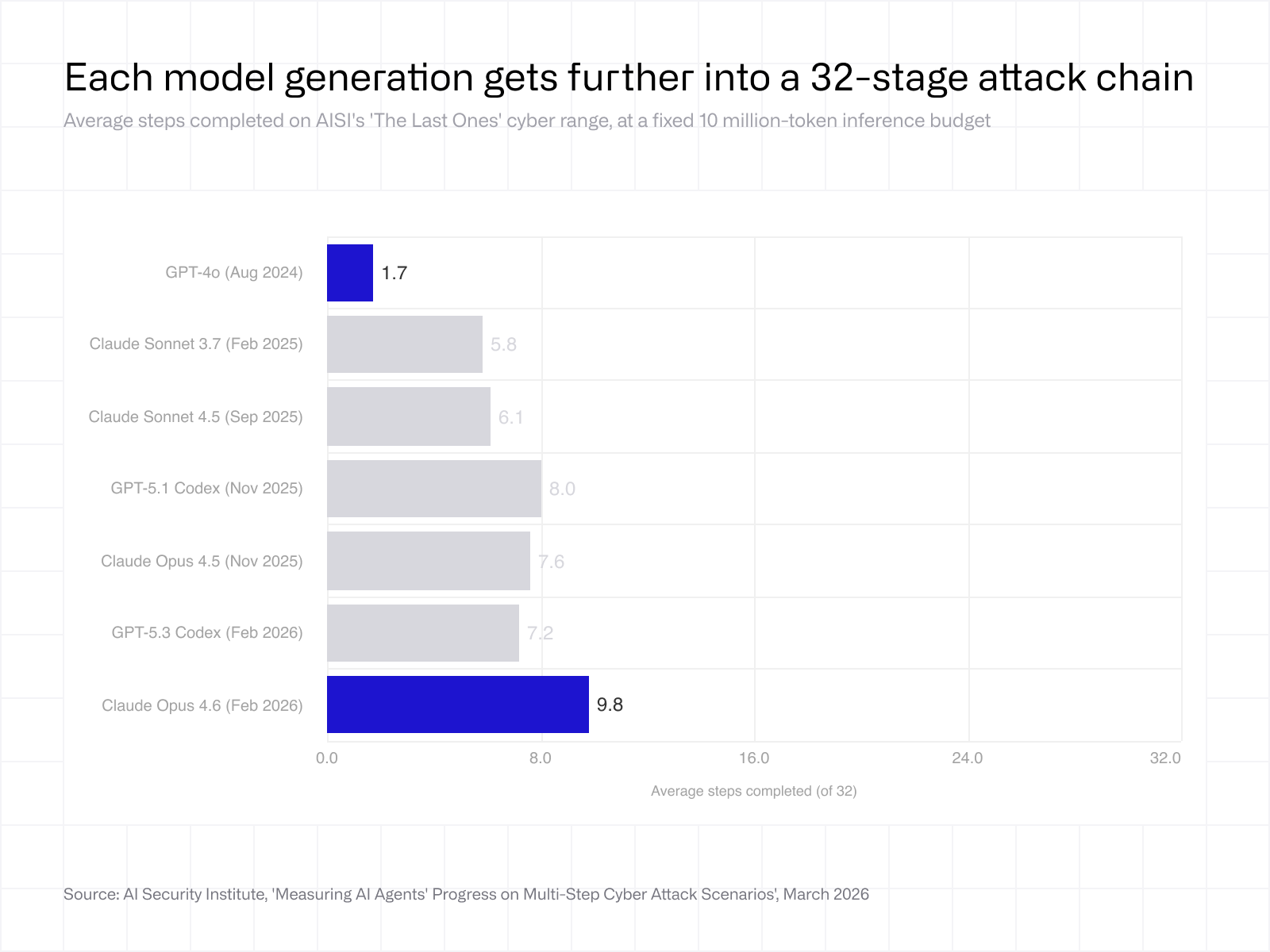
Beyond the coldcard exploitFigure 1: Average stages completed by frontier AI agents in AISI’s 32-stage corporate cyberattack benchmark at a fixed 10 million-token inference budget. Source: UK AI Security Institute.

Vulnerability exploitation is already becoming a more important route into corporate systems. Verizon's 2026 Data Breach Investigations Report found that it had become the leading initial access method, accounting for 31% of breaches, while third-party involvement was present in 48%.

That matters for finance, which depends on cloud providers, payment processors, identity providers, custodians and thousands of other third parties. The Financial Stability Board estimates that non-bank financial institutions alone held $256.8tr of assets in 2024. AI does not need to create a new category of cyberattack to change the risk profile of this infrastructure, it only needs to reduce the marginal cost of attacking existing weak points.

The same logic applies to fraud. The ECB and EBA found that payment fraud across the EU increased from €3.5B in 2023 to €4.2BColdcard Security Advisory in 2024. Strong customer authentication continued to perform well, but the institutions highlighted the growing importance of cases where legitimate users are manipulated into authenticating fraudulent transactions themselves.

AI potentially makes that attack surface larger. Voice generation, personalised phishing, synthetic identities and automated reconnaissance increase the sophistication and scale of social engineering. If an attacker cannot defeat authentication technically, the next option is to persuade the authenticated person to defeat it for them. The machine does not need to steal the key if it can persuade the person holding it to open the door.

What Coldcard actually tells us

The Coldcard exploit was not a failure of Bitcoin's consensus mechanism or underlying cryptography, but an implementation failure in the process used to generate cryptographic entropy. Secure protocols still require secure implementations. Bitcoin can provide strong cryptographic assurances at the protocol level while the hardware, software and users around it remain vulnerable.

Bitcoin itself continued functioning as designed, the attacker did not break its signature algorithm or consensus mechanism. Instead, weaknesses in the implementation meant some users' keys were not as unpredictable as they should have been. This complicates the traditional framing of self-custody. Removing a third-party custodian removes one form of counterparty risk, but it transfers responsibility for hardware, software, backups and operational security to the holder.

For some investors, incidents like this may strengthen the case for institutional custody or ETP structures where key management is handled professionally and combined with segregated storage, cold-storage policies, multi-party authorisation, white-listed wallets and monitoring. Institutional custody is not immune to cyber risk, but the trade-off is less about which model is “secure” and more about which risks investors are willing and equipped to manage themselves.

One reason Bitcoin security failures receive disproportionate attention is that losses are immediately visible. When a self-custody wallet is compromised, the owner generally bears the loss directly and the movement of assets is observable. Within traditional finance, losses can instead be distributed between institutions, insurers, payment providers and customers.

There is also a more important asymmetry. Bitcoin's base security architecture is designed to minimise the need for discretionary trust. Traditional finance cannot remove identity from its operating model. Banks must know who their customers are, determine what employees are authorised to do, maintain recovery mechanisms and allow human intervention when exceptional circumstances occur. As machines become better at imitating humans, identifying vulnerabilities and automating attacks, maintaining identity-based trust will likely become more expensive.

That does not mean Bitcoin or decentralised networks are inherently secure while traditional finance is insecure. Coldcard is evidence of why that claim would be too simplistic. But it does suggest that AI could dramatically alter the relative economics of different security architectures.

The Coldcard exploit showed that implementation quality matters just as much as cryptographic design. At the same time, attacks against some of Wall Street's most sophisticated investment firms illustrate the challenge facing identity-dependent financial systems as convincing human impersonation becomes increasingly cheap to produce.

These incidents are not evidence that one financial system is secure while the other is not, but there is huge asymmetry at the moment, with traditional finance having far more attack vectors and far larger sums of money at stake. We also believe that further news of AI related attacks is likely to drive people towards decentralized blockchain solutions, which are far less vulnerable relative to the centralized public ledger systems in finance or government.

Sources:

1 Coinkite Security Advisory, 30 July 2026, blog.coinkite.com

2 Bloomberg.com, 5 August 2026

Published onAug 13th, 2026

Writer
Former Head of Research at ETF Securities, James leads CoinShares' Research department with deep expertise in equity and fund management.

Welcome to CoinShares

Personal Data

0102

When you visit CoinShares website, cookies enhance your experience. They help us to show you more relevant content. Some cookies are necessary for the site to work and will always be active. Blocking some types of cookies may impact your experience of the website and the services which we offer on our website.

We use cookies on our site to optimize our services. Learn more about our EU cookie policy or US cookie policy.

  • Necessary
    Question circle icon
  • Preferences
    Question circle icon
  • Statistical
    Question circle icon
  • Marketing
    Question circle icon
Necessary cookies help make a website usable by enabling basic functions like page navigation and access to secure areas of the website. The website cannot function properly without these cookies.
Preference cookies enable a website to remember information that changes the way the website behaves or looks, like your preferred language or the region that you are in.
Statistic cookies help website owners to understand how visitors interact with websites by collecting and reporting information anonymously.
Marketing cookies are used to track visitors across websites. The intention is to display ads that are relevant and engaging for the individual user and thereby more valuable for publishers and third party advertisers.