



What is Cardano - ADA guide
 11 min read
- Altcoins
- Technology
The beginnings of Cardano
Cardano is a public, proof-of-stake blockchain built around peer-reviewed research and a two-layer architecture. The project began in 2015 under Charles Hoskinson, a co-founder of Ethereum, and is developed by Input Output Global (IOG) alongside the Cardano Foundation and Emurgo. The network launched in September 2017, introducing the native cryptocurrency ADA and a proof-of-stake consensus protocol called Ouroboros.
The stated ambition is to address the scalability, security, and sustainability trade-offs of earlier blockchains. Cardano's roadmap is organised into named eras (Byron, Shelley, Goguen, Basho, Voltaire), working toward a decentralised network with on-chain governance and a self-sustaining treasury. The Voltaire era, focused on on-chain governance, began rolling out through 2024 and 2025 with the activation of the Chang hard fork and the launch of community-elected committees.1
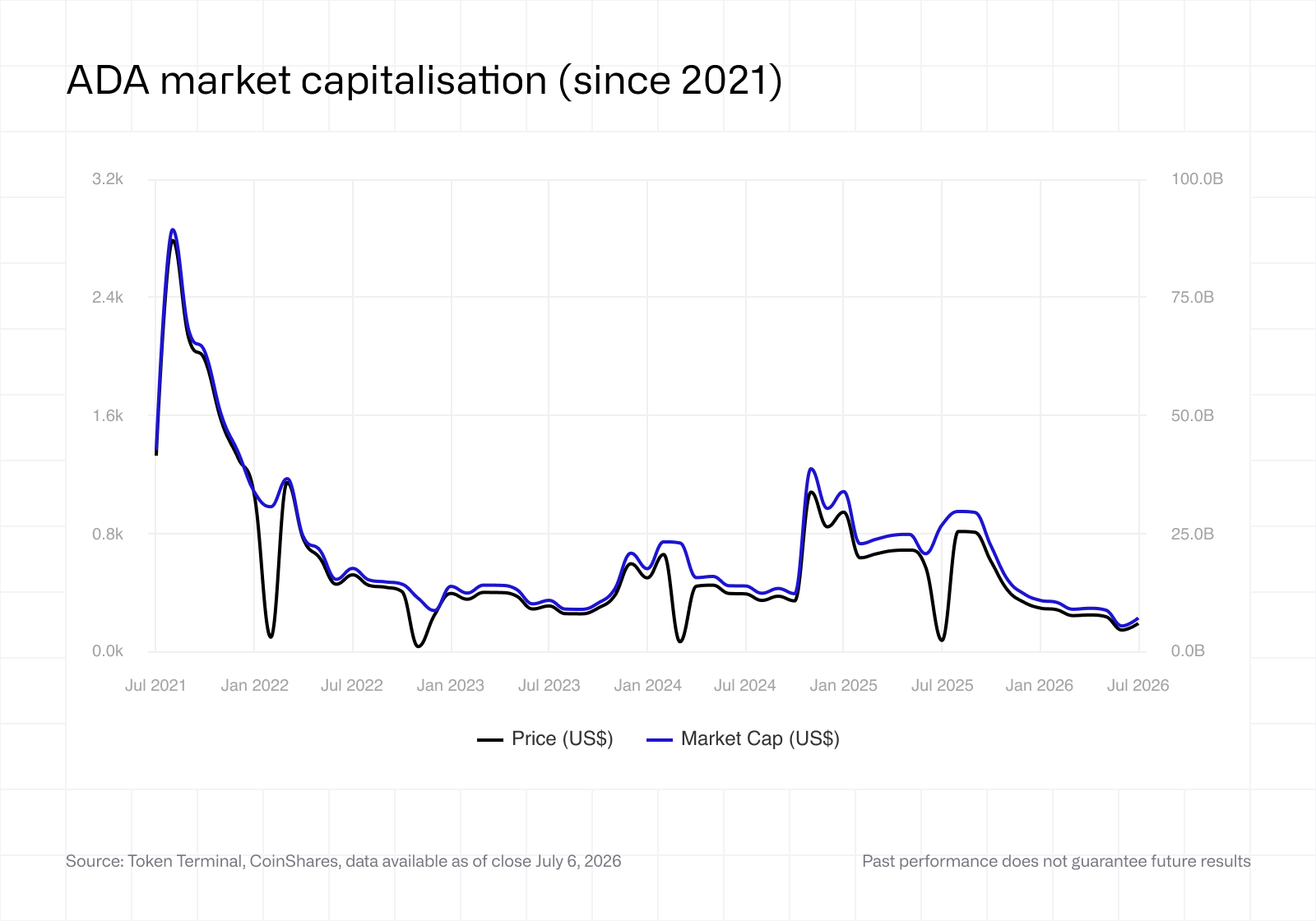
ADA traded at $0,144 on 30 June 2026, for a circulating market capitalisation of $5,37 billion across 37,3 billion tokens in circulation.
How the Cardano network works
Proof of stake and the Ouroboros protocol
Unlike Bitcoin's proof-of-work, or Ethereum's original proof-of-work before its 2022 transition to PoS, Cardano launched directly as a proof-of-stake chain. Ouroboros, the protocol that underpins it, was the first PoS design published with formal peer-reviewed security proofs.3
In practice, ADA holders delegate tokens to staking pools, which are then selected to produce blocks in proportion to delegated stake. Delegation is non-custodial: tokens never leave the holder's wallet, and there is no slashing or lock-up period. Energy consumption is a small fraction of proof-of-work networks, which has made Cardano a frequent reference in ESG-oriented crypto discussions.
The EUTXO model
Cardano uses an Extended Unspent Transaction Output (EUTXO) model. It is closer to how Bitcoin tracks balances than to Ethereum's account model, with one key addition: each unspent output can carry data and a script, allowing smart contracts to operate on it.
The practical implication is that transaction outcomes are deterministic. The result is known before submission, reducing a category of front-running and failed-transaction risks common on account-based chains. The trade-off is that some smart contract patterns (notably those requiring shared global state) are harder to express, and developers have had to adapt application designs. Smart contracts are written in Haskell-based languages, primarily Plutus for general logic and Marlowe for financial contracts.
Performance and scalability
Network capacity and transaction throughput
Cardano's base-layer throughput is moderate by current standards, well below high-performance chains like Solana or Sui, though generally sufficient for current network demand. Fees are denominated in ADA, are deterministic (the cost is known before submitting), and have remained low in absolute terms. Network uptime has been a relative strength: Cardano has avoided the multi-hour outages that have affected several competing Layer-1s, a record the team attributes to its conservative, formally verified engineering approach. The absolute numbers are small. Cardano collected $3,44M in network fees across 2025 and $401,127 over the first half of 2026, of which roughly a fifth is retained by the treasury. Low fees are a design goal, so this is partly intentional, but it also reflects modest demand for the network's blockspace.
Scaling approaches such as Hydra
Hydra is Cardano's primary Layer-2 scaling solution, funded through the community treasury. It works by creating "heads", off-chain channels where a subset of participants can transact at high speed before settling final state to the main chain. Benchmark conditions have demonstrated high throughput within individual heads. In February 2026 Input Output announced that Hydra had formally entered its adoption phase, shifting the team's focus from development to production feedback and real-world deployment.4 Named users include DeltaDeFi for high-performance trading and Masumi for micropayments, and Hydra v1 was used to run the Midnight Glacier Drop token distribution.4 The v1.3 release addressed memory use, fee calculation and partial fan-out for head management. Hydra remains a smaller scaling story than the rollup ecosystems on Ethereum. Hydra is no longer the whole scaling story either. Cardano's base-layer scaling programme is now Leios, a redesign of how blocks are produced and validated, which Input Output set out in a roadmap published in June 2026 and describes as the route to solving the throughput constraint at Layer 1 rather than around it.
Cardano compared with other blockchains
Cardano sits in a crowded smart-contract Layer-1 field. The simplest way to position it:
Against Ethereum, Cardano offers lower fees, a different (and arguably more predictable) execution model, and a research-first culture. Ethereum retains a substantially larger developer ecosystem, deeper DeFi liquidity, and the bulk of institutional infrastructure including spot ETFs and regulated staking products.
Against Solana and Sui, Cardano is slower at the base layer and has a smaller application ecosystem, but its conservative upgrade cadence has produced a stronger uptime record. Solana and Sui have prioritised raw performance; Cardano has prioritised formal correctness.
Against Bitcoin, the comparison is mostly orthogonal. Bitcoin is a store-of-value asset with limited programmability; Cardano is a general-purpose smart contract platform with a different investment thesis and a meaningfully smaller market capitalisation.
What is ADA used for?
ADA is the native cryptocurrency of Cardano, with a fixed maximum supply of 45 billion tokens.5
Transaction fees
Users pay fees in ADA to process transactions and execute smart contracts. Unlike Ethereum's EIP-1559 mechanism, Cardano fees are not burned. A portion goes to the Cardano treasury, which funds development and community proposals, and the remainder is distributed to stake pool operators and their delegators as part of staking rewards. Token Terminal records the treasury share at roughly a fifth of gross fees.2 Either way none of it is destroyed, which keeps ADA's monetary policy fully deterministic.
Staking and network participation
ADA holders delegate tokens to stake pools, or operate pools themselves, to secure the network and earn rewards. Because delegation is non-custodial and unlocked, staking on Cardano is operationally simpler than on networks with bonding periods or slashing.
Governance and voting
Under Voltaire, ADA holders vote on protocol upgrades, treasury allocations, and parameter changes via on-chain governance. Voting power is proportional to staked ADA, and holders can delegate their voting rights to Delegate Representatives (DReps) if they prefer not to vote directly. This aligns governance with economic stake without requiring active participation from every holder.
Ecosystem and use cases
Decentralised finance
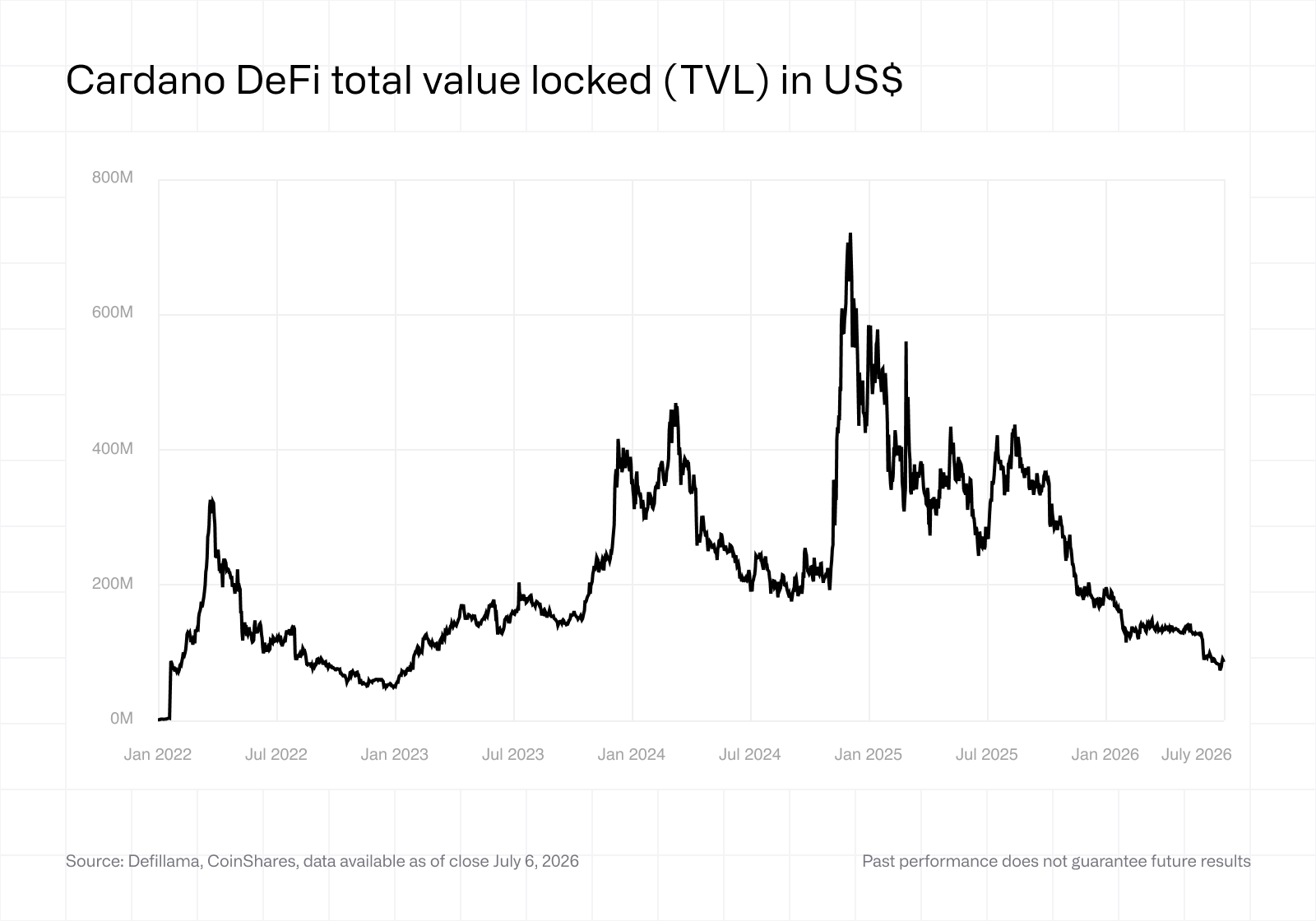
Cardano's DeFi sector is real but small relative to Ethereum or Solana. Total value locked stood at $82,4 million on 30 June 2026. The largest applications include Minswap (DEX), Liqwid Finance (lending), and Indigo (synthetic assets). One conspicuous gap is the absence of major native stablecoins: USDT, USDC, and USDe are not natively issued on Cardano, which limits the dollar-denominated DeFi activity that drives volume on competing chains. Total stablecoin supply on Cardano was $54,1 million on 30 June 2026, which puts a number on that gap.2 Native stablecoins such as Djed exist but have not achieved significant scale.
NFTs and digital assets
Cardano supports native tokens at the protocol level, meaning NFTs and other assets do not require a smart contract to mint or transfer. Marketplaces like JPG Store and NMKR have made Cardano one of the more active NFT chains by transaction count, though dollar volumes are smaller than on Ethereum or Solana.
Identity and enterprise applications
Cardano has pursued enterprise and identity use cases more visibly than most competing chains, including pilot work with governments and educational institutions on credential verification. In May 2025, developers from the BitcoinOS project demonstrated a "bridgeless" transfer of Bitcoin to Cardano using zero-knowledge proofs rather than a custodial bridge.7 The demo locked 1 BTC on Bitcoin, minted a programmable xBTC token on Cardano, and unwrapped it back to native BTC. It is a proof of concept rather than a production system, but it points toward a more security-conscious approach to cross-chain interoperability.
Main takeaways
ADA offers exposure to a smart contract network with a distinctive design and a strong emphasis on formal correctness. Its strengths are low energy consumption, deterministic fees, formal verification, and a strong uptime record. Its limitations are moderate base-layer throughput, limited Hydra adoption, a DeFi ecosystem that is smaller and less liquid than competitors, and the absence of native major stablecoins.
For investors building a diversified crypto allocation, ADA sits alongside Bitcoin (store of value) and Ethereum (dominant smart-contract platform) as a different bet on how blockchain infrastructure will mature. For investors building a diversified crypto allocation, ADA sits alongside Bitcoin (store of value) and Ethereum (dominant smart-contract platform) as a different bet on how blockchain infrastructure will mature. The previous version of this guide identified three things to watch: Hydra adoption, growth of the DeFi ecosystem, and execution of the Voltaire era. One of those has now moved, and in the wrong direction: DeFi total value locked fell by about 39% between April and June 2026 and is 82% below its December 2024 peak. As with any single-asset position, the size of any ADA allocation should reflect both conviction and the volatility characteristic of crypto markets.
FAQ
Is Cardano a cryptocurrency or a blockchain?
Both, depending on what is being referred to. Cardano is the blockchain network. ADA is the cryptocurrency native to that network. When people say "I bought Cardano", they usually mean they bought ADA. The two are often used interchangeably in casual conversation, but technically the chain is the infrastructure and the token is the asset that pays for using it.
What is ADA used for?
ADA has three main uses on Cardano. First, paying transaction fees to send tokens or interact with smart contracts. Second, staking: ADA holders delegate to stake pools to help secure the network and earn rewards. Third, governance: under the Voltaire era, ADA holders vote on protocol changes and treasury proposals, with voting power proportional to staked ADA.
Can you earn a yield on ADA?
Yes, by staking. ADA holders delegate to a stake pool, which produces blocks and shares the rewards. Delegation is non-custodial, so the tokens never leave your wallet, and there is no lock-up period and no slashing penalty, which makes it operationally simpler than staking on many other networks. Reward rates vary with network parameters and pool performance.
How does Cardano differ from Ethereum?
The two are built for overlapping purposes (smart contracts, decentralised applications, tokens) but differ meaningfully. Cardano uses an EUTXO accounting model and proof-of-stake from launch; Ethereum uses an account model and transitioned to proof-of-stake in 2022. Ethereum has a much larger developer ecosystem, deeper liquidity, and a more mature DeFi sector. Cardano has lower fees at the base layer, a research-first culture, and a more deterministic execution model. They are best understood as making different design trade-offs rather than directly competing for the same use case.
Sources
IOG, Voltaire era progress updates, 2024 to 2025
Token Terminal, ADA market cap and price data, June 2026
Kiayias, Russell, David, Oliynykov, "Ouroboros: A Provably Secure Proof-of-Stake Blockchain Protocol", CRYPTO 2017
IOG, Hydra benchmark documentation; production adoption status as of June 2026
Cardano protocol parameters; total supply 45,000,000,000 ADA
DefiLlama, Cardano chain TVL, early June 2026
BitcoinOS / Sundial protocol bridgeless transfer demo, May 2025
Published onMay 12th, 2026