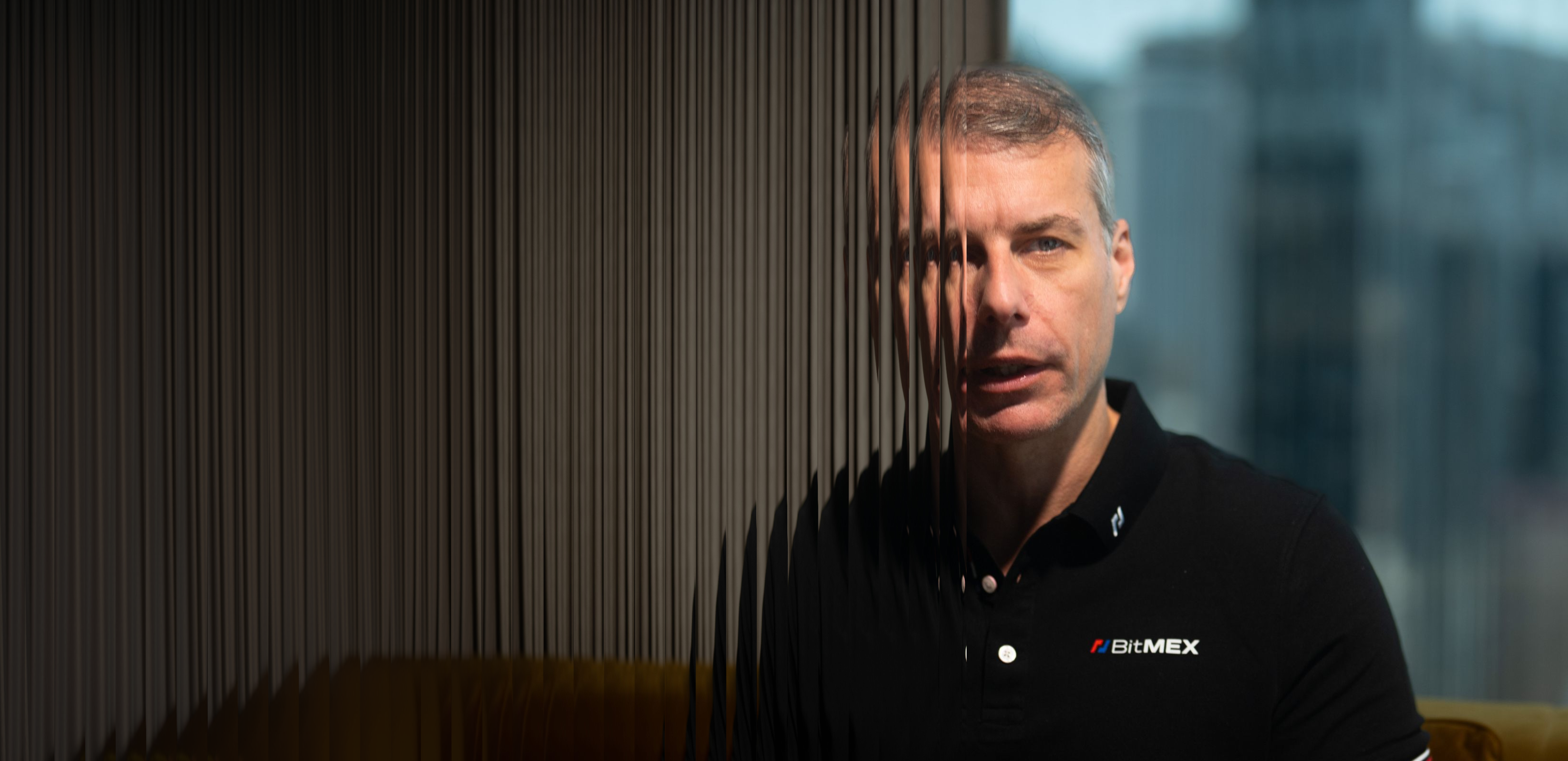
Interview — Stephan Lutz (BitMEX)
 12 min read
- Altcoins
- Technology
The materials on this website or any third-party websites accessed herein are not associated with and have not been reviewed or approved by: (i) Valkyrie Funds LLC dba CoinShares, its products, or the distributor of its products, or (ii) CoinShares Co., its products, or the marketing agent of its products.
"Pension funds adding crypto will drive the next crypto summer"
BitMEX is older than most of crypto's collective memory. Founded in 2014 by Arthur Hayes, Ben Delo and Samuel Reed, the exchange built something that the entire industry has since copied: the perpetual swap. A contract with no expiry, no settlement date, just an ever-rolling exposure to a spot price, anchored by a funding-rate mechanism that pays the side with fewer takers. By volume, it is the most-traded instrument in all of crypto. It is also, originally, a BitMEX product.
The founders became near-mythological figures, particularly Hayes, who used his Twitter feed and his long-form macro essays to translate central bank plumbing into a vocabulary that crypto traders could act on. Then came the regulatory chapter: in 2020, the US authorities brought charges around anti-money-laundering compliance, settlements followed, and the founders stepped back from day-to-day operations. That is the company Stephan Lutz inherited.
Trained inside PwC's European capital markets practice, with a decade at Deutsche Börse before that and another in banking before that, Lutz is, on paper, the institutional answer to the founder-led era. In person, he is something more interesting: a TradFi lifer who started reading about Bitcoin in 2015 while doing financial inclusion work for central banks in Southeast Asia, took the BitMEX call in three days, and sees no contradiction in trying to build a fully regulated venue while still funding Bitcoin core development through the firm's grants programme. We met him in Hong Kong, on the sidelines of Consensus, in the city where the perpetual swap was born.
The Node: Coming from traditional finance, what brought you to digital assets?
Stephan Lutz: That is the fun story, in a way, because it is not as if I switched into crypto only when I joined BitMEX. I started looking at all of this around 2015, well before I made the professional move. I was spending a lot of time in Southeast Asia, looking at financial stability questions for central banks, and at what we now call financial inclusion: how to bring more people into the banking system, and what the obstacles to that actually are around the globe.
Coming from Western Europe, you usually do not think about it. Everyone has a bank account, it is not an issue. Even in Hong Kong, Singapore, Japan, or South Korea. But almost everywhere else, it is. So I started looking at blockchain technology. I came at it more from the blockchain angle than the Bitcoin angle. Through blockchain, I learned about Bitcoin, which had already been running for a while by then, and I got involved.
When BitMEX called, I said yes within three days, to the surprise of pretty much everyone. I knew BitMEX, I knew the digital asset space, I knew the exchange business, I knew finance and compliance. I wanted to get my hands wrapped around this thing professionally anyway.
BitMEX's own story is fascinating. Can we say this is the platform that invented perpetual trading?
Yes. And I had no part in this; this was the founders' doing. I think the impact BitMEX had on crypto cannot be overstated, and I will tell you why.
It is known as the inventor of the perpetual swap, which is a financial innovation but frankly, the concept of perpetual swaps is quite old, it dates back to the 1980s, but it was never really implemented. What perpetual swaps do is allow you to take exposure to an asset, digital or not, with much higher capital efficiency. That is why they appealed to retail investors as well: they reduce the amount of capital you have to deploy.
But for me, that was not the whole thing. The whole thing was that this was combined with an actual pricing and funding mechanism that brought longs and shorts together. In an upward market, everyone wants to be long. In a downward market, like now, everyone wants to be short. You need a matching order book. So they came up with a funding mechanism, with pricing that ensures longs and shorts stay balanced, where you pay incentives to the opposing side. That has been copied by everyone.
The third innovation, which I would actually rank as the second most important, is the insurance fund mechanism. How do you enable trading with reduced (not eliminated) counterparty credit risk? In TradFi you have a clearing house. Because of the clearing house, you pay into the clearing fund, you provide capital for the lines of defence, you agree to mandatory contractual obligations in crisis scenarios. Only big institutions can become clearing members, and therefore only they can trade derivatives directly on the exchange. In crypto, this was solved differently: you have basically equal access for everyone without compromising on counterparty credit risk protection.
So: perpetual swap, insurance fund mechanism, and the third one, which is no longer an issue today, was providing a trusted wallet solution. Eleven or twelve years ago, fraud was a real thing. Are the coins still there? One of our slogans is "never lose the fucking coins", which simply means: make sure they are still there. If you trade on BitMEX, your assets are completely segregated. We do not use an omnibus account structure. House funds and customer funds are strictly segregated. There is essentially an audit running every couple of seconds, and if assets are missing or commingled, the trading engine would stop. We could close the exchange any minute and everyone would get their funds, because we do not rehypothecate, we do not use those assets for anything else, they do not flow out of the exchange. That reduces the passive yield you can extract, but it raises the security level by far. Those three things together were the actual innovation, and they have been copied, not always in full, but in many ways, by basically every crypto exchange out there.
BitMEX has always tried to stay technically ahead. You implemented batched transactions and SegWit early. How important is it to stay at the technical frontier?
It is an evolution. It is important, I do not want to diminish that. From our point of view, you have to be at the forefront of technical capabilities. Today the conversation is about throughput and latency. For institutional customers especially, rate limits matter: how many orders can you push through the system per second, per minute? We have effectively no rate limit. Of course there are operational limits, but where we are now, we do not impose hard caps, we provide guidance. If you push beyond that, you might see more latency, but we can work on it.
Twelve years ago, technical capability was a true differentiator. The industry was still evolving, and on Bitcoin specifically, you had to be good at the fundamental layer or you would not survive. Today, all the major exchanges can handle this well enough. If you come in and you cannot, you will be eaten alive. So the differentiating factors today are different. Back then, those innovations together with technical execution were 100% of your USP. Today they are an industry standard. The competition has shifted to the commercial side: market share, pricing, distribution.
The competition has expanded. How do you maintain market share?
That is the Holy Grail. That is whether you make it or not.
The fundamental layer remains the basis of everything we do, so we still look at technology day in and day out. The majority of our staff are engineers, because we do not want to lose that edge. Beyond that, today it is about structure. BitMEX is very OG, you could even say degen in a way: crypto-native, Bitcoin-native, with Bitcoin-maximalist roots. We want to keep part of that, because that is why BitMEX was founded. At the same time, we acknowledge that the industry has moved forward.
If you look ahead three or four years, TradFi institutions are entering the space, and they have a different mindset. Even if you are technically the best, they are looking at licences and regulatory approvals as a kind of rubber stamp, whether or not those things actually add value. They are there to stay, so we have to play along those lines.
Where we see ourselves differentiating, going forward more than today, is as the bridge between TradFi institutions and the DeFi world. TradFi trading is ring-fenced and permissioned, focused on external certificates: what is your licence, can you provide this audit, can you provide that. It is a paper exercise. Crypto-native counterparties look at the smart contract, at how the wallet works, technically. You need to be able to combine both. That is point one: adapt to the new world without compromising on what crypto has achieved.
Retail today is moving more towards decentralised exchanges: no KYC, great UI, cool risk-taking, frankly cool stuff. You can be dogmatic about which world you prefer, but I think, unideologically, the Holy Grail will be how you tap into the institutional side that is coming in and connect it to the original retail demand. That is where we want to be. We come from the individual trader's demand, this idea of taking out the intermediaries and giving direct access. If you want to trade on Eurex as an individual, you simply cannot. There are two or three intermediaries in between. We want to keep direct access, but connect it with the liquidity and firepower of the institutions coming in. So we are working on licences, on off-exchange custody, on integrating self-custodial wallets. And at the same time, we are working on a better experience for retail, because they do not want a Bloomberg terminal from the 1980s. They want something sleek, easy to use. The challenge is reducing complexity without losing the information you actually need to trade.
Let's talk about the elephant in the room. Hyperliquid was the success story of last year. Can you imagine a BitMEX version built on top of a Hyperliquid?
On one hand, we have to look at them as competitors. For an individual trader, it is a choice: BitMEX or Hyperliquid. To be frank, the benefits on Hyperliquid are a great UI, no KYC (so onboarding and offboarding are fast), and a strong incentive scheme. As long as they grow, it is a virtuous cycle. If they shrink, it becomes vicious. But great stuff. You had this before with other DEXes, with other decentralised platforms. I look at it with great respect for what the team has built.
Whether Hyperliquid is the one that stays, I do not know. Maybe they are. Maybe they are still here in ten or twenty years. But the concept of a DEX is here to stay; which DEX, that is to be determined. My only reservation, and not in a critical way, is that the model depends on ever-increasing incentives. We are a more stable business.
So yes, it is competition, because we have to give traders a reason to stay with BitMEX or come to BitMEX. At the same time, we are playing in a fundamentally different space. Yes, institutions are trying to access Hyperliquid, but it is a different game. If you want to combine the old TradFi world with the (no longer that new) crypto-native world, Hyperliquid cannot do it. They cannot move to a licensed business model without compromising everything they have built. They operate as a DEX precisely because they did not want to compromise on UI, UX, ease of use, frictionless onboarding, fully permissionless access, and incentives that are not allowed under most licensing regimes. That is exactly why our sweet spot is the bridge: BitMEX was built as a professional, institutional-grade platform that happens to be open to individuals. We are simply recognising that the centre of gravity is shifting from individuals towards institutions.
You list tokenised equities and commodities on BitMEX. How much will tokenisation change the industry?
A lot, and I hope even more so. What we see today is interesting because the industry is going for the assets that are easiest to tokenise. An equity is already tokenised, fractionalised, dematerialised. It is partial ownership of a company; the certificates of the 1990s and 2000s are gone. So an equity is a wrapper, and now crypto provides a wrapper of a wrapper. Easy. It is fungible, basically universally convertible already, and legally battle-tested if a dispute arises. That is why the industry is going for equities, bonds, deposits. Private credit might be next, plus some commodities. Because it is doable.
What changed compared to the last cycle is that crypto-natives now want to diversify and de-risk their portfolios. Once you have built wealth, you want to maintain it. Last cycle was: do not talk to me about equities, they are boring, I want the memecoin, the NFT, the ten-bagger, the 100x return. The people who actually built some wealth now say: a 5% return is fine. Which is funny when you think about it, but that is why it works. So we are integrating TradFi into digital-native technology.
The real Holy Grail is when we can tokenise buildings like this one [he refers to our hotel downtown Hong Kong], directly. The UAE is leading the way: they allow title transfers in a fully digital way, on chain, no notary, no document, no wrapper of a wrapper of a wrapper. That is point one. But there are still legal issues to be battle-tested: what happens in a default, in a dispute, how do you maintain your legal position, especially cross-border. None of that is fully resolved yet, and that will be the Holy Grail. We will probably talk about this in three or four years, because there is still work for regulators and lawmakers. The UAE is taking the lead; if they succeed, it will be copied. For now, the focus is on bringing TradFi assets on chain.
Trading regulation is constantly evolving, especially in the US. What kind of changes do you expect?
I expect that the US, as a general theme, will be more open for business. If you look at the requests, the legislation, the way regulators behave, it does not mean there is no regulation anymore. It means they are moving from "something is only allowed if it is explicitly allowed, anything else is forbidden" to "if it is not explicitly forbidden, you can try". That is point one.
Point two, and this is my personal interpretation, is that the US is on a mission to overhaul its TradFi infrastructure. If you look at many of the stablecoin projects, sorry to say, but it is not about stablecoins. It is about integrating blockchain technology as the underlying settlement mechanism for financial transactions, which is a much bigger story than a stablecoin. It looks like a stablecoin because you need something dollar-denominated, so you call it a stablecoin. But what they are actually doing is replacing back-end infrastructure. The US financial industry is in desperate need of this; they are decades behind even Europe. That is why you see the discussion in Europe play out so differently. Europe is not anti-crypto, but it is more cautious, because the problems in its traditional financial infrastructure are smaller than in the US.
Something that is overlooked when people talk about BitMEX is your research department, and your grants to Bitcoin developers. How important is staying close to the core of the ecosystem?
It is important. Frankly, it does not provide a real ROI. It is more about recognising where we come from, and keeping the channel open as a two-way street. The BitMEX founders were basically Bitcoin maximalists, and in a way, they still are. They acknowledge what is going on, which is why they allow and want to adapt. It is not a pivot, it is an adaptation. But it is close to their heart to provide a choice for people who want to be their own bank. That was a slogan in the early days, "be your own bank". It is not for everyone; my mother does not want to be her own bank. I might, because I come from the industry and I love it. Providing that choice is why we stay close to the Bitcoin community, why we keep those channels open, so we do not forget where we come from and we keep reminding ourselves why we are doing this.
BitMEX celebrated its tenth anniversary two years ago. How do you see the rest of this decade?
That is an interesting one, and honestly, we do not know. Not in the sense that we do not care. In TradFi, you have cycles of five to seven years and a typical budgeting cycle of three years. In crypto, you have twelve-month plans that you adapt after six.
What is here to stay? Number one, the RWA story we just discussed: more financial assets on chain. That will be a thing for the next eighteen months, and then the next cycle moves into real RWA. Number two, something everyone is talking about as if it has already happened: traditional asset managers actually allocating to digital assets. The ETFs are not really an allocation in that sense, they are a pure play, like a commodities ETF. If you really want bitcoin, buy it outright; do not go via an ETF. ETFs are for a different audience.
The moment pension funds and actively managed funds add crypto and digital assets to their portfolios, that will make a real difference. They are not there yet. They all talk about it, they are interested, they are on the sidelines. They are waiting for licensing, for internal clarity, they were waiting for what just happened in the US, and now they are waiting for Europe to align its stance, because crypto regulation in Europe is still siloed. You have MiCA for spot trading, and then you have the rest, and they do not interact. Once they do, it will unlock things, and I think we will see an explosion of trading volumes. I am cautious in my timing, but I am very convinced this is what will drive the next crypto, or rather Bitcoin, summer. Because these days it is really about Bitcoin and the top five L1s. That is it.