


Zcash NU7: Faster Private Payments
 3 min read
The materials on this website or any third-party websites accessed herein are not associated with and have not been reviewed or approved by: (i) Valkyrie Funds LLC dba CoinShares, its products, or the distributor of its products, or (ii) CoinShares Co., its products, or the marketing agent of its products.
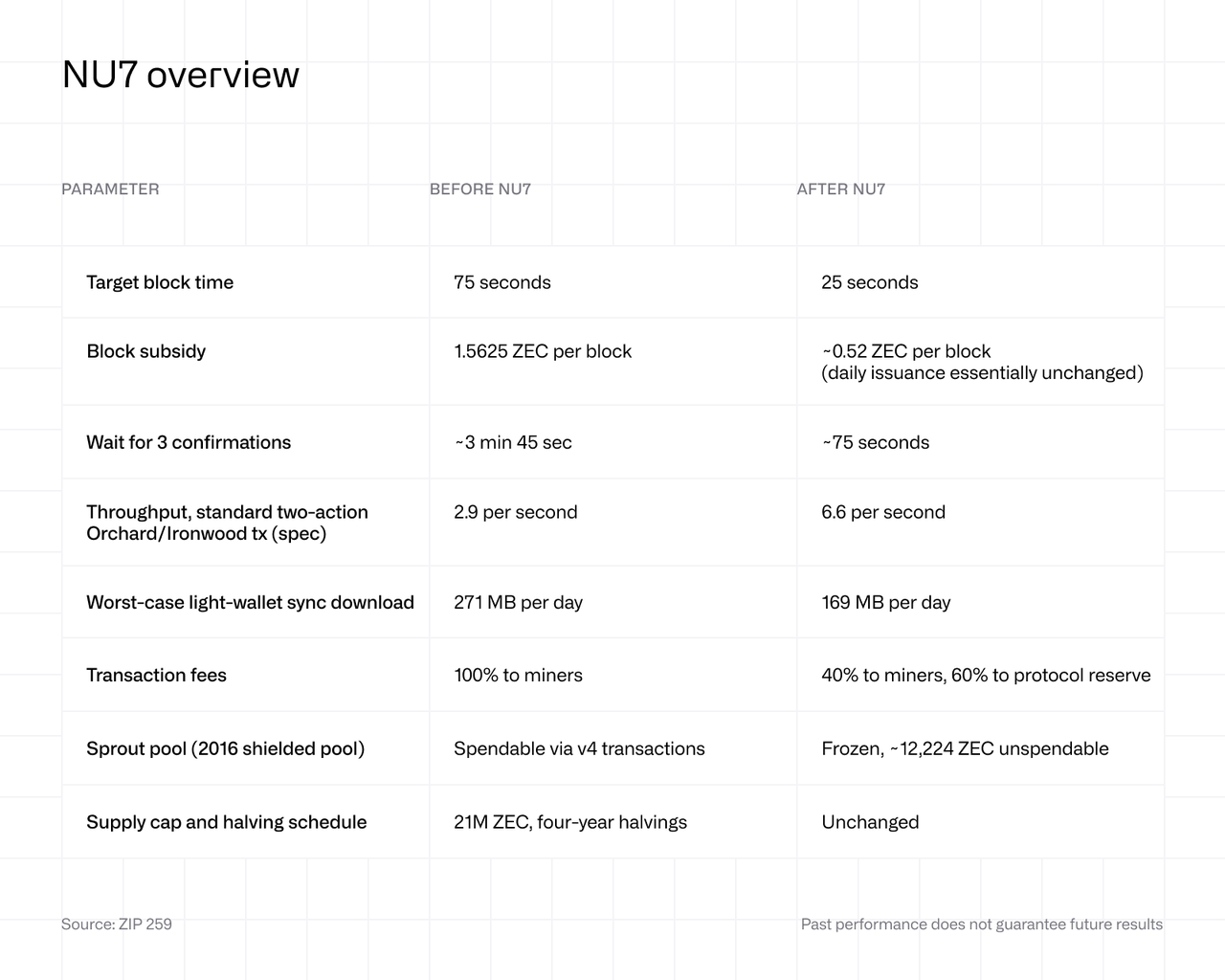
Zcash implemented its NU7 upgrade at block 3,543,405 at 02:34 UTC on the 6th of November. The main change within this upgrade is block time: cutting the expected wait time for a first confirmation from 75 to 25 seconds once difficulty settles at the target. An exchange that keeps a usual 3-confirmation requirement would see its expected on-chain wait fall from about 3:45 minutes to approximately 75 seconds.
This is an important step as Zcash addresses one of its main bottlenecks, which is not privacy, but friction. Shielded transactions hide sender, receiver and amount, as we have explored in detail, but they were slow to confirm and expensive for wallets to find. NU7 addresses both of these issues directly.
NU7 also limits shielded activity in each block, cutting the maximum amount of data light wallets need to download each day from 271 MB to 169 MB. But with blocks arriving 3 times as often, estimated capacity for standard private payments still more than doubles, from 2.9 to 6.6 transactions per second.
In the first 2 and a half hours after activation, blocks arrived every 39 seconds on average as mining difficulty adjusted to the faster pace. Separately, the Zakura team tested full 2 MB blocks across 80 nodes in 11 regions. Faster blocks meant more competition between miners producing blocks at similar times, with the share of blocks discarded by the network rising from 1.57% to 3.43%. This seems like a pretty reasonable tradeoff for faster payments.
 Source: ZIP 259
Retiring Sprout and funding future security
NU7 retires Sprout, Zcash’s original shielded pool, freezing roughly 12,224 ZEC, less than 0.1% of supply. Coinholders backed the change to remove it, as it had become a security risk. Sean Bowe has outlined a possible way to recover the funds in a future upgrade, but nothing has been approved.
The fee change redirects 60% of transaction fees into a reserve for future mining rewards. These funds leave circulation now and begin returning through block rewards around February 2031. The 21M supply cap and scheduled halvings remain exactly the same as before. Fee contributions are small today, but Bowe’s separate proposal to redirect the 8% of issuance allocated to Zcash Community Grants would add roughly 144 ZEC a day, providing substantially more funding for future network security. There is no timeline on implementation of this.
It will be important to see whether faster confirmations translate into greater use of Zcash for private payments.