


Bitcoin's drawdown in context
 3 min read
The materials on this website or any third-party websites accessed herein are not associated with and have not been reviewed or approved by: (i) Valkyrie Funds LLC dba CoinShares, its products, or the distributor of its products, or (ii) CoinShares Co., its products, or the marketing agent of its products.
Volatility has been a common and persistent concern of potential bitcoin investors since the early days when it was first discovering a market price. It is true that bitcoin has been more volatile than most monies, and this is likely the reason for its limited global use as a medium of exchange at present.
We find that bitcoin's volatility may best be explained visually, please see below ten instances when its price has fallen over 50%, in just 18 years of existence.
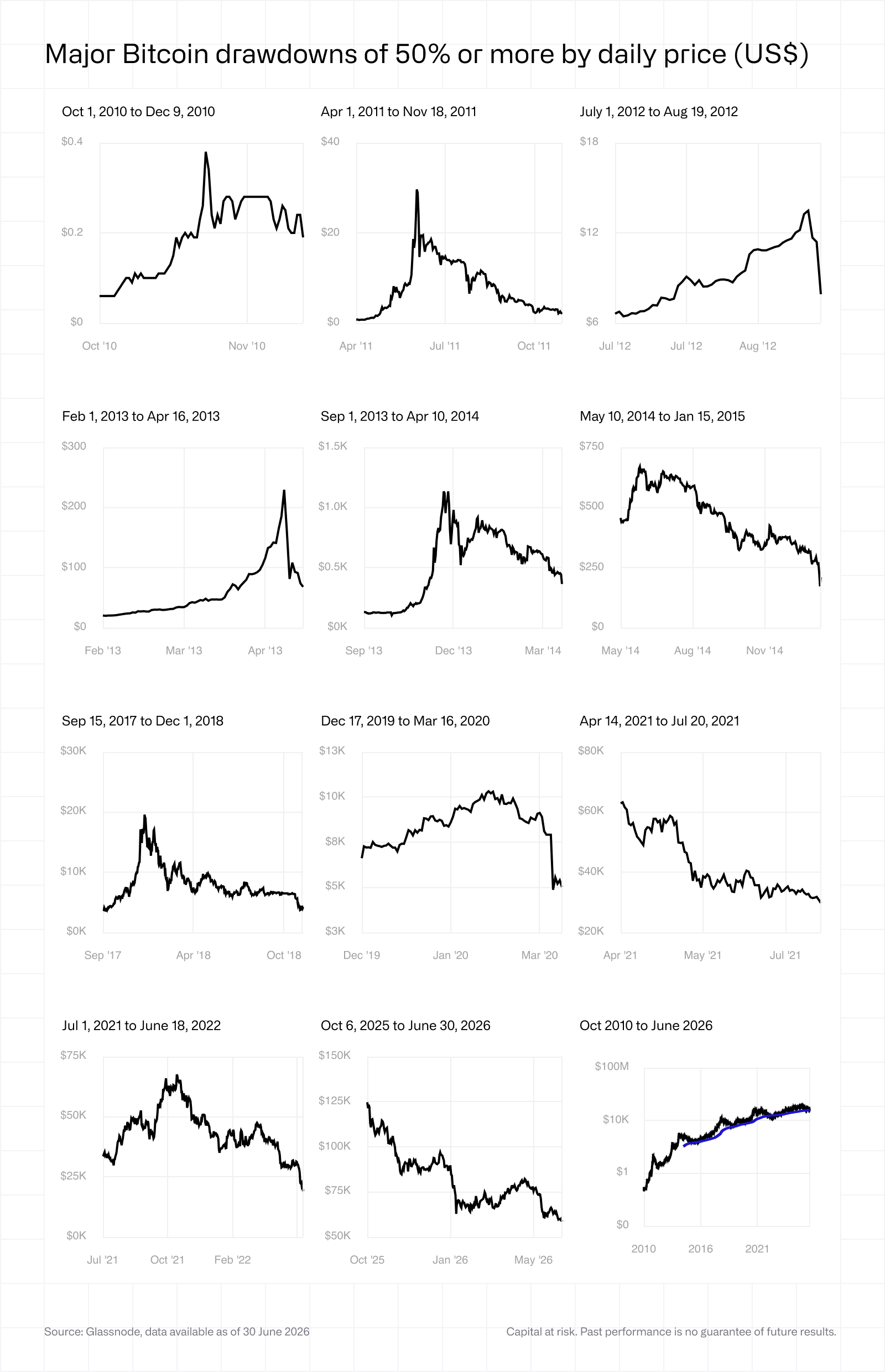 Based on past performance, long-term investors in Bitcoin have been able to achieve positive returns despite its sharp price fluctuations. To them, a downside volatility event is an opportunity to accumulate coins, and is to some extent now expected, or at least unsurprising.
Many are choosing to simply wait for bitcoin to move past its youthful phases of adoption, expecting that volatility will decrease as bitcoin markets become more liquid and less speculative over time. Others have found that volatility is not an issue at all, as changes in BTC exchange rates have historically had no effect on how Bitcoin functions, and it is very unlikely to do so in the future.
Not everyone is poised with the perspective of a long-term bitcoin owner, however. In a world of dollar-denominated debt, the exchange rate of BTC rightly matters to potential investors, as well as existing owners who either speculate on bitcoin's potential as a store of wealth or regularly spend it on goods and services.
For those investors, we think the historical record offers a soothing angle to view it. Each of the drawdowns illustrated above, outside of present day, resolved, in their entirety, by eventually discovering a new price high. In other words, no bear market or cycle downturn has proven permanent. For investors, the focus has historically been more on the timing of their exposure than on whether a recovery in share prices is taking place.
One observation that has attracted increasing attention among market practitioners is the behavior of bitcoin's price relative to its 200-week moving average. This long-run trend measure, which smooths across roughly four years of price history, has historically served as a near floor indicator during cyclical bear markets. On the handful of occasions that bitcoin's spot price has traded at or below this level, the subsequent forward returns have been, by any conventional measure, exceptional.
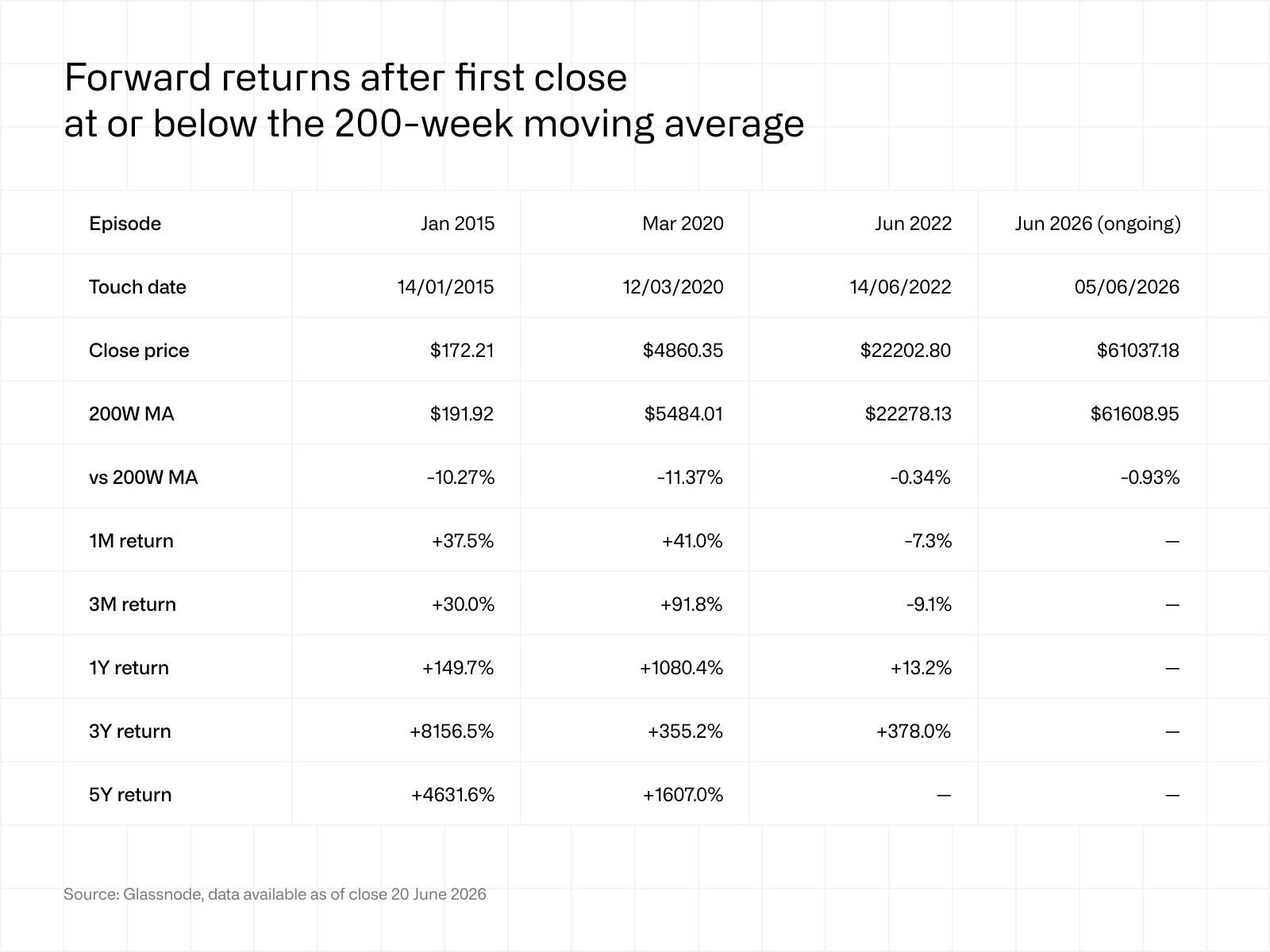
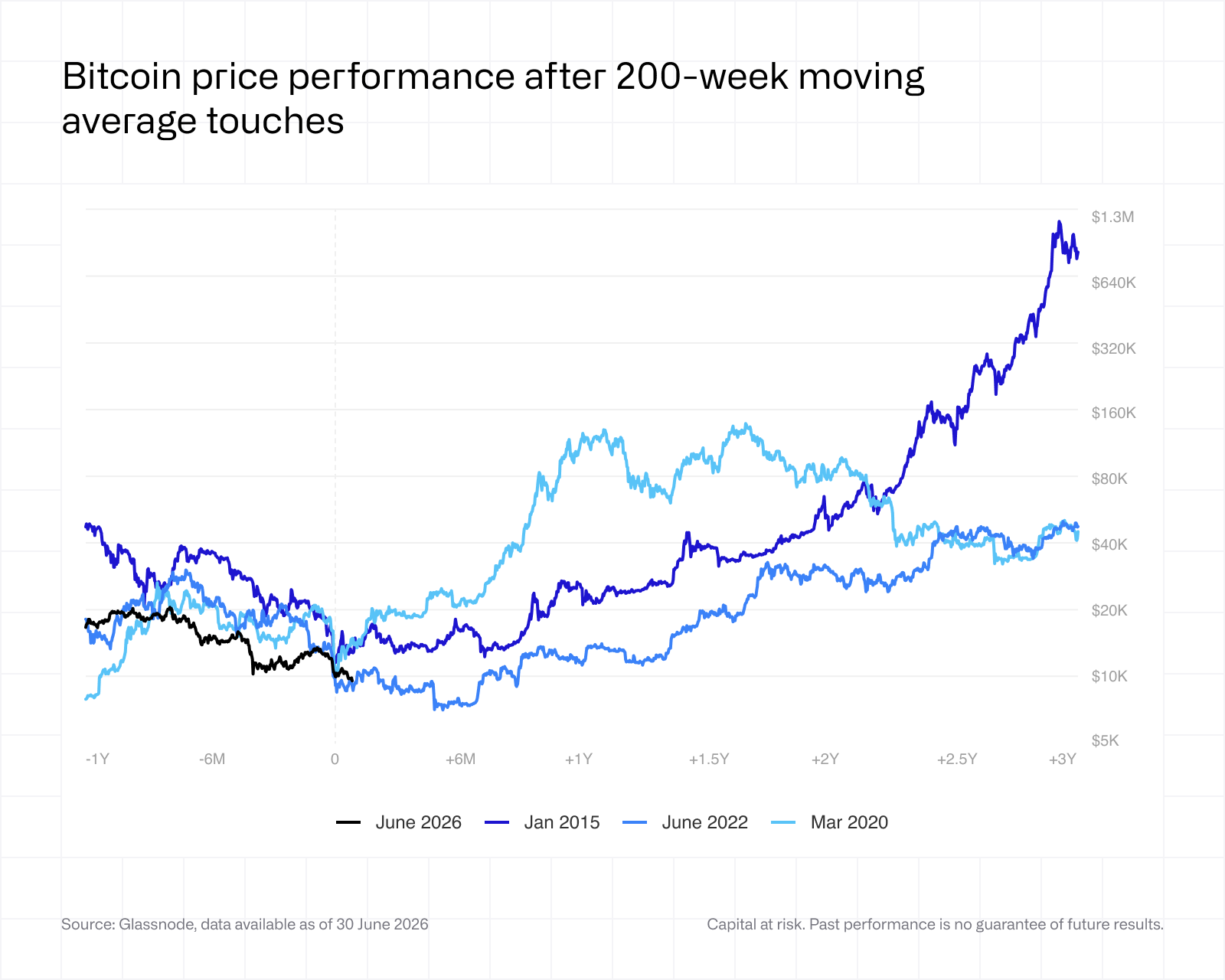
It bears noting that the sample is small. Five completed episodes across eleven years is not a large dataset to draw statistical conclusions, and each instance carried its own distinct macroeconomic and maturity phases, from the sparse market infrastructure of 2015, to the pandemic liquidity shock of March 2020, to the mass deleveraging of bitcoin lending in 2022. Each circumstance has nuance; the outcome, so far, directionally has not.
Whether the current episode — this sixth recorded instance, in which bitcoin's price touched the 200-week moving average in June 2026 following a drawdown of over 50% from its October 2025 high — follows the same pattern remains to be seen, of course. But history suggests that such moments have tended to represent extremes of pessimism rather than the beginning of any structural downturn; the long-time bitcoin owner would almost undoubtedly tell you the same (though, it may sound something like, “this happens every time, bitcoin is still not dead.”)
On every prior occasion, quantitatively, bitcoin has been worth more one year later than it was at the point of that first touch.
Volatility, then, may still be viewed as a feature of bitcoin’s current stage of maturation; to those who see it that way, it is also an opportunity. Assets in the process of global price discovery do not arrive at equilibrium cleanly. If they did, the risk would not fit the possible reward. Historical data shows that investors who held on to their bitcoin positions despite short-term downturns have, in many cases, seen their investment appreciate over the long term.
Published onJul 29th, 2026
