
This website uses cookies
We use cookies to personalise content and ads, to provide social media features and to analyse our traffic. We also share information about your use of our site with our social media, advertising and analytics partners who may combine it with other information that you’ve provided to them or that they’ve collected from your use of their services.
Consent Selection
Details
  • Necessary cookies help make a website usable by enabling basic functions like page navigation and access to secure areas of the website. The website cannot function properly without these cookies.

    • Learn more about this provideropens in a new window
      CookieConsentStores the user's cookie consent state for the current domain
      Maximum Storage Duration: 1 yearType: HTTP Cookie
    • Learn more about this provideropens in a new window
      bcookieUsed in order to detect spam and improve the website's security.
      Maximum Storage Duration: 1 yearType: HTTP Cookie
      li_gcStores the user's cookie consent state for the current domain
      Maximum Storage Duration: 180 daysType: HTTP Cookie
    • Learn more about this provideropens in a new window
      datadomeUsed in context with the website's BotManager. The BotManager detects, categorizes and compiles reports on potential bots trying to access the website.
      Maximum Storage Duration: 1 yearType: HTTP Cookie
    • _pk_testcookie_domainThis cookie determines whether the browser accepts cookies.
      Maximum Storage Duration: 1 dayType: HTTP Cookie
    • __cf_bm [x3]This cookie is used to distinguish between humans and bots. This is beneficial for the website, in order to make valid reports on the use of their website.
      Maximum Storage Duration: 1 dayType: HTTP Cookie
  • Preference cookies enable a website to remember information that changes the way the website behaves or looks, like your preferred language or the region that you are in.
    • Learn more about this provideropens in a new window
      lidcRegisters which server-cluster is serving the visitor. This is used in context with load balancing, in order to optimize user experience.
      Maximum Storage Duration: 1 dayType: HTTP Cookie
  • Statistic cookies help website owners to understand how visitors interact with websites by collecting and reporting information anonymously.
    • Learn more about this provideropens in a new window
      guestRegisters data on visitors' website-behaviour. This is used for internal analysis and website optimization.
      Maximum Storage Duration: 1 monthType: HTTP Cookie
    • Learn more about this provideropens in a new window
      personalization_idThis cookie is set by Twitter - The cookie allows the visitor to share content from the website onto their Twitter profile.
      Maximum Storage Duration: 400 daysType: HTTP Cookie
    • _pk_uidUsed by Piwik Analytics Platform to identify the visitor on repeat visits to the website.
      Maximum Storage Duration: 1 yearType: HTTP Cookie
      _pk_id#Collects statistics on the user's visits to the website, such as the number of visits, average time spent on the website and what pages have been read.
      Maximum Storage Duration: 1 yearType: HTTP Cookie
      _pk_ses#Used by Piwik Analytics Platform to track page requests from the visitor during the session.
      Maximum Storage Duration: 1 dayType: HTTP Cookie
    • FPGSIDRegisters statistical data on users' behaviour on the website. Used for internal analytics by the website operator.
      Maximum Storage Duration: 1 dayType: HTTP Cookie
      FPIDRegisters statistical data on users' behaviour on the website. Used for internal analytics by the website operator.
      Maximum Storage Duration: 400 daysType: HTTP Cookie
      FPLCRegisters a unique ID that is used to generate statistical data on how the visitor uses the website.
      Maximum Storage Duration: 1 dayType: HTTP Cookie
    • _gaRegisters a unique ID that is used to generate statistical data on how the visitor uses the website.
      Maximum Storage Duration: 2 yearsType: HTTP Cookie
      _ga_#Used by Google Analytics to collect data on the number of times a user has visited the website as well as dates for the first and most recent visit.
      Maximum Storage Duration: 2 yearsType: HTTP Cookie
  • Marketing cookies are used to track visitors across websites. The intention is to display ads that are relevant and engaging for the individual user and thereby more valuable for publishers and third party advertisers.
    • Learn more about this provideropens in a new window

      Some of the data collected by this provider is for the purposes of personalization and measuring advertising effectiveness. The provider may use the IP Addresses for ads measurement and ads personalization.

      ads/ga-audiencesUsed by Google AdWords to re-engage visitors that are likely to convert to customers based on the visitor's online behaviour across websites.
      Maximum Storage Duration: SessionType: Pixel Tracker
    • Learn more about this provideropens in a new window
      userRefererDetermines how the user accessed the website. This information is used by the website operator in order to measure the efficiency of their marketing.
      Maximum Storage Duration: 1 monthType: HTTP Cookie
    • Learn more about this provideropens in a new window
      #:session-dataTracks the individual sessions on the website, allowing the website to compile statistical data from multiple visits. This data can also be used to create leads for marketing purposes.
      Maximum Storage Duration: PersistentType: HTML Local Storage
      eng_mtTracks the conversion rate between the user and the advertisement banners on the website - This serves to optimise the relevance of the advertisements on the website.
      Maximum Storage Duration: PersistentType: HTML Local Storage
      t_gidThis cookie assigns a specific visitor ID, when the visitor interacts with ads or content from the website - this allows the website to target the visitor with similar ads or content.
      Maximum Storage Duration: 1 yearType: HTTP Cookie
      t_pt_gidCollects information on user preferences and/or interaction with web-campaign content - This is used on CRM-campaign-platform used by website owners for promoting events or products.
      Maximum Storage Duration: 1 yearType: HTTP Cookie
      taboola global:user-idSets a unique ID for the visitor, that allows third party advertisers to target the visitor with relevant advertisement. This pairing service is provided by third party advertisement hubs, which facilitates real-time bidding for advertisers.
      Maximum Storage Duration: PersistentType: HTML Local Storage
      taboola_session_idThis cookie is used to collect information on a visitor. This information will become an ID string with information on a specific visitor – ID information strings can be used to target groups with similar preferences, or can be used by third-party domains or ad-exchanges.
      Maximum Storage Duration: SessionType: HTTP Cookie
    • Learn more about this provideropens in a new window
      1/i/adsct [x2]Collects data on user behaviour and interaction in order to optimize the website and make advertisement on the website more relevant.
      Maximum Storage Duration: SessionType: Pixel Tracker
      muc_adsCollects data on user behaviour and interaction in order to optimize the website and make advertisement on the website more relevant.
      Maximum Storage Duration: 400 daysType: HTTP Cookie
      guest_idCollects data related to the user's visits to the website, such as the number of visits, average time spent on the website and which pages have been loaded, with the purpose of personalising and improving the Twitter service.
      Maximum Storage Duration: 400 daysType: HTTP Cookie
      guest_id_adsCollects information on user behaviour on multiple websites. This information is used in order to optimize the relevance of advertisement on the website.
      Maximum Storage Duration: 400 daysType: HTTP Cookie
      guest_id_marketingCollects information on user behaviour on multiple websites. This information is used in order to optimize the relevance of advertisement on the website.
      Maximum Storage Duration: 400 daysType: HTTP Cookie
    • _gcl_auUsed by Google AdSense for experimenting with advertisement efficiency across websites using their services.
      Maximum Storage Duration: 3 monthsType: HTTP Cookie
      _gcl_lsTracks the conversion rate between the user and the advertisement banners on the website - This serves to optimise the relevance of the advertisements on the website.
      Maximum Storage Duration: PersistentType: HTML Local Storage
    • pardot [x2]Used in context with Account-Based-Marketing (ABM). The cookie registers data such as IP-addresses, time spent on the website and page requests for the visit. This is used for retargeting of multiple users rooting from the same IP-addresses. ABM usually facilitates B2B marketing purposes.
      Maximum Storage Duration: SessionType: HTTP Cookie
  • Unclassified cookies are cookies that we are in the process of classifying, together with the providers of individual cookies.
    • cs_analytics_ip_blockedPending
      Maximum Storage Duration: SessionType: HTTP Cookie
      user_tokenPending
      Maximum Storage Duration: 1 yearType: HTTP Cookie
    • _twpidPending
      Maximum Storage Duration: SessionType: HTTP Cookie
Cookie declaration last updated on 8/20/26 by Cookiebot
[#IABV2_TITLE#]
[#IABV2_BODY_INTRO#]
[#IABV2_BODY_LEGITIMATE_INTEREST_INTRO#]
[#IABV2_BODY_PREFERENCE_INTRO#]
[#IABV2_BODY_PURPOSES_INTRO#]
[#IABV2_BODY_PURPOSES#]
[#IABV2_BODY_FEATURES_INTRO#]
[#IABV2_BODY_FEATURES#]
[#IABV2_BODY_PARTNERS_INTRO#]
[#IABV2_BODY_PARTNERS#]
About
Cookies are small text files that can be used by websites to make a user's experience more efficient.

The law states that we can store cookies on your device if they are strictly necessary for the operation of this site. For all other types of cookies we need your permission.

This site uses different types of cookies. Some cookies are placed by third party services that appear on our pages.

You can at any time change or withdraw your consent from the Cookie Declaration on our website.

Learn more about who we are, how you can contact us and how we process personal data in our Privacy Policy.

Please state your consent ID and date when you contact us regarding your consent.
Image What is Chainlink - LINK guide

What is Chainlink - LINK guide

Timer12 min read

  • Altcoins

The materials on this website or any third-party websites accessed herein are not associated with and have not been reviewed or approved by: (i) Valkyrie Funds LLC dba CoinShares, its products, or the distributor of its products, or (ii) CoinShares Co., its products, or the marketing agent of its products.

Blockchains cannot see outside themselves. A smart contract can enforce a rule perfectly, but it has no way of knowing the price of gold, whether a shipment arrived, or what a bank's ledger says. Chainlink is the infrastructure that tells them.

Almost every use of a blockchain in finance depends on outside information being delivered reliably. Chainlink now sits between traditional financial institutions and the chains they are experimenting with, and it is being paid more each year for doing so.

In short

  • Chainlink is an oracle network: it delivers external data and computation to smart contracts, and moves messages between chains.

  • Protocol fees were $23,26M across 2025 and $30,04M in the first half of 2026 alone, with roughly 99% retained as revenue.3

  • Its customers now include Swift, DTCC, Euroclear, J.P. Morgan's Kinexys, UBS and Mastercard.4,5

  • LINK traded at $7,18 on 30 June 2026, a market capitalisation of $5,37 billion.

The problem an oracle solves

Imagine a smart contract that pays out an insurance claim if a flight is delayed. The contract can hold the money and execute the rule without anyone's permission. What it cannot do is find out whether the flight was late.

Someone has to tell it. If that someone is a single source, the whole arrangement depends on that source being honest and available, which removes the point of using a blockchain in the first place. An oracle network solves this by having many independent operators fetch the same information, compare answers, and deliver an aggregated result that no single participant can falsify.

Chainlink runs Decentralised Oracle Networks, groups of independent node operators that collect data, reach agreement on it, and write the result on-chain. Operators are paid in LINK, and their reputation is tied to the accuracy of what they report, so supplying bad data costs them future work.

The network is deliberately chain-agnostic. It serves Ethereum, Solana, Avalanche and dozens of others, and it works with private and permissioned chains too. That neutrality is central to its position: Chainlink does not need any particular chain to win.

What it actually sells

The product range has widened well beyond price feeds.

  • Data Feeds and Data Streams deliver market prices and other reference data on-chain.

  • CCIP, the Cross-Chain Interoperability Protocol, moves tokens and messages between chains.

  • Proof of Reserve verifies that a tokenised asset is backed by what its issuer claims.

  • The Automated Compliance Engine (ACE) enforces rules such as eligibility checks and transfer restrictions, alongside Cross-Chain Identity and policy tooling.4

  • The Chainlink Runtime Environment (CRE) lets institutions assemble these pieces into workflows, for example taking a custodian's deposit notification, verifying reserves, applying a compliance policy and minting a token, without building the plumbing themselves.5

  • Verifiable Random Function (VRF) produces provably fair randomness, used in gaming and collectibles.

The direction of travel is clear from that list: Chainlink started by selling data and now sells the machinery for issuing and administering regulated financial products on-chain.

Who uses it

This is where Chainlink differs from most crypto infrastructure, because a good deal of the demand comes from institutions rather than from crypto-native applications.

Chainlink has worked with Swift, the messaging network banks use for cross-border instructions, on connecting existing bank systems to tokenised assets.4 It has worked with DTCC, Euroclear and more than twenty other financial market infrastructures on a shared approach to processing corporate actions, the notices about dividends, splits and similar events that currently arrive at institutions in inconsistent formats.4 DTCC is integrating the Runtime Environment into its collateral platform to support round-the-clock collateral movement.5

Other named users include J.P. Morgan's Kinexys, UBS, ANZ, Mastercard, Fidelity, Deutsche Börse's Crypto Finance, SBI Group, WisdomTree and GLEIF.4,5

Two caveats are worth stating plainly. Much of this work is at pilot or early production stage, and a pilot is not revenue. And these institutions are buying Chainlink's services, which does not require them to buy LINK.

Paying node operators

LINK is the unit in which oracle services are paid for. When an application requests data, the fee reaches the node operators that supplied it. This is the token's original and still principal function.

Staking and security

Since December 2022, LINK holders and node operators have been able to stake tokens, putting capital at risk against the accuracy of the service. The intent is to make dishonest reporting expensive rather than merely reputationally costly.

Supply

LINK has a fixed total supply of one billion tokens, with no ongoing issuance. Circulating supply was 748,099,970 on 30 June 2026, so roughly a quarter of the total remains outside circulation, held largely by Chainlink Labs and the ecosystem programmes.3 Those holdings are a real consideration: the gap between circulating and total supply is a form of supply overhang.

Market performance

LINK traded at $7,18 on 30 June 2026, giving a circulating market capitalisation of $5,37 billion.3 Past performance is not a guide to future returns.
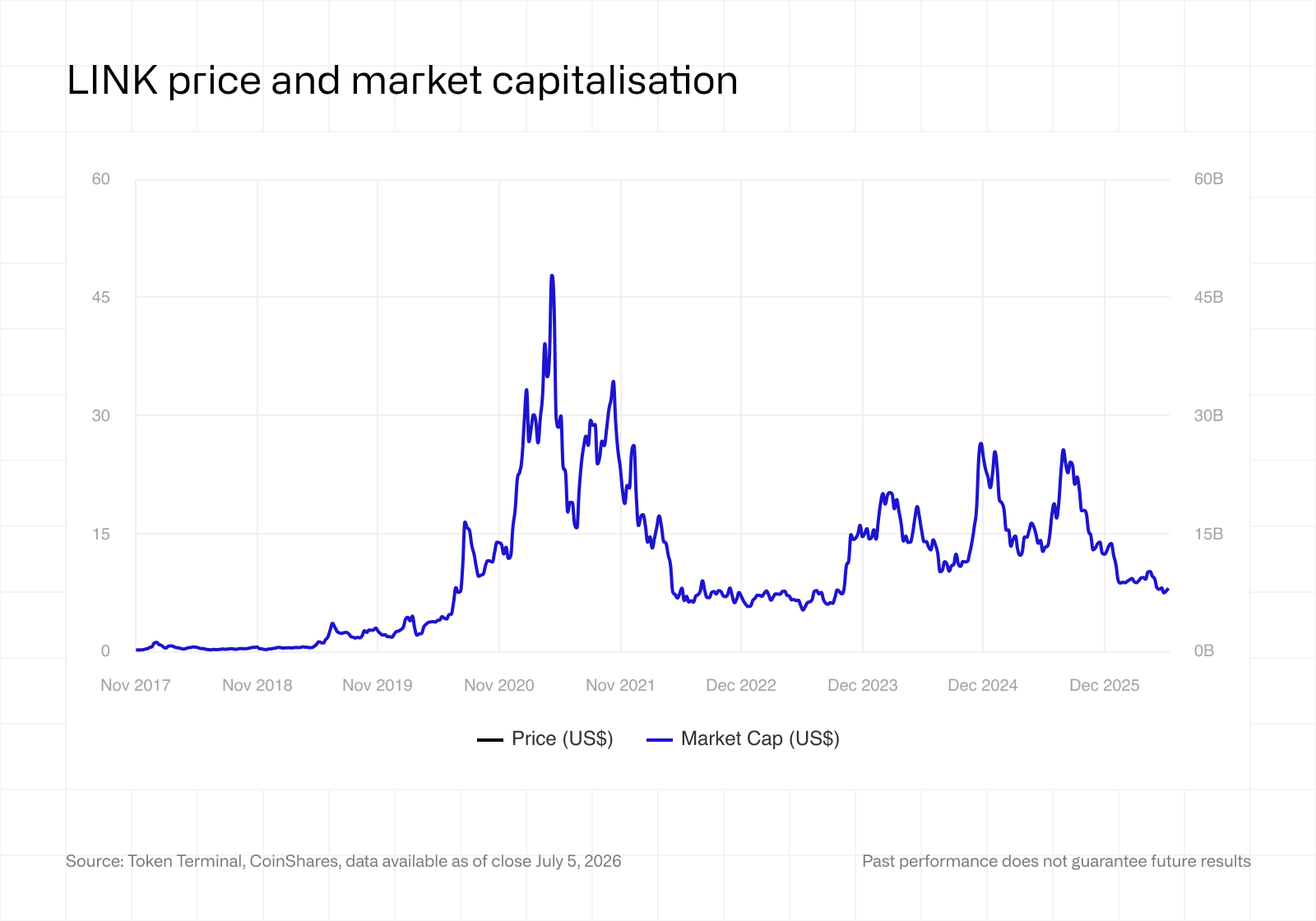
LINK price and market capitalisation

The protocol's numbers

Chainlink is unusual in this category because it earns real and growing revenue, with over $23,26M of fees generated in 2025, and already $30,04M in the first semester of 2026, 99% of which is retained by Chainlink. 

Indeed, fee income in six months exceeded the whole of the preceding year, which almost nothing else in crypto managed over that period. And Chainlink retains about 99% of what it charges, because it is a service business rather than a chain paying out block rewards.

Set against the market: annualising the first half gives roughly $59 million of revenue against a $5,37 billion market capitalisation, a multiple of about ninety times.3 That is demanding by the standards of a software business and cheap by the standards of most crypto assets, which have no revenue at all. Which comparison is the right one is the substance of the investment question.

Strengths and limitations

Strengths

Chainlink has a genuine and growing revenue line, which very few crypto protocols do, and it keeps almost all of it.

It is chain-agnostic, so it benefits from tokenisation growing anywhere rather than needing a particular chain to succeed.

Its institutional customer list is the strongest in crypto infrastructure, and the Swift and DTCC work addresses processes that genuinely cost the industry money today.

Supply is capped with no ongoing issuance, and the product range has widened from data feeds into compliance and workflow tooling, which are harder for a customer to replace.

Limitations

Institutions buy Chainlink's services without needing to hold LINK, so the link between commercial success and token demand is indirect. This is the central question for anyone holding the token rather than admiring the business.

Roughly a quarter of total supply sits outside circulation and represents a potential overhang.

Much of the institutional work is at pilot stage, and pilots convert into revenue slowly or not at all.

Competition is real, from Pyth and RedStone among others, and from the possibility that large institutions build equivalent capability in-house rather than buying it.

And oracle failure is a systemic risk: a wrong price delivered to a lending protocol can trigger liquidations, so Chainlink's reliability is load-bearing for a great deal of on-chain finance.

Conclusion

Chainlink is the clearest example in crypto of a protocol whose business and whose token have come apart. The business grew its fee income by more in six months than it earned in the previous year, and sells to Swift, DTCC and a list of large banks. The token lost roughly two thirds of its value across the same eighteen months.

Whether that gap closes depends on something specific and checkable: how much of Chainlink's revenue reaches LINK holders, and by what mechanism. An investor's view on Chainlink the business and their view on LINK the token should be formed separately, because the connection between them is a design choice rather than an identity.

Frequently asked questions

What is an oracle in crypto?

A service that delivers information from outside a blockchain to a smart contract running on it. Blockchains cannot access external data on their own, so anything that depends on a real-world fact, a price, a delivery, a bank balance, needs an oracle. Chainlink is the largest of them.

Paying for oracle services, which compensates the node operators that supply the data, and staking, where holders and operators put capital at risk against the accuracy of the service.

Yes, and it is growing. The protocol collected $23,26 million in fees across 2025 and $30,04 million in the first half of 2026, retaining roughly 99% as revenue.3 That makes it one of a small number of crypto protocols with a real revenue line.

No. Chainlink is a network of oracle nodes that serves blockchains. It works across Ethereum, Solana, Avalanche and many others, including private chains, and does not compete with them.

Who are Chainlink's competitors?

Other oracle networks, principally Pyth and RedStone. The longer-term competitive question is whether large financial institutions build equivalent capability internally instead of buying it.


Sources

1 Chainlink documentation, oracle network architecture

2 Chainlink, staking programme, live since December 2022

3 Token Terminal, LINK market, fee, revenue and supply data, figures at 30 June 2026

4 Chainlink, work with Swift, Euroclear, DTCC and banking and capital markets institutions

5 Chainlink Runtime Environment, and DTCC's integration of it into its collateral platform

Published onJul 26th, 2023

Welcome to CoinShares

Personal Data

0102

When you visit CoinShares website, cookies enhance your experience. They help us to show you more relevant content. Some cookies are necessary for the site to work and will always be active. Blocking some types of cookies may impact your experience of the website and the services which we offer on our website.

We use cookies on our site to optimize our services. Learn more about our EU cookie policy or US cookie policy.

  • Necessary
    Question circle icon
  • Preferences
    Question circle icon
  • Statistical
    Question circle icon
  • Marketing
    Question circle icon
Necessary cookies help make a website usable by enabling basic functions like page navigation and access to secure areas of the website. The website cannot function properly without these cookies.
Preference cookies enable a website to remember information that changes the way the website behaves or looks, like your preferred language or the region that you are in.
Statistic cookies help website owners to understand how visitors interact with websites by collecting and reporting information anonymously.
Marketing cookies are used to track visitors across websites. The intention is to display ads that are relevant and engaging for the individual user and thereby more valuable for publishers and third party advertisers.