



Bitcoin is volatile. Yes. But it’s worth it.
 5 min read
- Finance
- Altcoins
The materials on this website or any third-party websites accessed herein are not associated with and have not been reviewed or approved by: (i) Valkyrie Funds LLC dba CoinShares, its products, or the distributor of its products, or (ii) CoinShares Co., its products, or the marketing agent of its products.
Bitcoin is volatile. Critics treat this as a flaw, a sign of immaturity or speculation, something to be engineered away before the asset can be taken seriously. But volatility is not inherently a problem. Gold, one of the most trusted stores of value in financial history, has itself seen sharp price swings this year. Volatility is a feature of any asset whose value is being actively discovered or reassessed. The question worth asking is not whether bitcoin is volatile, but what that volatility means, and what investors can do with it.
What is bitcoin volatility?
Volatility measures how much an asset’s price fluctuates over a given period. For traditional assets, that tends to be modest: a government bond might move a fraction of a percent on most days, and even a large-cap equity might shift a few percentage points in a week. Bitcoin operates on a different scale entirely.
Historically, bitcoin's annualised volatility has been a multiple of what most traditional asset classes experience. Prior to the launch of US spot bitcoin ETFs, annualised realised volatility typically exceeded 150%. That figure has compressed steadily since, with a decline from a peak daily volatility of 7.58% in 2013 to a record low of 2.24% in 2025 as institutional participation deepened.1 Bitcoin remains structurally more volatile than most asset classes an advisor would typically include in a portfolio, but the direction of travel is clear.
This is not a defect. Volatility reflects uncertainty about value, and in an asset that is still establishing its role in the global financial system, a degree of price dispersion is expected. The more important question is how that volatility behaves in context.
What drives bitcoin volatility?
Several forces converge to produce bitcoin’s price swings.
Macro liquidity conditions set the broader backdrop. Bitcoin tends to be sensitive to shifts in risk appetite, moving with markets during periods of tightening and outperforming during periods of monetary expansion. This sensitivity has grown as institutional holders have increased their allocations, linking bitcoin more directly to the same macro signals that drive equities and credit.
Regulatory developments remain a persistent source of event-driven volatility. A jurisdiction announcing new restrictions, a central bank commenting on digital assets, or a major approval from a securities regulator can each move the market materially in a short window. The announcement of spot bitcoin ETPs in the US in early 2024 is a clear example: the market repriced significantly in the weeks around the approval as sentiment shifted.
Leverage within crypto markets amplifies both directions. Derivatives platforms allow participants to take highly leveraged positions, which means that sharp moves in either direction can trigger cascading liquidations, exacerbating price swings beyond what fundamentals alone would suggest.
Finally, evolving institutional participation is reshaping volatility dynamics. As more long-term, less leveraged holders enter the market, the composition of the holder base changes. Long-term holders who buy and hold through drawdowns reduce the pool of sellers in a downturn. This structural shift may, over time, compress bitcoin’s volatility range, though that transition is gradual and non-linear.
Why bitcoin volatility matters to investors
Volatility is often framed as risk. But for an active investor, volatility is also opportunity. Wide price swings create entry and exit points that don’t exist in more stable markets. For traders, volatility is the essential input: without it, there is no meaningful return differential between entry and exit.
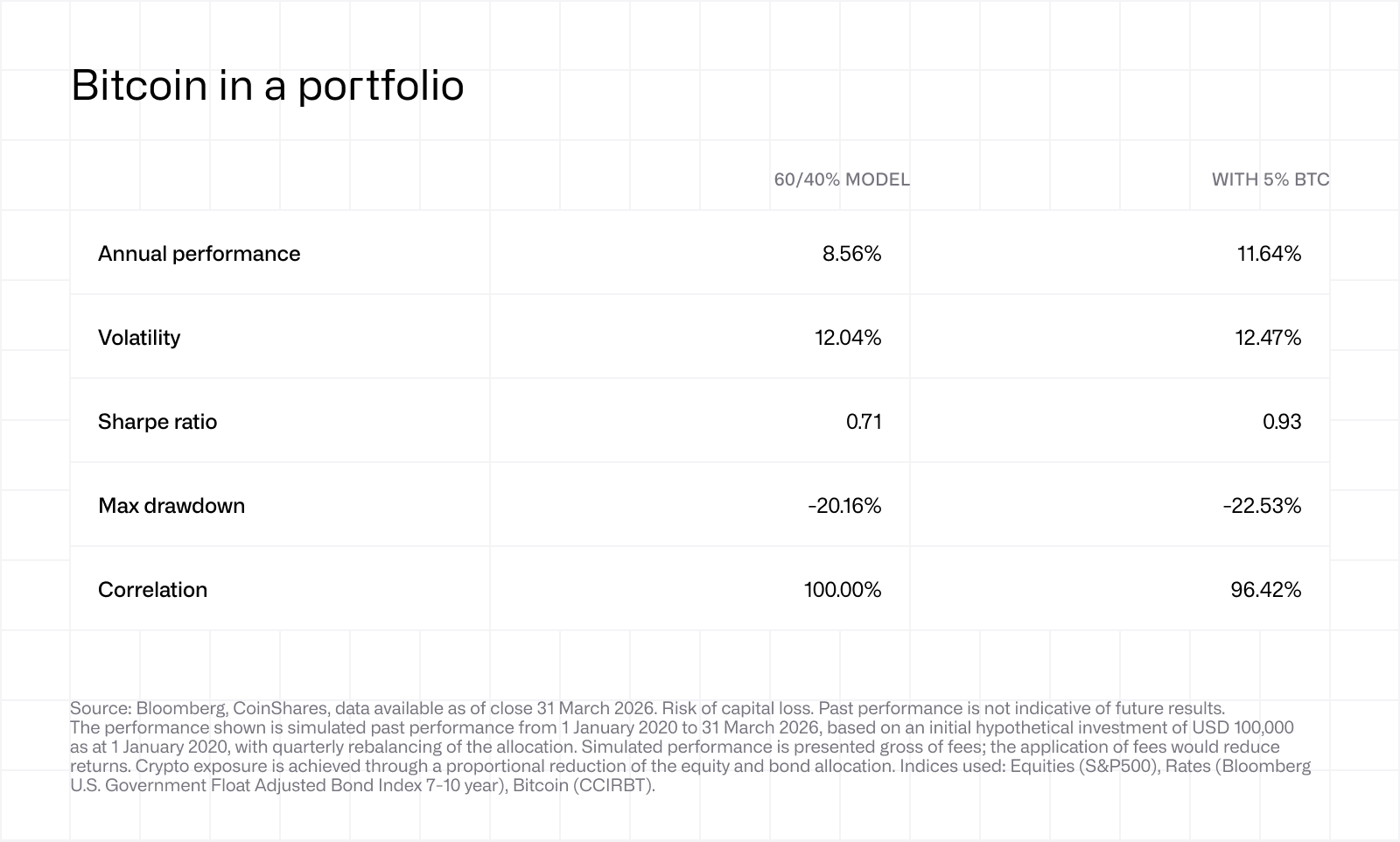
For longer-term holders, bitcoin’s volatility creates a different kind of challenge: the psychological and practical difficulty of maintaining conviction through significant drawdowns. A portfolio that fell 24% during its worst observed period (as in the CoinShares baseline allocation model) tests investor discipline in a way that a bond allocation does not. The question is whether the risk-adjusted return profile justifies that discomfort. CoinShares’ own modelling suggests it does. See below.
Why volatility matters in portfolio construction
From a portfolio construction standpoint, volatility is the raw material of risk management. It feeds directly into position sizing, drawdown expectations, and correlation calculations.
Bitcoin’s correlation to equities has varied considerably over time. During the 2022 macro tightening cycle, it moved closely with risk assets. In other periods, it has shown low or negative correlation to traditional portfolios, which creates diversification value. This inconsistency matters: advisors should not assume that past correlation patterns will hold, particularly during periods of market stress.
What the CoinShares model demonstrates is that the diversification benefit, even imperfectly, is material. The annualised performance improvement from adding bitcoin to a 60/40 baseline is not explained by correlation alone but by the asymmetric return profile that bitcoin’s volatility creates when sized appropriately. A 5% allocation captures meaningful upside while limiting the overall portfolio’s exposure to bitcoin-specific drawdowns.
How bitcoin volatility is measured
Like equity markets, bitcoin now has an implied volatility measure. The CME CF Bitcoin Volatility Index (BVX) uses options pricing data from CME bitcoin options markets to construct a forward-looking estimate of expected 30-day volatility. It is calculated continuously from live orderbook data and provides a standardized way to gauge how much volatility the market expects in the near term.
BVX readings tend to spike during periods of uncertainty and compress during calm markets, mirroring the behaviour of equity volatility indexes. This makes it a useful gauge not just of bitcoin’s own expected volatility but of broader sentiment in the digital asset market.
1 “Is bitcoin’s four-year cycle broken?”, Caleb and Brown, 10 March 2026
Published onJun 23rd, 2026