This website uses cookies
We use cookies to personalise content and ads, to provide social media features and to analyse our traffic. We also share information about your use of our site with our social media, advertising and analytics partners who may combine it with other information that you’ve provided to them or that they’ve collected from your use of their services.
Consent Selection
Details
  • Necessary cookies help make a website usable by enabling basic functions like page navigation and access to secure areas of the website. The website cannot function properly without these cookies.

    • Learn more about this provideropens in a new window
      CookieConsentStores the user's cookie consent state for the current domain
      Maximum Storage Duration: 1 yearType: HTTP Cookie
    • Learn more about this provideropens in a new window
      bcookieUsed in order to detect spam and improve the website's security.
      Maximum Storage Duration: 1 yearType: HTTP Cookie
      li_gcStores the user's cookie consent state for the current domain
      Maximum Storage Duration: 180 daysType: HTTP Cookie
    • Learn more about this provideropens in a new window
      datadomeUsed in context with the website's BotManager. The BotManager detects, categorizes and compiles reports on potential bots trying to access the website.
      Maximum Storage Duration: 1 yearType: HTTP Cookie
    • _pk_testcookie_domainThis cookie determines whether the browser accepts cookies.
      Maximum Storage Duration: 1 dayType: HTTP Cookie
    • __cf_bm [x3]This cookie is used to distinguish between humans and bots. This is beneficial for the website, in order to make valid reports on the use of their website.
      Maximum Storage Duration: 1 dayType: HTTP Cookie
  • Preference cookies enable a website to remember information that changes the way the website behaves or looks, like your preferred language or the region that you are in.
    • Learn more about this provideropens in a new window
      lidcRegisters which server-cluster is serving the visitor. This is used in context with load balancing, in order to optimize user experience.
      Maximum Storage Duration: 1 dayType: HTTP Cookie
  • Statistic cookies help website owners to understand how visitors interact with websites by collecting and reporting information anonymously.
    • Learn more about this provideropens in a new window
      guestRegisters data on visitors' website-behaviour. This is used for internal analysis and website optimization.
      Maximum Storage Duration: 1 monthType: HTTP Cookie
    • Learn more about this provideropens in a new window
      personalization_idThis cookie is set by Twitter - The cookie allows the visitor to share content from the website onto their Twitter profile.
      Maximum Storage Duration: 400 daysType: HTTP Cookie
    • _pk_uidUsed by Piwik Analytics Platform to identify the visitor on repeat visits to the website.
      Maximum Storage Duration: 1 yearType: HTTP Cookie
      _pk_id#Collects statistics on the user's visits to the website, such as the number of visits, average time spent on the website and what pages have been read.
      Maximum Storage Duration: 1 yearType: HTTP Cookie
      _pk_ses#Used by Piwik Analytics Platform to track page requests from the visitor during the session.
      Maximum Storage Duration: 1 dayType: HTTP Cookie
    • FPGSIDRegisters statistical data on users' behaviour on the website. Used for internal analytics by the website operator.
      Maximum Storage Duration: 1 dayType: HTTP Cookie
      FPIDRegisters statistical data on users' behaviour on the website. Used for internal analytics by the website operator.
      Maximum Storage Duration: 400 daysType: HTTP Cookie
      FPLCRegisters a unique ID that is used to generate statistical data on how the visitor uses the website.
      Maximum Storage Duration: 1 dayType: HTTP Cookie
    • _gaRegisters a unique ID that is used to generate statistical data on how the visitor uses the website.
      Maximum Storage Duration: 2 yearsType: HTTP Cookie
      _ga_#Used by Google Analytics to collect data on the number of times a user has visited the website as well as dates for the first and most recent visit.
      Maximum Storage Duration: 2 yearsType: HTTP Cookie
  • Marketing cookies are used to track visitors across websites. The intention is to display ads that are relevant and engaging for the individual user and thereby more valuable for publishers and third party advertisers.
    • Learn more about this provideropens in a new window

      Some of the data collected by this provider is for the purposes of personalization and measuring advertising effectiveness. The provider may use the IP Addresses for ads measurement and ads personalization.

      ads/ga-audiencesUsed by Google AdWords to re-engage visitors that are likely to convert to customers based on the visitor's online behaviour across websites.
      Maximum Storage Duration: SessionType: Pixel Tracker
    • Learn more about this provideropens in a new window
      userRefererDetermines how the user accessed the website. This information is used by the website operator in order to measure the efficiency of their marketing.
      Maximum Storage Duration: 1 monthType: HTTP Cookie
    • Learn more about this provideropens in a new window
      #:session-dataTracks the individual sessions on the website, allowing the website to compile statistical data from multiple visits. This data can also be used to create leads for marketing purposes.
      Maximum Storage Duration: PersistentType: HTML Local Storage
      eng_mtTracks the conversion rate between the user and the advertisement banners on the website - This serves to optimise the relevance of the advertisements on the website.
      Maximum Storage Duration: PersistentType: HTML Local Storage
      t_gidThis cookie assigns a specific visitor ID, when the visitor interacts with ads or content from the website - this allows the website to target the visitor with similar ads or content.
      Maximum Storage Duration: 1 yearType: HTTP Cookie
      t_pt_gidCollects information on user preferences and/or interaction with web-campaign content - This is used on CRM-campaign-platform used by website owners for promoting events or products.
      Maximum Storage Duration: 1 yearType: HTTP Cookie
      taboola global:user-idSets a unique ID for the visitor, that allows third party advertisers to target the visitor with relevant advertisement. This pairing service is provided by third party advertisement hubs, which facilitates real-time bidding for advertisers.
      Maximum Storage Duration: PersistentType: HTML Local Storage
      taboola_session_idThis cookie is used to collect information on a visitor. This information will become an ID string with information on a specific visitor – ID information strings can be used to target groups with similar preferences, or can be used by third-party domains or ad-exchanges.
      Maximum Storage Duration: SessionType: HTTP Cookie
    • Learn more about this provideropens in a new window
      1/i/adsct [x2]Collects data on user behaviour and interaction in order to optimize the website and make advertisement on the website more relevant.
      Maximum Storage Duration: SessionType: Pixel Tracker
      muc_adsCollects data on user behaviour and interaction in order to optimize the website and make advertisement on the website more relevant.
      Maximum Storage Duration: 400 daysType: HTTP Cookie
      guest_idCollects data related to the user's visits to the website, such as the number of visits, average time spent on the website and which pages have been loaded, with the purpose of personalising and improving the Twitter service.
      Maximum Storage Duration: 400 daysType: HTTP Cookie
      guest_id_adsCollects information on user behaviour on multiple websites. This information is used in order to optimize the relevance of advertisement on the website.
      Maximum Storage Duration: 400 daysType: HTTP Cookie
      guest_id_marketingCollects information on user behaviour on multiple websites. This information is used in order to optimize the relevance of advertisement on the website.
      Maximum Storage Duration: 400 daysType: HTTP Cookie
    • _gcl_auUsed by Google AdSense for experimenting with advertisement efficiency across websites using their services.
      Maximum Storage Duration: 3 monthsType: HTTP Cookie
      _gcl_lsTracks the conversion rate between the user and the advertisement banners on the website - This serves to optimise the relevance of the advertisements on the website.
      Maximum Storage Duration: PersistentType: HTML Local Storage
    • pardot [x2]Used in context with Account-Based-Marketing (ABM). The cookie registers data such as IP-addresses, time spent on the website and page requests for the visit. This is used for retargeting of multiple users rooting from the same IP-addresses. ABM usually facilitates B2B marketing purposes.
      Maximum Storage Duration: SessionType: HTTP Cookie
  • Unclassified cookies are cookies that we are in the process of classifying, together with the providers of individual cookies.
    • cs_analytics_ip_blockedPending
      Maximum Storage Duration: SessionType: HTTP Cookie
      user_tokenPending
      Maximum Storage Duration: 1 yearType: HTTP Cookie
    • _twpidPending
      Maximum Storage Duration: SessionType: HTTP Cookie
Cookie declaration last updated on 8/20/26 by Cookiebot
[#IABV2_TITLE#]
[#IABV2_BODY_INTRO#]
[#IABV2_BODY_LEGITIMATE_INTEREST_INTRO#]
[#IABV2_BODY_PREFERENCE_INTRO#]
[#IABV2_BODY_PURPOSES_INTRO#]
[#IABV2_BODY_PURPOSES#]
[#IABV2_BODY_FEATURES_INTRO#]
[#IABV2_BODY_FEATURES#]
[#IABV2_BODY_PARTNERS_INTRO#]
[#IABV2_BODY_PARTNERS#]
About
Cookies are small text files that can be used by websites to make a user's experience more efficient.

The law states that we can store cookies on your device if they are strictly necessary for the operation of this site. For all other types of cookies we need your permission.

This site uses different types of cookies. Some cookies are placed by third party services that appear on our pages.

You can at any time change or withdraw your consent from the Cookie Declaration on our website.

Learn more about who we are, how you can contact us and how we process personal data in our Privacy Policy.

Please state your consent ID and date when you contact us regarding your consent.
Image Hybrid finance Q1 2026 report

Hybrid finance Q1 2026 report

Timer13 min read

  • Finance
  • Bitcoin
  • Data

The first report to analyse Hybrid Finance

Finance is being rewired. What is actually happening is more consequential and more durable: traditional capital markets infrastructure and on-chain rails are converging into a single financial system. Public blockchains are settling institutional assets. Wall Street asset managers are issuing funds on Ethereum. Derivatives platforms generating hundreds of millions in quarterly revenue are running entirely on-chain. Bitcoin catalysed this convergence by proving that a blockchain-native asset could earn institutional trust and deliver portfolio utility at scale. Hybrid Finance is what comes next.

CoinShares defines Hybrid Finance as the intersection of three structural forces: settlement infrastructure capable of carrying real economic weight; the tokenisation of traditional assets including treasuries, equities, and commodities; and user-facing on-chain applications generating real, recurring revenues. These are not speculative categories. They are measurable, and they are growing.

This is the first edition of the CoinShares Hybrid Finance Report, produced in collaboration with Token Terminal. Its purpose is to move the conversation from narrative to data — to apply a consistent analytical framework to the segments driving convergence and track their development on a quarterly basis. The report covers five empirical segments: stablecoins, tokenised funds, tokenised stocks, tokenised commodities, and on-chain businesses, with an additional view on the settlement layers that underpin all of them.

The timing is deliberate. 2026 marks the point at which Hybrid Finance transitions from visible trend to measurable market structure. Total stablecoin supply has crossed $297 billion. Tokenised fund AUM has grown 181% year-on-year. A decentralised derivatives exchange — Hyperliquid — generated more quarterly revenue than many regulated exchanges. The infrastructure is no longer theoretical. The question now is which platforms, issuers, and chains capture durable positions within it.

This report is CoinShares and Token Terminal’s attempt to answer that question systematically, one quarter at a time.

Ethereum dominates settlement, while Hyperliquid leads in revenue

Stablecoins

Stablecoins1 represent the foundational layer of Hybrid Finance, functioning as on-chain equivalents of fiat currencies. They are primarily used for trading, payments, and as collateral within on-chain financial applications.

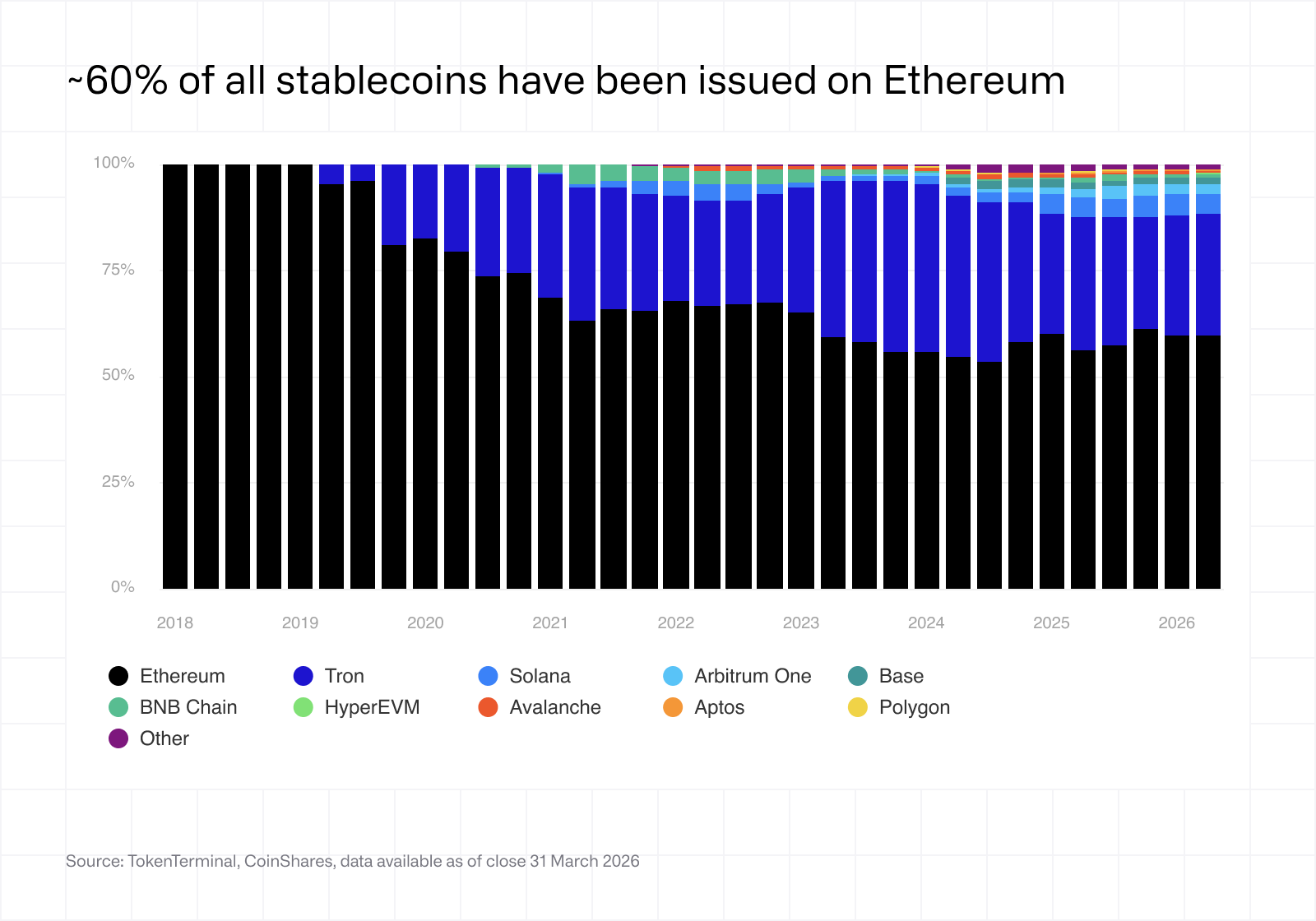
In Q1, the stablecoin market reached $297.6 billion in on-chain market capitalisation, reinforcing its position as the largest and most mature segment within Hybrid Finance: a 37.2% increase year over year, yet flat since Q4 2025 (+0.2%). Market leadership remains concentrated among crypto-native issuers, such as Tether, Circle, Sky2, Ethena, and Paxos. Approximately 60% of all stablecoins are issued on Ethereum, with growing activity on Tron, Solana, Arbitrum, and Base. 
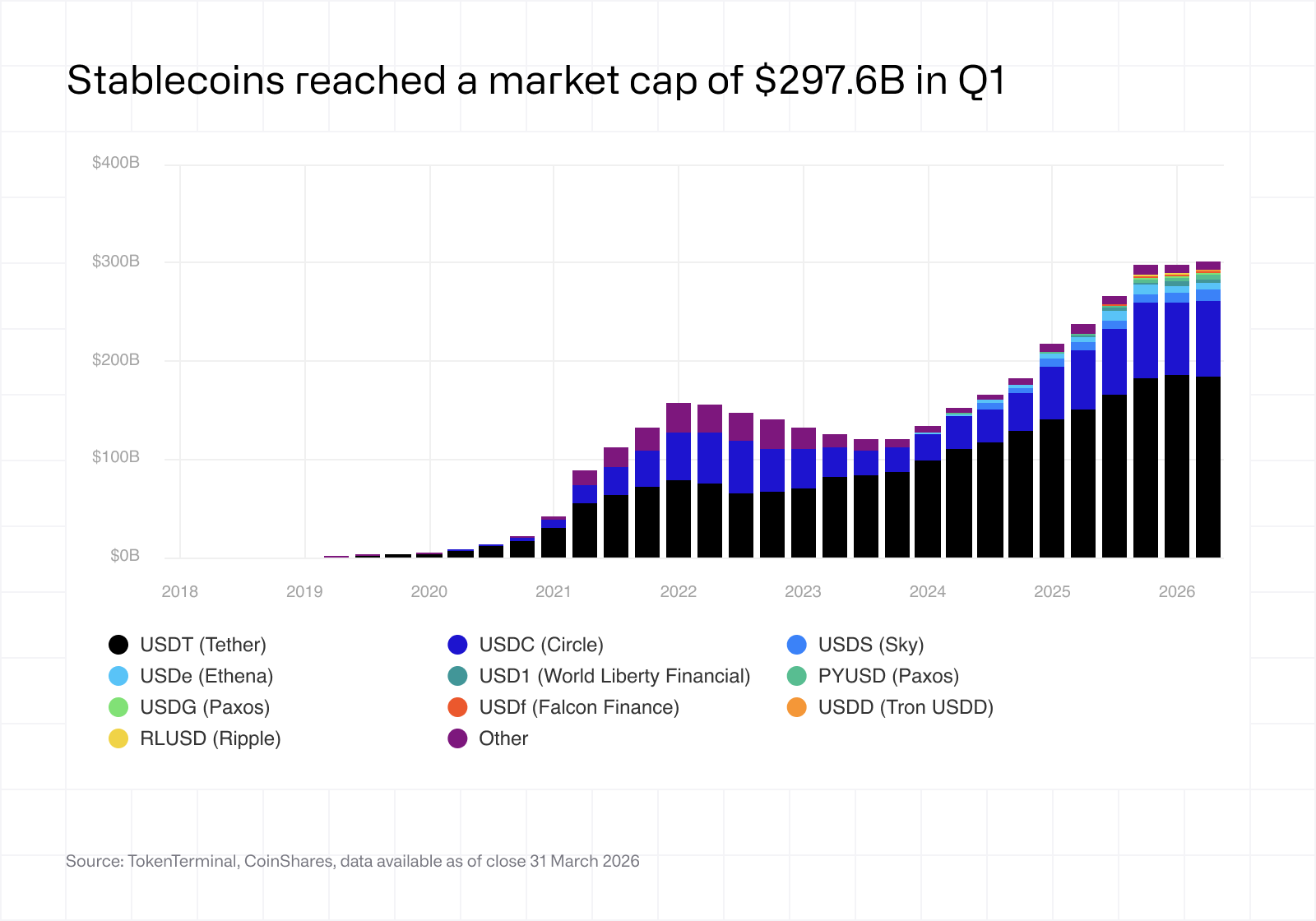
Stablecoins reached a market cap of $2976B in Q1

60% of all stablecoins have been issued on Ethereum

Tokenised funds

Tokenised funds3 extend traditional asset management into the on-chain environment, enabling investors to access structured financial products with greater transparency and composability. 

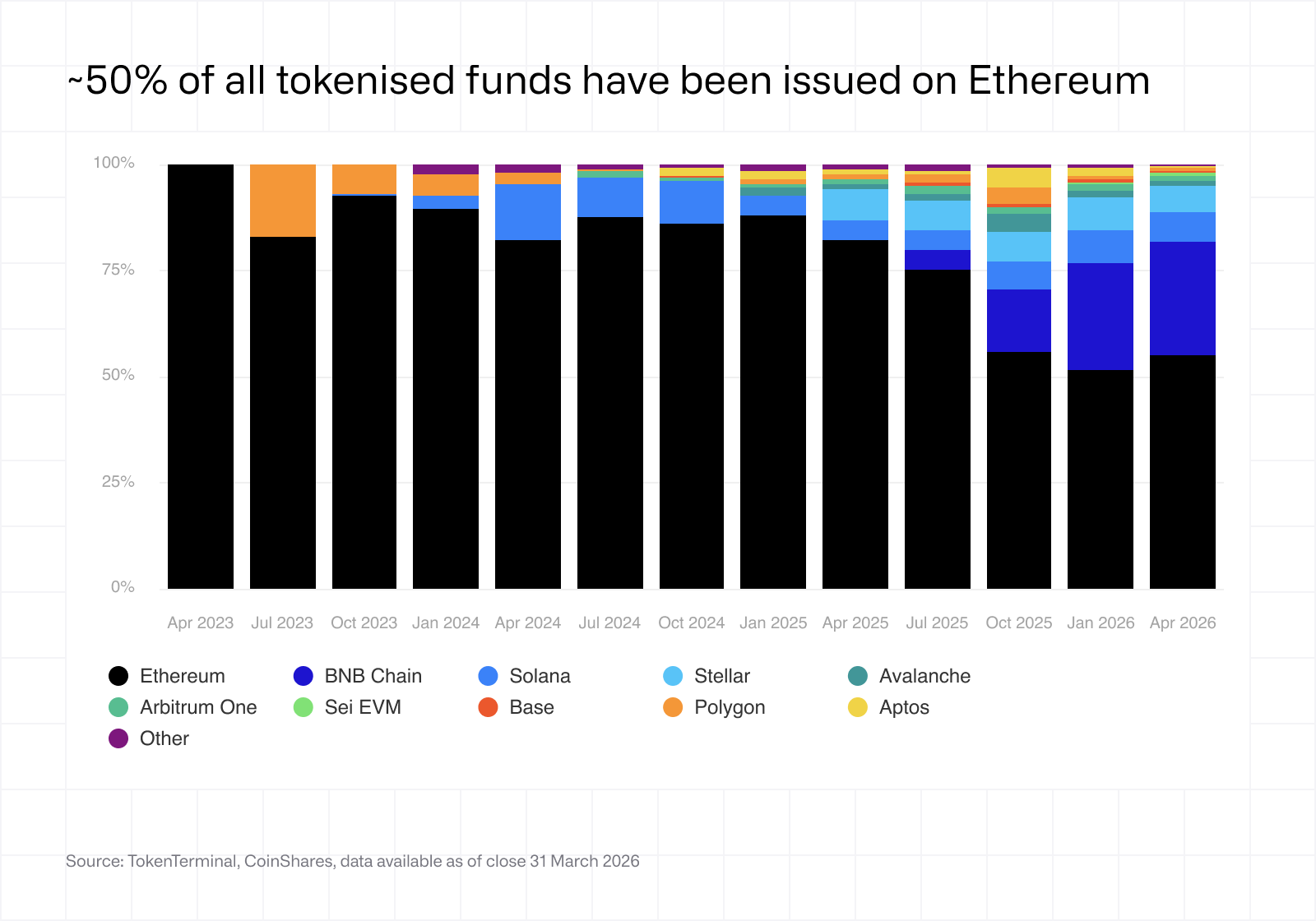
In Q1, tokenised funds reached $9.0 billion in on-chain assets under management, a 181.3% YoY increase, and +12.6% from Q4 2025, which makes this category one of the fastest-growing segments in Hybrid Finance. A significant portion of this growth is driven by tokenised strategies backed by short-duration US Treasury instruments, reflecting strong demand for low-risk, yield-bearing assets on-chain. The market remains concentrated among a small number of Wall Street issuers (BlackRock, Franklin Templeton, etc.), alongside crypto-native issuers such as Circle and Ondo, with close to 50% of all issuance concentrated on Ethereum.
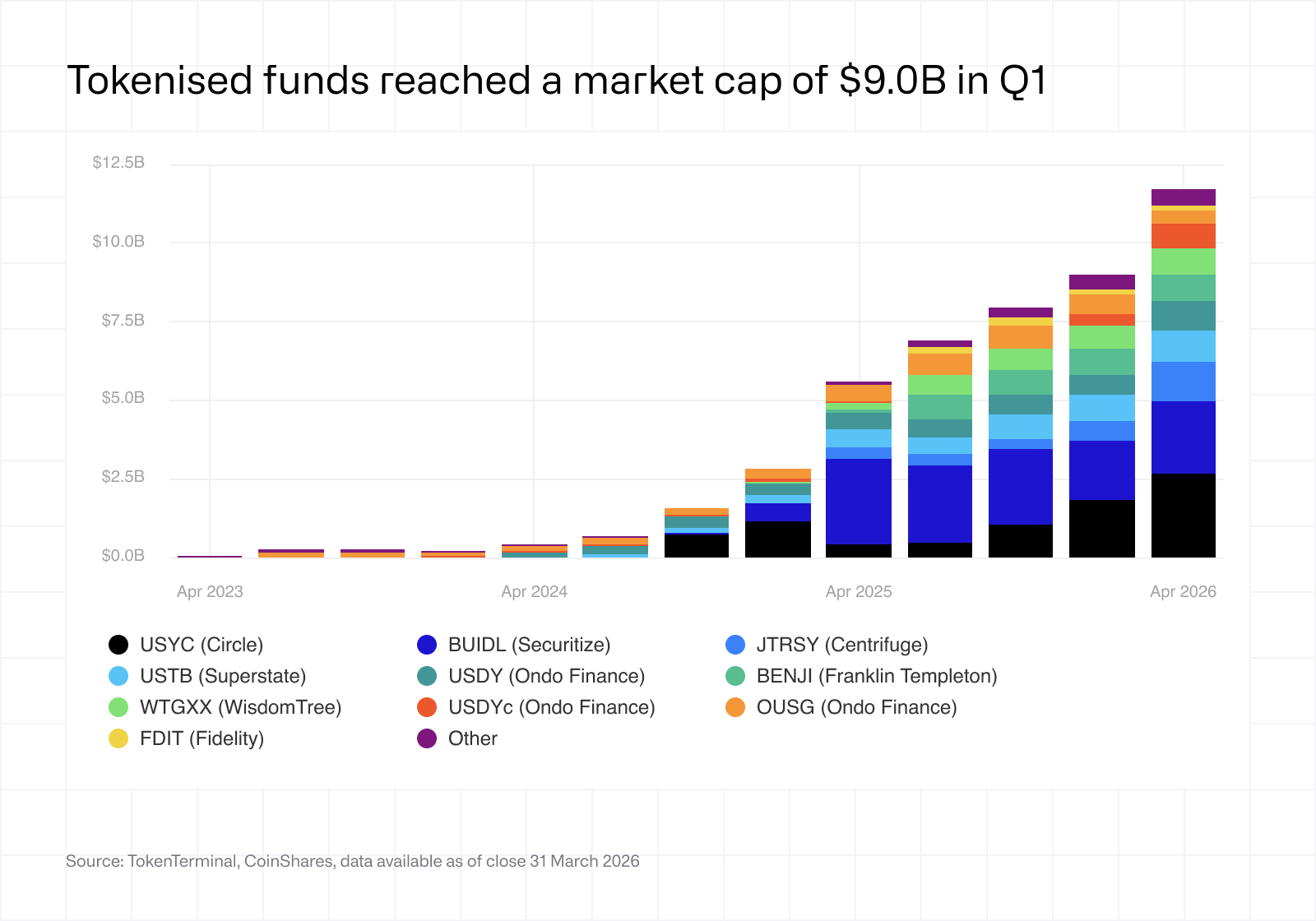
Tokenised funds market cap

Tokenised funds issues in Ethereum

Tokenised stocks

Tokenised stocks4 represent the migration of public and private equities onto blockchain infrastructure, enabling fractional ownership and continuous trading. These instruments aim to replicate traditional equity exposure while introducing programmability and global accessibility. 

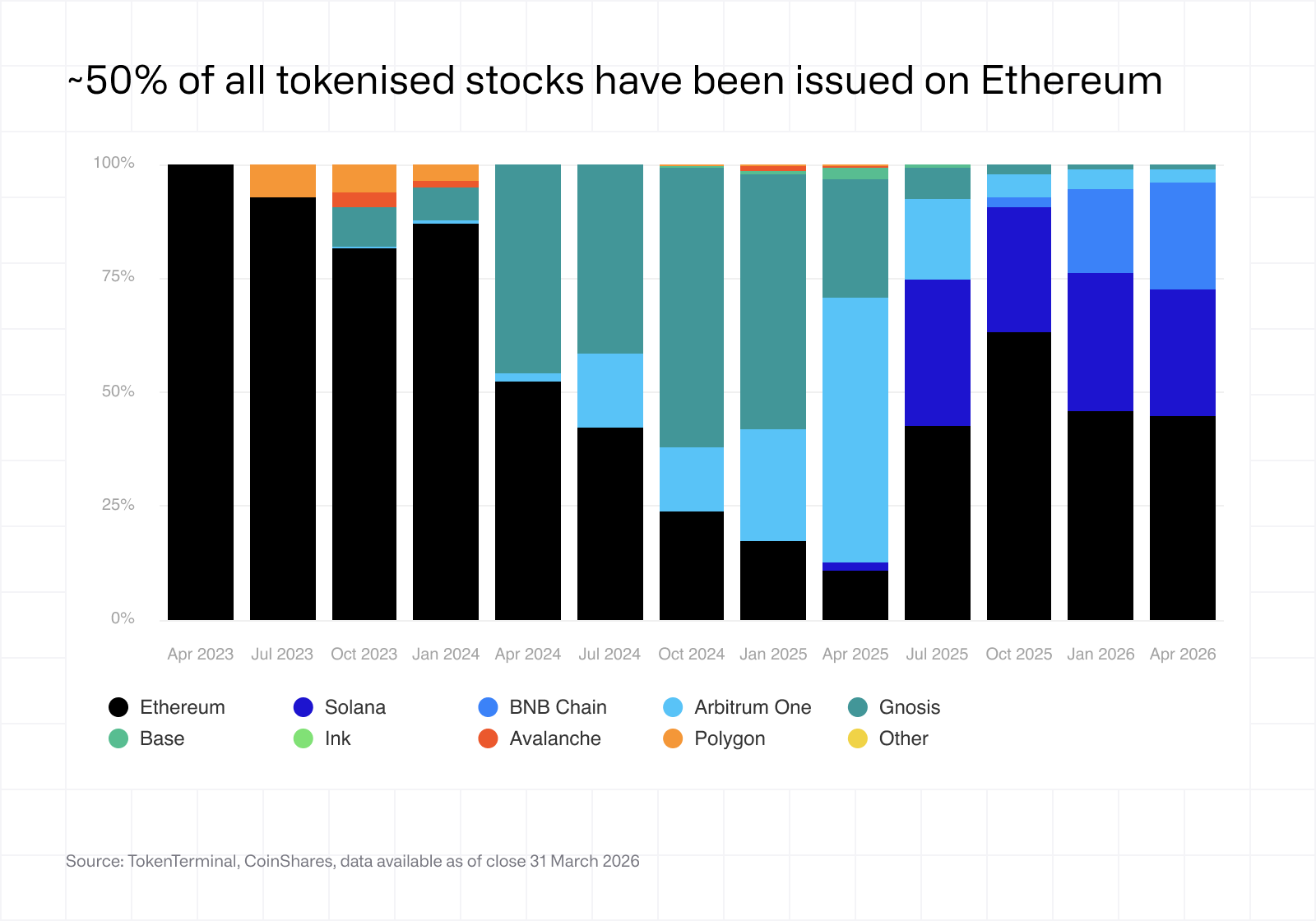
In Q1, the tokenised stock market reached $773.3 million in on-chain market capitalisation, reflecting an early-stage but rapidly growing segment: barely existent a year ago ($27.6M), its market cap surged 2,697% YoY, following a significant increase in Q4 2025 ($504.1M). The growth has been primarily driven by crypto-native issuers, such as Ondo Finance and xStocks. Approximately 50% of all tokenised stocks are issued on Ethereum, with the remainder distributed across Solana, BNB Chain, and Arbitrum - Arbitrum is also the settlement layer where Robinhood has issued thousands of stocks.
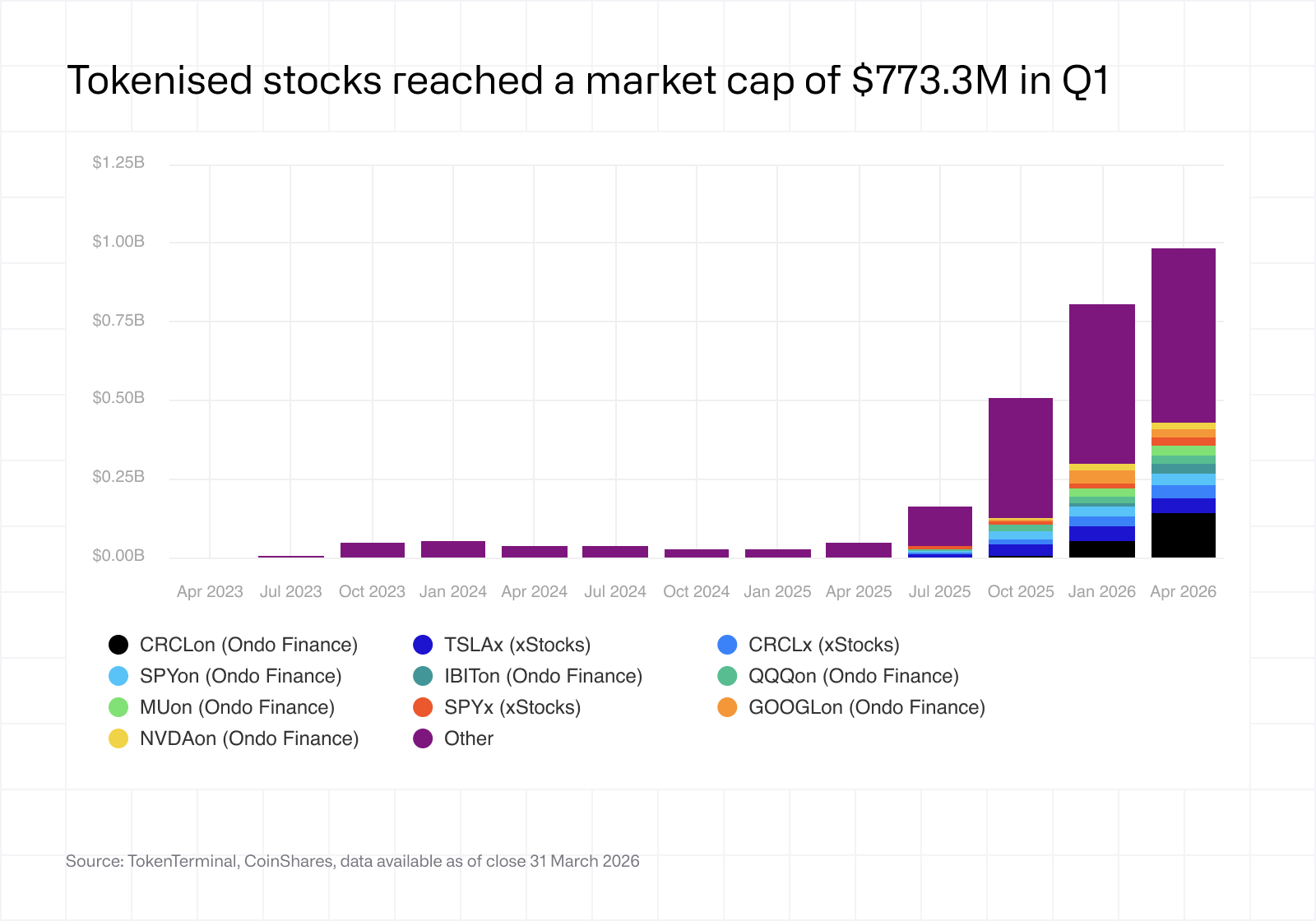
Tokenised stocks market cap

tokenised stocks issues on Ethereum

Tokenised commodities

Tokenised commodities5 bring physical assets onto blockchain rails, enabling digital ownership and global transferability. 

This segment is also growing at a significant pace as in Q1, tokenised commodities reached $4.9B in on-chain market capitalisation, from $3.1B in Q4 2025 (+59.7%), while it was still marginal a year ago: $1.1B (+350%). Gold-backed tokens dominate the category, reflecting demand for on-chain exposure to traditional store-of-value assets. The growth of this category is primarily driven by two issuers, Tether and Paxos. Both XAUT (Tether’s gold stablecoin) and PAXG (Paxos’ one) have seen increasing user demand in recent quarters, driven by the price appreciation of gold.

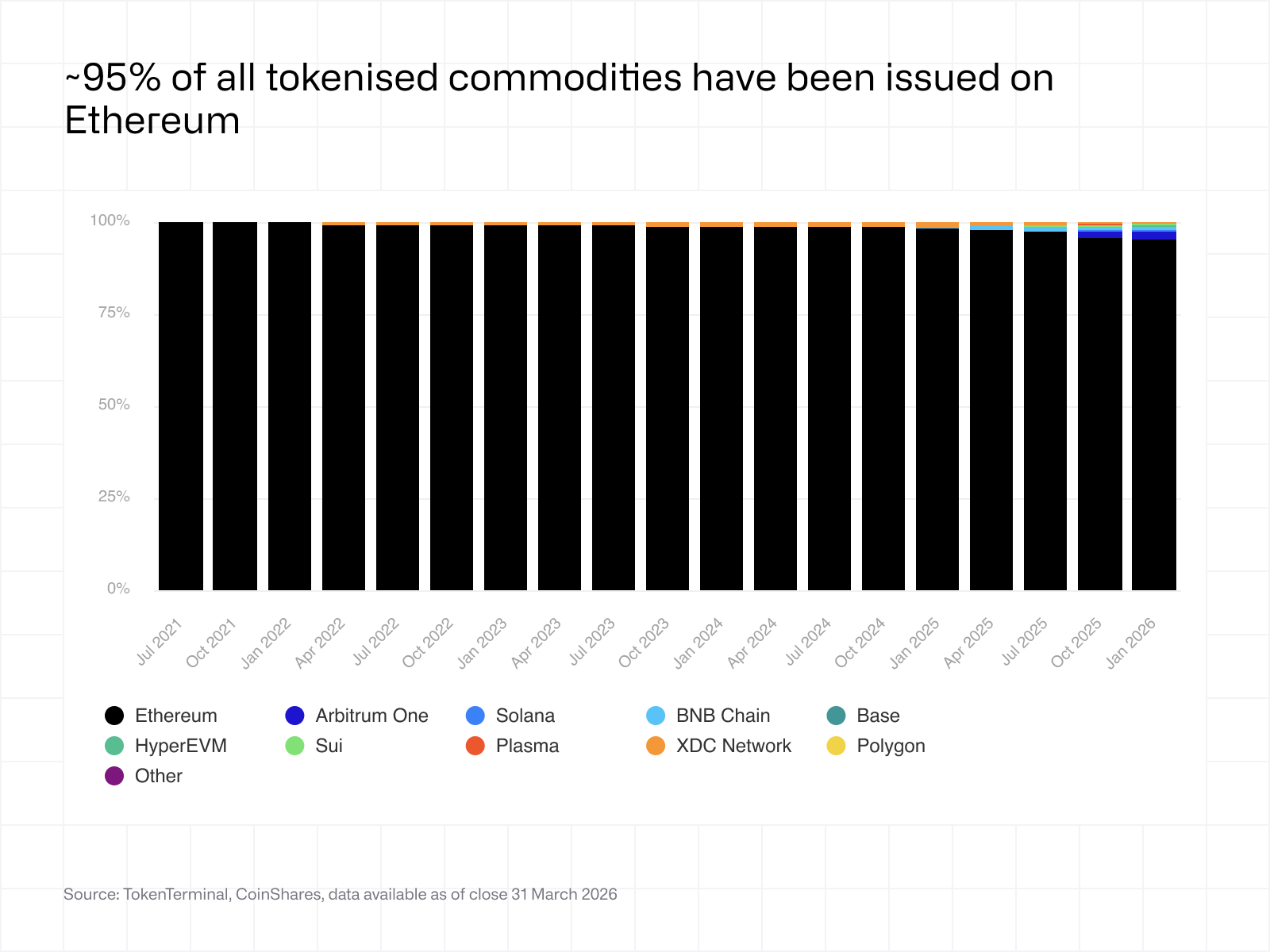
Approximately 95% of all tokenised commodity issuance is concentrated on Ethereum, making it the most dominant settlement layer across all of Hybrid Finance.
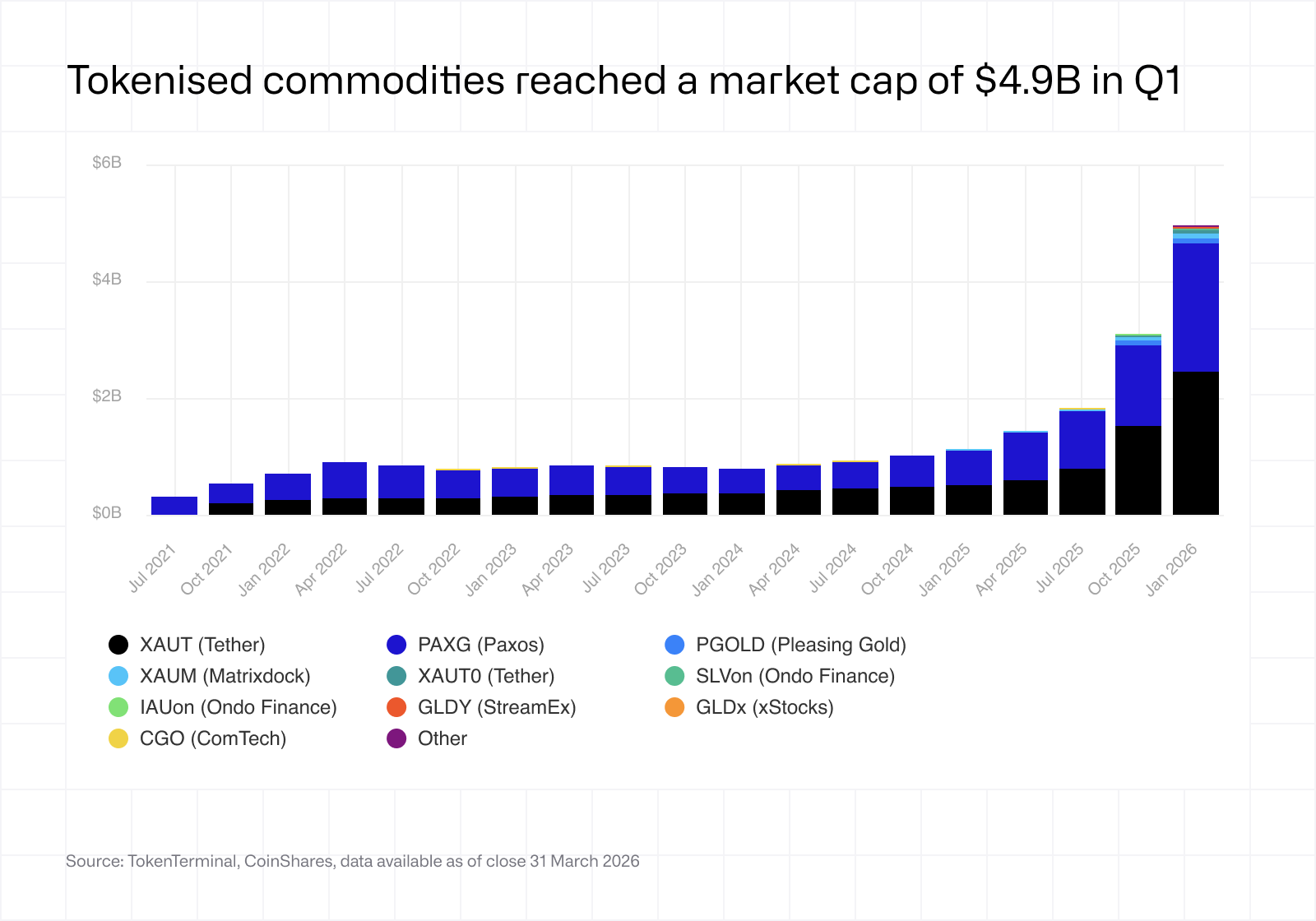
tokenised commodities

tokenised commodities issues on Ethereum

On-chain businesses

On-chain businesses represent a new category of internet-native companies that generate revenue directly from blockchain-based activity, and distribute a portion of that to their tokenholders.

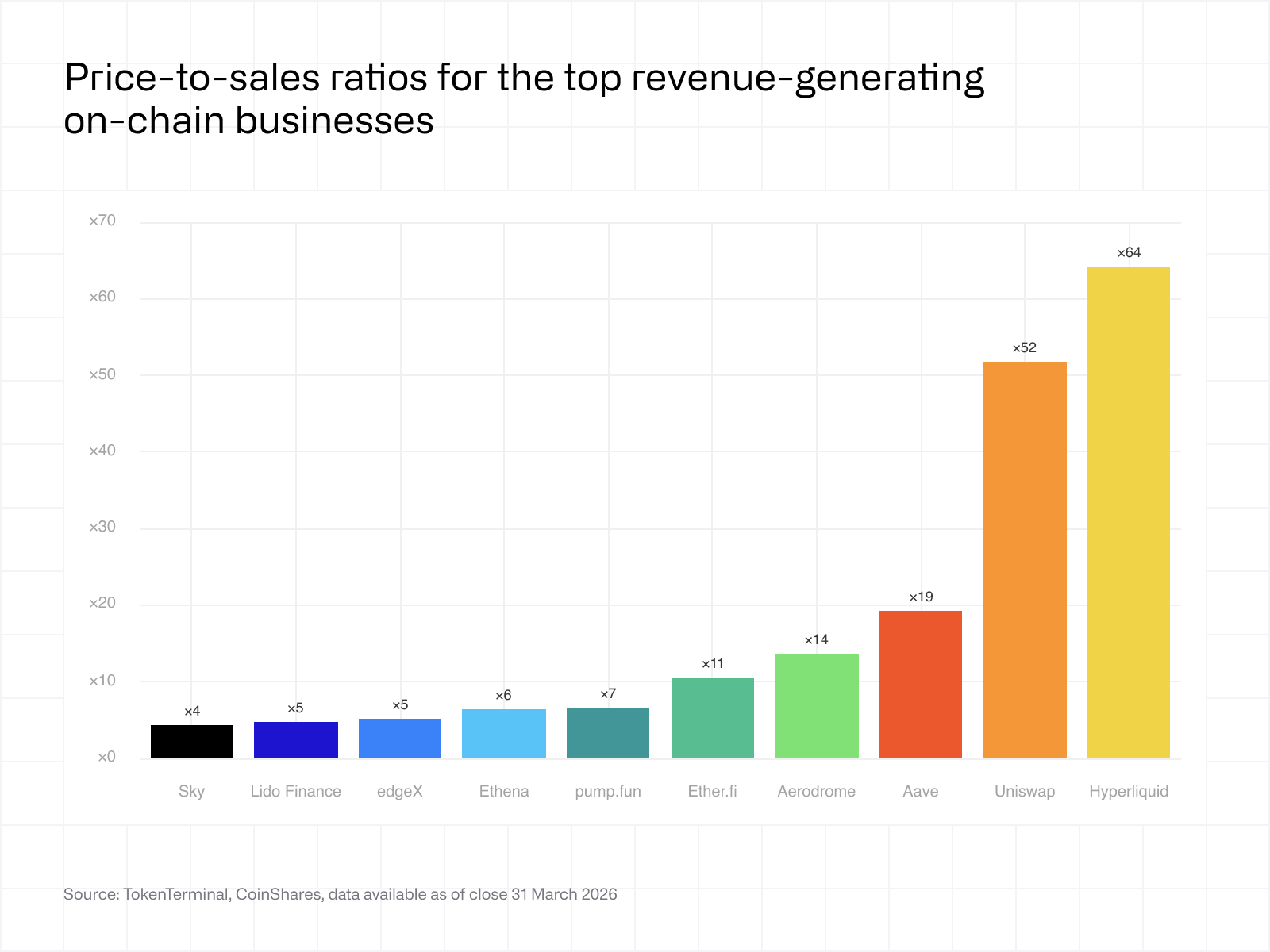
In Q1, leading on-chain businesses generated $587.9 million in revenue, with revenue highly concentrated among a small number of trading platforms and stablecoin issuers, such as Hyperliquid and Sky, respectively. Unlike other stablecoin issuers like Tether and Circle, a portion of Sky’s revenue is protocol-native, being generated from stability fees charged to borrowers who mint USDS against on-chain collateral, which is why it also qualifies as an on-chain business. However, Sky also allocates a significant share of USDS liquidity into off-chain yield sources: this model makes Sky a transitional case, more on-chain than Tether and Circle but not entirely so.These platforms demonstrate that on-chain businesses can generate substantial fee-based revenues, which makes their economic profiles comparable to traditional financial services businesses. As a result, on-chain businesses are increasingly valued with familiar public markets frameworks, like revenue and earnings multiples.
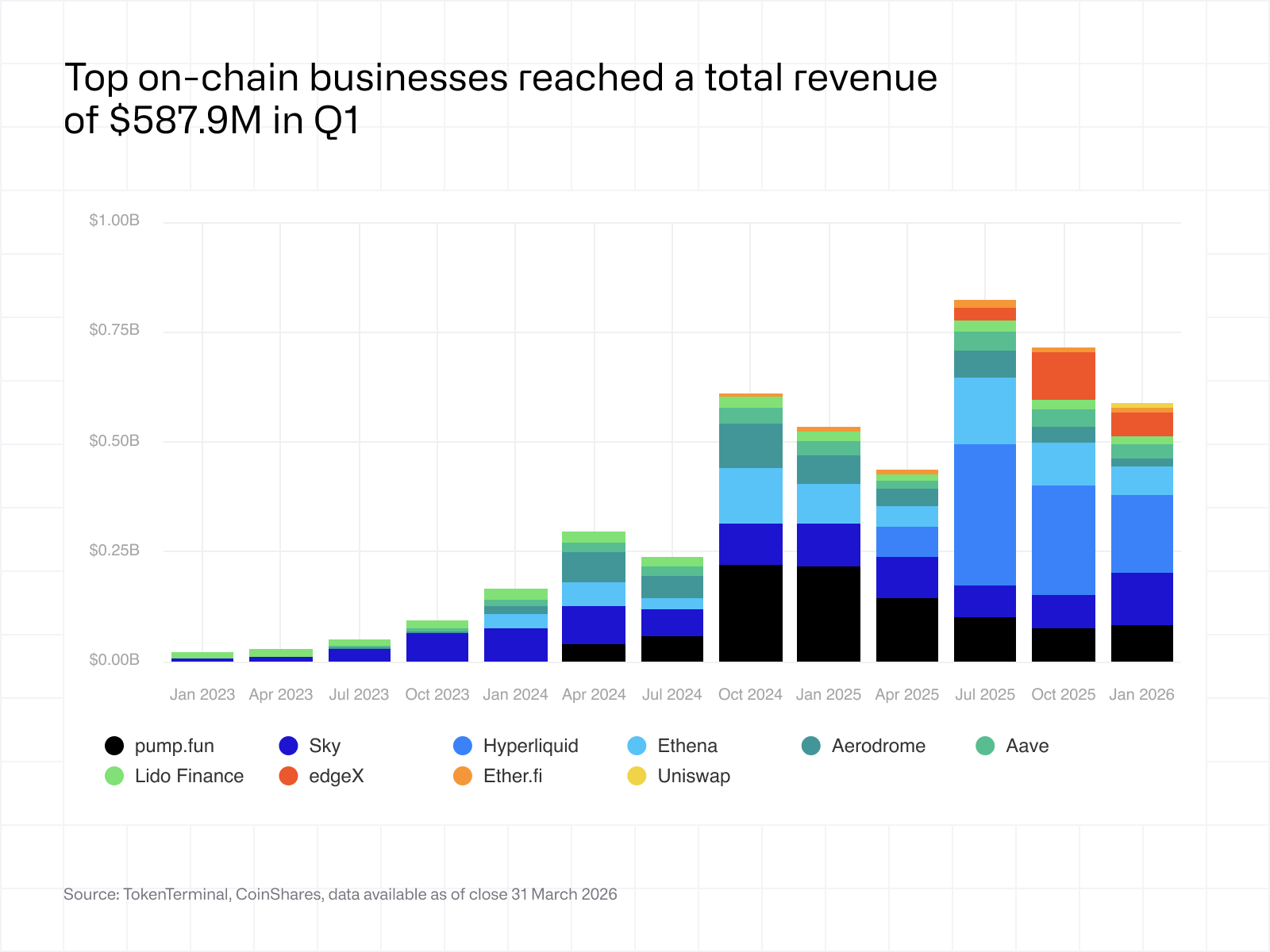
Top on-chain business total revenue

Price to sales ratio for top revenue generating on-chain business

Settlement layers

General-purpose L1 and L2 blockchains provide settlement for large volumes of tokenised assets but monetise only transaction activity, not the assets themselves. Their fee model is usage-based, which means revenue scales with transfers and interactions rather than balances or AUM. This creates a structural gap between economic value supported and revenue captured.

Stablecoins make this explicit. Ethereum secures roughly $180 billion in stablecoin supply. At a 4% yield, this implies about $7 billion in annual issuer revenue. Ethereum captures only a small fraction of this through transaction fees, since users pay per transfer, not for holding or issuing the asset. Value accrues to the issuer, while the settlement layer remains economically underexposed to the capital it supports. The smaller Hyperliquid figure is explained by the fact its revenue comes from the trading activity, not the settlement fees. More explanation in the following segment. 
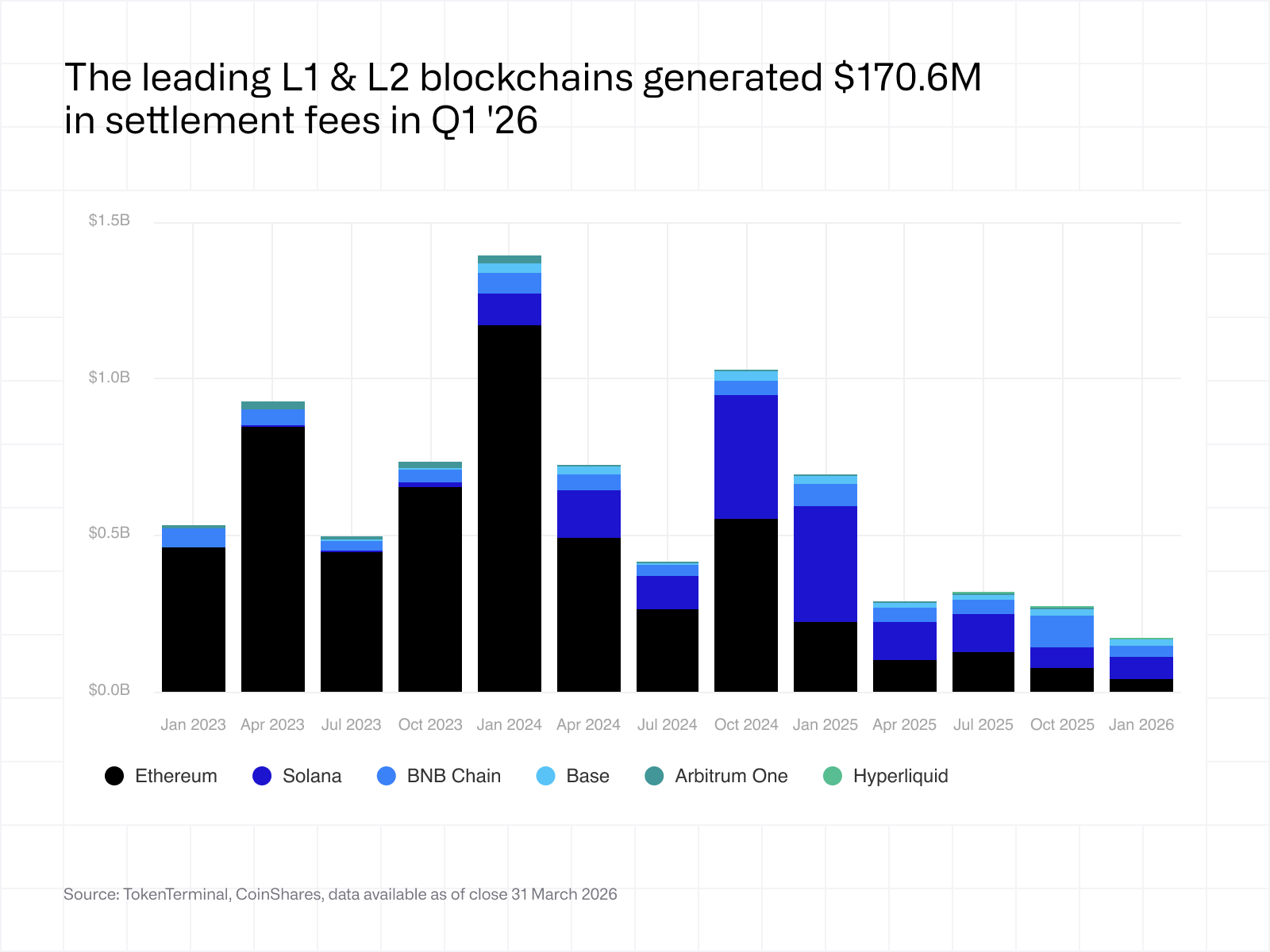
Leading L1 and L2 blockchains generated

Conclusion

Revenue and economic value in Hybrid Finance are generated in a clear order: by on-chain businesses first, then by asset issuers, and finally by the underlying chains.

On-chain businesses such as Hyperliquid, Uniswap, and Aerodrome are the primary winners today because they generate revenue from trading, borrowing, and collateral usage. As more real-world assets move on-chain, these platforms gain access to yield-bearing and institution-backed collateral, which increases transaction volume and expands their revenue base. This position is likely to strengthen over the next 12 to 18 months, as user activity continues to concentrate in a small number of venues with deep liquidity and tight spreads.

Asset issuers form the second layer, as they issue the assets that are traded, borrowed, and used as collateral across these applications. In stablecoins, Tether and Circle lead due to distribution and liquidity, while Sky and Ethena are emerging by offering yield-bearing alternatives that may attract capital. In tokenised funds, BlackRock, Franklin Templeton, and Ondo lead by pairing institutional credibility with access to Treasury yields, and their leadership is likely to hold unless new issuers improve distribution or economics. In tokenised commodities, Tether Gold and Paxos Gold dominate due to demand for gold exposure, and this is unlikely to change because demand remains concentrated in gold. In tokenised stocks, Ondo and xStocks lead today, but the category remains open due to its small size, and leadership may change quickly as new issuers enter and liquidity develops.

Chains form the final layer by generating revenue from the transaction activity created above them. Ethereum remains the dominant settlement layer due to its depth of liquidity and security, while other chains compete by offering lower fees and higher throughput. As more assets and applications concentrate on a given chain, transaction volume increases, which directly translates into higher fee revenue. In its own way, Hyperliquid reflects this observation. Over the next 12 to 18 months, outcomes at the chain level are likely to depend on their ability to attract leading applications and issuers, as users and transactions follow where liquidity is deepest.

Across all layers, the mechanism is consistent: assets attract liquidity, applications turn that liquidity into revenue, and chains monetise the resulting transaction activity. The key question is which applications and issuers become default choices for users, and which chains are able to retain that activity over time.

Final thoughts

Hyperliquid: a case example of successful vertical integration

Hyperliquid captures value by combining infrastructure and application into a single system. It operates its own L1 while running a decentralized derivatives exchange that generates the majority of revenue. This shifts monetisation from passive settlement fees to direct user-level revenue, where margins are highest.

In Q1 2026, Hyperliquid generated $178.7M in revenue, with approximately 96% coming from trading activity and only a minimal contribution from the base layer. By owning the application, Hyperliquid captures the full economic flow of its core use case, with revenue scaling directly with user activity. This creates a strategic pressure for general-purpose chains. If value continues to accrue at the application layer, chains may need to move up the stack by launching or integrating native applications to capture higher-margin revenue streams. The trade-off is structural. Greater revenue capture comes at the cost of reduced neutrality and may reshape how ecosystems are organised.
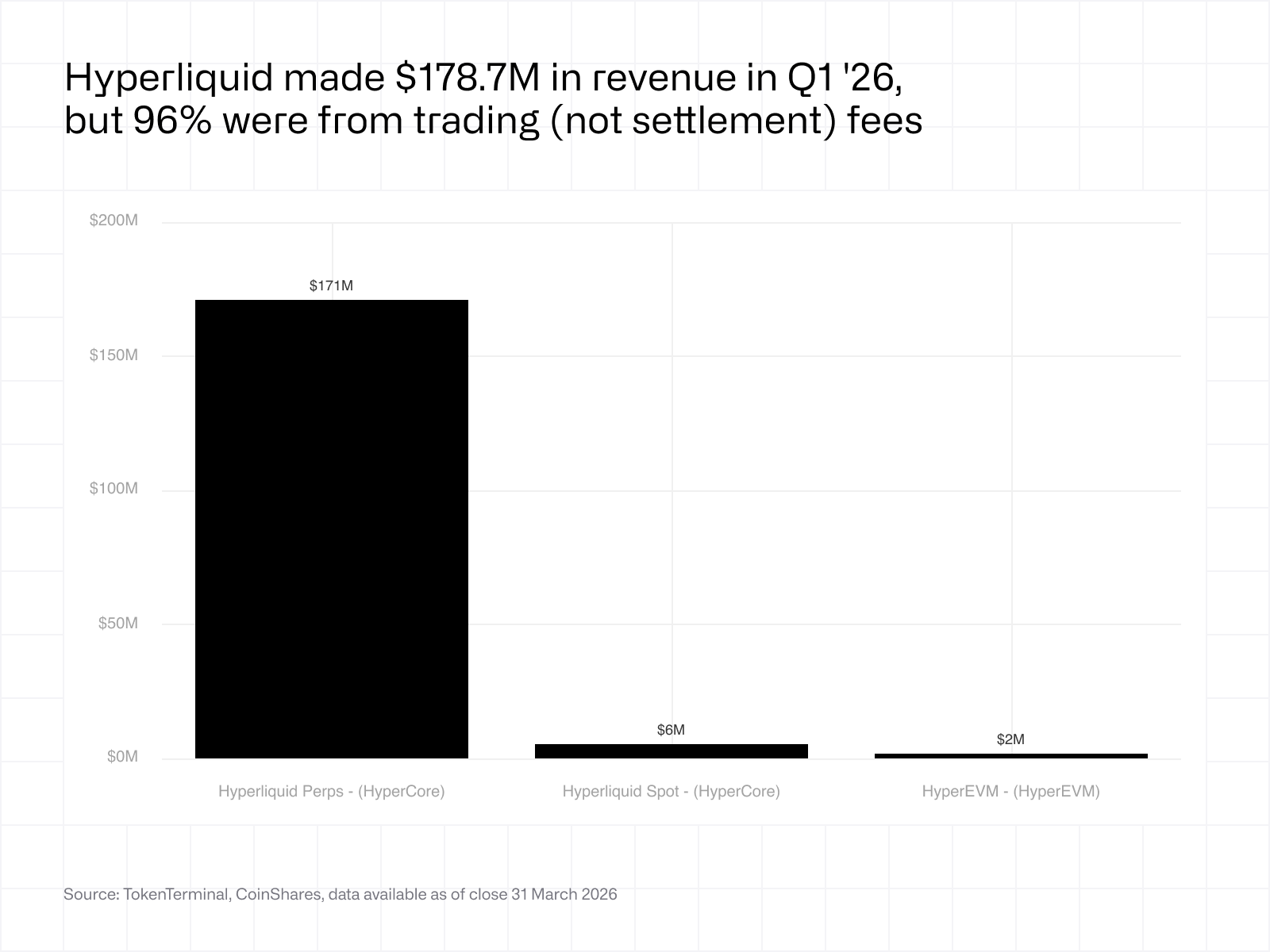
Hyperliquid revenue


1A stablecoin is a digital asset designed to maintain a stable value relative to a reference unit, typically USD, with that stability achieved through collateralisation, active strategies, or hedging-based mechanisms.

2Sky's USDS is covered here as a stablecoin; its fee-generating protocol mechanics are addressed in the on-chain businesses section.

3A tokenised fund is a digital asset that represents pooled investment capital, with allocation decisions executed by a designated manager or a programmable strategy.

4A tokenised stock is a digital asset that represents ownership in, or economic exposure to, a company or companies, with that exposure implemented through direct equity holdings or synthetic mechanisms.

5A tokenised commodity is a digital asset that represents ownership of, or economic exposure to, physical goods, with that exposure implemented through physical holdings or synthetic mechanisms.

Published onApr 23rd, 2026

Writer
CoinShares Author Logo
CoinShares

related articles

Welcome to CoinShares

Personal Data

0102

When you visit CoinShares website, cookies enhance your experience. They help us to show you more relevant content. Some cookies are necessary for the site to work and will always be active. Blocking some types of cookies may impact your experience of the website and the services which we offer on our website.

We use cookies on our site to optimize our services. Learn more about our EU cookie policy or US cookie policy.

  • Necessary
    Question circle icon
  • Preferences
    Question circle icon
  • Statistical
    Question circle icon
  • Marketing
    Question circle icon

Don't invest unless you're prepared to lose all the money you invest. This is a high-risk investment, and you should not expect to be protected if something goes wrong. Take 2 mins to learn more. Approved by Archax 19/12/2025

Necessary cookies help make a website usable by enabling basic functions like page navigation and access to secure areas of the website. The website cannot function properly without these cookies.
Preference cookies enable a website to remember information that changes the way the website behaves or looks, like your preferred language or the region that you are in.
Statistic cookies help website owners to understand how visitors interact with websites by collecting and reporting information anonymously.
Marketing cookies are used to track visitors across websites. The intention is to display ads that are relevant and engaging for the individual user and thereby more valuable for publishers and third party advertisers.