
This website uses cookies
We use cookies to personalise content and ads, to provide social media features and to analyse our traffic. We also share information about your use of our site with our social media, advertising and analytics partners who may combine it with other information that you’ve provided to them or that they’ve collected from your use of their services.
Consent Selection
Details
  • Necessary cookies help make a website usable by enabling basic functions like page navigation and access to secure areas of the website. The website cannot function properly without these cookies.

    • Learn more about this provideropens in a new window
      CookieConsentStores the user's cookie consent state for the current domain
      Maximum Storage Duration: 1 yearType: HTTP Cookie
    • Learn more about this provideropens in a new window
      bcookieUsed in order to detect spam and improve the website's security.
      Maximum Storage Duration: 1 yearType: HTTP Cookie
      li_gcStores the user's cookie consent state for the current domain
      Maximum Storage Duration: 180 daysType: HTTP Cookie
    • Learn more about this provideropens in a new window
      datadomeUsed in context with the website's BotManager. The BotManager detects, categorizes and compiles reports on potential bots trying to access the website.
      Maximum Storage Duration: 1 yearType: HTTP Cookie
    • _pk_testcookie_domainThis cookie determines whether the browser accepts cookies.
      Maximum Storage Duration: 1 dayType: HTTP Cookie
    • __cf_bm [x3]This cookie is used to distinguish between humans and bots. This is beneficial for the website, in order to make valid reports on the use of their website.
      Maximum Storage Duration: 1 dayType: HTTP Cookie
  • Preference cookies enable a website to remember information that changes the way the website behaves or looks, like your preferred language or the region that you are in.
    • Learn more about this provideropens in a new window
      lidcRegisters which server-cluster is serving the visitor. This is used in context with load balancing, in order to optimize user experience.
      Maximum Storage Duration: 1 dayType: HTTP Cookie
  • Statistic cookies help website owners to understand how visitors interact with websites by collecting and reporting information anonymously.
    • Learn more about this provideropens in a new window
      guestRegisters data on visitors' website-behaviour. This is used for internal analysis and website optimization.
      Maximum Storage Duration: 1 monthType: HTTP Cookie
    • Learn more about this provideropens in a new window
      personalization_idThis cookie is set by Twitter - The cookie allows the visitor to share content from the website onto their Twitter profile.
      Maximum Storage Duration: 400 daysType: HTTP Cookie
    • _pk_uidUsed by Piwik Analytics Platform to identify the visitor on repeat visits to the website.
      Maximum Storage Duration: 1 yearType: HTTP Cookie
      _pk_id#Collects statistics on the user's visits to the website, such as the number of visits, average time spent on the website and what pages have been read.
      Maximum Storage Duration: 1 yearType: HTTP Cookie
      _pk_ses#Used by Piwik Analytics Platform to track page requests from the visitor during the session.
      Maximum Storage Duration: 1 dayType: HTTP Cookie
    • FPGSIDRegisters statistical data on users' behaviour on the website. Used for internal analytics by the website operator.
      Maximum Storage Duration: 1 dayType: HTTP Cookie
      FPIDRegisters statistical data on users' behaviour on the website. Used for internal analytics by the website operator.
      Maximum Storage Duration: 400 daysType: HTTP Cookie
      FPLCRegisters a unique ID that is used to generate statistical data on how the visitor uses the website.
      Maximum Storage Duration: 1 dayType: HTTP Cookie
    • _gaRegisters a unique ID that is used to generate statistical data on how the visitor uses the website.
      Maximum Storage Duration: 2 yearsType: HTTP Cookie
      _ga_#Used by Google Analytics to collect data on the number of times a user has visited the website as well as dates for the first and most recent visit.
      Maximum Storage Duration: 2 yearsType: HTTP Cookie
  • Marketing cookies are used to track visitors across websites. The intention is to display ads that are relevant and engaging for the individual user and thereby more valuable for publishers and third party advertisers.
    • Learn more about this provideropens in a new window

      Some of the data collected by this provider is for the purposes of personalization and measuring advertising effectiveness. The provider may use the IP Addresses for ads measurement and ads personalization.

      ads/ga-audiencesUsed by Google AdWords to re-engage visitors that are likely to convert to customers based on the visitor's online behaviour across websites.
      Maximum Storage Duration: SessionType: Pixel Tracker
    • Learn more about this provideropens in a new window
      userRefererDetermines how the user accessed the website. This information is used by the website operator in order to measure the efficiency of their marketing.
      Maximum Storage Duration: 1 monthType: HTTP Cookie
    • Learn more about this provideropens in a new window
      #:session-dataTracks the individual sessions on the website, allowing the website to compile statistical data from multiple visits. This data can also be used to create leads for marketing purposes.
      Maximum Storage Duration: PersistentType: HTML Local Storage
      eng_mtTracks the conversion rate between the user and the advertisement banners on the website - This serves to optimise the relevance of the advertisements on the website.
      Maximum Storage Duration: PersistentType: HTML Local Storage
      t_gidThis cookie assigns a specific visitor ID, when the visitor interacts with ads or content from the website - this allows the website to target the visitor with similar ads or content.
      Maximum Storage Duration: 1 yearType: HTTP Cookie
      t_pt_gidCollects information on user preferences and/or interaction with web-campaign content - This is used on CRM-campaign-platform used by website owners for promoting events or products.
      Maximum Storage Duration: 1 yearType: HTTP Cookie
      taboola global:user-idSets a unique ID for the visitor, that allows third party advertisers to target the visitor with relevant advertisement. This pairing service is provided by third party advertisement hubs, which facilitates real-time bidding for advertisers.
      Maximum Storage Duration: PersistentType: HTML Local Storage
      taboola_session_idThis cookie is used to collect information on a visitor. This information will become an ID string with information on a specific visitor – ID information strings can be used to target groups with similar preferences, or can be used by third-party domains or ad-exchanges.
      Maximum Storage Duration: SessionType: HTTP Cookie
    • Learn more about this provideropens in a new window
      1/i/adsct [x2]Collects data on user behaviour and interaction in order to optimize the website and make advertisement on the website more relevant.
      Maximum Storage Duration: SessionType: Pixel Tracker
      muc_adsCollects data on user behaviour and interaction in order to optimize the website and make advertisement on the website more relevant.
      Maximum Storage Duration: 400 daysType: HTTP Cookie
      guest_idCollects data related to the user's visits to the website, such as the number of visits, average time spent on the website and which pages have been loaded, with the purpose of personalising and improving the Twitter service.
      Maximum Storage Duration: 400 daysType: HTTP Cookie
      guest_id_adsCollects information on user behaviour on multiple websites. This information is used in order to optimize the relevance of advertisement on the website.
      Maximum Storage Duration: 400 daysType: HTTP Cookie
      guest_id_marketingCollects information on user behaviour on multiple websites. This information is used in order to optimize the relevance of advertisement on the website.
      Maximum Storage Duration: 400 daysType: HTTP Cookie
    • _gcl_auUsed by Google AdSense for experimenting with advertisement efficiency across websites using their services.
      Maximum Storage Duration: 3 monthsType: HTTP Cookie
      _gcl_lsTracks the conversion rate between the user and the advertisement banners on the website - This serves to optimise the relevance of the advertisements on the website.
      Maximum Storage Duration: PersistentType: HTML Local Storage
    • pardot [x2]Used in context with Account-Based-Marketing (ABM). The cookie registers data such as IP-addresses, time spent on the website and page requests for the visit. This is used for retargeting of multiple users rooting from the same IP-addresses. ABM usually facilitates B2B marketing purposes.
      Maximum Storage Duration: SessionType: HTTP Cookie
  • Unclassified cookies are cookies that we are in the process of classifying, together with the providers of individual cookies.
    • cs_analytics_ip_blockedPending
      Maximum Storage Duration: SessionType: HTTP Cookie
      user_tokenPending
      Maximum Storage Duration: 1 yearType: HTTP Cookie
    • _twpidPending
      Maximum Storage Duration: SessionType: HTTP Cookie
Cookie declaration last updated on 8/20/26 by Cookiebot
[#IABV2_TITLE#]
[#IABV2_BODY_INTRO#]
[#IABV2_BODY_LEGITIMATE_INTEREST_INTRO#]
[#IABV2_BODY_PREFERENCE_INTRO#]
[#IABV2_BODY_PURPOSES_INTRO#]
[#IABV2_BODY_PURPOSES#]
[#IABV2_BODY_FEATURES_INTRO#]
[#IABV2_BODY_FEATURES#]
[#IABV2_BODY_PARTNERS_INTRO#]
[#IABV2_BODY_PARTNERS#]
About
Cookies are small text files that can be used by websites to make a user's experience more efficient.

The law states that we can store cookies on your device if they are strictly necessary for the operation of this site. For all other types of cookies we need your permission.

This site uses different types of cookies. Some cookies are placed by third party services that appear on our pages.

You can at any time change or withdraw your consent from the Cookie Declaration on our website.

Learn more about who we are, how you can contact us and how we process personal data in our Privacy Policy.

Please state your consent ID and date when you contact us regarding your consent.

The Halving In Hindsight

Timer7 min read

  • Bitcoin
  • Mining

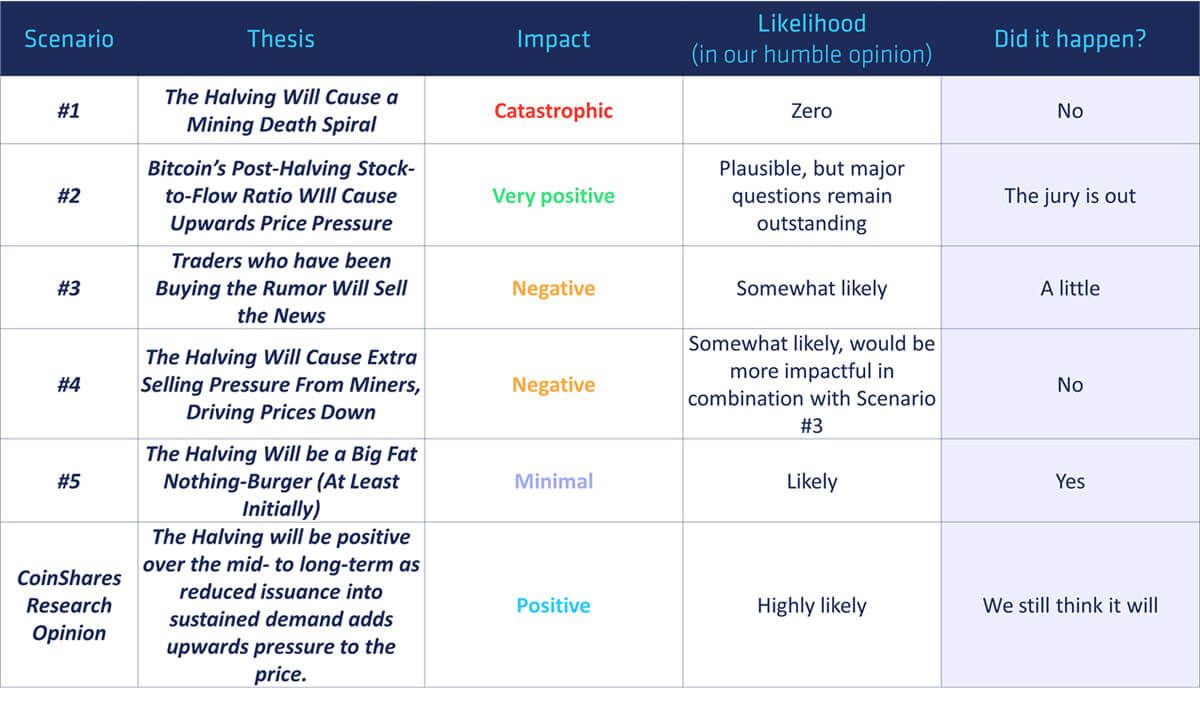
A few weeks ago, in May right before the much anticipated third Bitcoin halving, we wrote a piece where we laid out some potential outcome scenarios and analysed them based on likelihood and impact.

Our scenario overview looked like this:
The Halving

With the third halving now done and dusted, it is time to examine the immediate short-term outcome and have a closer look at the current state of the network.

Did any of the listed scenarios come true? If not, what did actually happen and where are we now?

Scenario #1: The Halving Will Cause a Mining Death Spiral

Not much to say about this scenario. It didn’t happen this time either because the concept of a death spiral is a theoretical edge case, not a real-world possibility. If there did indeed exist some imbalance in the mining incentive structure that risked catastrophically dislocating Bitcoin from its relatively steady state of block production, one would think that this would have already happened by now.

Scenario #2: Bitcoin’s Post-Halving Stock-to-Flow Ratio Will Cause the Price to Spike

Proponents of this theory will argue that it is too soon to make any judgement as to whether its predictive outcome will actually come true. This is probably fair. During the periods after the two preceding halvings, price increases have taken many months to materialise and we would be mistaken to expect this time to be different.

As it stands, prices have not significantly moved outside of the bands in which it’s been trading over the last month or so, let alone spiked.

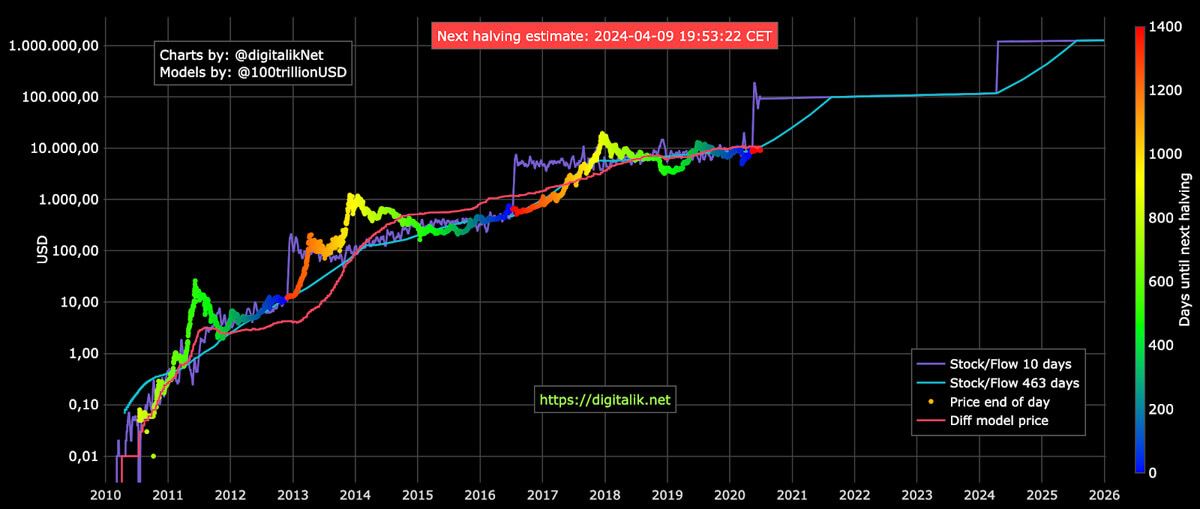
This stability in price has continued even though over the first 23 days post-halving, only 793 bitcoins were produced each day—a 12% reduction on top of the 50% reduction caused by the halving itself (now at 900 btc/day)—causing Bitcoin’s stock-to-flow level to reach new record highs.

Bitcoin’s Stock-to-Flow Metric Reached All-Time Highs Right After the Halving
Halving estimate 2024 04 09

Source: digitalik.net

The reason such a low number of coins were produced was that block times remained abnormally high for an extended period of time due to reduced hashrates. A drop in hashrate was a predictable outcome of reduced mining revenue, and within less than a week after the halving, the hashrate had fallen almost down to 85 EH/s (approximately 30%).

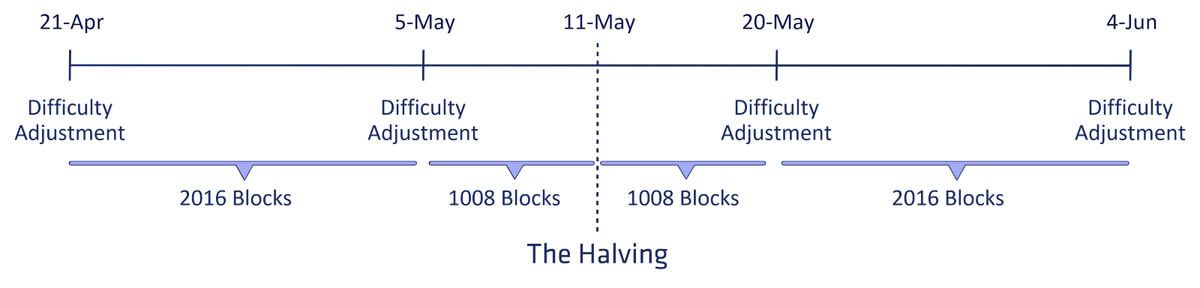
Complicating matters somewhat, the halving itself fell at the exact midpoint between two difficulty adjustments. This caused the first adjustment to count 1008 blocks before the halving and 1008 blocks after the halving as its input for the new difficulty.
The HalvingSource: CoinShares Research

In other words, by the time the first difficulty adjustment was due—1008 blocks after the halving—even though the hashrate had at that point dropped by ~30%, difficulty was only reduced by -6.00% because adjustments are calculated on the basis of the average over the preceding 2016 blocks. It took another 2016 blocks for the difficulty to adjust all the way down to its local bottom after a second reduction of -9.29%.

But even though issuance averaged 12% below its 900 btc/day target for more than three weeks, causing stock-to-flow levels to spike, market prices have not moved outside of normal volatility bands. Prices remain well below yearly highs and we have not observed any abnormal upwards movements. We remain skeptical of the stock-to-flow model in general, but concede that more time is needed for a full evaluation of its predictions.

Scenarios #3 & #4: Traders who have been Buying the Rumor Will Sell the News & The Halving Will Cause Extra Selling Pressure From Miners, Driving Prices Down

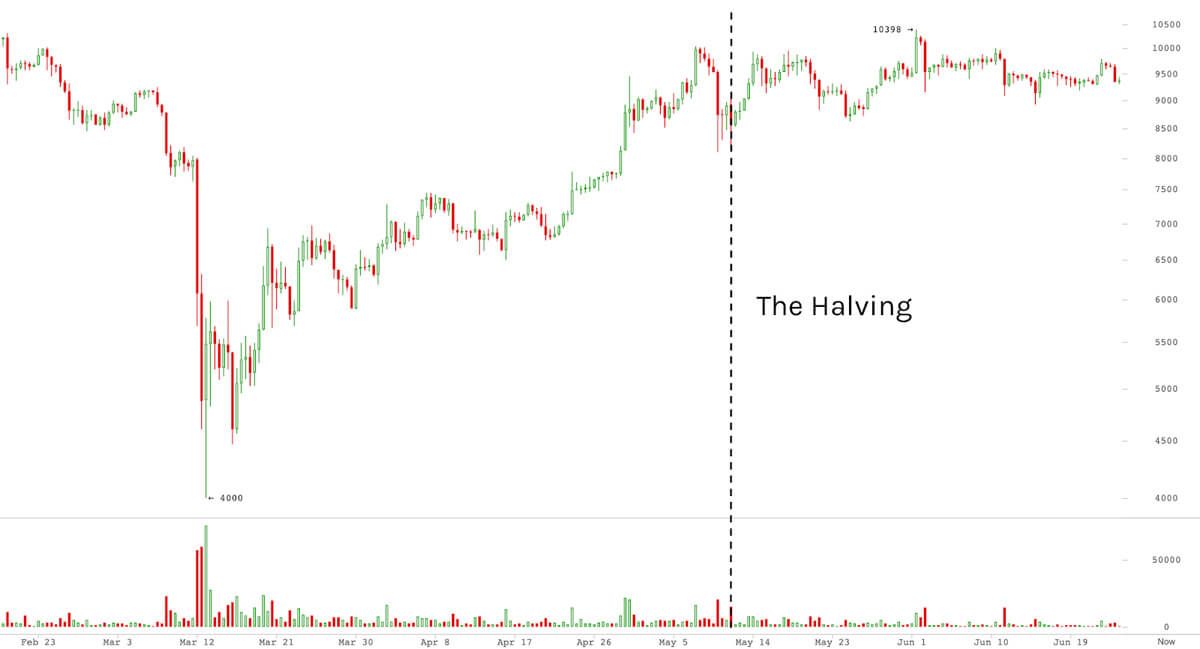
In the hours before the halving on May 11, the bitcoin price was hovering around $8,700-levels, having dropped from right above $10,000 over the preceding 3 days. This move could conceivably be a case of speculative traders ‘buying the rumour’ and then, slightly prematurely, ‘selling the news’. It could also possibly be a case of miners selling extra coins going into the halving to strengthen their cash reserves (although panic-selling three days before the event doesn’t strike us as a likely action by miners).

The Halving did not Cause Extraordinary Volatility in Bitcoin Prices

US$..
The Halving graphSource: bitcoinwisdom.io

However, looking at these moves within the context of the normal volatility levels of bitcoin (normally ranging between 1% - 5%), we don’t believe they can be considered anything out of the ordinary. The price didn’t make any major moves on the day of and after the halving, within three days, it again reached levels just shy of $10,000, paring back its pre-halving losses. In bitcoin markets, moves of similar magnitude are pretty much par for the course.

Scenario #5: The Halving Will be a Big Fat Nothing-Burger (At Least Initially)

At the technical level, the halving was, fairly predictably, rather boring. The system didn’t break, all nodes kept functioning as intended and the block reward came down exactly as expected.

The hashrate initially dropped and the difficulty followed soon thereafter. If anything should count as a surprise in this context, it was the speed with which the hashrate recovered.

At the time of writing prices are in the mid-to-low $9,000-range, well within the yearly range. With both short-term bulls and bears left disappointed, and neither hashrate nor price nor the protocol doing anything outside of the ordinary, we are led to conclude that at least on a short-term basis, just like the two previous halvings, this one was also indeed a big fat nothing-burger.

The Rapid Recovery of the Hashrate was the Biggest Surprise of the Halving

Around half-way through the first full post-halving difficulty period, the hashrate already started recovering. At this point the price was hovering around the $9,500-range, providing some relief to low-margin miners compared to the high $8,000-levels. The recovery was swift, and before the end of May 3-day hashrate estimates were back above 100 EH/s, by early June they approached 120 EH/s. At the third post-halving adjustment, difficulty increased by a massive 14.8% from the bottom, more or less resetting the difficulty to pre-halving levels.

Bitcoin 3-day Hashrate Estimate Fell Post-Halving Then Rapidly Recovered

EH/s
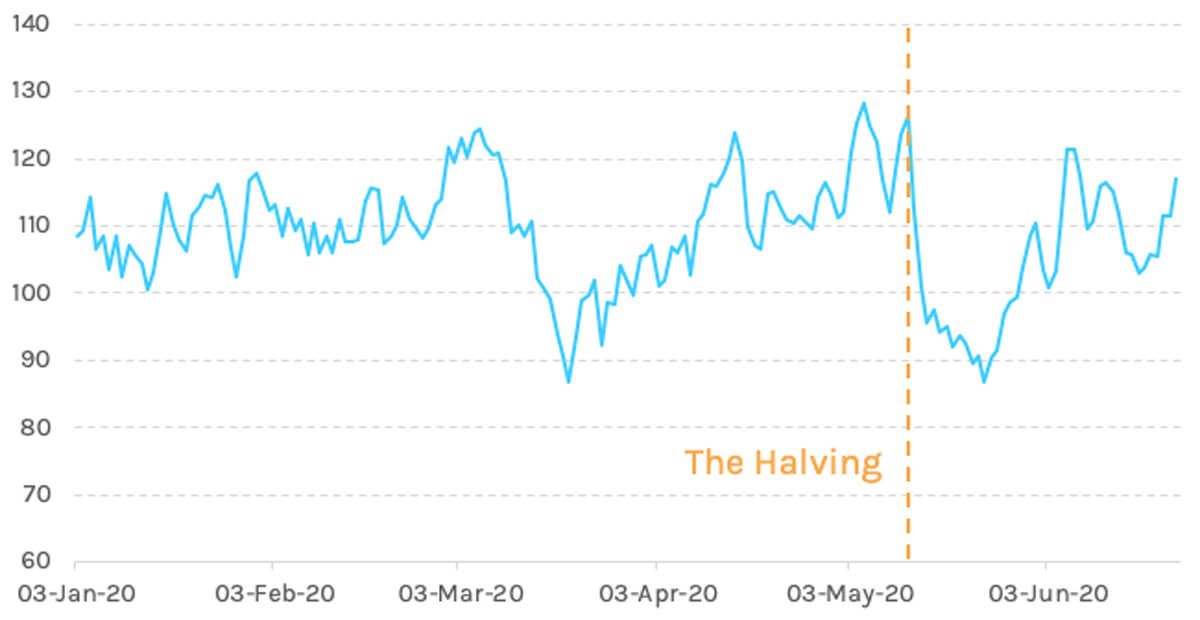
Bitcoin 3-day Hashrate Estimate Fell Post-Halving Then Rapidly RecoveredSource: CoinMetrics

In late April, we estimated that between 10% and 20% of hashpower would be forced off the network, post-halving, even with prices between $9,000 and $10,000. We based this on our estimate that around 30% of the network consisted of previous generation hardware whose efficiency would make them obsolete post-halving except in areas of abnormally cheap power (<¢1/kWh). This leads us to believe that the recovery in hashrate has predominantly been fuelled by new additions of next-generation hardware replacing obsolete gear.

Going forward we might experience higher than normal hashrate volatility as the mining network adjusts to find its new difficulty equilibrium.

But in the absence of any dramatic negative price action we don’t expect any double-digit difficulty adjustments neither up nor down. As the now mostly obsolete older generation gear gets swapped for more efficient hardware, we suspect a return to the standard of slowly increasing difficulty conditions.

And What About the CoinShares Research Opinion, Then?

Our opinion remains that the halving is likely to have a positive effect on price over the mid- to long-term, as supply is reduced in the face of what seems to be unshaken demand. However, these effects will take much longer than a few weeks to materialise.

The rapid recovery in hashrate and difficulty means that mining margins are likely to remain thin at current prices. However, we still believe the reduction of ongoing supply, in the face of seemingly undeterred demand, and in a macroeconomic context of record levels of monetary expansion has the potential to act as a trifecta of positive catalysts for bitcoin markets over the mid- to long-term.

Published onJul 14th, 2020

Writer
Led Bitcoin Research since 2017.

Welcome to CoinShares

Personal Data

0102

When you visit CoinShares website, cookies enhance your experience. They help us to show you more relevant content. Some cookies are necessary for the site to work and will always be active. Blocking some types of cookies may impact your experience of the website and the services which we offer on our website.

We use cookies on our site to optimize our services. Learn more about our EU cookie policy or US cookie policy.

  • Necessary
    Question circle icon
  • Preferences
    Question circle icon
  • Statistical
    Question circle icon
  • Marketing
    Question circle icon

Don't invest unless you're prepared to lose all the money you invest. This is a high-risk investment, and you should not expect to be protected if something goes wrong. Take 2 mins to learn more. Approved by Archax 19/12/2025

Necessary cookies help make a website usable by enabling basic functions like page navigation and access to secure areas of the website. The website cannot function properly without these cookies.
Preference cookies enable a website to remember information that changes the way the website behaves or looks, like your preferred language or the region that you are in.
Statistic cookies help website owners to understand how visitors interact with websites by collecting and reporting information anonymously.
Marketing cookies are used to track visitors across websites. The intention is to display ads that are relevant and engaging for the individual user and thereby more valuable for publishers and third party advertisers.