
This website uses cookies
We use cookies to personalise content and ads, to provide social media features and to analyse our traffic. We also share information about your use of our site with our social media, advertising and analytics partners who may combine it with other information that you’ve provided to them or that they’ve collected from your use of their services.
Consent Selection
Details
  • Necessary cookies help make a website usable by enabling basic functions like page navigation and access to secure areas of the website. The website cannot function properly without these cookies.

    • Learn more about this provideropens in a new window
      CookieConsentStores the user's cookie consent state for the current domain
      Maximum Storage Duration: 1 yearType: HTTP Cookie
    • Learn more about this provideropens in a new window
      bcookieUsed in order to detect spam and improve the website's security.
      Maximum Storage Duration: 1 yearType: HTTP Cookie
      li_gcStores the user's cookie consent state for the current domain
      Maximum Storage Duration: 180 daysType: HTTP Cookie
    • Learn more about this provideropens in a new window
      datadomeUsed in context with the website's BotManager. The BotManager detects, categorizes and compiles reports on potential bots trying to access the website.
      Maximum Storage Duration: 1 yearType: HTTP Cookie
    • _pk_testcookie_domainThis cookie determines whether the browser accepts cookies.
      Maximum Storage Duration: 1 dayType: HTTP Cookie
    • __cf_bm [x3]This cookie is used to distinguish between humans and bots. This is beneficial for the website, in order to make valid reports on the use of their website.
      Maximum Storage Duration: 1 dayType: HTTP Cookie
  • Preference cookies enable a website to remember information that changes the way the website behaves or looks, like your preferred language or the region that you are in.
    • Learn more about this provideropens in a new window
      lidcRegisters which server-cluster is serving the visitor. This is used in context with load balancing, in order to optimize user experience.
      Maximum Storage Duration: 1 dayType: HTTP Cookie
  • Statistic cookies help website owners to understand how visitors interact with websites by collecting and reporting information anonymously.
    • Learn more about this provideropens in a new window
      personalization_idThis cookie is set by Twitter - The cookie allows the visitor to share content from the website onto their Twitter profile.
      Maximum Storage Duration: 400 daysType: HTTP Cookie
    • _pk_uidUsed by Piwik Analytics Platform to identify the visitor on repeat visits to the website.
      Maximum Storage Duration: 1 yearType: HTTP Cookie
      _pk_id#Collects statistics on the user's visits to the website, such as the number of visits, average time spent on the website and what pages have been read.
      Maximum Storage Duration: 1 yearType: HTTP Cookie
      _pk_ses#Used by Piwik Analytics Platform to track page requests from the visitor during the session.
      Maximum Storage Duration: 1 dayType: HTTP Cookie
    • FPGSIDRegisters statistical data on users' behaviour on the website. Used for internal analytics by the website operator.
      Maximum Storage Duration: 1 dayType: HTTP Cookie
      FPIDRegisters statistical data on users' behaviour on the website. Used for internal analytics by the website operator.
      Maximum Storage Duration: 400 daysType: HTTP Cookie
      FPLCRegisters a unique ID that is used to generate statistical data on how the visitor uses the website.
      Maximum Storage Duration: 1 dayType: HTTP Cookie
    • _gaRegisters a unique ID that is used to generate statistical data on how the visitor uses the website.
      Maximum Storage Duration: 2 yearsType: HTTP Cookie
      _ga_#Used by Google Analytics to collect data on the number of times a user has visited the website as well as dates for the first and most recent visit.
      Maximum Storage Duration: 2 yearsType: HTTP Cookie
  • Marketing cookies are used to track visitors across websites. The intention is to display ads that are relevant and engaging for the individual user and thereby more valuable for publishers and third party advertisers.
    • Learn more about this provideropens in a new window

      Some of the data collected by this provider is for the purposes of personalization and measuring advertising effectiveness. The provider may use the IP Addresses for ads measurement and ads personalization.

      ads/ga-audiencesUsed by Google AdWords to re-engage visitors that are likely to convert to customers based on the visitor's online behaviour across websites.
      Maximum Storage Duration: SessionType: Pixel Tracker
    • Learn more about this provideropens in a new window
      #:session-dataTracks the individual sessions on the website, allowing the website to compile statistical data from multiple visits. This data can also be used to create leads for marketing purposes.
      Maximum Storage Duration: PersistentType: HTML Local Storage
      eng_mtTracks the conversion rate between the user and the advertisement banners on the website - This serves to optimise the relevance of the advertisements on the website.
      Maximum Storage Duration: PersistentType: HTML Local Storage
      t_gidThis cookie assigns a specific visitor ID, when the visitor interacts with ads or content from the website - this allows the website to target the visitor with similar ads or content.
      Maximum Storage Duration: 1 yearType: HTTP Cookie
      t_pt_gidCollects information on user preferences and/or interaction with web-campaign content - This is used on CRM-campaign-platform used by website owners for promoting events or products.
      Maximum Storage Duration: 1 yearType: HTTP Cookie
      taboola global:user-idSets a unique ID for the visitor, that allows third party advertisers to target the visitor with relevant advertisement. This pairing service is provided by third party advertisement hubs, which facilitates real-time bidding for advertisers.
      Maximum Storage Duration: PersistentType: HTML Local Storage
      taboola_session_idThis cookie is used to collect information on a visitor. This information will become an ID string with information on a specific visitor – ID information strings can be used to target groups with similar preferences, or can be used by third-party domains or ad-exchanges.
      Maximum Storage Duration: SessionType: HTTP Cookie
    • Learn more about this provideropens in a new window
      1/i/adsct [x2]Collects data on user behaviour and interaction in order to optimize the website and make advertisement on the website more relevant.
      Maximum Storage Duration: SessionType: Pixel Tracker
      muc_adsCollects data on user behaviour and interaction in order to optimize the website and make advertisement on the website more relevant.
      Maximum Storage Duration: 400 daysType: HTTP Cookie
      guest_idCollects data related to the user's visits to the website, such as the number of visits, average time spent on the website and which pages have been loaded, with the purpose of personalising and improving the Twitter service.
      Maximum Storage Duration: 400 daysType: HTTP Cookie
      guest_id_adsCollects information on user behaviour on multiple websites. This information is used in order to optimize the relevance of advertisement on the website.
      Maximum Storage Duration: 400 daysType: HTTP Cookie
      guest_id_marketingCollects information on user behaviour on multiple websites. This information is used in order to optimize the relevance of advertisement on the website.
      Maximum Storage Duration: 400 daysType: HTTP Cookie
    • _gcl_auUsed by Google AdSense for experimenting with advertisement efficiency across websites using their services.
      Maximum Storage Duration: 3 monthsType: HTTP Cookie
      _gcl_lsTracks the conversion rate between the user and the advertisement banners on the website - This serves to optimise the relevance of the advertisements on the website.
      Maximum Storage Duration: PersistentType: HTML Local Storage
    • pardot [x2]Used in context with Account-Based-Marketing (ABM). The cookie registers data such as IP-addresses, time spent on the website and page requests for the visit. This is used for retargeting of multiple users rooting from the same IP-addresses. ABM usually facilitates B2B marketing purposes.
      Maximum Storage Duration: SessionType: HTTP Cookie
  • Unclassified cookies are cookies that we are in the process of classifying, together with the providers of individual cookies.
    • cs_analytics_ip_blockedPending
      Maximum Storage Duration: SessionType: HTTP Cookie
      user_tokenPending
      Maximum Storage Duration: 1 yearType: HTTP Cookie
    • aw_daPending
      Maximum Storage Duration: PersistentType: HTML Local Storage
    • _twpidPending
      Maximum Storage Duration: SessionType: HTTP Cookie
      _twsidPending
      Maximum Storage Duration: SessionType: HTTP Cookie
Cookie declaration last updated on 10/19/26 by Cookiebot
[#IABV2_TITLE#]
[#IABV2_BODY_INTRO#]
[#IABV2_BODY_LEGITIMATE_INTEREST_INTRO#]
[#IABV2_BODY_PREFERENCE_INTRO#]
[#IABV2_BODY_PURPOSES_INTRO#]
[#IABV2_BODY_PURPOSES#]
[#IABV2_BODY_FEATURES_INTRO#]
[#IABV2_BODY_FEATURES#]
[#IABV2_BODY_PARTNERS_INTRO#]
[#IABV2_BODY_PARTNERS#]
About
Cookies are small text files that can be used by websites to make a user's experience more efficient.

The law states that we can store cookies on your device if they are strictly necessary for the operation of this site. For all other types of cookies we need your permission.

This site uses different types of cookies. Some cookies are placed by third party services that appear on our pages.

You can at any time change or withdraw your consent from the Cookie Declaration on our website.

Learn more about who we are, how you can contact us and how we process personal data in our Privacy Policy.

Please state your consent ID and date when you contact us regarding your consent.
Image The four ways stablecoins reach an equity portfolio

The four ways stablecoins reach an equity portfolio

Timer9 min read

  • Finance
  • Altcoins
  • Data

Stablecoins have grown beyond a crypto-market story. They can move the earnings and valuations of listed banks, exchanges and payment networks without an investor ever buying one. When people move cash from current accounts into tokens backed by Treasury bills, banks lose cheap funding and may have to replace it at a higher cost.
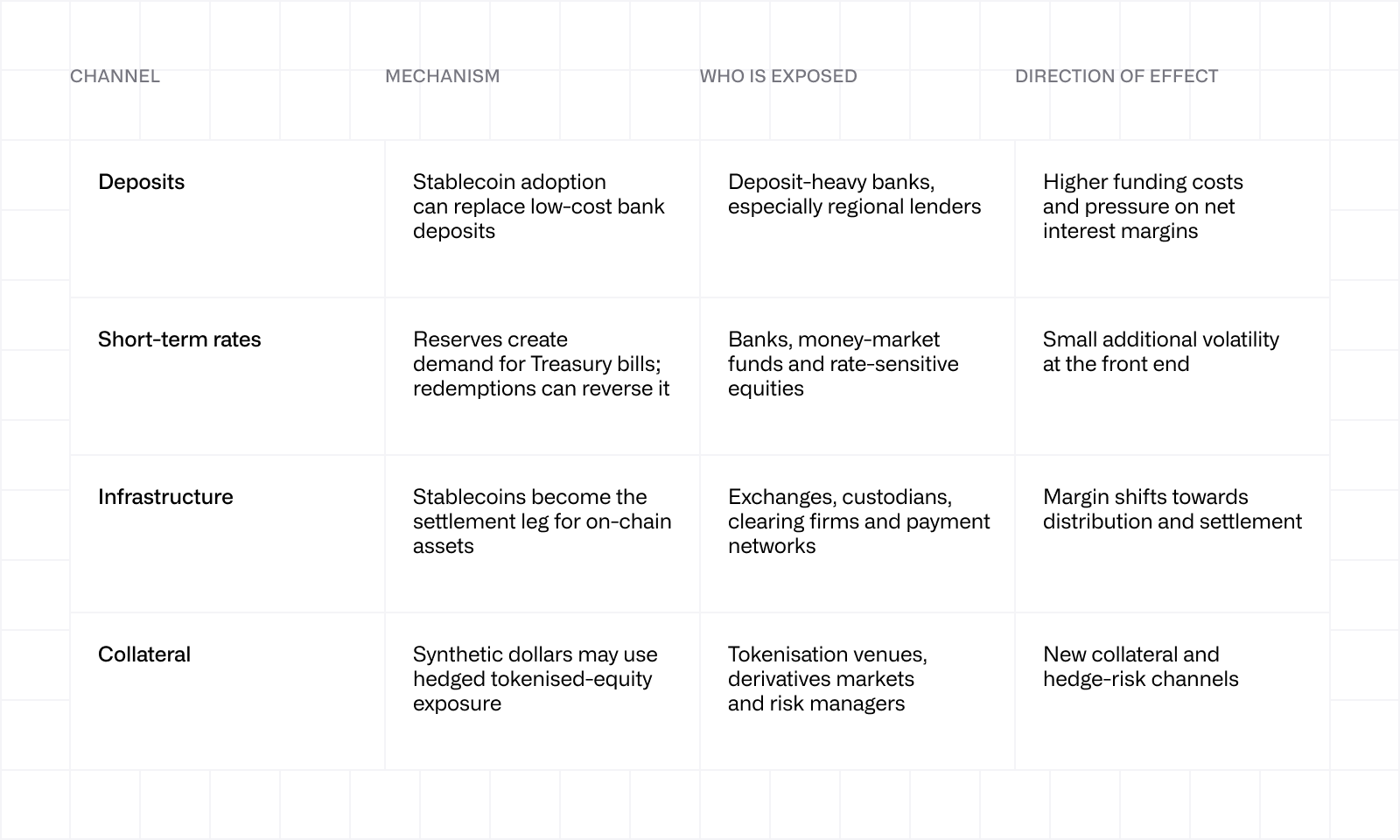
how to stablecoins transmit into equity markets

Do stablecoins take deposits away from banks, and which banks are most exposed?

Treasury advisers flagged $6.6T of US transactional deposits as exposed in April 2025 and total stablecoin supply equals 4.6% of that figure. An IMF study with data to June 2025 found no significant share price reaction in large or community banks to stablecoin demand shocks. So far, stablecoin adoption looks more like a margin risk than a funding shock. 

A stablecoin works like a very simple bank. Someone hands over a dollar and the issuer keeps safe assets against it, known as stablecoin reserves. A current account is cheap, steady funding, because customers rarely move it and earn little for leaving it there. When that dollar moves into a stablecoin, the bank has to replace it with funding that costs more.

The scale so far is small next to the pool at stake. Total supply stood at $305.83B on 27 September 2026, 0.8% below the $308.16B of 31 March. Two issuers, Tether and Circle, hold 84.7% of it. A static market is itself the finding: the deposit threat is a question of years and policy, not of this quarter's growth rate.

Exposure is uneven. Investors can screen on net interest income as a share of total revenue: lending-heavy banks, such as US regional lenders, score higher than diversified banks or investment banks, so they have more to lose if funding costs rise. The same screen works on European financials.

The policy fight sets the speed. The GENIUS Act, signed in July 2025, requires one dollar of reserves for every token and bars issuers from paying interest to holders. It does not clearly stop exchanges paying rewards on tokens held on their platforms, and many do. According to the Congressional Research Service (6 March 2026) and the Council of Economic Advisers (April 2026), banks want exchanges to stop paying rewards on stablecoins, because those rewards make the tokens compete more directly with bank deposit accounts. Exchanges want to keep offering them. It is a fight over whether a token is allowed to look like a current account, with bank equities on one side and exchange equities on the other.

How do stablecoins affect Treasury bill yields and short-term rates?

Stablecoin reserves sit mostly in short-dated US government instruments, so supply growth adds demand at the front end. BIS research using data through March 2026 finds that a $3.5B inflow lowers three-month bill yields by 0.7 basis points on impact and about four basis points within ten days, with a larger effect when Treasury-market liquidity is strained.

A basis point is one hundredth of a percentage point, so the effect is real but small. An earlier version found that equal-sized outflows had a larger effect. The current BIS research does not restate that comparison, so treat the asymmetry as unsettled.

In its Q2 2026 attestation release of 31 July 2026, Tether reported $187.8B of total assets at 30 June, with most reserves held in US government-backed instruments and short-term liquidity facilities.

For an equity investor, growth is a mild tailwind for bill prices. A shrinking market could be a sharper shock, because the stress that triggers redemptions is when the bill market can least absorb the selling. The BIS paper measures the yield response to stablecoin flows; it does not show that redemptions occur when bill-market liquidity is weakest. Treat this as a risk scenario, not an observed outcome. Redemptions on that scale have not been tested. The largest seven-day fall in supply in the past year was $3.83B, in the week to 1 February 2026.

What an equity investor takes from this is not a level but a variance. Stablecoins add a little to rate swings and do not set the level, but short rates feed bank funding costs, money market fund yields and the discount rate on every other asset.

How are stablecoins changing settlement and market infrastructure?

Stablecoins are becoming the cash leg of on-chain settlement, so distribution and settlement revenue is now contested. Circle’s five-year agreement with Binance, announced on 22 September 2026 with a $100M Binance equity investment, shows how much issuers lean on large distributors for reach.

The settlement leg is the cash side of a trade, where money changes hands as the asset is delivered. On blockchains, that leg increasingly uses stablecoins. This is the most structural channel: its importance depends less on today’s supply growth than on where tokenised assets eventually settle. Where an asset settles, in which currency and on whose rails are revenue questions for exchanges, clearing houses, custodians and card networks, all of which are listed.

Two features of the plumbing matter. A dollar that settles in seconds, at any hour, can be posted, moved and recalled in ways a bank wire cannot, which lets intermediaries hold smaller buffers and changes what their service is worth. And because stablecoin settlement never closes while shares trade on exchange hours, a timing gap opens between the two markets.

Ethereum’s share of stablecoin supply fell from 53.0% to 48.0% between 31 March and 27 September 2026, while Tron rose from 28.0% to 30.9%, Solana from 4.8% to 5.4% and Hyperliquid from 1.7% to 2.5%. The shift indicates which networks are gaining a larger share of stablecoin liquidity and, with it, greater economic relevance.

Distribution is where the rent settles. Circle’s release describes a $100M share purchase by Binance at a 5.0% discount, and a commercial agreement under which Binance promotes USDC and Circle provides infrastructure. It gives no fee terms. With total supply broadly flat and USDC share little changed (24.7% against 25.1% on 31 March), the deal suggests distribution has become a cost of defending reach. Whether it reduces issuer margins depends on terms Circle has not yet disclosed. The question for investors is not whether stablecoins win but which listed layer keeps the margin.

Why are stablecoins starting to be backed by tokenised equities?

Ethena said on 25 September 2026 that Binance will be its first venue for extending USDe’s basis trade into equity perpetual futures, and The Block reported that part of the backing will be tokenised US equities. Equities are becoming collateral for instruments priced like cash, which makes the quality of that collateral a diligence question.

USDe is a synthetic dollar backed by a trade rather than bank deposits. Ethena holds tokenised equities, blockchain tokens that track listed shares, and shorts matching perpetual futures, derivatives without an expiry date, so price movements are designed to offset. The remaining return is the funding rate, a payment between traders for leverage. Cash-and-carry, in other words, with equities in place of commodities.

This creates a new source of demand for tokenised shares and equity perpetuals, driven by collateral needs rather than a view on the company. The key question is whether the hedge holds under stress, given that equity-perpetual markets are far thinner than their crypto equivalents. Synthetic dollars can blur the line between cash-like instruments and equity-backed collateral.

Ethena deserves a fair counterweight. USDe supply fell 74.7%, from $14.83B on 4 October 2025 to $3.75B on 28 April 2026, a redemption of that size settled without the instrument breaking, which is the test the design exists to pass. It stood at $4.94B on 27 September 2026. 

The practical step is not to form a view on any stablecoin. It is to know where in a portfolio the exposure already sits: regional bank margins, front-end rate swings, exchange and payment network revenue, and now the collateral behind instruments treated as cash.

FAQs

Do stablecoins take deposits away from banks, and which banks are most exposed? Some deposits move, but supply is flat and equals 4.6% of the $6.6T of US transactional deposits flagged as at risk. Deposit-funded lenders, such as US regional banks, carry the most exposure.

How do stablecoins affect Treasury bill yields and short-term rates? Slightly: BIS research finds a $3.5B inflow lowers three-month bill yields by about 4 basis points within ten days.

How are stablecoins changing settlement and market infrastructure? Settlement and distribution revenue is now contested between exchanges, custodians, clearing firms, card networks and issuers.

Why are stablecoins starting to be backed by tokenised equities? Equity hedges widen the pool of assets that can back a synthetic dollar beyond crypto, at the cost of tying its stability to thinner equity derivatives markets.

Published onOct 23rd, 2026

Writer
CoinShares Author Logo
CoinShares

Don't invest unless you're prepared to lose all the money you invest. This is a high-risk investment, and you should not expect to be protected if something goes wrong. Take 2 mins to learn more. Approved by Archax 19/12/2025