
Uniswap, the fee machine at the heart of Robinhood's new chain
 4 min read
- Altcoins
When Robinhood switched on the public mainnet of Robinhood Chain on 1 July, most of the attention went to the headline products: tokenised stocks tradable around the clock in more than 120 countries, perpetual futures in the wallet, agentic trading accounts.1 The more revealing detail sat lower in the announcement. Among the chain's day-one partners, the brokerage with 27.7 million funded customers named Uniswap, which is deploying a dedicated AMM to serve as a primary public liquidity protocol.1
It is worth asking why a company of Robinhood's scale leans on existing DeFi infrastructure for the most critical piece of its exchange stack. The fee data explains why that choice carried so little risk.
The largest fee generator in DeFi history
Uniswap has now collected over $5.0B in cumulative trading fees, more than any other decentralised protocol ever built.2
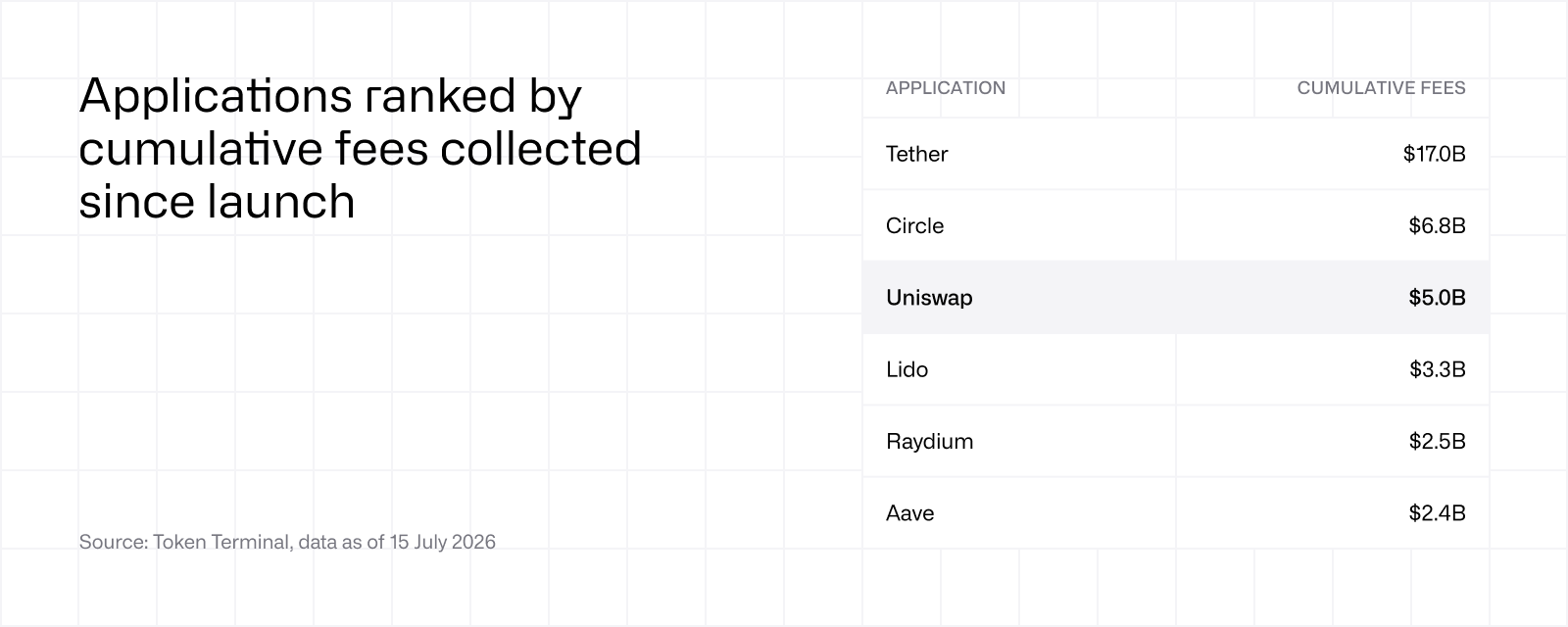 Cumulative fees, all crypto applications, as of 15 July 20262
Only the stablecoin issuers Tether and Circle have earned more, and both are centralised companies running money-market operations. Strip those out and Uniswap sits alone at the top of decentralised protocols.2
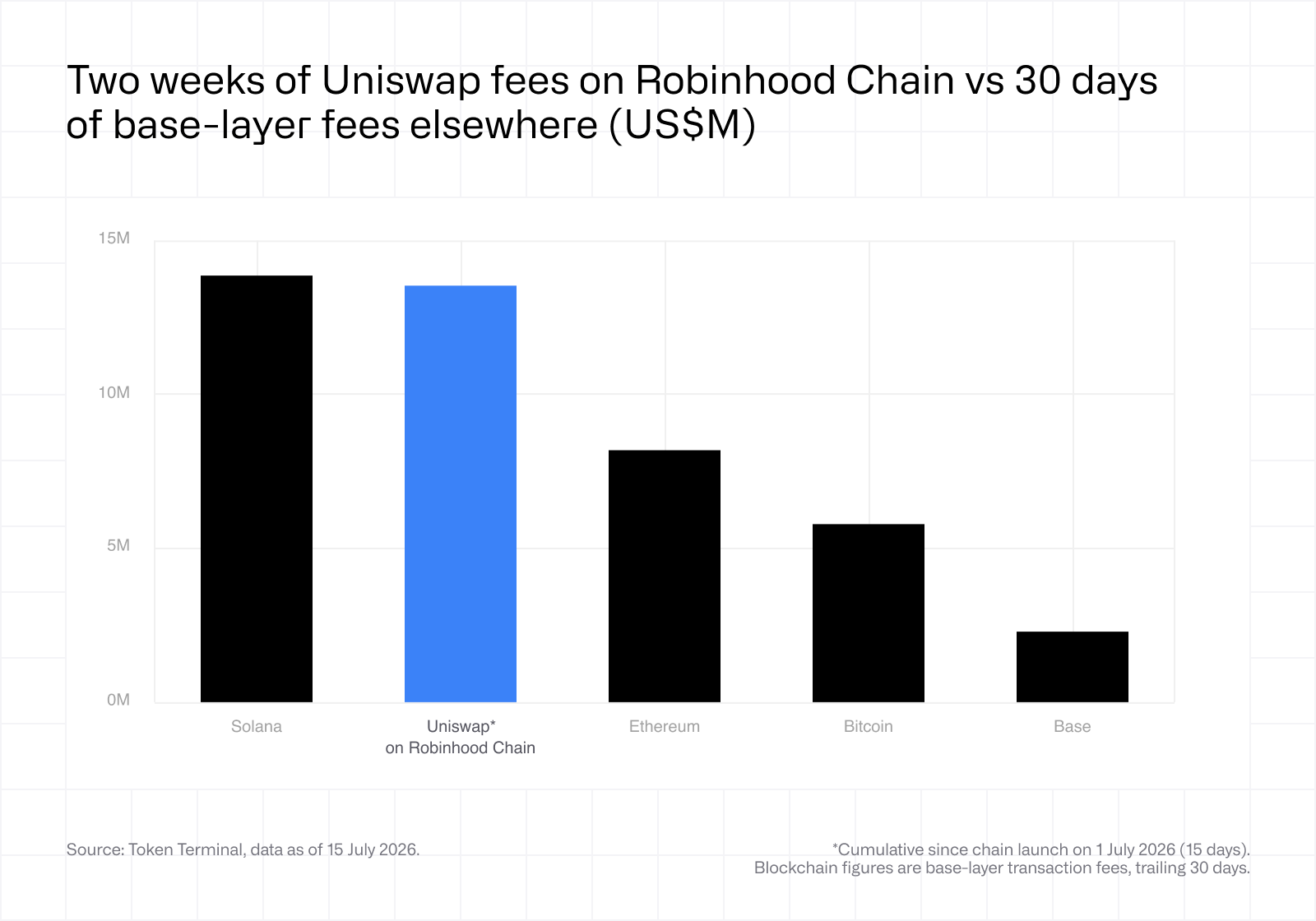
The run rate remains substantial. Over the past 30 days, Uniswap generated $42.8M in fees on $38.3B of spot volume, an annualised pace of roughly $520M.2 To put that in perspective, users have paid more to trade on Uniswap’s deployment on Robinhood Chain in 15 days since launch ($13.2M) than they have paid in base-layer fees on Ethereum ($8.2M), Bitcoin ($5.8M), Solana ($13.8M) and Base ($2.3M) over the past 30 days.2 An application is out-earning the blockchains it runs on.
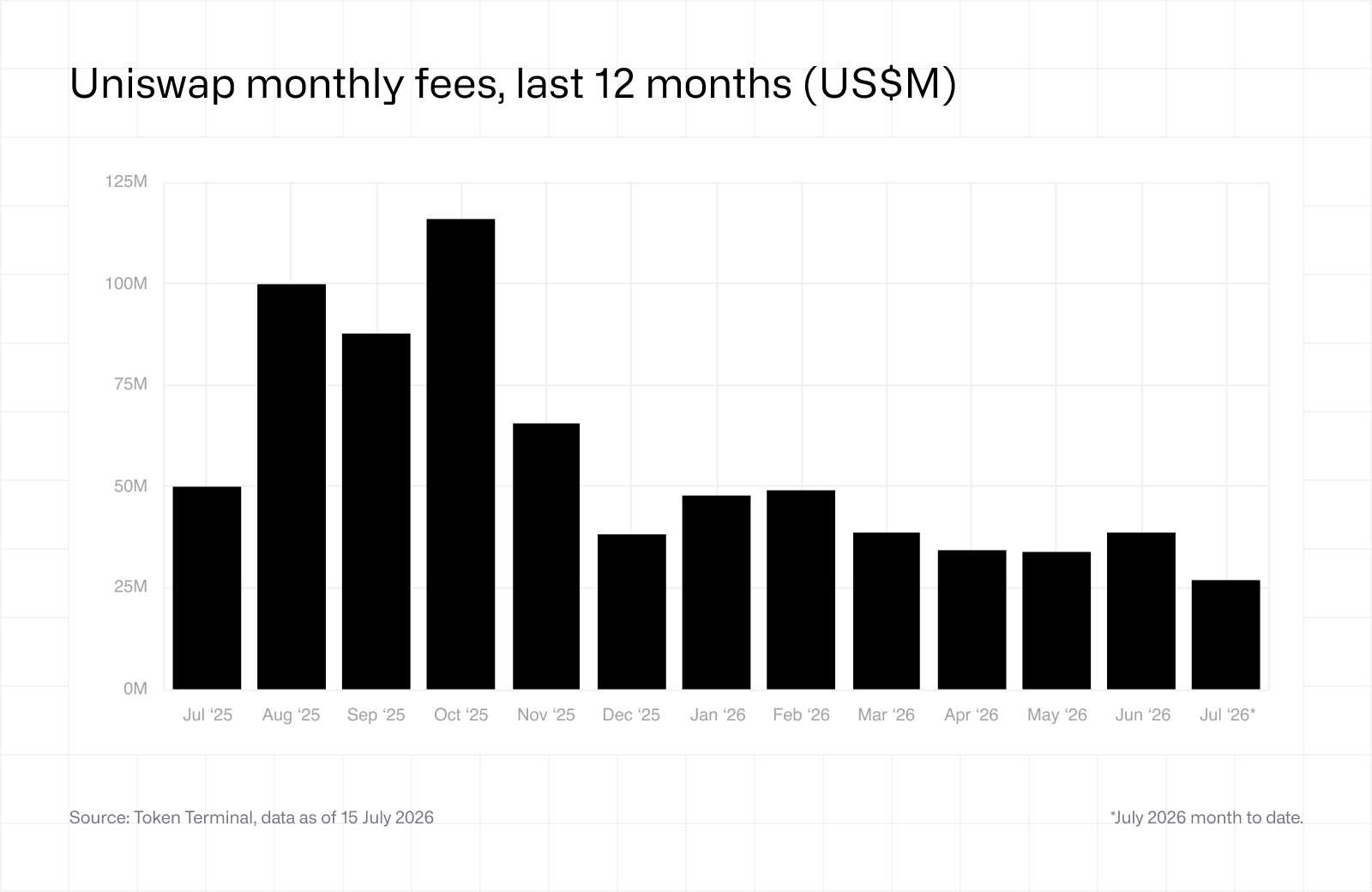
 The caveat: activity is well off its cycle peak. Monthly fees topped $115.9M in October 2025 and have since settled into a $34M to $49M range through 2026.2 Fee income at Uniswap is a function of volatility and volume, and both have cooled. The application durability balances the picture. Live since 2018, Uniswap has generated fees without interruption through two full market cycles, across four protocol versions, on multiple chains, without custody, order books or market-making agreements. A brokerage integrating an exchange needs exactly that property: liquidity infrastructure that keeps functioning whether markets are euphoric or dead. Years of uninterrupted fee generation are the closest thing DeFi has to an operating track record.
The fee switch changes the story
What has changed is who gets paid. For most of its existence, Uniswap passed every dollar of fees to liquidity providers while the protocol, and UNI holders, earned nothing. That ended on 27 December 2025, when the long-debated fee switch went live. The protocol now retains roughly 9.5% of total fees, about $4.1M over the past 30 days, with the remaining 90.5% still flowing to LPs.2 At the current pace that is close to $50M of annualised protocol revenue, modest against a $5B fee history, but it converts Uniswap from a public utility into something an investor can actually value.
That makes the Robinhood integration more than a distribution win. Tokenised stocks swapped through Uniswap's AMM on Robinhood Chain generate the same swap fees that built those numbers. Could tokenised equities become Uniswap's next fee leg? In its first week, Robinhood Chain recorded roughly $570M of DEX volume on about $22M of liquidity, much of it memecoin speculation rather than stock tokens.3 Against $38B of monthly Uniswap spot volume that is a rounding error, but it is a new asset class, attached to a retail funnel of 27.7 million customers, on a chain where Uniswap is a flagship venue.
Fee generation has always been the cleanest measure of product-market fit in crypto. On that measure, Robinhood didn't take a risk. It picked the incumbent.
Sources
Robinhood Markets, "Robinhood Accelerates Global Expansion with Robinhood Chain Mainnet, Stock Tokens, Agentic Trading and New Suite of DeFi Products", 1 July 2026
Token Terminal, data as of 15 July 2026
crypto.news, "Robinhood Chain did $570m volume on $21m of liquidity: the launch week autopsy", July 2026