

This website uses cookies
We use cookies to personalise content and ads, to provide social media features and to analyse our traffic. We also share information about your use of our site with our social media, advertising and analytics partners who may combine it with other information that you’ve provided to them or that they’ve collected from your use of their services.
Consent Selection
Details
  • Necessary cookies help make a website usable by enabling basic functions like page navigation and access to secure areas of the website. The website cannot function properly without these cookies.

    • Learn more about this provideropens in a new window
      CookieConsentStores the user's cookie consent state for the current domain
      Maximum Storage Duration: 1 yearType: HTTP Cookie
    • Learn more about this provideropens in a new window
      bcookieUsed in order to detect spam and improve the website's security.
      Maximum Storage Duration: 1 yearType: HTTP Cookie
      li_gcStores the user's cookie consent state for the current domain
      Maximum Storage Duration: 180 daysType: HTTP Cookie
    • Learn more about this provideropens in a new window
      datadomeUsed in context with the website's BotManager. The BotManager detects, categorizes and compiles reports on potential bots trying to access the website.
      Maximum Storage Duration: 1 yearType: HTTP Cookie
    • _pk_testcookie_domainThis cookie determines whether the browser accepts cookies.
      Maximum Storage Duration: 1 dayType: HTTP Cookie
    • __cf_bm [x3]This cookie is used to distinguish between humans and bots. This is beneficial for the website, in order to make valid reports on the use of their website.
      Maximum Storage Duration: 1 dayType: HTTP Cookie
  • Preference cookies enable a website to remember information that changes the way the website behaves or looks, like your preferred language or the region that you are in.
    • Learn more about this provideropens in a new window
      lidcRegisters which server-cluster is serving the visitor. This is used in context with load balancing, in order to optimize user experience.
      Maximum Storage Duration: 1 dayType: HTTP Cookie
  • Statistic cookies help website owners to understand how visitors interact with websites by collecting and reporting information anonymously.
    • Learn more about this provideropens in a new window
      guestRegisters data on visitors' website-behaviour. This is used for internal analysis and website optimization.
      Maximum Storage Duration: 1 monthType: HTTP Cookie
    • Learn more about this provideropens in a new window
      personalization_idThis cookie is set by Twitter - The cookie allows the visitor to share content from the website onto their Twitter profile.
      Maximum Storage Duration: 400 daysType: HTTP Cookie
    • _pk_uidUsed by Piwik Analytics Platform to identify the visitor on repeat visits to the website.
      Maximum Storage Duration: 1 yearType: HTTP Cookie
      _pk_id#Collects statistics on the user's visits to the website, such as the number of visits, average time spent on the website and what pages have been read.
      Maximum Storage Duration: 1 yearType: HTTP Cookie
      _pk_ses#Used by Piwik Analytics Platform to track page requests from the visitor during the session.
      Maximum Storage Duration: 1 dayType: HTTP Cookie
    • FPGSIDRegisters statistical data on users' behaviour on the website. Used for internal analytics by the website operator.
      Maximum Storage Duration: 1 dayType: HTTP Cookie
      FPIDRegisters statistical data on users' behaviour on the website. Used for internal analytics by the website operator.
      Maximum Storage Duration: 400 daysType: HTTP Cookie
      FPLCRegisters a unique ID that is used to generate statistical data on how the visitor uses the website.
      Maximum Storage Duration: 1 dayType: HTTP Cookie
    • _gaRegisters a unique ID that is used to generate statistical data on how the visitor uses the website.
      Maximum Storage Duration: 2 yearsType: HTTP Cookie
      _ga_#Used by Google Analytics to collect data on the number of times a user has visited the website as well as dates for the first and most recent visit.
      Maximum Storage Duration: 2 yearsType: HTTP Cookie
  • Marketing cookies are used to track visitors across websites. The intention is to display ads that are relevant and engaging for the individual user and thereby more valuable for publishers and third party advertisers.
    • Learn more about this provideropens in a new window

      Some of the data collected by this provider is for the purposes of personalization and measuring advertising effectiveness. The provider may use the IP Addresses for ads measurement and ads personalization.

      ads/ga-audiencesUsed by Google AdWords to re-engage visitors that are likely to convert to customers based on the visitor's online behaviour across websites.
      Maximum Storage Duration: SessionType: Pixel Tracker
    • Learn more about this provideropens in a new window
      userRefererDetermines how the user accessed the website. This information is used by the website operator in order to measure the efficiency of their marketing.
      Maximum Storage Duration: 1 monthType: HTTP Cookie
    • Learn more about this provideropens in a new window
      #:session-dataTracks the individual sessions on the website, allowing the website to compile statistical data from multiple visits. This data can also be used to create leads for marketing purposes.
      Maximum Storage Duration: PersistentType: HTML Local Storage
      eng_mtTracks the conversion rate between the user and the advertisement banners on the website - This serves to optimise the relevance of the advertisements on the website.
      Maximum Storage Duration: PersistentType: HTML Local Storage
      t_gidThis cookie assigns a specific visitor ID, when the visitor interacts with ads or content from the website - this allows the website to target the visitor with similar ads or content.
      Maximum Storage Duration: 1 yearType: HTTP Cookie
      t_pt_gidCollects information on user preferences and/or interaction with web-campaign content - This is used on CRM-campaign-platform used by website owners for promoting events or products.
      Maximum Storage Duration: 1 yearType: HTTP Cookie
      taboola global:user-idSets a unique ID for the visitor, that allows third party advertisers to target the visitor with relevant advertisement. This pairing service is provided by third party advertisement hubs, which facilitates real-time bidding for advertisers.
      Maximum Storage Duration: PersistentType: HTML Local Storage
      taboola_session_idThis cookie is used to collect information on a visitor. This information will become an ID string with information on a specific visitor – ID information strings can be used to target groups with similar preferences, or can be used by third-party domains or ad-exchanges.
      Maximum Storage Duration: SessionType: HTTP Cookie
    • Learn more about this provideropens in a new window
      1/i/adsct [x2]Collects data on user behaviour and interaction in order to optimize the website and make advertisement on the website more relevant.
      Maximum Storage Duration: SessionType: Pixel Tracker
      muc_adsCollects data on user behaviour and interaction in order to optimize the website and make advertisement on the website more relevant.
      Maximum Storage Duration: 400 daysType: HTTP Cookie
      guest_idCollects data related to the user's visits to the website, such as the number of visits, average time spent on the website and which pages have been loaded, with the purpose of personalising and improving the Twitter service.
      Maximum Storage Duration: 400 daysType: HTTP Cookie
      guest_id_adsCollects information on user behaviour on multiple websites. This information is used in order to optimize the relevance of advertisement on the website.
      Maximum Storage Duration: 400 daysType: HTTP Cookie
      guest_id_marketingCollects information on user behaviour on multiple websites. This information is used in order to optimize the relevance of advertisement on the website.
      Maximum Storage Duration: 400 daysType: HTTP Cookie
    • _gcl_auUsed by Google AdSense for experimenting with advertisement efficiency across websites using their services.
      Maximum Storage Duration: 3 monthsType: HTTP Cookie
      _gcl_lsTracks the conversion rate between the user and the advertisement banners on the website - This serves to optimise the relevance of the advertisements on the website.
      Maximum Storage Duration: PersistentType: HTML Local Storage
    • pardot [x2]Used in context with Account-Based-Marketing (ABM). The cookie registers data such as IP-addresses, time spent on the website and page requests for the visit. This is used for retargeting of multiple users rooting from the same IP-addresses. ABM usually facilitates B2B marketing purposes.
      Maximum Storage Duration: SessionType: HTTP Cookie
  • Unclassified cookies are cookies that we are in the process of classifying, together with the providers of individual cookies.
    • cs_analytics_ip_blockedPending
      Maximum Storage Duration: SessionType: HTTP Cookie
      user_tokenPending
      Maximum Storage Duration: 1 yearType: HTTP Cookie
    • _twpidPending
      Maximum Storage Duration: SessionType: HTTP Cookie
Cookie declaration last updated on 8/20/26 by Cookiebot
[#IABV2_TITLE#]
[#IABV2_BODY_INTRO#]
[#IABV2_BODY_LEGITIMATE_INTEREST_INTRO#]
[#IABV2_BODY_PREFERENCE_INTRO#]
[#IABV2_BODY_PURPOSES_INTRO#]
[#IABV2_BODY_PURPOSES#]
[#IABV2_BODY_FEATURES_INTRO#]
[#IABV2_BODY_FEATURES#]
[#IABV2_BODY_PARTNERS_INTRO#]
[#IABV2_BODY_PARTNERS#]
About
Cookies are small text files that can be used by websites to make a user's experience more efficient.

The law states that we can store cookies on your device if they are strictly necessary for the operation of this site. For all other types of cookies we need your permission.

This site uses different types of cookies. Some cookies are placed by third party services that appear on our pages.

You can at any time change or withdraw your consent from the Cookie Declaration on our website.

Learn more about who we are, how you can contact us and how we process personal data in our Privacy Policy.

Please state your consent ID and date when you contact us regarding your consent.
Image The convergence of Bitcoin mining and AI: from crypto niche to digital power infrastructure

The convergence of Bitcoin mining and AI: from crypto niche to digital power infrastructure

Timer8 min read

  • Finance
  • Technology

Bitcoin miners spent a decade building exactly what the AI economy now needs most: large-scale, power-dense computing facilities. That overlap is reshaping an entire industry, and how investors should think about it.

Bitcoin mining is the process by which new BTC enters circulation and transactions are validated on the network. Miners compete to solve computational puzzles, and the winner earns newly minted bitcoin as a block reward. This proof-of-work mechanism is what secures the largest and most battle-tested decentralised network in digital assets.

But mining has also matured into a standalone industry, with its own economics, supply chain, energy strategy and publicly listed companies. And over the past two years, that industry has undergone its most significant transformation yet: a structural convergence with artificial intelligence and high-performance computing (HPC). What was once a pure-play bet on bitcoin is becoming something broader, a category we would describe as digital power infrastructure.

The economics of mining, briefly

Mining economics rest on three variables: the bitcoin price, the block reward, and energy costs. The April 2024 halving cut the block reward from 6.25 to 3.125 BTC, and newly issued bitcoin still accounts for over 99% of miner revenue, with transaction fees making up the small remainder.1 At the same time, competition has never been fiercer. Hashrate, the combined computing power miners deploy on the network, crossed 1 zettahash per second for the first time in 2025 and remains near record levels.2 That is a one followed by 21 zeros. If every person on Earth performed one calculation per second, it would take humanity roughly 4,000 years to match what the network now processes every second.

Miners therefore face a business where revenue per unit of computation is programmatically squeezed every four years while the cost of competing keeps rising. The winners have always been energy arbitrageurs: operators who secure cheap electricity, often from renewable, stranded or curtailed sources, and convert it into a globally tradeable digital asset.

That pressure explains what happened next. When a new customer arrived willing to pay premium, contracted, dollar-denominated rates for the exact assets miners already owned, the industry listened.

Why AI came knocking

The explosion of demand for AI has created a structural shortage of data centre capacity. The International Energy Agency projects that global data centre electricity consumption will roughly double from around 485 terawatt-hours (TWh) in 2025 to about 950 TWh by 2030, with AI the most important driver. For scale, by 2030 data centres alone would consume slightly more electricity than the whole of Japan does today, and in the United States they are expected to account for almost half of all electricity demand growth to 2030.3

The binding constraint is no longer chips. It is energised land: sites with secured grid connections, high-voltage infrastructure, cooling capability and power purchase agreements. These take years to permit and build from scratch. Bitcoin miners, as it happens, have spent the past decade assembling exactly this portfolio. Mining facilities are large-scale computing sites optimised for power density and heat management, with utility relationships and energy expertise that transfer directly to AI hosting.

From pivot to proof

What began as a speculative narrative has hardened into contracted revenue. Core Scientific has signed 12-year hosting agreements with AI cloud provider CoreWeave worth $10.2B in total contract value.4 IREN secured a five-year, $9.7B AI cloud contract with Microsoft covering NVIDIA GB300 deployments at its Childress, Texas campus.5 TeraWulf has announced over $12B in long-term HPC hosting contracts, and its HPC leasing revenue overtook its bitcoin mining income for the first time in the first quarter of 2026.6 Hut 8 signed a 15-year lease for its Beacon Point campus in Texas reported at $9.8B.7

Across the listed mining sector, cumulative announced AI and HPC contracts now exceed $70B.8 For a group of companies whose combined annual mining revenue is a fraction of that figure, this is not diversification at the margin. It is a re-founding of the business model around two demand engines: bitcoin block rewards and contracted AI compute.
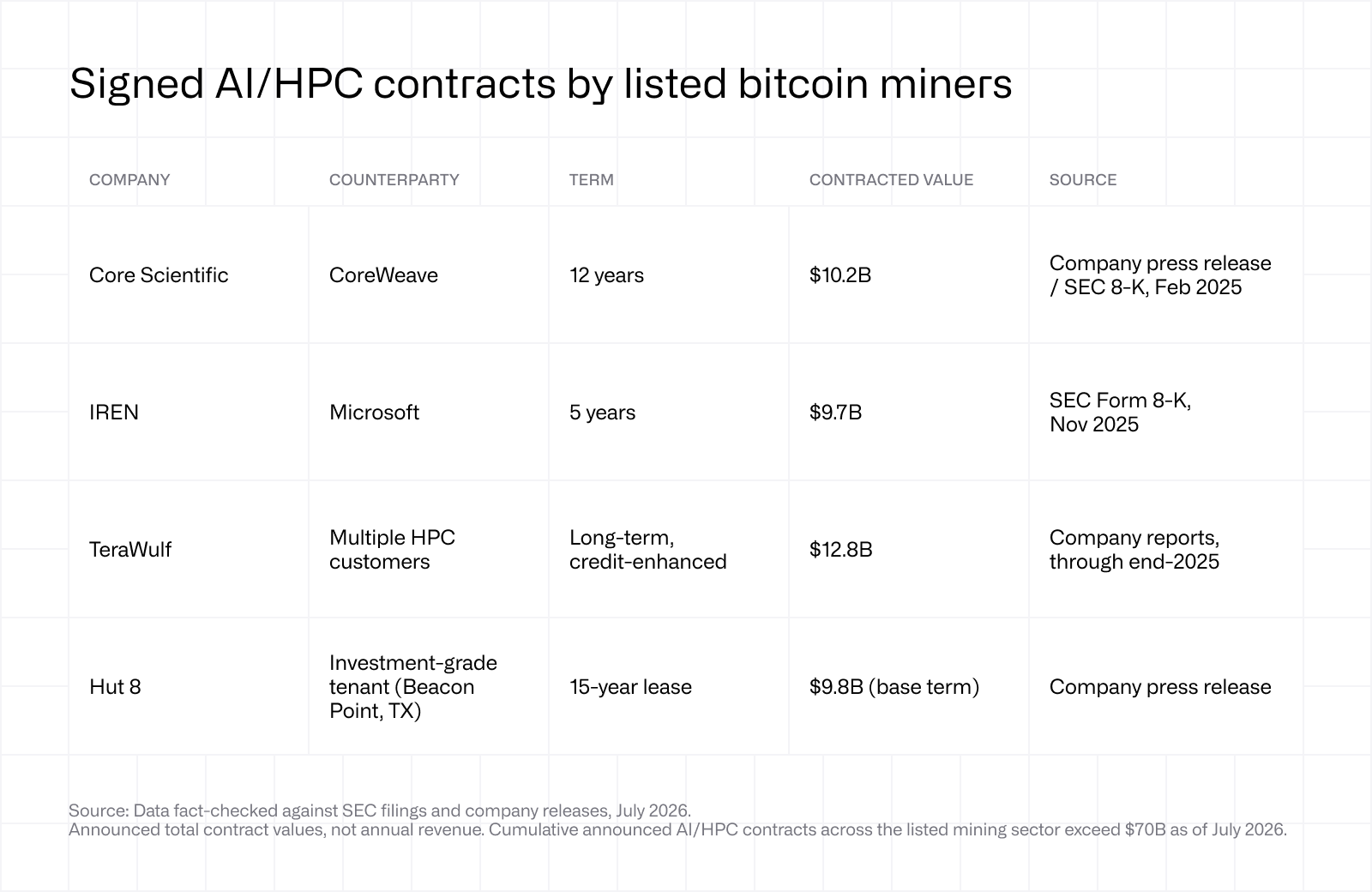
Signed AI HPC contracts by listed bitcoin miners

Energy as the common denominator

The deeper logic of the convergence is energy. Bitcoin mining pioneered a model of energy commoditisation: monetising power at the source, regardless of location or grid connectivity, including flared gas and surplus renewable output. Many mining operations also act as demand-response assets, curtailing consumption when grids are stressed and earning revenue for doing so.

AI data centres now compete for the same scarce resource, but with a different profile: they need firm, always-on power and pay for reliability rather than flexibility. Companies that control cheap, scalable energy capacity can therefore arbitrage between three markets at once: mining bitcoin, hosting AI workloads, and selling flexibility back to the grid. As global power demand accelerates, driven by AI, electrification and data growth, that optionality is the industry's most durable asset.

What this means for WGMI

This transformation is why the CoinShares Bitcoin Mining ETF (WGMI) has updated its strategy. The Fund now invests at least 80% of its net assets in securities of Bitcoin Mining and Digital Power Companies, replacing its prior focus solely on bitcoin mining companies.9

The definition of eligible companies has been expanded to reflect the convergence described above. It now includes companies operating hyperscale data centres designed to support AI and other applications; companies engaged in the design, manufacture or supply of components for data centre operations and AI applications, including semiconductors; companies involved in power generation, energy infrastructure equipment and storage solutions essential to data centre operations; and companies involved in high-performance and quantum computing technologies supporting AI workloads.9 The Fund retains flexibility to invest up to 20% of its net assets in companies with broader bitcoin or digital infrastructure exposure.9

The Fund's investable universe has been redrawn to match where the industry itself has gone: from bitcoin mining as a crypto niche to bitcoin mining as one application of a larger digital power and compute infrastructure theme.

What should investors keep in mind?

The convergence does not remove risk; it changes its shape. Mining equities remain operationally leveraged to the bitcoin price and can fall more sharply than bitcoin itself in drawdowns. The AI hosting business introduces new exposures: customer concentration around a small number of AI counterparties, execution risk on multi-year construction timelines, and financing needs that have grown with ambition. And AI infrastructure demand itself, while structural, will not move in a straight line.

But for investors who previously saw mining stocks as a one-dimensional bitcoin proxy, that framing is now out of date. The sector today offers a multi-thematic case: exposure to bitcoin's supply dynamics, to the buildout of AI computing capacity, and to the ongoing transformation of how energy is sourced, priced and consumed. Few industries sit at that intersection. Fewer still arrived there already holding the right assets.


Sources

1 Token Terminal, Bitcoin miner revenue data, as of 11 July 2026

2 Hashrate Index / CoinWarz network data, July 2026

3 International Energy Agency, Energy and AI report, 2026 update

4 Core Scientific / CoreWeave hosting agreements, company announcements

5 IREN, SEC Form 8-K, November 2025

6 TeraWulf, company reports, Q1 2026

7 Hut 8, company announcement, Beacon Point campus lease

8 Aggregate of announced sector contracts, company disclosures, as of July 2026

9 CoinShares Bitcoin Mining ETF (WGMI), prospectus

Published onAug 18th, 2026

Writer
CoinShares Author Logo
CoinShares

Welcome to CoinShares

Personal Data

0102

When you visit CoinShares website, cookies enhance your experience. They help us to show you more relevant content. Some cookies are necessary for the site to work and will always be active. Blocking some types of cookies may impact your experience of the website and the services which we offer on our website.

We use cookies on our site to optimize our services. Learn more about our EU cookie policy or US cookie policy.

  • Necessary
    Question circle icon
  • Preferences
    Question circle icon
  • Statistical
    Question circle icon
  • Marketing
    Question circle icon

Don't invest unless you're prepared to lose all the money you invest. This is a high-risk investment, and you should not expect to be protected if something goes wrong. Take 2 mins to learn more. Approved by Archax 19/12/2025

Necessary cookies help make a website usable by enabling basic functions like page navigation and access to secure areas of the website. The website cannot function properly without these cookies.
Preference cookies enable a website to remember information that changes the way the website behaves or looks, like your preferred language or the region that you are in.
Statistic cookies help website owners to understand how visitors interact with websites by collecting and reporting information anonymously.
Marketing cookies are used to track visitors across websites. The intention is to display ads that are relevant and engaging for the individual user and thereby more valuable for publishers and third party advertisers.