This website uses cookies
We use cookies to personalise content and ads, to provide social media features and to analyse our traffic. We also share information about your use of our site with our social media, advertising and analytics partners who may combine it with other information that you’ve provided to them or that they’ve collected from your use of their services.
Consent Selection
Details
  • Necessary cookies help make a website usable by enabling basic functions like page navigation and access to secure areas of the website. The website cannot function properly without these cookies.

    • Learn more about this provideropens in a new window
      CookieConsentStores the user's cookie consent state for the current domain
      Maximum Storage Duration: 1 yearType: HTTP Cookie
    • Learn more about this provideropens in a new window
      bcookieUsed in order to detect spam and improve the website's security.
      Maximum Storage Duration: 1 yearType: HTTP Cookie
      li_gcStores the user's cookie consent state for the current domain
      Maximum Storage Duration: 180 daysType: HTTP Cookie
    • Learn more about this provideropens in a new window
      datadomeUsed in context with the website's BotManager. The BotManager detects, categorizes and compiles reports on potential bots trying to access the website.
      Maximum Storage Duration: 1 yearType: HTTP Cookie
    • _pk_testcookie_domainThis cookie determines whether the browser accepts cookies.
      Maximum Storage Duration: 1 dayType: HTTP Cookie
    • __cf_bm [x3]This cookie is used to distinguish between humans and bots. This is beneficial for the website, in order to make valid reports on the use of their website.
      Maximum Storage Duration: 1 dayType: HTTP Cookie
  • Preference cookies enable a website to remember information that changes the way the website behaves or looks, like your preferred language or the region that you are in.
    • Learn more about this provideropens in a new window
      lidcRegisters which server-cluster is serving the visitor. This is used in context with load balancing, in order to optimize user experience.
      Maximum Storage Duration: 1 dayType: HTTP Cookie
  • Statistic cookies help website owners to understand how visitors interact with websites by collecting and reporting information anonymously.
    • Learn more about this provideropens in a new window
      guestRegisters data on visitors' website-behaviour. This is used for internal analysis and website optimization.
      Maximum Storage Duration: 1 monthType: HTTP Cookie
    • Learn more about this provideropens in a new window
      personalization_idThis cookie is set by Twitter - The cookie allows the visitor to share content from the website onto their Twitter profile.
      Maximum Storage Duration: 400 daysType: HTTP Cookie
    • _pk_uidUsed by Piwik Analytics Platform to identify the visitor on repeat visits to the website.
      Maximum Storage Duration: 1 yearType: HTTP Cookie
      _pk_id#Collects statistics on the user's visits to the website, such as the number of visits, average time spent on the website and what pages have been read.
      Maximum Storage Duration: 1 yearType: HTTP Cookie
      _pk_ses#Used by Piwik Analytics Platform to track page requests from the visitor during the session.
      Maximum Storage Duration: 1 dayType: HTTP Cookie
    • FPGSIDRegisters statistical data on users' behaviour on the website. Used for internal analytics by the website operator.
      Maximum Storage Duration: 1 dayType: HTTP Cookie
      FPIDRegisters statistical data on users' behaviour on the website. Used for internal analytics by the website operator.
      Maximum Storage Duration: 400 daysType: HTTP Cookie
      FPLCRegisters a unique ID that is used to generate statistical data on how the visitor uses the website.
      Maximum Storage Duration: 1 dayType: HTTP Cookie
    • _gaRegisters a unique ID that is used to generate statistical data on how the visitor uses the website.
      Maximum Storage Duration: 2 yearsType: HTTP Cookie
      _ga_#Used by Google Analytics to collect data on the number of times a user has visited the website as well as dates for the first and most recent visit.
      Maximum Storage Duration: 2 yearsType: HTTP Cookie
  • Marketing cookies are used to track visitors across websites. The intention is to display ads that are relevant and engaging for the individual user and thereby more valuable for publishers and third party advertisers.
    • Learn more about this provideropens in a new window

      Some of the data collected by this provider is for the purposes of personalization and measuring advertising effectiveness. The provider may use the IP Addresses for ads measurement and ads personalization.

      ads/ga-audiencesUsed by Google AdWords to re-engage visitors that are likely to convert to customers based on the visitor's online behaviour across websites.
      Maximum Storage Duration: SessionType: Pixel Tracker
    • Learn more about this provideropens in a new window
      userRefererDetermines how the user accessed the website. This information is used by the website operator in order to measure the efficiency of their marketing.
      Maximum Storage Duration: 1 monthType: HTTP Cookie
    • Learn more about this provideropens in a new window
      #:session-dataTracks the individual sessions on the website, allowing the website to compile statistical data from multiple visits. This data can also be used to create leads for marketing purposes.
      Maximum Storage Duration: PersistentType: HTML Local Storage
      eng_mtTracks the conversion rate between the user and the advertisement banners on the website - This serves to optimise the relevance of the advertisements on the website.
      Maximum Storage Duration: PersistentType: HTML Local Storage
      t_gidThis cookie assigns a specific visitor ID, when the visitor interacts with ads or content from the website - this allows the website to target the visitor with similar ads or content.
      Maximum Storage Duration: 1 yearType: HTTP Cookie
      t_pt_gidCollects information on user preferences and/or interaction with web-campaign content - This is used on CRM-campaign-platform used by website owners for promoting events or products.
      Maximum Storage Duration: 1 yearType: HTTP Cookie
      taboola global:user-idSets a unique ID for the visitor, that allows third party advertisers to target the visitor with relevant advertisement. This pairing service is provided by third party advertisement hubs, which facilitates real-time bidding for advertisers.
      Maximum Storage Duration: PersistentType: HTML Local Storage
      taboola_session_idThis cookie is used to collect information on a visitor. This information will become an ID string with information on a specific visitor – ID information strings can be used to target groups with similar preferences, or can be used by third-party domains or ad-exchanges.
      Maximum Storage Duration: SessionType: HTTP Cookie
    • Learn more about this provideropens in a new window
      1/i/adsct [x2]Collects data on user behaviour and interaction in order to optimize the website and make advertisement on the website more relevant.
      Maximum Storage Duration: SessionType: Pixel Tracker
      muc_adsCollects data on user behaviour and interaction in order to optimize the website and make advertisement on the website more relevant.
      Maximum Storage Duration: 400 daysType: HTTP Cookie
      guest_idCollects data related to the user's visits to the website, such as the number of visits, average time spent on the website and which pages have been loaded, with the purpose of personalising and improving the Twitter service.
      Maximum Storage Duration: 400 daysType: HTTP Cookie
      guest_id_adsCollects information on user behaviour on multiple websites. This information is used in order to optimize the relevance of advertisement on the website.
      Maximum Storage Duration: 400 daysType: HTTP Cookie
      guest_id_marketingCollects information on user behaviour on multiple websites. This information is used in order to optimize the relevance of advertisement on the website.
      Maximum Storage Duration: 400 daysType: HTTP Cookie
    • _gcl_auUsed by Google AdSense for experimenting with advertisement efficiency across websites using their services.
      Maximum Storage Duration: 3 monthsType: HTTP Cookie
      _gcl_lsTracks the conversion rate between the user and the advertisement banners on the website - This serves to optimise the relevance of the advertisements on the website.
      Maximum Storage Duration: PersistentType: HTML Local Storage
    • pardot [x2]Used in context with Account-Based-Marketing (ABM). The cookie registers data such as IP-addresses, time spent on the website and page requests for the visit. This is used for retargeting of multiple users rooting from the same IP-addresses. ABM usually facilitates B2B marketing purposes.
      Maximum Storage Duration: SessionType: HTTP Cookie
  • Unclassified cookies are cookies that we are in the process of classifying, together with the providers of individual cookies.
    • cs_analytics_ip_blockedPending
      Maximum Storage Duration: SessionType: HTTP Cookie
      user_tokenPending
      Maximum Storage Duration: 1 yearType: HTTP Cookie
    • _twpidPending
      Maximum Storage Duration: SessionType: HTTP Cookie
Cookie declaration last updated on 8/20/26 by Cookiebot
[#IABV2_TITLE#]
[#IABV2_BODY_INTRO#]
[#IABV2_BODY_LEGITIMATE_INTEREST_INTRO#]
[#IABV2_BODY_PREFERENCE_INTRO#]
[#IABV2_BODY_PURPOSES_INTRO#]
[#IABV2_BODY_PURPOSES#]
[#IABV2_BODY_FEATURES_INTRO#]
[#IABV2_BODY_FEATURES#]
[#IABV2_BODY_PARTNERS_INTRO#]
[#IABV2_BODY_PARTNERS#]
About
Cookies are small text files that can be used by websites to make a user's experience more efficient.

The law states that we can store cookies on your device if they are strictly necessary for the operation of this site. For all other types of cookies we need your permission.

This site uses different types of cookies. Some cookies are placed by third party services that appear on our pages.

You can at any time change or withdraw your consent from the Cookie Declaration on our website.

Learn more about who we are, how you can contact us and how we process personal data in our Privacy Policy.

Please state your consent ID and date when you contact us regarding your consent.
Image Near Protocol (NEAR) guide

Near Protocol (NEAR) guide

Timer13 min read

  • Altcoins

Founded by Illia Polosukhin and Alexander Skidanov, NEAR launched its mainnet on April 22, 2020, under the NEAR Foundation after early research in AI (2017–2018) and blockchain development (2018).

NEAR was created to address earlier blockchains’ performance and usability limitations. The protocol focuses on speed, cost-efficiency, and simplicity for developers building scalable decentralized applications.

NEAR technical architecture and key innovations

NEAR is a blockchain built for speed, low costs, and ease of use.

Instead of making every transaction go through a single bottleneck, NEAR splits its network into smaller pieces—like adding extra lanes to a highway—so many transactions can be processed at the same time. This system, called sharding, keeps things fast and prevents traffic jams, even when lots of people are using it.

NEAR also makes things simple with easy-to-read account names (no long strings of numbers and letters) and keeps costs tiny, just a fraction of a cent per transaction. Thanks to its design, transactions are confirmed in about one second, much faster and cheaper than Bitcoin or Ethereum.

NEAR is also carbon-neutral, meaning it offsets its environmental footprint. And unlike some competitors that create separate side networks (like Avalanche or Cosmos), NEAR builds sharding directly into its core system. This makes it more unified and reliable for both big companies and everyday users.

How NEAR improves developer experience

NEAR improves user interaction by replacing complex hexadecimal wallet addresses with human-readable account names, reducing errors and making account management more intuitive.

For developers, contracts compile to WebAssembly (WASM), allowing developers to build in familiar languages such as Rust and AssemblyScript. As a result, developers lower barriers to entry and accelerate deployment.

NEAR network performance metrics

Core benchmarks highlight how NEAR performs at scale:

  • Transaction speed: blocks finalize in just 1.2 seconds with 600ms block times, enabling real-time applications such as gaming, trading and payments to operate without settlement delays.

  • Scalability: the network has sustained peaks of roughly 14 million daily transactions on December 01,2023, demonstrating resilience under surges in user activity and enterprise-grade workloads without congestion.

  • Uptime reliability: The network has maintained strong uptime since 2020, supported by a decentralized validator set and resilient consensus

  • Low cost: transactions confirm at under one cent, with 70% of fees burned. This keeps costs predictable while reducing token supply over time.

These metrics confirm NEAR’s ability to deliver high-throughput performance, reliable availability and predictable costs for both enterprise infrastructure and large-scale consumer adoption.

Token utility and near’s economic model

The NEAR token underpins protocol operations, aligning users, developers and validators while maintaining sustainability via:

  • Network fees: paid in NEAR for transactions, staking and contract execution.

  • Validator rewards: incentives secure the chain and encourage long-term participation.

  • Storage costs: contracts pay for the space they occupy, keeping the network lean.

  • Fee burn: 70% of transaction fees are destroyed, adding deflationary pressure. In theory, this means that as network usage grows, the reduced token supply can increase scarcity, supporting long-term value retention.

  • Enterprise utility: NEAR powers subnets and rollups via the Blockchain Operating System (BOS).

Together, these functions make NEAR more than just a utility token, embedding it into the protocol’s economic design as a driver of security, efficiency and enterprise adoption.

Token Supply and distribution

The sustainability of NEAR’s token economy is reinforced by its supply structure and allocation model:

  • Total supply: One billion NEAR tokens minted at mainnet genesis on April 22, 2020.

  • Distribution: Allocated across community grants, early backers, the NEAR Foundation, core contributors, and long-term ecosystem growth.

  • Locking & vesting: Team and backer allocations follow multi-year schedules to align incentives.

  • Inflation vs burn: Validator rewards (~5% annually) are offset by fee burning, enabling potential net deflation depending on activity.

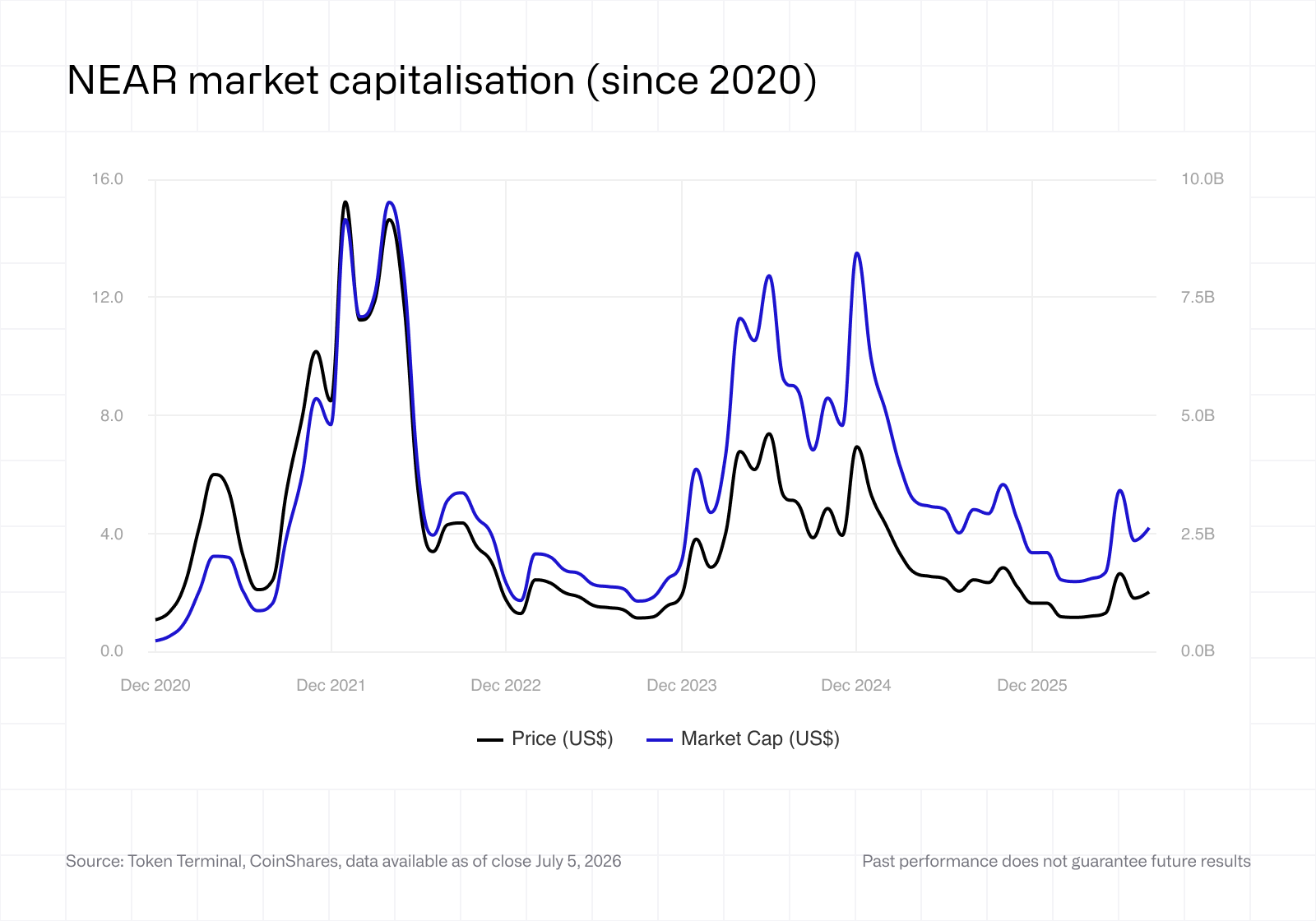
Near (NEAR) market cap

Governance, treasury and the NEAR Digital Collective (NDC)

The NEAR Foundation continues to play a role in funding and protocol oversight, but governance is steadily transitioning to the NEAR Digital Collective (NDC). The NDC is a community-led framework that pushes decentralized governance, covering funding, elections and policy decisions, through structures like the House of Merit, Council of Advisors, and Transparency Commission, with all outcomes transparently recorded on-chain.

By shifting governance from foundation-led oversight to the community-driven NDC, NEAR reduces centralization risk and provides enterprises with transparent, resilient and stable decision-making for mission-critical deployments.

Ecosystem growth and interoperability

NEAR’s ecosystem spans interoperability tools, decentralized applications and custom execution environments in the form of:

  • Cross-chain connectivity: Aurora (Ethereum-compatible Layer-2), Octopus Network (appchains) and Rainbow Bridge link NEAR and Ethereum.

  • DeFi growth: Ref Finance and Burrow support trading and lending with live price feeds.

  • NFT adoption: Paras and Mintbase provide low-cost minting and trading.

  • Tooling support: integrations with The Graph, Chainlink and Ceramic to benefit from indexing, oracles and identity.

  • Custom subnets: institutions can launch environments with independent validators and gas tokens while maintaining settlement security.

Together, these elements blend scalability, interoperability and developer traction, fueling ecosystem growth across DeFi, NFTs and enterprise use cases.

As of August 2025, NEAR holds roughly $154.7 million in total value locked (TVL) across DeFi protocols. While this places NEAR below Ethereum and Solana in ecosystem size, it underscores steady adoption across DeFi and enterprise-focused applications.

Near total value locked (TVL)

Pros and performance-driven benefits of near protocol

NEAR delivers a combination of speed, cost-efficiency and scalability that strengthens both consumer-facing and enterprise-grade applications. Key benefits include:

  • Fast finality: 1-2 second settlement supports trading platforms and real-time gaming infrastructure.

  • Predictable costs: Stable gas fees simplify financial planning and long-term budgeting for businesses.

  • High throughput: As of 2025, NEAR averages around 63 TPS in real time, but has demonstrated bursts exceeding 4,000 TPS and a theoretical capacity of 16,000 TPS.

  • Developer-friendly design: Multi-language contract support helps adoption by existing in-house teams, reducing retraining costs and speeding up deployment.

  • Deflationary token model: Fee burning strengthens token economics as activity scales, supporting scarcity and long-term value retention.

  • Efficient coding incentives: Storage fees encourage optimized contracts, lowering infrastructure bloat and improving network efficiency.

  • Custom subnets: Modular deployments let industries like finance, gaming and supply chains build blockchains designed for their needs.

Risk factors and considerations for near protocol

While NEAR offers robust performance, certain challenges remain relevant for investors, developers and enterprises to review:

  • Liquidity fragmentation risk: subnets are powerful for customization, but overuse could splinter liquidity and developer synergies, hurting the seamless interaction that makes DeFi ecosystems thrive.

  • Ecosystem maturity: application depth remains smaller compared to Ethereum’s established base.

  • Validator concentration: large staking entities may increase the risk of centralization.

  • Regulatory uncertainty: DAO governance and token classification remain undefined across jurisdictions, with competing global frameworks creating compliance challenges.

Strategic insights for enterprise decision-makers

NEAR is best understood as complementary to Ethereum rather than purely competitive. Its Aurora EVM bridge allows developers to deploy Ethereum-compatible apps while benefiting from NEAR’s faster, lower-cost execution. 

For Bitcoin, NEAR does not directly compete as a monetary asset but instead complements BTC’s role by offering smart contract infrastructure and cross-chain interoperability that expand real-world use cases. As a result, NEAR provides scalability, modularity and predictable economics for enterprise adoption while reducing onboarding and infrastructure risk.

Conclusion

NEAR Protocol is maturing into a high-performance Layer-1 platform that balances speed, scalability and usability without compromising decentralization. 

The NEAR token model aligns network participants by combining staking incentives, storage costs and a deflationary fee-burn mechanism, confirming sustainability as usage scales.

Beyond its technical strengths, NEAR has invested in ecosystem growth through cross-chain interoperability, developer-friendly tooling and modular subnets that enable both consumer applications and enterprise-grade deployments. 

Published onSept 5th, 2025

Writer
CoinShares Author Logo
CoinShares

Welcome to CoinShares

Personal Data

0102

When you visit CoinShares website, cookies enhance your experience. They help us to show you more relevant content. Some cookies are necessary for the site to work and will always be active. Blocking some types of cookies may impact your experience of the website and the services which we offer on our website.

We use cookies on our site to optimize our services. Learn more about our EU cookie policy or US cookie policy.

  • Necessary
    Question circle icon
  • Preferences
    Question circle icon
  • Statistical
    Question circle icon
  • Marketing
    Question circle icon

Don't invest unless you're prepared to lose all the money you invest. This is a high-risk investment, and you should not expect to be protected if something goes wrong. Take 2 mins to learn more. Approved by Archax 19/12/2025

Necessary cookies help make a website usable by enabling basic functions like page navigation and access to secure areas of the website. The website cannot function properly without these cookies.
Preference cookies enable a website to remember information that changes the way the website behaves or looks, like your preferred language or the region that you are in.
Statistic cookies help website owners to understand how visitors interact with websites by collecting and reporting information anonymously.
Marketing cookies are used to track visitors across websites. The intention is to display ads that are relevant and engaging for the individual user and thereby more valuable for publishers and third party advertisers.