



Integrating Bitcoin and crypto: a framework for strategic portfolio allocation
 5 min read
- Finance
- Bitcoin
- Ethereum
Over the past decade, digital currencies like Bitcoin (BTC) and Ethereum (ETH) have emerged as serious contenders for portfolio diversification. As adoption grows, investors face key questions: how much crypto is too much? What allocation strategy is appropriate? And how do you balance upside potential with downside risk?
A Bitcoin and crypto allocation depends on individual risk tolerance, there’s no one-size-fits-all formula. Success hinges on due diligence, education, and a firm grasp of volatility. Investors who understand inflation risks, fiat debasement, market cycles and the fundamentals of digital assets are better prepared to view downturns as strategic opportunities rather than threats.
Understanding portfolio allocation
Portfolio allocation is the disciplined process of dividing capital across asset classes such as stocks, bonds, real estate, commodities, and increasingly, cryptocurrencies, to optimize returns relative to risk.
The objective is not to chase short-term gains but to construct a portfolio that aligns with long-term goals, liquidity requirements and the investor's capacity to handle volatility.
Unlike speculative trading, allocation is a long-term framework. Correct allocation reinforces the psychological and financial resilience needed to hold through price drawdowns, reducing the temptation to make reactive decisions. A well-thought out allocation strategy provides structure in volatile markets but will help investors grow capital methodically over time.
Why a Bitcoin and crypto allocation matters
Cryptocurrencies are capable of delivering large returns but they come hand in hand with volatility. Bitcoin has experienced large gains over the years only to suffer equally severe reversals in others.
Assets like Ethereum and altcoins tend to exhibit even greater swings often amplified by shifts in sentiment, macro developments and regulation. That said, in small, intentional investments, Bitcoin and crypto can serve a role in portfolio construction. A modest allocation to BTC or ETH, in that order, is likely to provide a return without materially increasing overall portfolio risk, so long as sizing is appropriate.
The key is to view crypto not as a shortcut to riches but as a volatile and asymmetric asset class, one that demands clear-eyed risk management, patience, and discipline.
For investors willing to study digital assets and size positions appropriately allocation into BTC and crypto may offer differentiated returns that justify a small, deliberate role in long-term portfolios.
How to allocate crypto
Every portfolio strategy should reflect the investor’s goals, time horizon, and risk tolerance—especially when adding an asset class as volatile as Bitcoin and other cryptocurrencies.
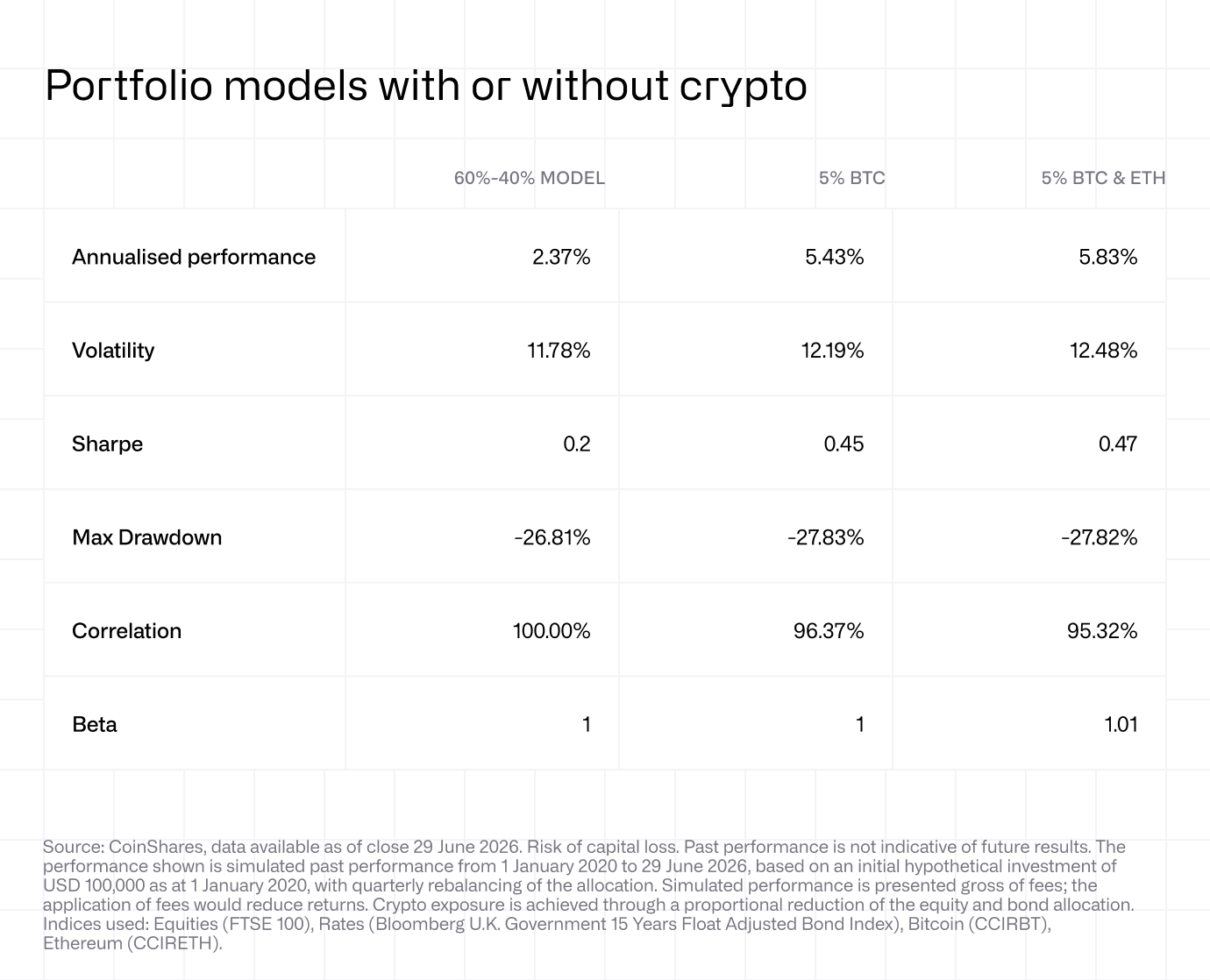
Based on CoinShares’ proprietary modelling, the optimal allocation to Bitcoin in a diversified multi-asset portfolio typically is 5%. At this level, Bitcoin can meaningfully improve risk-adjusted returns and diversification benefits without adding disproportionate volatility.
5%: A conservative allocation
For cautious investors seeking to enhance returns without destabilizing their portfolio of equities and bonds, 5% is the entry point where CoinShares’ models (based on historical performance from 2020 to 2026) show consistent improvements in Sharpe ratio.
At this allocation, even sharp drawdowns in Bitcoin have a manageable impact on overall performance, yet the position is large enough to benefit if Bitcoin appreciates significantly.While our conservative allocation often uses Bitcoin as the core position, it can potentially be complemented by Ethereum, which slightly increases the annualised performance with a marginal impact on the volatility and the maximum drawdown.
Of course, these models require discipline, especially in rebalancing during bull markets to prevent the allocation from becoming overweight.
The role of rebalancing
Rebalancing is the practice of restoring a portfolio's original allocation after market moves. For example, if a 5% crypto exposure doubles in value while stocks and bonds remain flat, crypto may now represent 9-10% of the total portfolio.
Failing to rebalance exposes the investor to unintended risks. In this case, selling some crypto and reallocating to other asset classes brings the portfolio back in line with an intended risk profile weighting. Rebalancing enforces discipline, helping investors "sell high and buy low" without reacting emotionally.
Most investors review their portfolio quarterly or annually. Some prefer automated rebalancing tools, while others rebalance manually based on threshold price (e.g., if any asset deviates 5% from its target weighting in a portfolio). Our models are based on quarterly rebalancing.
Bitcoin and Ethereum, far from being redundant
If Bitcoin remains the benchmark of digital assets, Ethereum offers exposure to a broader range of use cases: it powers financial applications (such as trading platforms, intermediary-free credit products, and yield-bearing assets) and hosts the largest share of the stablecoin economy.
This is why both have a place in a portfolio, with Bitcoin used as an anchor similar to gold and Ethereum as a technological bet, closer to some Nasdaq equities.
Conclusion
Even modest allocations can improve portfolio efficiency without meaningfully increasing overall risk, provided said allocations are set with intention and revisited periodically by the investor. For those with stronger conviction and longer time horizons, higher allocations may be appropriate but only when supported by a clear strategy and a risk management framework.
Rather than fearing volatility, welcoming volatility is central to long-term investing success within the Bitcoin and crypto industry.
Volatility should not be conflated with risk. Volatility is the cost of accessing asymmetric, long-term returns and insulating a portfolio against inflation and money debasement. Maintaining a disciplined rebalancing strategy and minimizing reactive decisions are factors to achieving consistent portfolio returns over time.
Crypto exposure doesn’t require outsized bets. It demands a calm, structured approach and the patience to let time and strategy work in tandem.
Published onApr 13th, 2026