
This website uses cookies
We use cookies to personalise content and ads, to provide social media features and to analyse our traffic. We also share information about your use of our site with our social media, advertising and analytics partners who may combine it with other information that you’ve provided to them or that they’ve collected from your use of their services.
Consent Selection
Details
  • Necessary cookies help make a website usable by enabling basic functions like page navigation and access to secure areas of the website. The website cannot function properly without these cookies.

    • Learn more about this provideropens in a new window
      CookieConsentStores the user's cookie consent state for the current domain
      Maximum Storage Duration: 1 yearType: HTTP Cookie
    • Learn more about this provideropens in a new window
      bcookieUsed in order to detect spam and improve the website's security.
      Maximum Storage Duration: 1 yearType: HTTP Cookie
      li_gcStores the user's cookie consent state for the current domain
      Maximum Storage Duration: 180 daysType: HTTP Cookie
    • Learn more about this provideropens in a new window
      datadomeUsed in context with the website's BotManager. The BotManager detects, categorizes and compiles reports on potential bots trying to access the website.
      Maximum Storage Duration: 1 yearType: HTTP Cookie
    • _pk_testcookie_domainThis cookie determines whether the browser accepts cookies.
      Maximum Storage Duration: 1 dayType: HTTP Cookie
    • __cf_bm [x3]This cookie is used to distinguish between humans and bots. This is beneficial for the website, in order to make valid reports on the use of their website.
      Maximum Storage Duration: 1 dayType: HTTP Cookie
  • Preference cookies enable a website to remember information that changes the way the website behaves or looks, like your preferred language or the region that you are in.
    • Learn more about this provideropens in a new window
      lidcRegisters which server-cluster is serving the visitor. This is used in context with load balancing, in order to optimize user experience.
      Maximum Storage Duration: 1 dayType: HTTP Cookie
  • Statistic cookies help website owners to understand how visitors interact with websites by collecting and reporting information anonymously.
    • Learn more about this provideropens in a new window
      personalization_idThis cookie is set by Twitter - The cookie allows the visitor to share content from the website onto their Twitter profile.
      Maximum Storage Duration: 400 daysType: HTTP Cookie
    • _pk_uidUsed by Piwik Analytics Platform to identify the visitor on repeat visits to the website.
      Maximum Storage Duration: 1 yearType: HTTP Cookie
      _pk_id#Collects statistics on the user's visits to the website, such as the number of visits, average time spent on the website and what pages have been read.
      Maximum Storage Duration: 1 yearType: HTTP Cookie
      _pk_ses#Used by Piwik Analytics Platform to track page requests from the visitor during the session.
      Maximum Storage Duration: 1 dayType: HTTP Cookie
    • FPGSIDRegisters statistical data on users' behaviour on the website. Used for internal analytics by the website operator.
      Maximum Storage Duration: 1 dayType: HTTP Cookie
      FPIDRegisters statistical data on users' behaviour on the website. Used for internal analytics by the website operator.
      Maximum Storage Duration: 400 daysType: HTTP Cookie
      FPLCRegisters a unique ID that is used to generate statistical data on how the visitor uses the website.
      Maximum Storage Duration: 1 dayType: HTTP Cookie
    • _gaRegisters a unique ID that is used to generate statistical data on how the visitor uses the website.
      Maximum Storage Duration: 2 yearsType: HTTP Cookie
      _ga_#Used by Google Analytics to collect data on the number of times a user has visited the website as well as dates for the first and most recent visit.
      Maximum Storage Duration: 2 yearsType: HTTP Cookie
  • Marketing cookies are used to track visitors across websites. The intention is to display ads that are relevant and engaging for the individual user and thereby more valuable for publishers and third party advertisers.
    • Learn more about this provideropens in a new window

      Some of the data collected by this provider is for the purposes of personalization and measuring advertising effectiveness. The provider may use the IP Addresses for ads measurement and ads personalization.

      ads/ga-audiencesUsed by Google AdWords to re-engage visitors that are likely to convert to customers based on the visitor's online behaviour across websites.
      Maximum Storage Duration: SessionType: Pixel Tracker
    • Learn more about this provideropens in a new window
      #:session-dataTracks the individual sessions on the website, allowing the website to compile statistical data from multiple visits. This data can also be used to create leads for marketing purposes.
      Maximum Storage Duration: PersistentType: HTML Local Storage
      eng_mtTracks the conversion rate between the user and the advertisement banners on the website - This serves to optimise the relevance of the advertisements on the website.
      Maximum Storage Duration: PersistentType: HTML Local Storage
      t_gidThis cookie assigns a specific visitor ID, when the visitor interacts with ads or content from the website - this allows the website to target the visitor with similar ads or content.
      Maximum Storage Duration: 1 yearType: HTTP Cookie
      t_pt_gidCollects information on user preferences and/or interaction with web-campaign content - This is used on CRM-campaign-platform used by website owners for promoting events or products.
      Maximum Storage Duration: 1 yearType: HTTP Cookie
      taboola global:user-idSets a unique ID for the visitor, that allows third party advertisers to target the visitor with relevant advertisement. This pairing service is provided by third party advertisement hubs, which facilitates real-time bidding for advertisers.
      Maximum Storage Duration: PersistentType: HTML Local Storage
      taboola_session_idThis cookie is used to collect information on a visitor. This information will become an ID string with information on a specific visitor – ID information strings can be used to target groups with similar preferences, or can be used by third-party domains or ad-exchanges.
      Maximum Storage Duration: SessionType: HTTP Cookie
    • Learn more about this provideropens in a new window
      1/i/adsct [x2]Collects data on user behaviour and interaction in order to optimize the website and make advertisement on the website more relevant.
      Maximum Storage Duration: SessionType: Pixel Tracker
      muc_adsCollects data on user behaviour and interaction in order to optimize the website and make advertisement on the website more relevant.
      Maximum Storage Duration: 400 daysType: HTTP Cookie
      guest_idCollects data related to the user's visits to the website, such as the number of visits, average time spent on the website and which pages have been loaded, with the purpose of personalising and improving the Twitter service.
      Maximum Storage Duration: 400 daysType: HTTP Cookie
      guest_id_adsCollects information on user behaviour on multiple websites. This information is used in order to optimize the relevance of advertisement on the website.
      Maximum Storage Duration: 400 daysType: HTTP Cookie
      guest_id_marketingCollects information on user behaviour on multiple websites. This information is used in order to optimize the relevance of advertisement on the website.
      Maximum Storage Duration: 400 daysType: HTTP Cookie
    • _gcl_auUsed by Google AdSense for experimenting with advertisement efficiency across websites using their services.
      Maximum Storage Duration: 3 monthsType: HTTP Cookie
      _gcl_lsTracks the conversion rate between the user and the advertisement banners on the website - This serves to optimise the relevance of the advertisements on the website.
      Maximum Storage Duration: PersistentType: HTML Local Storage
    • pardot [x2]Used in context with Account-Based-Marketing (ABM). The cookie registers data such as IP-addresses, time spent on the website and page requests for the visit. This is used for retargeting of multiple users rooting from the same IP-addresses. ABM usually facilitates B2B marketing purposes.
      Maximum Storage Duration: SessionType: HTTP Cookie
  • Unclassified cookies are cookies that we are in the process of classifying, together with the providers of individual cookies.
    • cs_analytics_ip_blockedPending
      Maximum Storage Duration: SessionType: HTTP Cookie
      user_tokenPending
      Maximum Storage Duration: 1 yearType: HTTP Cookie
    • _twpidPending
      Maximum Storage Duration: SessionType: HTTP Cookie
      _twsidPending
      Maximum Storage Duration: SessionType: HTTP Cookie
Cookie declaration last updated on 11/19/26 by Cookiebot
[#IABV2_TITLE#]
[#IABV2_BODY_INTRO#]
[#IABV2_BODY_LEGITIMATE_INTEREST_INTRO#]
[#IABV2_BODY_PREFERENCE_INTRO#]
[#IABV2_BODY_PURPOSES_INTRO#]
[#IABV2_BODY_PURPOSES#]
[#IABV2_BODY_FEATURES_INTRO#]
[#IABV2_BODY_FEATURES#]
[#IABV2_BODY_PARTNERS_INTRO#]
[#IABV2_BODY_PARTNERS#]
About
Cookies are small text files that can be used by websites to make a user's experience more efficient.

The law states that we can store cookies on your device if they are strictly necessary for the operation of this site. For all other types of cookies we need your permission.

This site uses different types of cookies. Some cookies are placed by third party services that appear on our pages.

You can at any time change or withdraw your consent from the Cookie Declaration on our website.

Learn more about who we are, how you can contact us and how we process personal data in our Privacy Policy.

Please state your consent ID and date when you contact us regarding your consent.
Image What does it mean to treat computing power as an asset class?

What does it mean to treat computing power as an asset class?

Timer11 min läsning

  • Ekonomi
  • Teknik
  • Data

Compute is computing capacity available to rent by the hour. Prices in dollars per GPU-hour help buyers compare costs and agree contracts. Contracts can support financing, but an investable asset also needs reliable prices and enforceable claims on customer payments.

A graphics processing unit, or GPU, trains and runs artificial intelligence (AI) models. A GPU-hour measures one hour of GPU access, providing a pricing unit much as the kilowatt-hour does for electricity.

Four layers carry different assets and obligations:
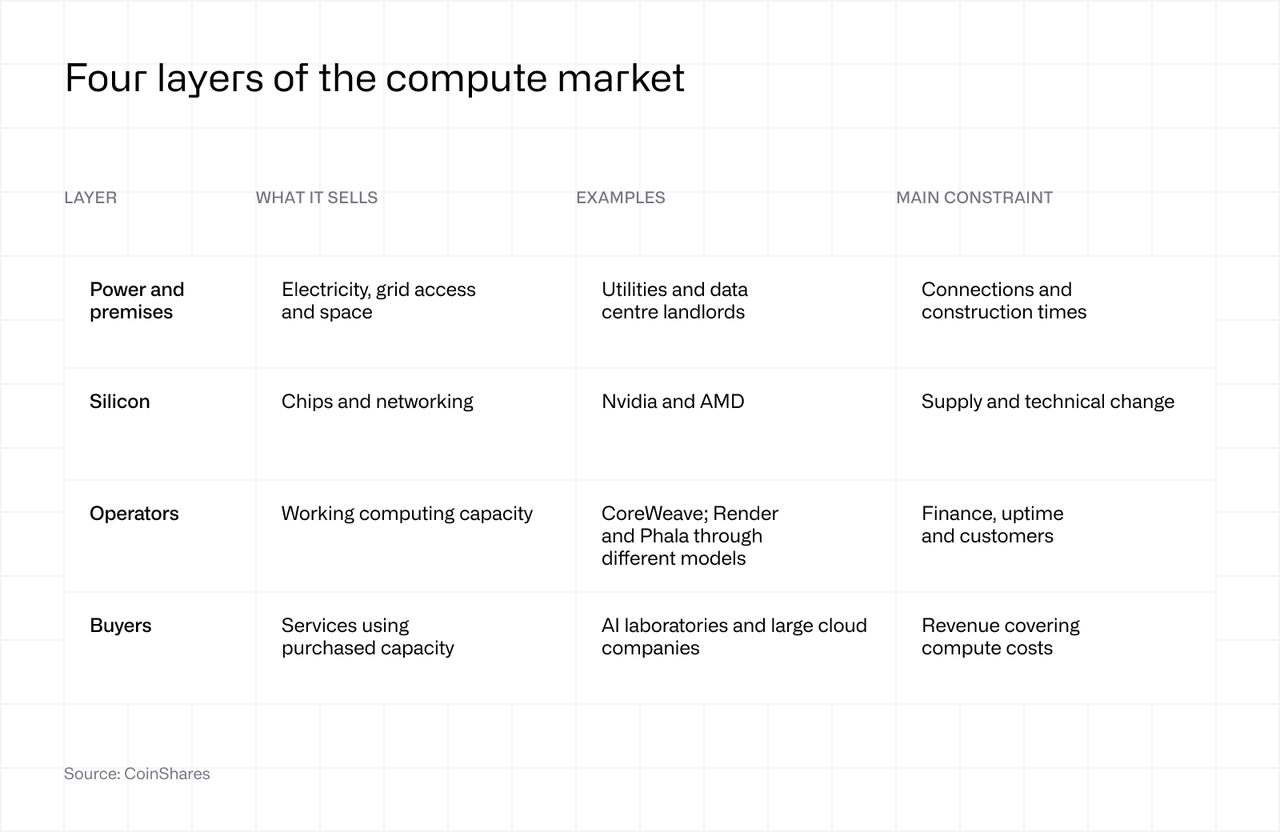
Four layers of the compute marketNeoclouds assemble GPUs, networking and data centre space to sell AI computing capacity. Leasing premises and financing chips lowers upfront equity needs but creates rent and debt payments. Hyperscalers, the largest cloud providers, can buy neocloud capacity while competing for cloud customers.

Crypto networks use tokens, transferable digital assets, to organise services and reward suppliers:

  • Render: The Render Foundation describes a network supplying computing power for 3D graphics and AI. Customer payments fund purchases of tokens, which are permanently removed, or “burned”. New tokens are also issued, so total supply may still grow. Burning tokens pays no income to holders.

  • Phala: Phala’s documentation describes services protecting sensitive data during computing tasks. Intel TDX and Nvidia H100/H200 hardware create protected spaces called trusted execution environments. Customers can check the protection before outsourcing work, reducing reliance on the operator while still trusting hardware security.

  • Bittensor: It is less a compute marketplace than a market for AI output. Bittensor’s documentation describes specialised groups called subnets. Some groups use computing power to produce AI answers or predictions; others supply computing power directly. Participants earn TAO or subnet tokens as rewards. Token rewards alone do not prove customers are funding income for holders.

CoinShares’ DePIN guide explains token-coordinated infrastructure.

The spending behind cloud services shows the scale of the physical infrastructure. Amazon’s 2025 annual report records $128.3B in capital spending, mainly on technology infrastructure, chiefly supporting the AWS cloud business, and facilities for fulfilling retail orders. The total extends beyond AI. 

Can you buy and sell compute like a commodity?

Compute can be rented immediately, reserved or bought through negotiated forward agreements. Exchange futures would give buyers and suppliers a standardised way to protect against changes in GPU rental prices. Building that market is more complicated, however, because the computing power and service terms behind each GPU-hour can differ.

The motivation is familiar from electricity, oil and shipping, where buyers want greater certainty over future costs while suppliers want more predictable revenue.
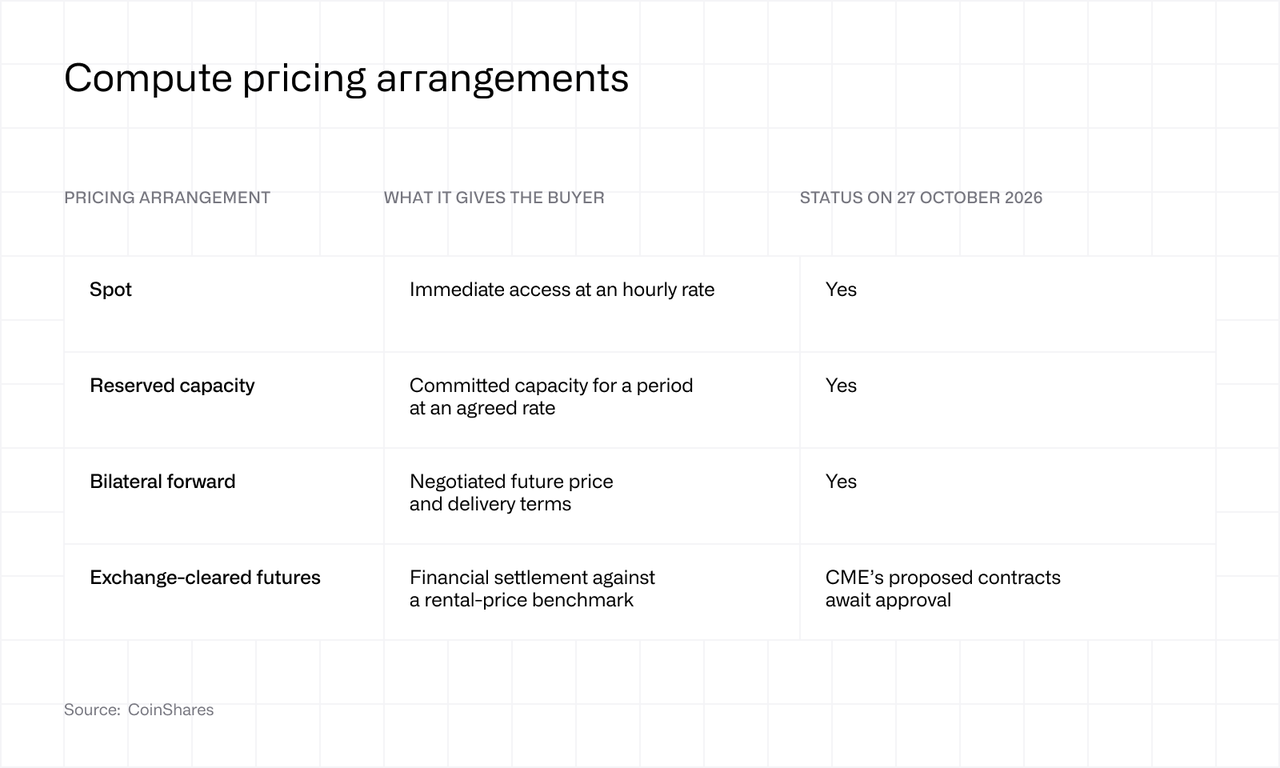
Compute pricing arrangements Reservation rates across durations can imply forward prices, provided hardware, location and service terms are comparable. On 11 August 2026, CME Group announced H100 and B200 rental-index futures, later postponing launch pending regulatory review. The CFTC extended the review to 8 January 2027. Approval would guarantee neither active trading nor a close match to customers’ computing bills.

CoreWeave said in September 2026 that new compute contracts had commanded higher prices since June. Three-to-six-month contracts were priced at around $40M per megawatt, calculated as annualised revenue divided by cluster power requirements. The measure expresses compute revenue relative to power capacity, which means compute is being priced as power. 

While customer contracts put a dollar price on computing capacity, token networks approach the problem from the other direction; Bittensor’s token rewards do not provide an equivalent rental-price benchmark. Exchange-cleared futures would help finance directors hedge GPU costs. Fees paid to holders or token buybacks can connect customer spending to holder benefits, while TAO’s supply cap alone grants no customer income. For now, the contract is what gives compute a price. The futures market will show whether that price can trade.

How are AI data centres financed, and what secures the debt?

AI data centres use equity and debt to pay for buildings, chips and networks before customers generate enough cash to cover the investment. Security can include the equipment and contracts to buy its output. Customer credit, payment obligations and contract length help determine borrowing terms. Because chips lose value every quarter while a signed contract does not, the customer's credit increasingly sets the terms.

An offtake agreement commits a customer to buy computing capacity. Like shipping charters or power purchase agreements, customer contracts give lenders future payments to assess alongside equipment values, subject to delivery of the agreed service.

In March 2026, CoreWeave closed a facility secured by computing infrastructure and a customer contract, anchored by Blackstone Credit & Insurance. Borrowing capacity starts at about $7.5B and can reach $8.5B as assets stabilise. CoreWeave described it as the first investment-grade rated GPU-backed financing, and Bloomberg reported that the contract behind it is with Meta.The rating followed the customer more than the chip. 

GPU-backed lending also uses crypto funding. USD.AI pools blockchain deposits for GPU loans governed by conventional legal agreements. USD.AI’s documentation describes sUSDai as a yield-bearing token drawing returns from GPU loans and Treasury bills held against unlent reserves. USD.AI’s current underwriting scores the operator, the customer’s credit and the strength of the offtake contract; the combined score sets the loan’s pricing tier and structure. USD.AI’s Compute IQ page uses a different operator, customer and contract scoring grid. Published pricing categories do not commit USD.AI to lend at the stated terms.

USD.AI’s published structure and borrower documentation describe lender protections:

  • Separate assets: A special purpose vehicle, a separate company designed to isolate assets from parent bankruptcy, holds GPUs, contracts and revenue accounts. Lenders have first-priority security over vehicle assets and a pledge of vehicle ownership.

  • Limited parent recourse: The parent generally owes no repayment, except for losses covered by a limited guarantee, including voluntary bankruptcy filings.

  • Equity and repayment: Documentation cites 70.0% to 80.0% loan-to-value. Principal falls in equal steps, typically over three years, with longer terms available. USD.AI’s pages describe the reserve as either one to three months of peak loan payments or about 10.0% of the loan amount.

  • Physical verification: Independent checks confirm working servers before funds leave escrow. Monitoring continues after lending begins because blockchain records alone cannot verify physical machines.

These terms come from public documentation, not signed loan agreements.

What are the biggest risks to the AI infrastructure buildout?

The main risks are hardware losing economic value faster than expected, customers failing to honour contracts, and capacity growing faster than profitable demand. A chip can remain useful while earning less than its owner needs to repay debt, so continued use alone does not establish investment value. Shorter accounting lives accelerate depreciation and reduce earnings. New GPU generations can weaken older equipment’s competitiveness before physical failure.

Amazon’s 2024 annual report, filed in 2025, shortened useful lives for some servers and networking equipment from six years to five from January 2025. Separately, early retirements led to approximately $920M in accelerated depreciation and related charges in Q4 2024. 

Stojkovic and colleagues model how computing tasks affect replacement timing, while Ornn, a commercial GPU data and rental provider, finds older GPUs economical for some tasks. Neither study determines how long owners should depreciate GPUs. Limited power can favour continued use or replacement with more efficient chips.

This is where depreciation meets financing. At 70.0% to 80.0% loan-to-value, falling GPU prices can leave server sales unable to repay the loan. Non-recourse terms generally prevent lenders pursuing the parent, increasing reliance on customer payments. Where included, USD.AI’s Barkr warranty may cover server resale shortfalls, but protection can be suspended during market-wide shocks. Conventional and blockchain-funded lenders share hardware risk.

The Richmond Fed's account of the telecom bust describes fibre capacity outpacing paying demand, followed by falling prices and bankruptcies. The networks offered useful, cheaper capacity to other businesses. Necessary infrastructure can still destroy investor capital.

Frequently asked questions

Does a GPU-hour buy a chip? 

No. It buys temporary access, not ownership.

Does a compute token track rental prices? 

Not automatically. Token incentives differ from contracts tied to rental benchmarks.

Does an offtake agreement remove credit risk?

No. It moves the risk onto the customer, whose solvency and contract terms decide whether payment arrives.

Does older hardware have no value? 

No. Value depends on revenue, costs and competing capacity.

Watch for exchange contracts attracting volume, operators shortening useful lives, and customer commitments lengthening. Credit quality matters alongside duration.

Publicerad den

Författare
Författare. Erfaren finansproffs med ACCA-kvalifikation och en kandidatexamen med utmärkelse (honours) i nationalekonomi från Maltas universitet.