



What is XRP - XRP guide
 14 min read
- Altcoins
XRP is the native token of the XRP Ledger, a payments network that launched in 2012. It was built to move money between countries in seconds for a fraction of a cent, competing with the correspondent banking system rather than with Bitcoin.
For most of its history the more urgent question about XRP was legal rather than technical: whether it was an unregistered security under US law. That question has been settled. What replaces it is a harder one, because Ripple the company and XRP the token are separate things, and over the past eighteen months they have moved in different directions.
In short:
The SEC case ended in August 2025 when both sides dropped their appeals. XRP is not a security when sold on the open market; certain past institutional sales were. Ripple pays a $125 million penalty and accepts a permanent injunction on direct institutional sales in the US.1,2
XRP traded at $1,04 on 30 June 2026, a market capitalisation of $64,65 billion.
Ripple obtained conditional approval for a US national bank charter in December 2025 and has spent more than $2,7 billion on acquisitions.4,5
The ledger itself is quiet: $834,700 of fees in the first half of 2026, and 17,761 average daily active addresses.3
Ripple's success and XRP's price are related but not the same thing, and the guide keeps them apart.
What XRP and the XRP Ledger are
Three things with similar names
Confusion here is common and worth clearing up first.
The XRP Ledger (XRPL) is the blockchain. It launched in 2012 and is open source.
XRP is the token native to that ledger. It exists to pay fees and to act as a bridge asset between currencies.
Ripple is a private company that builds payments products, holds a large quantity of XRP, and employs many of the ledger's developers. It did not create the ledger's consensus rules on its own and does not control the network.
The practical consequence is that news about Ripple is not automatically news about XRP, and the reverse. The market often trades them as one.
How the ledger agrees on transactions
Most blockchains use mining or staking to decide who records the next block. The XRPL does neither. Instead, each participant keeps a list of validators it trusts, called a unique node list, and a transaction is confirmed when a large supermajority of those trusted validators agrees on it and on its place in the ledger.
This is fast and cheap, with settlement in three to five seconds. The trade-off is that security rests on the composition of those trust lists rather than on economic stake, so the question "who do you trust, and why" is answered socially rather than by capital at risk. Critics see that as centralisation; the network's defenders see it as a reasonable design for a payments system.
Fees and the burn
Sending an XRP Ledger transaction costs a fraction of a cent, and the fee is destroyed rather than paid to anyone. There are no miners or validators collecting revenue.
That has an unusual consequence: nobody earns anything from running the network, which keeps costs low but means the ledger has no revenue model of its own. In the first half of 2026 the total value destroyed in fees across the entire network was $834,700.3
Supply and the escrow
XRP was created in a single issuance of 100 billion tokens, with no ongoing creation. Circulating supply was 62,24 billion on 30 June 2026.3 Ripple holds a large quantity in escrow contracts that release on a monthly schedule, with unused amounts returned to escrow. Because the burn is tiny and the escrow releases are not, supply reaching the market has grown over time rather than shrunk.
The SEC case, and how it ended
What was decided
The Securities and Exchange Commission sued Ripple in December 2020, alleging that XRP sales amounted to an unregistered securities offering. In July 2023 the court drew a distinction that has shaped US crypto regulation since: XRP sold on public exchanges to buyers who did not know who they were buying from was not a securities transaction, while direct sales to institutional buyers were.1
A final judgment followed, imposing a $125 million civil penalty and a permanent injunction on direct institutional sales in the US. Both sides appealed, then attempted a settlement that would have reduced the penalty and lifted the injunction. The judge refused it in June 2025. On 7 August 2025 both parties filed a joint dismissal of their appeals, which left the original outcome standing and ended the case.2
What it means now
Three practical points. XRP trades freely on US exchanges and, since November 2025, through US spot exchange-traded funds.7 Ripple operates under a court injunction governing how it may sell XRP directly to institutions. And the token-versus-security distinction the court drew, based on how an asset is sold rather than what it is, remains the most cited US precedent on the question.
For an investor, the useful point is that the legal overhang which dominated XRP's price for five years is gone. Its performance since is therefore a cleaner read on demand than at any point in its history.
Market performance
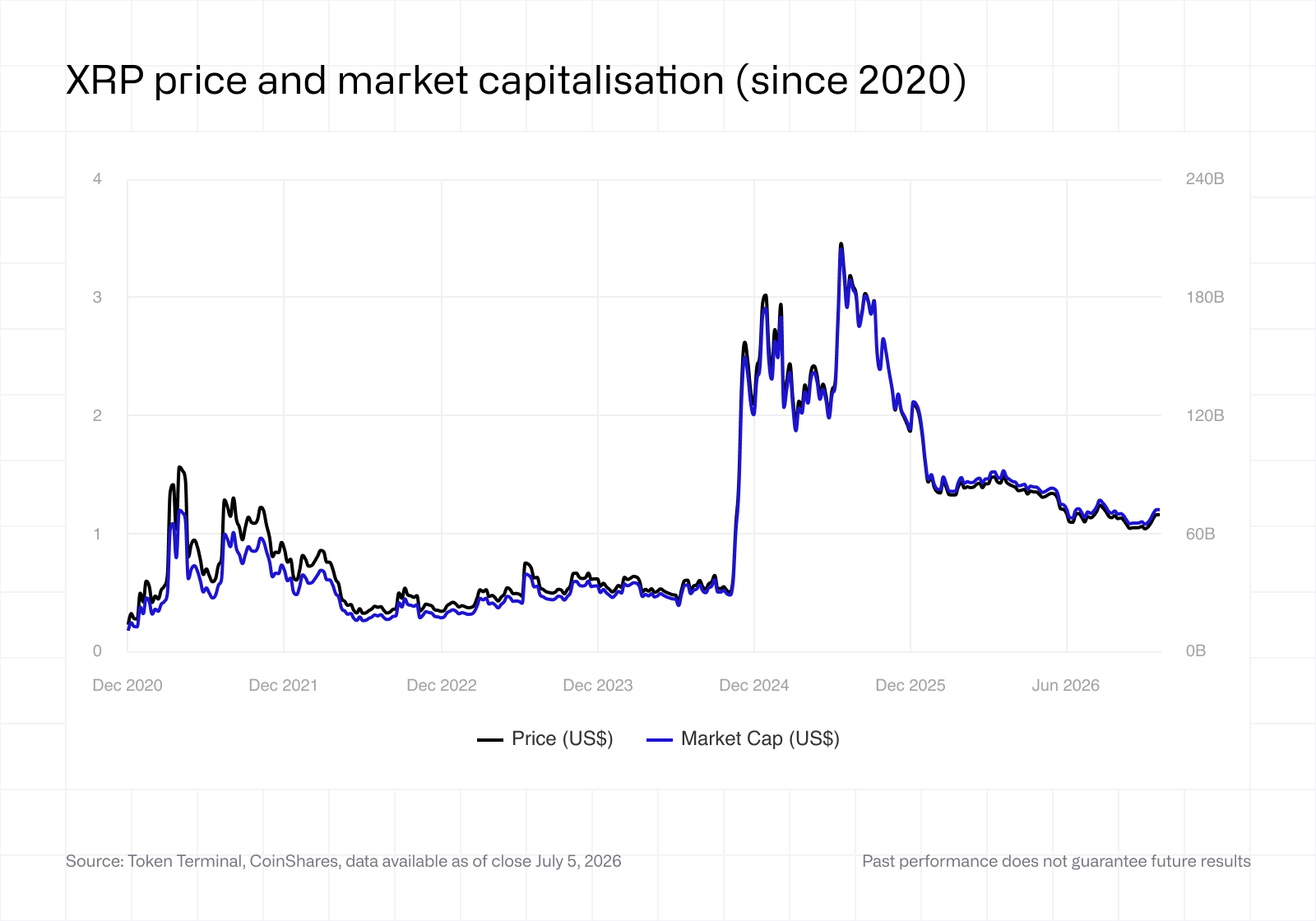
XRP traded at $1,04 on 30 June 2026, giving a circulating market capitalisation of $64,65 billion.3 Its record high of $3,56 and record market capitalisation of $210,47 billion were both set on 21 July 2025, two weeks before the case formally closed.3 Past performance is not a guide to future returns.
The sequence is worth noting. XRP peaked in the month the litigation was resolved and has fallen by more than half since, through a period in which Ripple obtained a bank charter, completed large acquisitions and saw ETFs launch on its token. Resolution of the legal risk was priced in advance, and the corporate progress that followed has not replaced it as a driver.
Ripple the company in 2026
A regulated stablecoin
Ripple launched RLUSD, a US dollar stablecoin, in December 2024 under New York State supervision. Stablecoin supply on the XRP Ledger stood at $815,08 million on 30 June 2026.3 RLUSD is also issued on other chains, so its total supply is larger than the XRPL figure alone.
A national bank charter
In December 2025, Ripple received conditional approval from the Office of the Comptroller of the Currency for a national bank charter, clearing the way for Ripple National Trust Bank to custody and manage RLUSD reserves.4 No crypto-native company had previously obtained one. Ripple has separately applied for a Federal Reserve master account, which would let it hold reserves directly at the central bank.
Acquisitions
Ripple has spent more than $2,7 billion buying companies, including the prime brokerage Hidden Road, the stablecoin payments firm Rail, and the treasury management platform GTreasury.5 The direction is consistent: Ripple is assembling a financial institution rather than a crypto protocol business.
Worth holding in mind:
None of the three developments above requires XRP. A bank charter, a dollar stablecoin and a prime broker can all operate without the token. Ripple's products can use XRP as a bridge asset, and some do, but the company's growth and the token's demand are linked by choice rather than by necessity. That is the core thing to understand before treating one as a proxy for the other.
The ledger's own numbers
Activity
The XRP Ledger is used less than its market value implies. It recorded an average of 25,875 daily active addresses across 2025 and 17,761 over the first half of 2026, with 16,469 on 30 June.3 Network fees, all of which are destroyed, totalled $7,30 million in 2025 and $834,700 in the first half of 2026.3
Set against a market capitalisation of $64,65 billion, those are small numbers, and the gap is larger than for any other major network in this series. Two readings are available. The optimistic one is that XRP's value rests on its potential role in institutional settlement rather than on retail transaction counts. The sceptical one is that a payments network which processes very little is not obviously worth $64 billion. The data does not settle it.
DeFi and tokenised assets
The XRPL was not built for smart contracts and its decentralised finance ecosystem is small: total value locked was $62,37 million on 30 June 2026.3 Ripple has added programmability through a separate Ethereum-compatible sidechain, which lets developers deploy Ethereum applications while settling on XRPL infrastructure. The stablecoin figure above is the more meaningful measure of what the ledger currently carries.
Strengths and limitations
Strengths
The legal position is unusually clear for a crypto asset. XRP has a US court ruling stating it is not a security when sold on the open market, which few assets can point to.1
Settlement is genuinely fast and cheap, and the ledger has operated continuously since 2012 without a significant failure.
The company behind it is now among the most heavily regulated in crypto, holding a conditional national bank charter, a New York-supervised stablecoin and a prime brokerage.4,5
Supply is fixed, with no new issuance.
Limitations
Network usage is low relative to market value, and fee income does not accrue to anyone because it is burned. There is no cash flow to value.
Ripple's institutional progress does not require XRP, so the link between the company's success and the token's demand is looser than it appears.
Escrow releases add supply to the market on a schedule that is not driven by demand.
Validator trust lists concentrate influence in a way economic staking does not, which is a live criticism of the consensus design.
And the injunction from the final judgment continues to constrain how Ripple may sell XRP directly to US institutions.1
Conclusion
XRP spent five years as a bet on a court case. That bet resolved in 2025, and the token reached its all-time high in the same month. Since then it has fallen by more than half while the company most associated with it has acquired a bank charter, a prime broker and a stablecoin business.
Ripple is building a regulated financial institution. XRP is a fixed-supply bridge asset on a fast, lightly used ledger. An investor can hold a view on either without holding the same view on both, and for most of XRP's history the market has not distinguished between them.
Frequently asked questions
Is XRP a security?
Not when it is sold on the open market. A US court ruled in July 2023 that public exchange sales of XRP were not securities transactions, while certain past direct sales to institutional buyers were. Both sides dropped their appeals in August 2025, so that ruling stands.1,2
Is XRP the same as Ripple?
No. Ripple is a private company. XRP is a token on the XRP Ledger, an open-source blockchain that launched in 2012. Ripple holds a large amount of XRP and employs many of the ledger's developers, but the two are legally and operationally distinct, and Ripple's products do not all require XRP.
Did the SEC case end?
Yes, in August 2025. Both Ripple and the SEC dismissed their appeals, leaving the 2023 ruling and the final judgment in place: a $125 million penalty and a permanent injunction on direct institutional sales in the US.2
What is RLUSD?
Ripple's US dollar stablecoin, launched in December 2024 under New York State supervision. It is issued on the XRP Ledger and on other chains. Stablecoin supply on the XRP Ledger was $815,08 million on 30 June 2026.3
Can you stake XRP?
No. The XRP Ledger does not use staking, so there is no native yield on XRP. Any product offering a return on XRP is lending it or deploying it somewhere, which carries counterparty risk that native staking on other networks does not.
Sources
1 SEC v. Ripple Labs, US District Court for the Southern District of New York, July 2023 summary judgment and subsequent final judgment
2 Joint stipulation dismissing both appeals, US Court of Appeals for the Second Circuit, 7 August 2025
3 Token Terminal, XRP and XRP Ledger market, fee, TVL, stablecoin and active address data, figures at 30 June 2026
4 Office of the Comptroller of the Currency, conditional approval for a national bank charter, December 2025
5 Reporting on Ripple's acquisitions of Hidden Road, Rail and GTreasury6. Ripple, RLUSD issuance and supervision7. Reporting on the launch of US spot XRP exchange-traded funds, from November 2025.
Published onMay 29th, 2024
