



What did the SEC's tokenised stock exemption actually approve?
 10 min read
On 17 September 2026, the SEC allowed certain platforms to trade US shares as blockchain tokens under a temporary set of rules. But following a share’s price is not enough. Investors must receive the same shareholder rights, including dividends and voting rights, as buyers of the original shares.
The announcement was not approval for every product sold as a “tokenised stock”. The distinction is between owning a share and buying a separate product whose price follows a share.
Platforms meeting the SEC’s conditions can trade eligible tokens without registering as traditional stock exchanges. Some firms providing tokens for buyers and sellers also receive relief from dealer registration requirements.
Automated market makers are software allowing participants admitted by the platform to trade against a pool of assets, rather than matching buyers with sellers. Order, page 33
The SEC also limits the scale of trading:
For shares in the S&P 500 and Russell 1000, plus certain other exchange-traded investments: a platform can offer up to 75 securities. Its average daily trading in each token cannot exceed 0.25% of the underlying investment’s average daily trading volume during the previous month.
For other eligible listed investments: a platform can offer up to 250 securities, with a higher limit of 2.5%.
For how long: the permission lasts from 17 September 2026 to 17 September 2031, unless the SEC changes the dates. Order, Section V
Affiliated platforms must combine trading volumes when applying the limits.The limits do not apply to the token market as a whole.
Before offering a token, a platform must check whether the token carries the same shareholder rights as the original share. If an unrelated business creates a token representing a company’s shares, the company must receive notice and a chance to object.
The US exemption relieves trading venues and liquidity providers; it does not approve individual products. Nor does it replace the permissions providers need to offer products in the EU.
Is a tokenised stock the same as owning the share, and do you get dividends and voting rights?
A tokenised stock can represent the share itself, an ownership interest held through a custodian, or a separate instrument linked to its price. Dividend treatment and voting rights depend on the structure. For the SEC exemption, the holder must receive the rights of the equivalent traditional share class.
Tokenisation represents an asset digitally on a shared ledger. CoinShares' tokenisation guide explains the process.
SEC staff explained the different types of tokenised securities in January 2026.
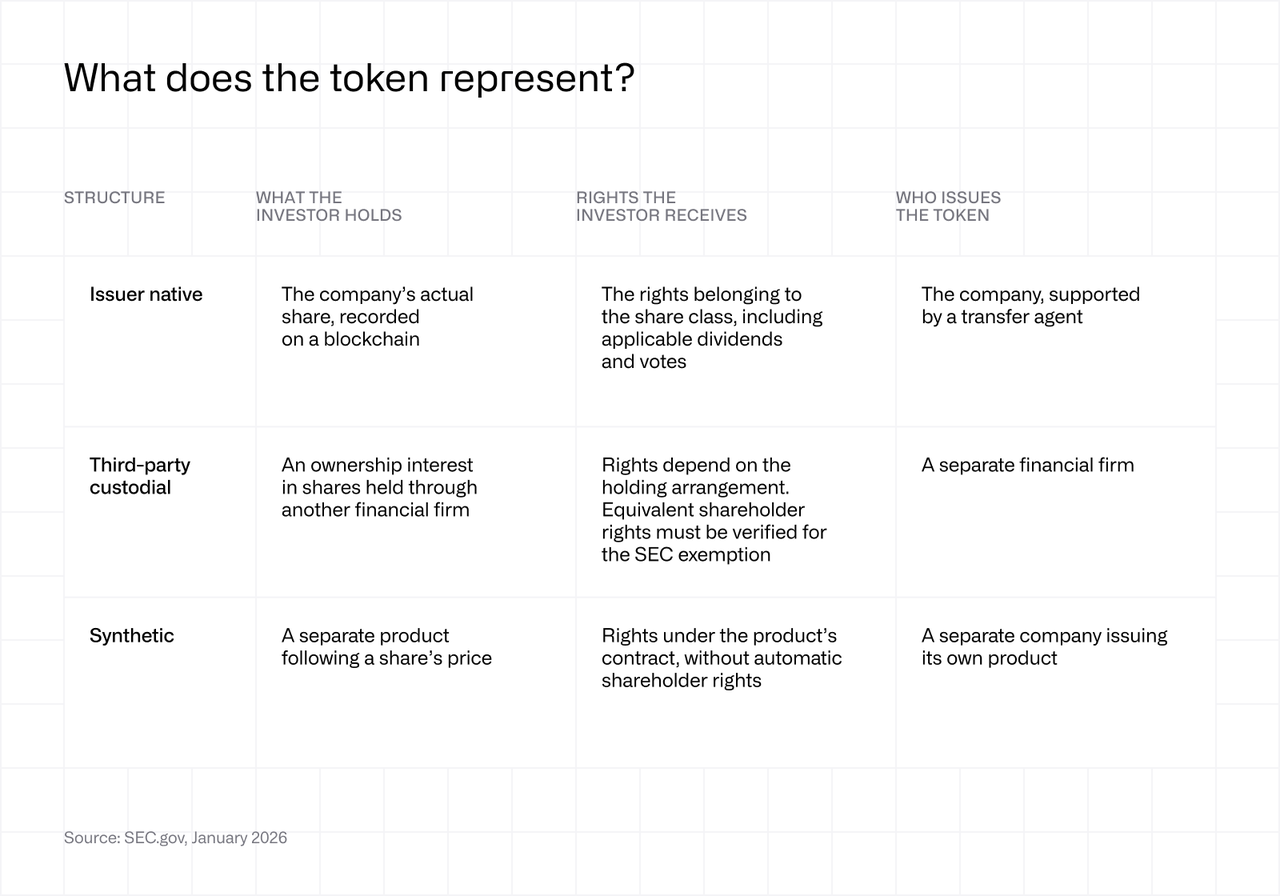
A transfer agent keeps track of who owns a company’s shares. A security entitlement gives an investor rights to shares held through a broker or another financial firm, rather than directly in the investor’s name.
The order excludes synthetic exposure and requires equivalent company interests and liquidation rights. The standard is not 1:1 backing or 1:1 redeemability: the test is whether the holder receives the same shareholder rights, dividends and votes included.
Who issues tokenised equities and how do their structures differ?
Tokenised equities do not all give investors the same ownership rights. Ondo and xStocks offer claims against an issuer, while Superstate describes recording actual company shares. Backpack separates its tokens from shares held in a brokerage account. The table compares the products and what investors receive.
According to Token Terminal, the tokenised equity market reached $4.68B on 2 November 2026, up from $407.5M a year earlier, with growth recorded every month.
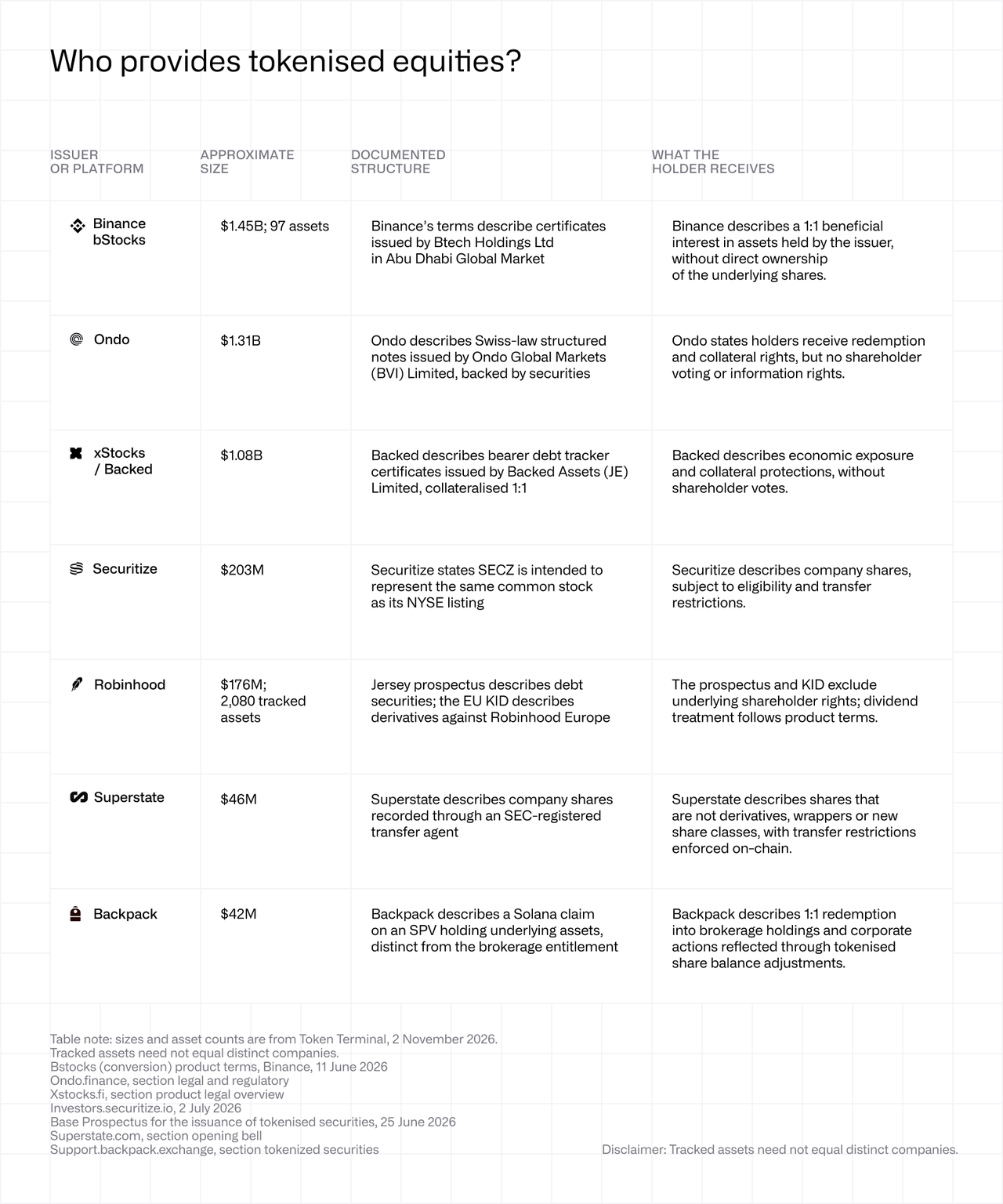
Backpack's brokerage explanation describes a property interest under New York's Uniform Commercial Code, Article 8. The token is a claim on a special purpose vehicle, a separate company holding the assets. Compare token rights with the rights attached to the brokerage holding received on redemption.
Securitize's 8 October 2026 entitlement-token launch describes dividend and applicable voting rights, separately from issuer-sponsored SECZ.
Beyond the table, Figure describes OPEN as a network for blockchain-registered equities. Dinari describes its Financial Network as infrastructure for securities liquidity and settlement. DTCC launched tokenised DTC entitlements on 28 October 2026, including through Canton Network.
The ranking is led by certificates and notes offering broad distribution. Native share offerings are smaller. Whether equivalent-rights structures gain market share over the following year is the comparison to revisit.
Why do tokenised stocks trade at a different price to the real share?
A token and its referenced share can trade in separate markets. Creation and redemption help keep the token’s price close to the share price, but access, inventory and trading hours can limit the process. When the stock market is closed, token demand can push the price far from the share’s last traded price.
Tram Doman, of Bullish, a backer of issuer-sponsored tokenisation, writing in CoinDesk opinion on 24 September 2026, reports Robinhood's AMC token moving from $2.55 to $23.16 late on 3 September, then back to $3.26 within the hour, on $10.5M of pool volume. The peak was 9.1 times AMC's $2.54 NYSE close seven hours earlier.
Doman links the move to demand for a memecoin quoted in tokenised AMC and reports a median closing-price deviation of 0.9% across seven sessions from 31 August to 9 September. Tram Doman column identifies one authorised participant, no minting or burning during the spike, and 47 mints on 4 September. The account suggests constrained arbitrage; causation remains Doman's interpretation.
An authorised participant creates or redeems through an issuer. Minting creates tokens; burning cancels tokens. Creation and redemption align depositary receipts with shares and ETPs with net asset value, but require access, inventory or borrowing, and executable conversion.
Robinhood's prospectus page 60, warns the issuer may be unable to trade collateral "outside of exchange market hours, or in the necessary quantities, or at all". The NYSE's regular session occupies 32.5 hours of a normal week, or 19.3% of 168 hours. Inventory and extended-hours trading can help, but continuous token trading cannot guarantee continuous underlying liquidity.
The wrapper serves investors seeking price exposure. Robinhood's EU KID pages 1 and 2, describes a derivative linked to a US-listed asset and identifies Robinhood Europe as the sole counterparty. As with a participating note, access comes through another party's obligation, bringing counterparty risk rather than shareholder ownership.
Before allocating, ask four questions: what rights does the token itself carry? Who is the issuer, and which jurisdiction governs the claim? Can more than one participant create and redeem? What happens to pricing when the underlying market closes?
FAQs
What did the SEC's tokenised stock exemption approve?
Conditional relief for qualifying venues and liquidity providers, not blanket product approval.
Is a tokenised stock the same as owning the share, and do you get dividends and voting rights?
Only some structures carry shareholder rights; backing alone is insufficient.
Who issues tokenised equities and how do their structures differ?
Companies and intermediaries issue shares, custodial interests or separate price-linked instruments.
Why do tokenised stocks trade at a different price to the real share?
Separate liquidity and constrained creation or redemption can prevent price alignment.