



Hyperliquid and Solana: indirect exposure to the prediction markets boom
 6 min read
Prediction markets have gone from a niche curiosity to one of the fastest-growing corners of finance. Combined monthly notional trading volume on Kalshi and Polymarket, the two largest platforms, rose from $4.5 billion in September 2025 to $43.7 billion in June 2026, the last figure boosted by the opening weeks of the 2026 FIFA World Cup.1 Pew Research Center's independent analysis of data from The Block puts the same combined figure at roughly $24 billion for April 2026, corroborating the trend.2 Kalshi has since raised $1 billion at a $22 billion valuation and was reportedly in talks in June to raise again at $40 billion, while Intercontinental Exchange has committed $2 billion to Polymarket, largely for access to its data.3
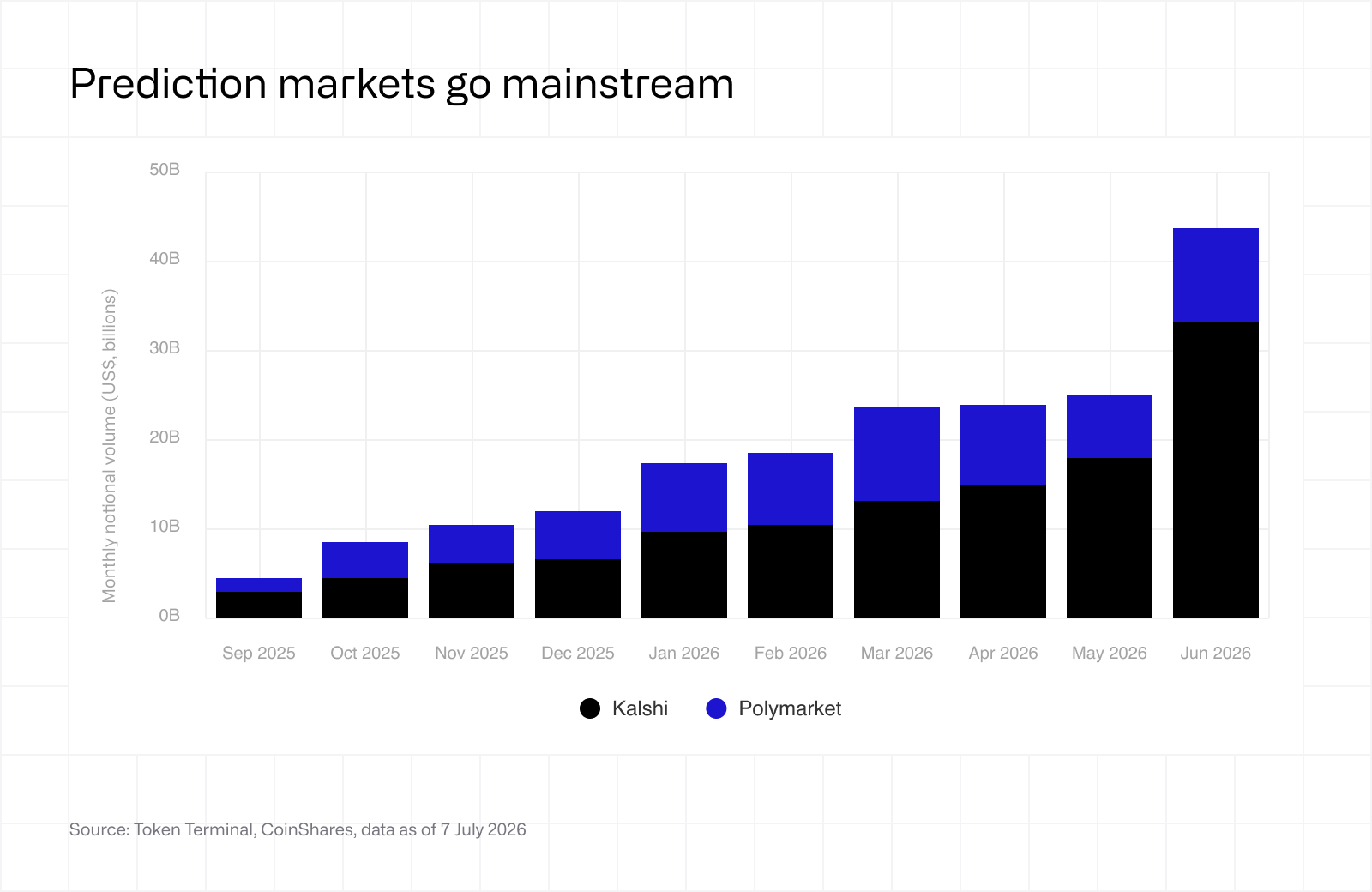 Neither company is publicly listed, and there is no token that represents direct ownership of either platform. But two blockchain networks, Hyperliquid and Solana, are becoming the infrastructure this growth increasingly runs on, and their native tokens, HYPE and SOL, offer investors a way to hold exposure to that trend indirectly.
Hyperliquid built prediction markets into its own exchange
Hyperliquid launched HIP-4, its own outcome markets feature, on 2 May 2026. It is a small, on-chain venue for the same kind of yes/no contracts that Kalshi and Polymarket trade, run directly inside Hyperliquid's existing perpetuals exchange. In its first nine weeks, HIP-4 processed $331.1 million in cumulative notional trading volume, growing from under $3 million in its launch week to a weekly peak above $75 million in late June, and generated $5,906 in protocol revenue on the underlying spot turnover, still a rounding error next to HYPE's $15.4 billion market capitalisation.4
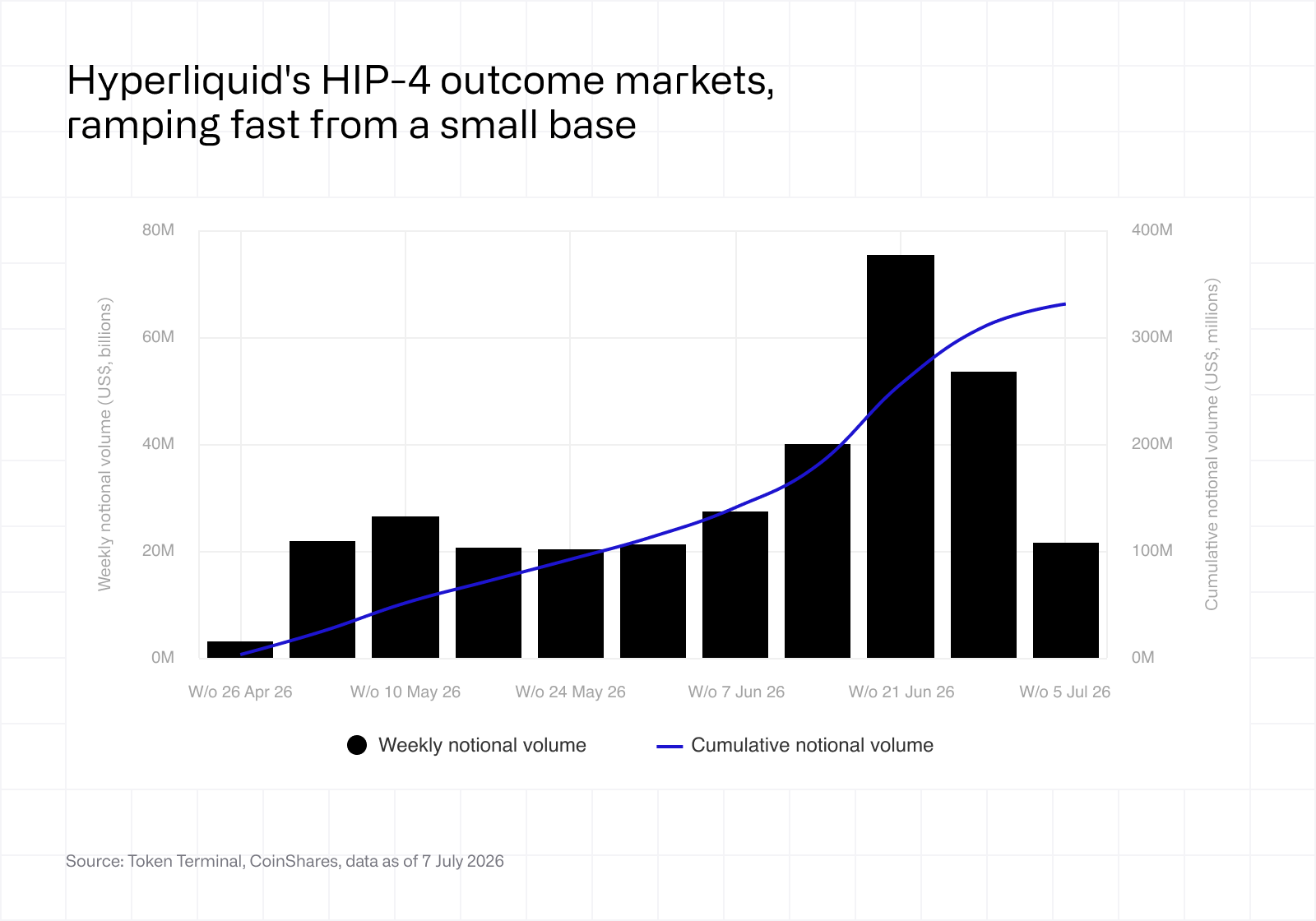 The link to HYPE runs through Hyperliquid's Assistance Fund, which uses protocol fee revenue, along with contributions such as the 50% of gross revenue that stablecoin issuer Circle pays in, to buy back HYPE on the open market.5 Every dollar HIP-4 generates adds, however marginally today, to that buyback pressure.
Solana has become the rail prediction markets are distributed on
Solana's role is different: it behaves less like a venue and more like a distribution layer. Phantom, Solana's dominant wallet with around 20 million users, began offering Kalshi-linked prediction markets in December 2025, letting users trade using Solana-based tokens without leaving the app.6 That arrangement ended on 1 June 2026, when Phantom replaced it with World, a prediction market built natively on Solana that settles automatically through Chainlink oracles and issues each position as a token the user holds directly in their own wallet.7 Separately, Jupiter, Solana's largest trading app, launched its own native venue, Forecast, in June, matching traders against competing market makers rather than a shared liquidity pool, and has said it intends to complement Polymarket rather than compete with it.8
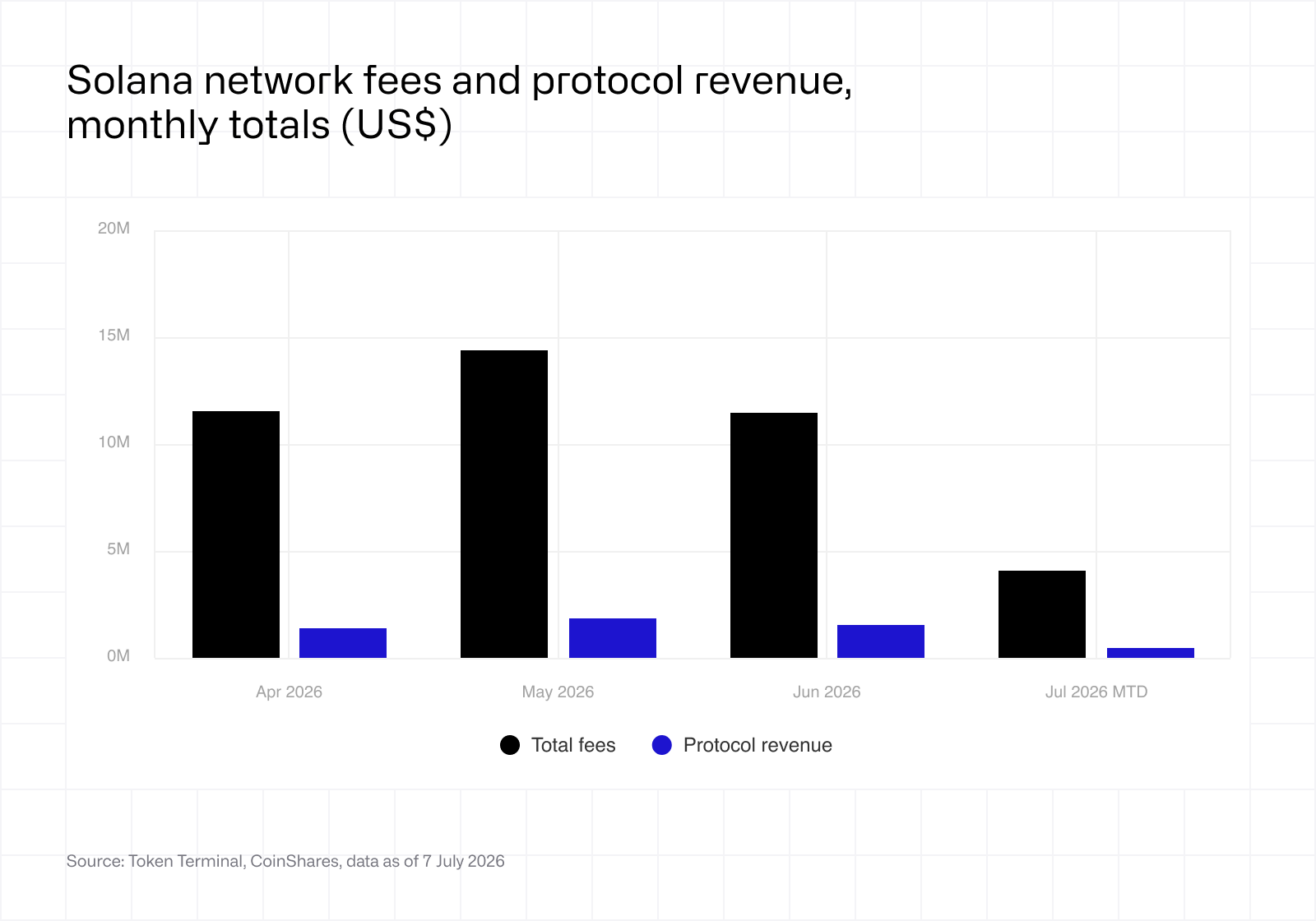
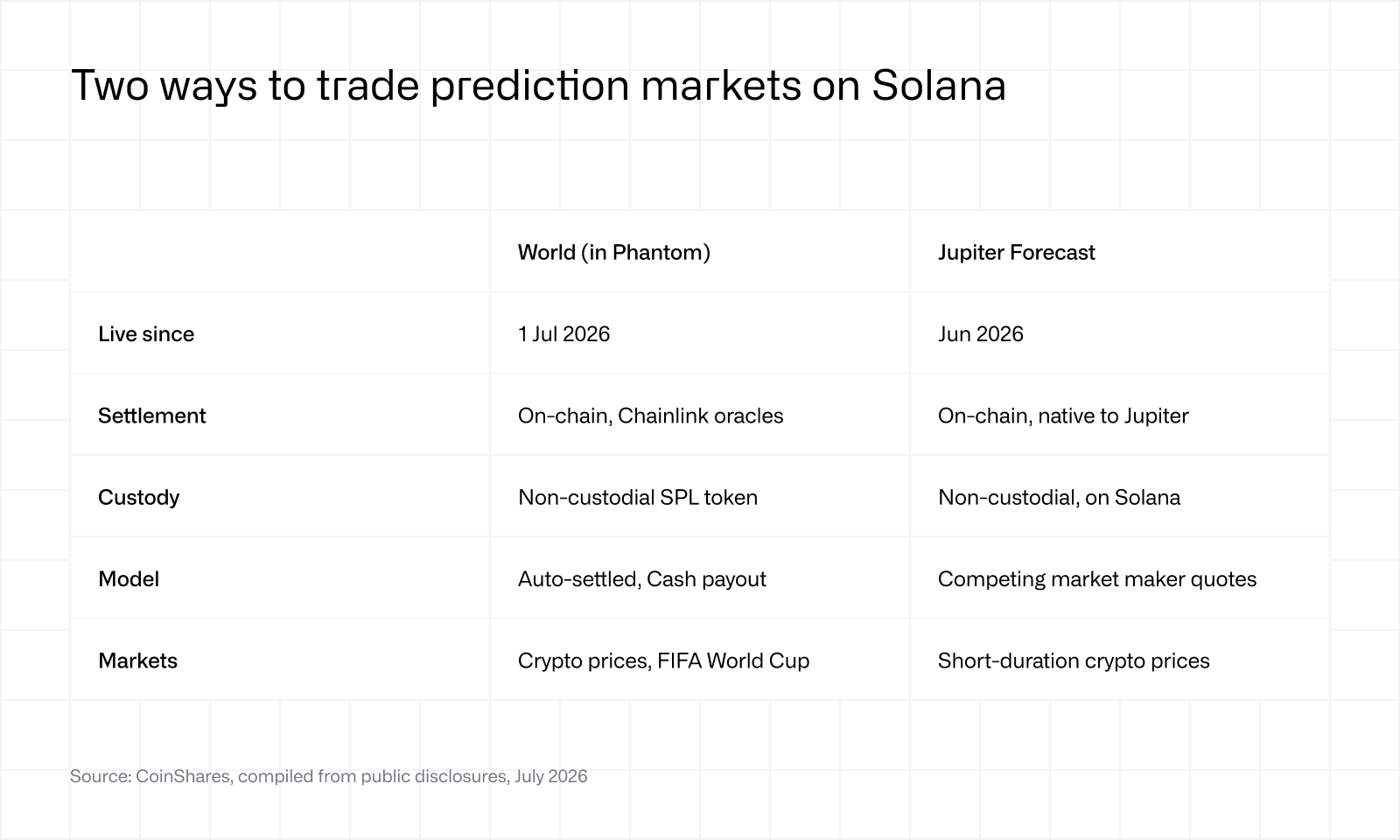 None of this activity necessarily shows up as Kalshi or Polymarket revenue. It shows up as Solana network activity, and Solana's protocol revenue, the roughly 50% of transaction fees the network retains, averaged around $1.4 million a month across April, May and June 2026, against a $47 billion SOL market capitalisation.9
A small revenue base, and an unsettled one
The scale mismatch in both cases is the honest caveat. HIP-4's five-figure revenue and Solana's modest monthly take are tiny relative to the tokens' market values, so this is a thesis about optionality and positioning rather than a near-term earnings driver. The venue churn on Solana, from Kalshi to World inside seven months, is also a reminder that distribution deals in this sector can move quickly, and today's dominant rail is not guaranteed to be tomorrow's.
For investors who want that exposure without trading the underlying protocols directly, CoinShares offers the CoinShares Hyperliquid Staking ETP and the CoinShares Solana Staking ETP giving a regulated route to hold HYPE and SOL rather than accessing the networks directly.10
Sources
Token Terminal, Kalshi and Polymarket monthly notional trading volume, as of 7 July 2026.
Pew Research Center, "Trading volume on prediction markets has soared in recent months," analysis of data from The Block, 27 May 2026.
Bloomberg / TechCrunch, "Kalshi doubles valuation in 5 months, hitting $22 billion," 7 May 2026; Coindesk, "Kalshi targets a massive $40 billion valuation, widening lead over rival Polymarket," 24 June 2026; Intercontinental Exchange investor relations, "$600 million investment in Polymarket," 27 March 2026.
Token Terminal, Hyperliquid Outcome Markets (HIP-4) weekly and cumulative notional/spot volume and revenue data, as of 7 July 2026; Token Terminal, HYPE price and market capitalisation, as of 7 July 2026.
Hyperliquid protocol data via Token Terminal, Assistance Fund and Circle revenue-sharing terms, as of 7 July 2026.
Coindesk, "Phantom adds Kalshi to wallet, lets users trade prediction markets with Solana tokens," 12 December 2025.
Coindesk, "Mysterious Solana project World unveiled as fully onchain prediction market," 1 July 2026; TechTimes, "Prediction market World launches in Phantom: Chainlink oracles auto-settle Solana trades," 2 July 2026.
Cryptopolitan, "Jupiter launches Forecast, Solana's first native prediction market," June 2026.
Token Terminal, Solana network fees and revenue, April-July 2026; Token Terminal, SOL price and market capitalisation, as of 7 July 2026.
CoinShares product pages, coinshares.com/etp/physical-hype/ and coinshares.com/etp/physical-solana/; product names and ISINs per internal product record (Notion, "Website Data :: HYPE and SOL on SIX").
Published onJul 16th, 2026