



What are crypto index ETPs?
 10 min read
- Finance
Introduction to crypto
Crypto in the real world
Crypto investment options
Strategies and practical tips
If you've read about single-asset ETPs—products that track one cryptocurrency like Bitcoin or Ethereum—you already understand the basic wrapper. Crypto index ETPs take that concept further by bundling multiple digital assets into a single product, much like an equity index fund holds a basket of stocks.
The idea is straightforward. Rather than picking individual coins, an index ETP gives you exposure to a defined segment of the crypto market—whether that's the largest assets by market capitalisation, or tokens focused on a particular theme such as smart contract infrastructure. You buy one product and get diversified access.
What is a crypto index?
An index is a standardised way of measuring the performance of a group of assets. In traditional finance, the S&P 500 tracks the 500 largest US companies. The FTSE 100 tracks the 100 largest UK-listed firms. These benchmarks give investors a snapshot of how a market—or a slice of it—is performing.
Crypto indexes work on the same principle. They group digital assets according to defined criteria—size, theme, liquidity—and track their combined performance. The result is a single number that moves up or down as the underlying basket of assets changes in value.
Indexes are governed by strict methodologies, typically developed and administered by specialist firms. In Europe, many crypto indexes are compliant with the EU Benchmarks Regulation (BMR), which imposes transparency, governance, and oversight standards—the same framework that applies to traditional financial benchmarks.
How does a crypto index ETP work?
A crypto index ETP is an exchange-traded product designed to replicate the performance of a crypto index. When you buy a share of the ETP, you're gaining exposure to the entire basket of assets the index tracks—without having to purchase each coin individually.
Physical crypto index ETPs work by actually purchasing and holding the underlying coins in the same proportions as the index. If Bitcoin represents 35% of the index, then 35% of the ETP's assets are held in Bitcoin. These assets are stored by a regulated custodian, just like single-asset physical ETPs.
As an investor, you simply buy and sell the ETP through your broker—on a regulated stock exchange, during normal trading hours. There's no need to open accounts on crypto exchanges, manage wallets, or handle private keys.
What are the main index methodologies?
Not all crypto indexes are built the same way. The methodology determines which assets are included, how they're weighted, and how often the index is updated. Here are the most common approaches:
Market-capitalisation weighted. Each asset's weight in the index is proportional to its market cap. Larger assets like Bitcoin and Ethereum naturally carry more weight, while smaller altcoins have a proportionally smaller share. This is the most common methodology in both traditional and crypto indexing, because it reflects how the market itself is structured.
Capped market-cap weighted. A variant of market-cap weighting that imposes a maximum allocation per coin—often 35%. This prevents any single asset from dominating the index. Given Bitcoin's outsized market share (frequently above 50% of total crypto market capitalisation), capping is a meaningful design choice that boosts diversification and gives more room to altcoins.
Equal weighted. Every constituent receives the same allocation regardless of size. This gives smaller assets the same influence as larger ones, which can amplify returns when emerging coins outperform—but also increases risk.
Thematic. Some indexes focus on a specific segment of the crypto market—for example, smart contract platforms, decentralised finance (DeFi) protocols, or layer-1 infrastructure. Thematic indexes let investors express a view on a particular trend within the broader crypto ecosystem.
What are the benefits of crypto index ETPs?
Diversification in a single trade. Instead of selecting and purchasing individual cryptocurrencies, an index ETP spreads your investment across multiple assets at once. This reduces concentration risk—the danger that a single coin's poor performance drags down your entire crypto allocation.
Automatic rebalancing. Crypto markets move fast. An asset that was the fifth-largest by market cap a quarter ago might not hold that position today. Index ETPs are rebalanced at regular intervals—typically quarterly—so that the product continues to reflect the current state of the market. This happens automatically, with no action required on your part.
Dynamic allocation. Because index methodologies are rules-based, rising assets can enter the index while declining ones drop out. This means you're always exposed to the most relevant coins in the category the index tracks, without having to monitor rankings yourself.
Passive management. For investors who don't want to spend time analysing individual crypto projects, index ETPs provide a set-and-forget approach. You gain broad market exposure without the research burden of active stock-picking—or in this case, coin-picking.
Regulatory framework. Like single-asset crypto ETPs, index ETPs are listed on regulated stock exchanges. The underlying indexes themselves may be EU BMR-compliant, adding an additional layer of governance, transparency, and oversight.
What should you consider before investing?
Index ETPs solve several problems, but they come with trade-offs worth understanding.
Index methodology matters. The same ten coins can produce very different performance depending on how they're weighted. A market-cap-weighted index will behave differently from an equal-weighted one, even with identical constituents. Understanding the methodology helps you know what you're actually buying.
You may hold assets you wouldn't choose individually. An index follows its rules mechanically. If a coin enters the top 10 by market cap, it joins the index—regardless of whether you personally believe in the project. This is the nature of passive investing: you accept the methodology's selections.
Rebalancing frequency and costs. Quarterly rebalancing strikes a balance between staying current and controlling transaction costs. More frequent rebalancing could incur higher costs, while less frequent updates might lag market shifts.
Management fees vary. Crypto index ETPs have historically carried higher fees than single-asset products, though competition has driven costs down significantly—some providers, including CoinShares, now offer index ETPs with 0% management fees.
CoinShares' crypto index ETPs
CoinShares offers two crypto index ETPs, both tracking indexes co-developed with Compass Financial Technologies—a specialist index administrator registered under the EU Benchmarks Regulation (BMR). Both products are physically backed, meaning the underlying coins are purchased and held by Komainu, an institutional-grade custodian established by CoinShares, Nomura, and Ledger. Reserves are independently verified by The Network Firm using blockchain-based auditing.
CoinShares Physical Top 10 Crypto Market ETP (Ticker: CTEN | ISIN: JE00BPRDNL86)
This ETP tracks the CoinShares-Compass Top 10 Crypto Market Index, which groups the ten largest digital assets by market capitalisation—excluding stablecoins, privacy coins, and meme coins. Each constituent's weight is proportional to its market cap, capped at 35% to prevent excessive concentration in Bitcoin. The index is rebalanced quarterly, ensuring that rising assets can enter and declining ones can exit. With a 0% annual management fee, CTEN is one of the most cost-efficient crypto index ETPs available in Europe.
CoinShares Physical Smart Contract Platform ETP (Ticker: CSSC | ISIN: JE00BPRDNM93)
This thematic ETP focuses on the infrastructure layer of the crypto ecosystem. It tracks the CoinShares-Compass Smart Contract Platform Index, which selects the ten largest cryptocurrencies associated with smart contract platforms—the blockchains that power decentralised applications (dApps), decentralised finance (DeFi), and the broader Web3 ecosystem. Like CTEN, it uses market-cap weighting capped at 35%, rebalances quarterly, and carries a 0% annual management fee.
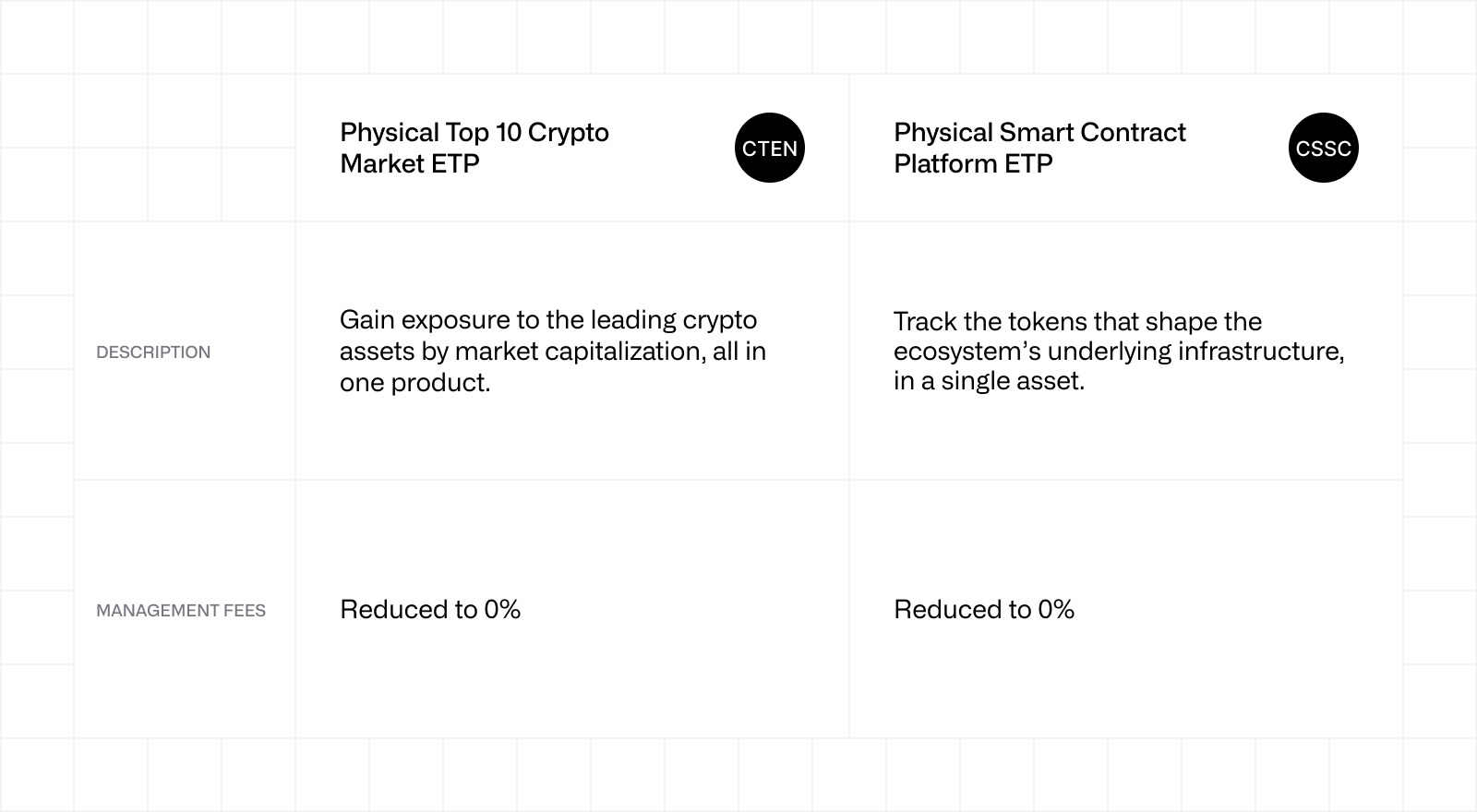
Both products share several design principles:
100% physical backing: Real crypto is held in the same proportions as the index.
BMR-compliant indexes: Meeting EU standards for benchmark governance and transparency.
35% per-coin cap: Boosting diversification and reducing concentration risk.
Quarterly rebalancing: Keeping pace with market shifts without excessive turnover.
Listed on Deutsche Börse Xetra: Europe's leading ETP trading venue.
0% management fee: CoinShares generates revenue through staking eligible coins within the index, enabling it to waive management fees entirely.
Who should consider crypto index ETPs?
Crypto index ETPs are particularly suited to investors who want broad digital asset exposure without the research burden of evaluating individual projects. If you believe in the long-term growth of the crypto market but aren't sure which specific coins will outperform, an index approach removes the need to pick winners.
They're also a natural choice for investors looking to add crypto as a portfolio diversifier. A broad-market index ETP like CTEN captures the overall direction of the crypto market, while a thematic product like CSSC lets you express a specific conviction—in this case, that smart contract platforms will be central to the next phase of internet infrastructure.
For those already holding single-asset ETPs such as Bitcoin or Ethereum, an index ETP can complement that position by adding exposure to a wider set of altcoins through a single, automatically maintained product.
Key takeaways
Crypto index ETPs bundle multiple digital assets into a single exchange-traded product, offering diversified exposure through one trade.
Index methodologies—market-cap weighted, equal weighted, or thematic—determine which assets are included and how they're allocated.
Automatic quarterly rebalancing keeps the product aligned with market shifts, with no action required from investors.
CoinShares offers two index ETPs—CTEN (broad market) and CSSC (smart contract platforms)—both physically backed, BMR-compliant, and available at 0% management fees.
As with all crypto investments, index ETPs carry risks including volatility and the potential loss of capital.
Published onFeb 18th, 2026

Introduction to crypto
Crypto in the real world
Crypto investment options
Strategies and practical tips
