



How to be exposed to crypto
 10 min read
- Finance
Introduction to crypto
Crypto in the real world
Crypto investment options
Strategies and practical tips
Once you've decided to add crypto to your portfolio, the next step is choosing how to gain that exposure. Three main paths are available to European investors: spot trading on exchanges, crypto derivatives, and exchange-traded products (ETPs). Each comes with different levels of regulation, security, and convenience.
What are the main ways to invest in crypto?
European investors today have more options than ever to access digital assets. The three primary routes are:
Direct ownership via exchanges — buying and holding cryptocurrency yourself
Derivatives — contracts that derive their value from crypto prices
Exchange-Traded Products (ETPs) — regulated securities that track crypto prices
The right choice depends on your investment goals, technical comfort level, and how much responsibility you want for custody and security.
How does buying crypto directly on exchanges work?
Crypto exchanges allow you to buy and sell digital assets directly. When you purchase Bitcoin or Ethereum on an exchange, you own the underlying asset — this is called direct exposure.
However, direct ownership comes with significant responsibilities:
Custody risk: You're responsible for securing your assets, whether stored on the exchange or in a personal wallet
Key management: If you use self-custody (a private wallet), losing your private keys means losing your crypto permanently
Platform risk: Exchanges can face hacks, outages, or insolvency
Direct crypto ownership requires you to manage custody, understand wallet security, and navigate the technical complexity of blockchain transactions.
What changed with MiCA?
The regulatory landscape for crypto exchanges in Europe transformed in 2024-2025. The Markets in Crypto-Assets Regulation (MiCA) became fully applicable on 30 December 2024, requiring all Crypto-Asset Service Providers (CASPs) — including exchanges — to obtain authorisation to operate in the EU.
Under MiCA, exchanges must now:
Obtain licences from national regulators
Meet capital requirements and governance standards
Comply with anti-money laundering (AML) obligations
Provide clear disclosures to customers
This represents a significant improvement from the pre-MiCA era when regulatory standards varied dramatically across jurisdictions. The FTX collapse in 2022 — where an offshore exchange mismanaged customer funds, leaving investors locked out — illustrated the risks of under-regulated platforms.

What about crypto derivatives?
Derivatives are financial contracts whose value is based on an underlying asset — in this case, cryptocurrency. Two main channels exist: over-the-counter (OTC) derivatives and listed derivatives.
OTC derivatives
OTC derivatives are privately negotiated between parties rather than traded on regulated exchanges. Products like perpetual swaps have no expiration date, allowing traders to hold positions indefinitely.
However, OTC derivatives are typically traded on offshore platforms with limited transparency. You're exposed to counterparty risk — if the other party defaults, you may lose your position.
Listed derivatives
Listed derivatives trade on regulated exchanges such as the Chicago Mercantile Exchange (CME). They're subject to oversight by authorities like the Commodity Futures Trading Commission (CFTC) in the US or the Financial Conduct Authority (FCA) in the UK.
Listed derivatives offer stronger protections — trades are guaranteed by a clearinghouse that acts as counterparty to both sides, mitigating default risk. However, they're complex instruments typically suited to sophisticated investors.

What are crypto ETPs and why do European investors use them?
Exchange-Traded Products (ETPs) offer a third path: gaining crypto exposure through regulated securities that trade on traditional stock exchanges.
An ETP is a financial instrument that tracks the price of an underlying asset — in this case, cryptocurrencies like Bitcoin or Ethereum — without requiring you to own or custody the asset yourself.
Why ETPs, not ETFs, in Europe?
You may have heard about Bitcoin ETFs launching in the US in January 2024. In Europe, the term "ETP" is more accurate than "ETF" due to regulatory differences.
Under EU UCITS regulations, funds cannot be based on a single asset. This means Bitcoin or Ethereum cannot be wrapped in an ETF structure in Europe. Instead, European crypto products are typically structured as Exchange-Traded Commodities (ETCs) or Exchange-Traded Notes (ETNs) — both falling under the broader ETP umbrella. This is not a crypto specificity: for instance, gold is wrapped in the same structure of product.
In the end, European crypto ETPs serve the same purpose as US crypto ETFs: providing regulated, convenient access to digital asset prices.
What are the advantages of crypto ETPs?
Regulation and oversight
ETPs are regulated products supervised by national financial authorities. They trade on regulated securities exchanges alongside traditional assets. CoinShares Physical ETPs, for example, are listed across major European exchanges including Xetra (Germany), Euronext (France and Netherlands), and SIX Swiss Exchange (Switzerland).
No custody burden
With a physically-backed ETP, the issuer purchases and secures the underlying cryptocurrency on your behalf. The assets are held by institutional-grade custodians, removing the technical complexity of wallet management and key security.
Proof of reserves
Reputable ETP issuers provide transparent verification that each product is backed by actual cryptocurrency. CoinShares ETPs, for instance, are independently verified by The Network Firm, with reserves publicly available in real-time.
Portfolio integration
You can buy ETPs through your existing broker, bank, or investment platform. They sit alongside your other investments — stocks, bonds, funds — on a single account, simplifying monitoring and rebalancing.
Product variety
ETPs allow exposure to individual assets (Bitcoin, Ethereum, Solana) or diversified baskets through index products. Some ETPs also offer built-in staking rewards, sharing the yield generated by proof-of-stake cryptocurrencies with investors.

What are the limitations?
Unlike crypto exchanges (which operate 24/7), ETPs can only be traded when the stock exchange they're listed on is open. This narrower trading window is consistent with other traditional financial assets. Although one might see this as an issue, we consider this as a feature since it prevents investors from reacting carelessly to market movements.
How do I choose the right approach?
The best method depends on your priorities:
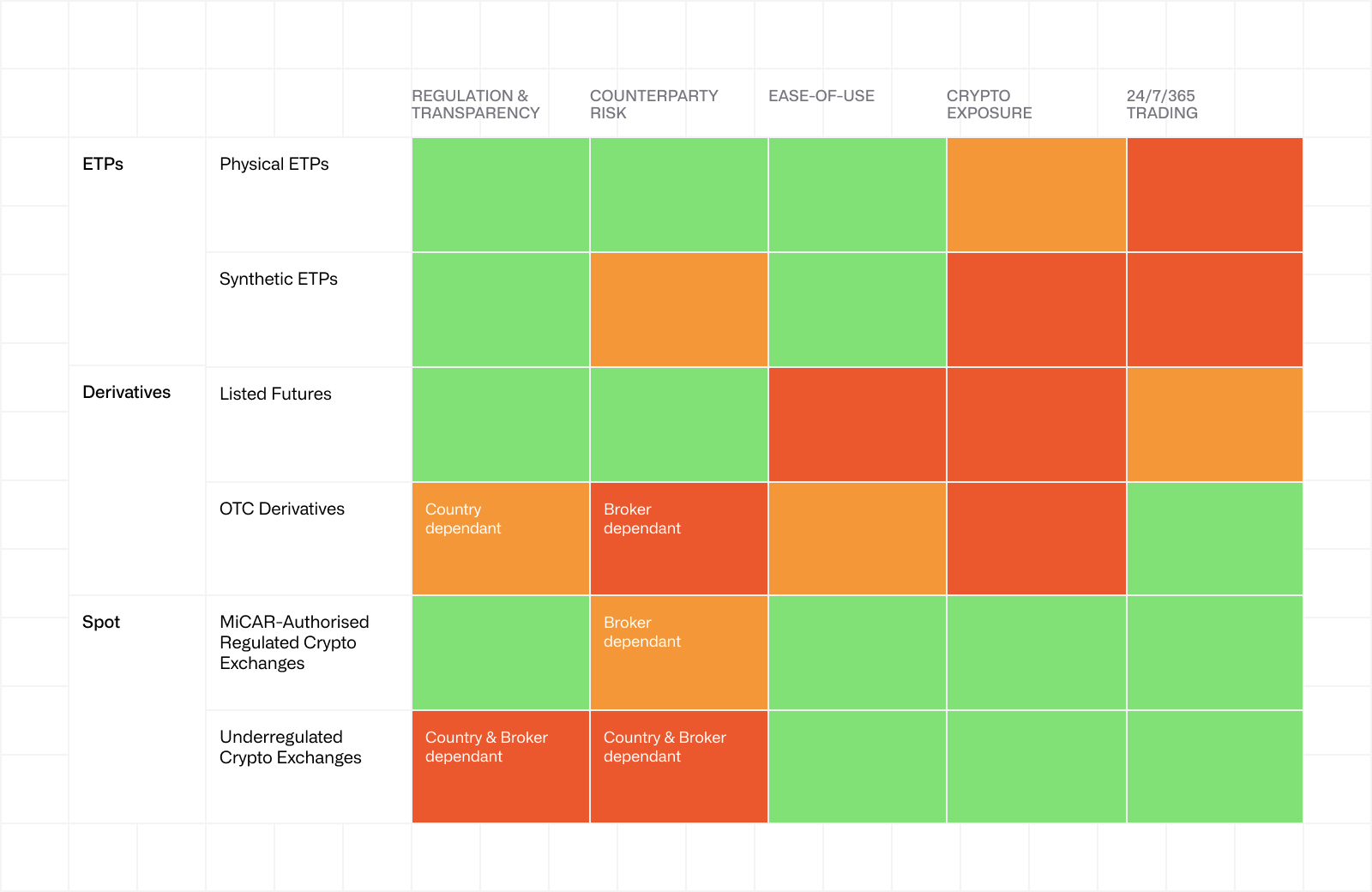
For investors who want straightforward exposure without managing custody, security, or navigating the technical aspects of blockchain, ETPs offer a compelling solution. They provide the benefits of crypto price exposure within a familiar, regulated framework.
For those who want direct control, the ability to use crypto for payments or DeFi, or access to a wider range of assets, direct ownership through a MiCA-regulated exchange may be appropriate — provided you're prepared for the custody responsibilities.
Conclusion
The world of crypto investment offers multiple entry points, each with distinct trade-offs between control, convenience, and security.
Europe's regulatory landscape has matured significantly. MiCA now provides a comprehensive framework for exchanges and service providers, while ETPs continue to offer a regulated bridge between traditional finance and digital assets. European investors have had access to crypto ETPs since 2015 — giving the region a head start in regulated crypto investment products.
Whatever path you choose, understanding the risks and regulations associated with each option is essential. Your decision should align with your investment goals, technical comfort, and how much time you want to spend managing your crypto exposure.
To explore CoinShares' range of crypto ETPs, visit our product catalogue.
Published onFeb 18th, 2026

Introduction to crypto
Crypto in the real world
Crypto investment options
Strategies and practical tips
