

Trading hope: how crypto became Lebanon’s plan B
 11 min read
- Finance
Since 2019, Lebanon has been experiencing one of the worst economic crises in modern history, according to the World Bank. CoinShares’ The Node visited to understand what alternatives cryptocurrencies can bring to a land-based economy. Are they up to the task?
Summer is drawing to a close, yet the air in Beirut still clings with heat, thick, heavy, and laced with the fumes of exhaust pipes and humming private generators. Life, chaotic as ever, has stumbled back into motion after enduring yet another brief but devastating flare-up between Israel and Hezbollah in the autumn of 2024. It follows a string of calamities: the port explosion four years earlier, and the 2019 financial crash, described by the World Bank as the worst economic crisis in modern history.
In the wake of the thawra - the revolution that, in October 2019, brought together Lebanese of all sects and regions - the collapse of the national currency sent shockwaves through the country. The Lebanese pound lost 98% of its value; what was once 1,500 pounds to the dollar now costs 90,000. Banks, unable to provide cash to their clients, began shuttering their branches one after another. According to the Central Bank of Lebanon, nearly 300 have since closed. GDP has plummeted by 40%, and banks have wiped out some 80 billion dollars in losses. What strikes most, however, is their concentration in Beirut, a city where almost every remaining branch is now barricaded, its counters sealed behind steel doors. Along the coastal highway, the old billboards for luxury goods have been replaced by ads for trading apps and forex platforms, promising a new way to make money in a cash-only economy.

Following the bankruptcy declared by the Central Bank in November 2019, led for 30 years by the former governor Riad Salamé before his departure in 2023, around $76 billion in deposits were frozen. “A significant share of people’s savings in commercial bank deposits was misused and wasted over the past thirty years,” stated the World Bank in its 2022 Public Finance Review of Lebanon. “It is important that the Lebanese people understand that the core elements of the post-civil war economy - the economy of the Second Lebanese Republic - have disappeared and will never return. It is equally important that they understand this collapse was deliberate,” the organisation insisted.
No profession was spared. Doctors, lawyers, police officers, and soldiers all saw their salaries fall below $200 per month. “People panicked: they either drastically cut their standard of living, or jumped into pyramid schemes and miracle solutions. Many turned to cryptocurrency,” explains Michel Haber, a Lebanese entrepreneur, crypto expert, and CEO of Astrofi Tech, a digital and marketing solutions company.
Interest in crypto among Lebanese people emerged even before the crisis, enough for the Central Bank to issue as early as 2013 the first official warning of its kind in the region. It prohibited banks and exchange offices from carrying out any cryptocurrency transactions.
“The reason,” says a Bank of Lebanon senior official speaking anonymously, “was to avoid the risks linked to the extreme volatility of these assets. Prices rose and fell uncontrollably, and people could lose their money, their capital, or their savings without understanding how these currencies worked. They are neither issued nor regulated by any central bank, so there is no official guarantee behind them”, explain the one we meet in his office inside the institution’s imposing headquarters in Hamra, whose flamboyant, almost rococo interior décor still bears traces of the golden age of the Lebanese financial elite. Yet the warning did little to slow the rise of crypto in Lebanon. On the contrary: as the economic and banking crises deepened after 2019, cryptocurrencies quickly became part of everyday life.
Buy crypto like cigarettes
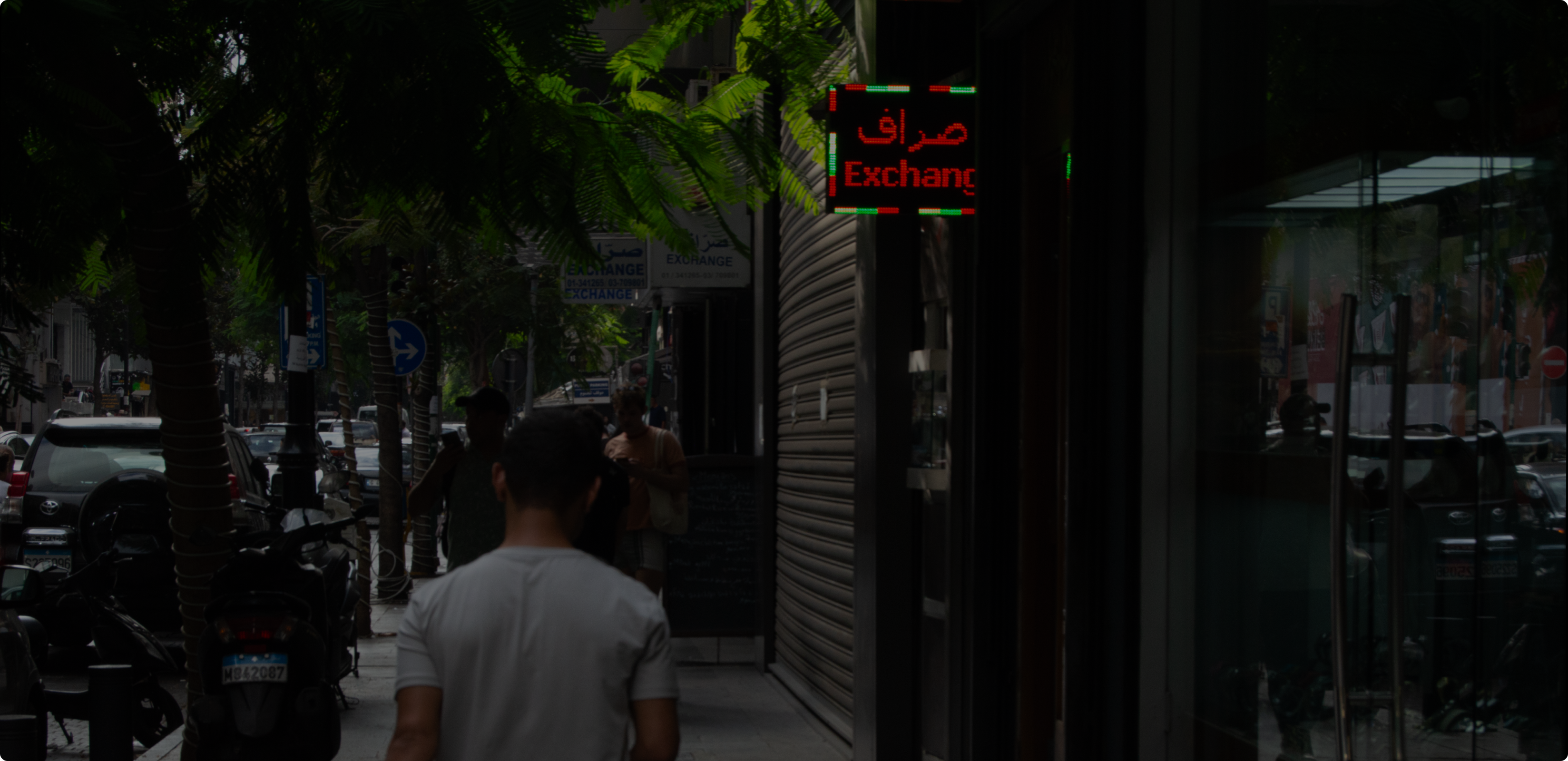
Within a few years, crypto desks multiplied across the country. From Beirut to the Bekaa plain, and along the coastal highway linking north and south, exchange offices such as OMT, Wish Money, or Bob Money began offering not only their usual money transfer services and electronic goods - or even cigarettes - but also the possibility to buy, sell, or invest in crypto.
 Lebanon’s case illustrates how cryptocurrencies have become woven into daily life for a population cut off from its own money. Since 2019, as banks imposed withdrawal limits and the Lebanese pound collapsed, digital assets emerged as both an investment tool, a means of exchange, and a substitute for the traditional banking system.
Mario Awad, in his early forties, welcomes us in a tracksuit and heavy gold chain at his flashy duplex on the ground floor of a Byblos suburb residence, which also serves as the headquarters of his small crypto-trading empire. Since 2017, he has operated in this ecosystem, now heading eight branches in various Christian towns (Byblos, Batroun, Baabdah) in partnership with Binance since 2022.
Before crypto, Awad, nicknamed the “Don of Cryptos”, ran a chain of souvenir shops. He used them to launch his new business: “People could deposit or withdraw cash there. We don’t always handle big amounts, but most clients make transactions of $500, $1,000, $5,000 or $8,000. Those who buy from us are mostly traders, or people buying a bit of Bitcoin for their children, as long-term savings, not as daily protection against inflation.”
According to him, he was the first in Lebanon to introduce Binance gift cards, which allow users to purchase crypto in a simple and accessible way. His offices, he insists, are licensed trading partners of Binance, with whom he has maintained a direct collaboration since the start of their partnership. As we speak, his phone never stops ringing. His most trusted clients don’t even need to visit the shop to place their trades, they contact him directly on WhatsApp, where deals are made through voice messages, with a surprising sense of ease. The amounts exchanged during our visit remain undisclosed.
About 90% of his clients live in Lebanon, but Awad avoids specifics. “We have thousands of Binance accounts, but I can’t give exact figures,” he says. This lack of transparency recurs throughout the conversation. Despite the apparent legality of his business, he admits it’s perceived as a “bad business” and remains cautious. His home is guarded by two security men, seven days a week.
Like him, many Lebanese have turned - legally or otherwise - to crypto trading. Of a hundred or so offices we geolocated nationwide (a high number for a country three times smaller than Belgium), many turned out to be ghost offices or simple mailboxes. The market is unstable and shape-shifting: some actors offer training sessions, online or in person; others vanish after a few WhatsApp or Telegram exchanges, too wary of potential repercussions to continue.
The real concentration, however, is online. Instagram, WhatsApp and Telegram host dozens of Lebanese trading groups - some genuine communities, others outright scams. On Telegram, many rely on mixers such as Tornado Cash, which blend funds from multiple wallets to obscure transactions and make tracing virtually impossible. The method is often marketed as a way to “clean” earnings or protect anonymity - but in reality, it deepens the opacity of an already unregulated market.
A regulatory grey zone
In theory, all crypto transactions are illegal. They bypass local banks, financial institutions, and e-wallets based in Lebanon. “It is forbidden to trade through a Lebanese bank account, a financial company, or a local brokerage firm. Some people open accounts abroad, on platforms like Binance,” notes the senior Central Bank official.
The official does not condemn crypto itself, but calls for strict regulation “to prevent abuse, money laundering, and terrorist financing.” He advocates for an “EU-style framework, inspired by the MiCA regulation.” “Lebanese judges are currently very strict, because we know how crucial it is for Lebanon to exit the Gafi ‘grey list’.”
According to him, “around twenty people are currently imprisoned for having placed online bets using cryptocurrencies.” Some cafés had accepted crypto and converted it into dollars to feed gambling accounts, without any identity checks. “That activity could have generated revenue for the State, but it was diverted.”
The official refuses to disclose more details but reiterates the position: “For now, the rule is clear - any crypto trading, formal or informal, is banned.” Yet privately, he admits the ban cannot last forever: “We must recognise them in order to supervise them. Many Lebanese make a legal living through these activities.” The senior BDL official adds that the Banque du Liban is now leaning toward the creation of a national digital currency. The current Lebanese model, he explains, “would be closer to a CBDC, a system regulated and controlled by the state, dematerialised and digital, but not decentralised.”
The Central Bank is thus considering a regulatory framework, but the task is immense: digitalising the economy requires first rebuilding public trust in financial institutions. According to him, “the use of cards, cheques, and bank transfers has risen by more than 35 % in a year,” yet the divide remains deep.
 Despite this legal challenge, the Lebanese have lost all trust in their country’s banks and financial institutions. “They tell themselves: our institutions, which were meant to protect us, betrayed us, so we’ve nothing left to lose by trying something else,” explains economist and Lebanese University professor Jassem Ajaka, slipping a few bills to an elderly woman begging in the café where we meet. Disillusion breeds risk-taking.
The spectre of scams
When we met a year ago, Georges, a 30-year-old captain in the Lebanese army, had a very different view on crypto. “When the pound collapsed in 2020,” he recalls, “we all wanted to escape the system, to find a way out of a country falling apart.” Like many young Lebanese, he turned to crypto, driven by the fear of missing out. It was a way to preserve a semblance of stability, to invest what little savings he had left. “There were good months, I managed to 10× my portfolio, but also terrible ones. In the end, I lost.”
Like economist Jassem Ajaka, who says Lebanon’s crypto-friendly crowd is a mix of tech-savvy youth and those who can afford to invest money they can afford to lose, Georges concludes: “This field only benefits the whales, the big wallets. Small investors have no chance. The winners are the ones with inside information. There’s no real technical analysis, no reliable prediction.” He adds, disillusioned: “It [crypto] is based on nothing. To buy it, you exchange your real money for a digital token, as if you were turning something solid into vapor. And yet we still believe it’s the future.”
Entering Beirut through the northern suburbs, the walls along the highway already tell the story. Graffiti, scrawled in black on concrete, screams: “BITCOIN RUIN ME,” “JAMES RUIN ME.” Cries of disillusion left by those burned by the crypto promise. Among the biggest scams was one that left deep scars: Binance Fund. The name was misleading, and that was the trick. It had nothing to do with the global Binance platform, but many Lebanese believed it was a legitimate local branch. The result: a pyramid scheme, modelled on Ponzi tactics, that swallowed nearly $300 million.
The system was simple, too simple. Binance Fund promised astronomical interest rates, guaranteed monthly income, and “no risk.” Investors received “rewards” daily or monthly, paid via parallel exchanges such as Western Union or MoneyGram. Around 3,000 unofficial exchange points enrolled clients in the Binance Fund, taking commissions in return. As long as the money flowed, everyone believed in it. Then in 2021, the platform stopped paying. Silence. No identifiable managers, no possible recourse. The scam cruelly echoed the collapse of Lebanon’s banking system two years earlier. But the culture of fraud had spread even further. Ads began appearing: “Selling my account for $5,000, I’m leaving the country and need cash.”
Cash is king, but for how long?
In Lebanon, cash is king. No credit cards, no transfers, everything runs on physical money. A parallel economy that, over time, has become the only system still working in a country where the State controls little. With the crisis, cafés and shops ran entirely on cash. For Lamia Bissat, director of the Basil Fuleihan Institute of Public Finance and consultant for the IMF and World Bank, this shadow economy has become self-evident:
“It’s a cash economy, invisible to the State. And of course, it generates no tax revenue. Public income remains derisory, even if some indicators show improvement. We’re talking about a private sector that may have recovered 70 % of its activity, sometimes more, but this isn’t reflected in tax data or official records. Because the public sector itself has not recovered. Civil servants have left, salaries are still at 25 % of their pre-crisis level, and the whole machinery of the State is at a standstill.”
This structural imbalance has turned Lebanon into a ghost economy, a country that works without a State, pays without a system, and organises without a plan. Money circulates, but outside fiscal and institutional oversight. Remittances from the diaspora, 33 % of GDP, about $6.7 billion according to the Treasury Directorate, are the clearest example. The funds arrive in cash or through informal channels, entirely bypassing the Central Bank. “There’s a channel that’s not popular in Europe, but very common here,” explains Michel Haber of Astrofi Tech. “If I’m in Paris and someone says, ‘You’re going to Lebanon?’ I’ll carry some money and hand it to that person’s parents when I arrive. Crypto just makes that process easier.”
But with cryptocurrencies, yet another untraceable system has emerged. “My cousins send money home through stablecoins on Binance, and I withdraw it for them with only 2 or 3 % fees without Western Union’s absurd 10 %,” a user says.
 For Haber, however, remaining a cash economy means remaining a country without a future. He therefore advocates a controlled digital transition: “Today, our institutions aren’t capable of regulating crypto. That’s why I’m launching an IT syndicate, an initiative to mobilise Lebanese brains from around the world and build a credible roadmap to help the Central Bank digitalise and reduce cash use.”
To rebuild Lebanon’s economy, the State must not only restore stability but also demonstrate its capacity to monitor financial flows, so it can tax properly and curb corruption. With blockchain transparency, those flows could finally become traceable.
Published onOct 24th, 2025

