



Integrating Bitcoin and crypto: a framework for strategic portfolio allocation
 13 min read
- Finance
- Bitcoin
- Ethereum
Over the past decade, digital currencies like Bitcoin (BTC) and Ethereum (ETH) have emerged as serious contenders for portfolio diversification. As adoption grows, investors face key questions: how much crypto is too much? What allocation strategy is appropriate? And how do you balance upside potential with downside risk?
The right size for a Bitcoin and crypto position depends on each investor's objectives, time horizon and tolerance for loss; there is no single formula. What helps is understanding how these assets behave: how volatile they are, how they have moved through market cycles, and what they do inside a portfolio rather than on their own.
Understanding portfolio allocation
Portfolio allocation is the disciplined process of dividing capital across asset classes such as stocks, bonds, real estate, commodities, and increasingly, cryptocurrencies, to optimize returns relative to risk.
The objective is not to chase short-term gains but to construct a portfolio that aligns with long-term goals, liquidity requirements and the investor's capacity to handle volatility.
Unlike speculative trading, allocation is a long-term framework. Correct allocation reinforces the psychological and financial resilience needed to hold through price drawdowns, reducing the temptation to make reactive decisions. A well-thought out allocation strategy provides structure in volatile markets but will help investors grow capital methodically over time.
Why a Bitcoin and crypto allocation matters
Cryptocurrencies are capable of delivering large returns but they come hand in hand with volatility. Bitcoin has experienced large gains over the years only to suffer equally severe reversals in others.
Ethereum and smaller cryptoassets have historically moved even more sharply, often amplified by shifts in sentiment, macroeconomic news and regulation. Held in small, deliberate amounts, however, Bitcoin and crypto can play a role in portfolio construction. In our simulated backtest, a small position added only modestly to the portfolio's overall volatility, provided it was held at a fixed size and rebalanced every quarter.
The key is to view crypto not as a shortcut to riches but as a volatile and asymmetric asset class, one that demands clear-eyed risk management, patience, and discipline.
For investors willing to study digital assets and size positions appropriately allocation into BTC and crypto may offer differentiated returns that justify a small, deliberate role in long-term portfolios.
How to allocate crypto
Every portfolio strategy should reflect the investor’s goals, time horizon, and risk tolerance—especially when adding an asset class as volatile as Bitcoin and other cryptocurrencies.
We modelled a European portfolio of 60% equities (Euro Stoxx 50) and 40% bonds (10-year Bund), then gave 5% of its weight to Bitcoin, held as a separate portion fund managers call a "sleeve". The equity and bond weights were reduced in proportion to make room. In this simulated backtest, run from 1 January 2020 to 30 September 2026, the portfolio with the 5% Bitcoin allocation showed higher risk-adjusted returns: it earned more return for each unit of volatility it carried.
5%: A conservative allocation
In the simulation, the rest of the portfolio absorbed much of the Bitcoin sleeve's sharp moves, while Bitcoin's gains still showed in the overall return. The results over the period tested:
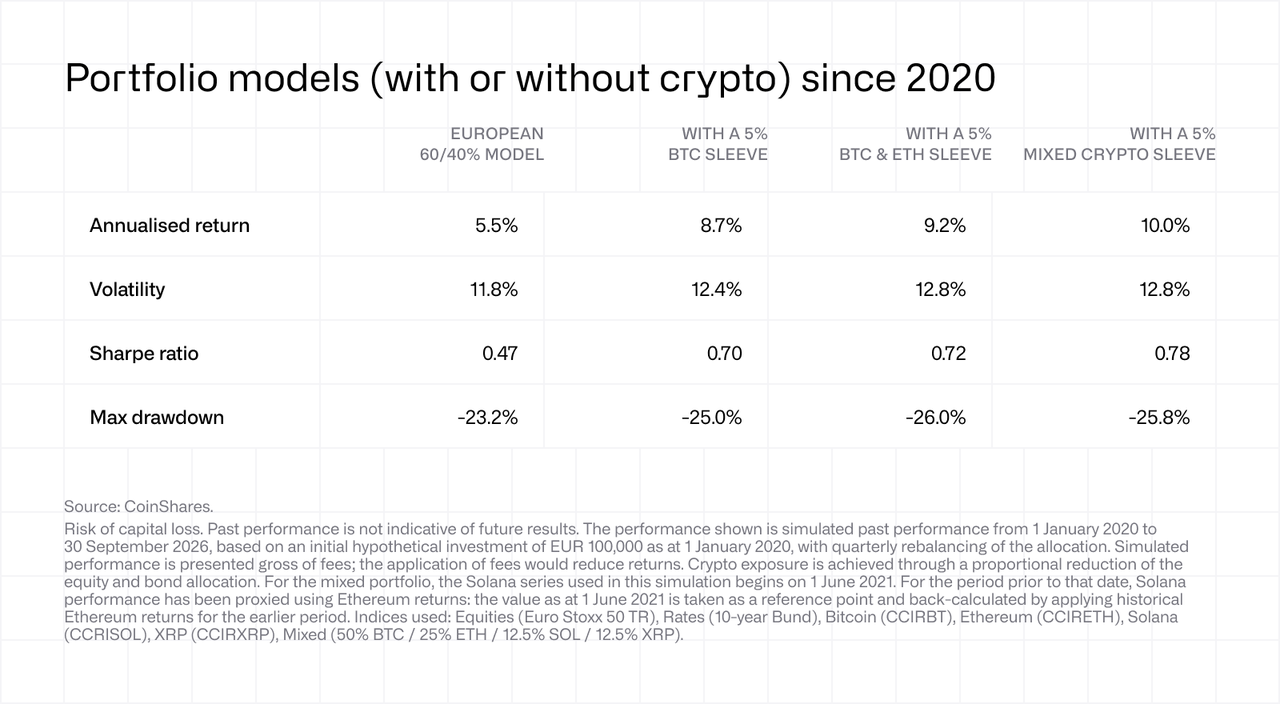
Read in plain terms: in the simulation, the Bitcoin sleeve added 3.1 percentage points a year to the return, while volatility rose by 0.7 percentage points and the worst peak-to-trough fall deepened by 1.8 percentage points. The Sharpe ratio, which measures return per unit of volatility, rose from 0.47 to 0.70.
Bitcoin is the core of the sleeve in our models. Splitting the same 5% between Bitcoin and Ethereum raised the simulated return slightly, with a small increase in volatility and in the worst drawdown. A mixed sleeve of Bitcoin, Ethereum, Solana and XRP showed the highest simulated return and risk-adjusted return, with the same volatility as the Bitcoin and Ethereum sleeve.
Of course, these models require discipline, especially in rebalancing during bull markets to prevent the allocation from becoming overweight.
The role of rebalancing
Rebalancing is the practice of restoring a portfolio's original allocation after market moves. For example, if a 5% crypto exposure doubles in value while stocks and bonds remain flat, crypto may now represent 9-10% of the total portfolio.
Our European backtest shows what is at stake. Left to drift with no rebalancing over the same period, the portfolio that started with 5% in Bitcoin ended with a volatility of 18.2% instead of 12.4%, and its worst fall reached -34.6% instead of -25.0%. The higher return came with a very different portfolio from the one the investor set out to hold.
Failing to rebalance exposes the investor to unintended risks. In this case, selling some crypto and reallocating to other asset classes brings the portfolio back in line with an intended risk profile weighting. Rebalancing enforces discipline, helping investors "sell high and buy low" without reacting emotionally.
Most investors review their portfolio quarterly or annually. Some prefer automated rebalancing tools, while others rebalance manually based on threshold price (e.g., if any asset deviates 5% from its target weighting in a portfolio). Our models are based on quarterly rebalancing.
Bitcoin and Ethereum, far from being redundant
If Bitcoin remains the benchmark of digital assets, Ethereum offers exposure to a broader range of use cases: it powers financial applications (such as trading platforms, intermediary-free credit products, and yield-bearing assets) and hosts the largest share of the stablecoin economy.
This is why both have a place in a portfolio, with Bitcoin used as an anchor similar to gold and Ethereum as a technological bet, closer to some Nasdaq equities.
Conclusion
In our European backtest, a 5% Bitcoin sleeve earned the portfolio more return for each unit of volatility over the period tested, at the cost of a modestly higher volatility and a somewhat deeper worst fall. The small size is what kept that cost modest, and quarterly rebalancing is what kept the size small.
One way to read the 5% figure is to ask what a total loss on that sleeve would mean for the whole: a portfolio would lose five of every hundred units invested. Crypto assets can lose all of their value, and any decision should take account of your own circumstances.
In the model, the result rested on a fixed size and a rebalancing rule applied consistently, not on a large bet.
CoinShares exchange-traded products give access to Bitcoin and Ethereum through a regular brokerage account. See the products available in your country: https://coinshares.com/etp/